Market Summary
Executive Summary and Global Market Analysis
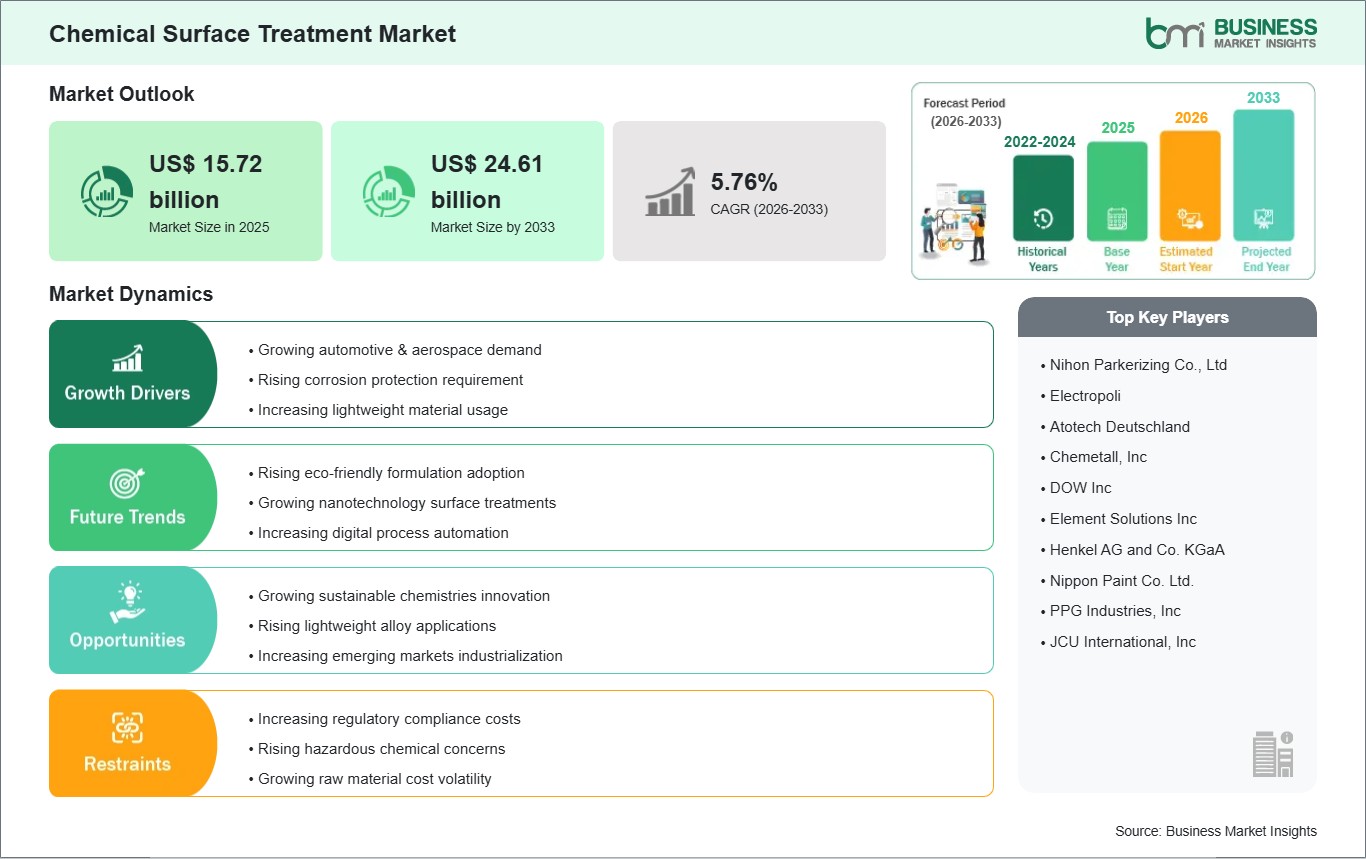
Chemical surface treatment uses chemical processes to change the surface properties of materials, mainly metals and alloys. This improvement boosts corrosion resistance, adhesion, wear resistance, and appearance. Examples of these treatments are anodizing, phosphating, passivation, pickling, and conversion coatings. They are crucial in industries like automotive, aerospace, construction, and electronics. By protecting surfaces from damage and increasing component lifespan, chemical surface treatments help improve efficiency, cut maintenance costs, and ensure reliable products. As the demand grows for high-performance materials and durable industrial components, these treatments remain essential for both manufacturing and maintenance.
Market growth is fueled by rising industrialization, fast growth in automotive and aerospace manufacturing, and the need for longer-lasting, corrosion-resistant materials. New developments in coating formulas, eco-friendly treatment methods, and automation of surface finishing techniques increase demand. Also, growing awareness of sustainable manufacturing and regulatory support for safer chemical treatments aid the expansion of the global chemical surface treatment market.
Segment Analysis
Chemical Surface Treatment Market Segmentation
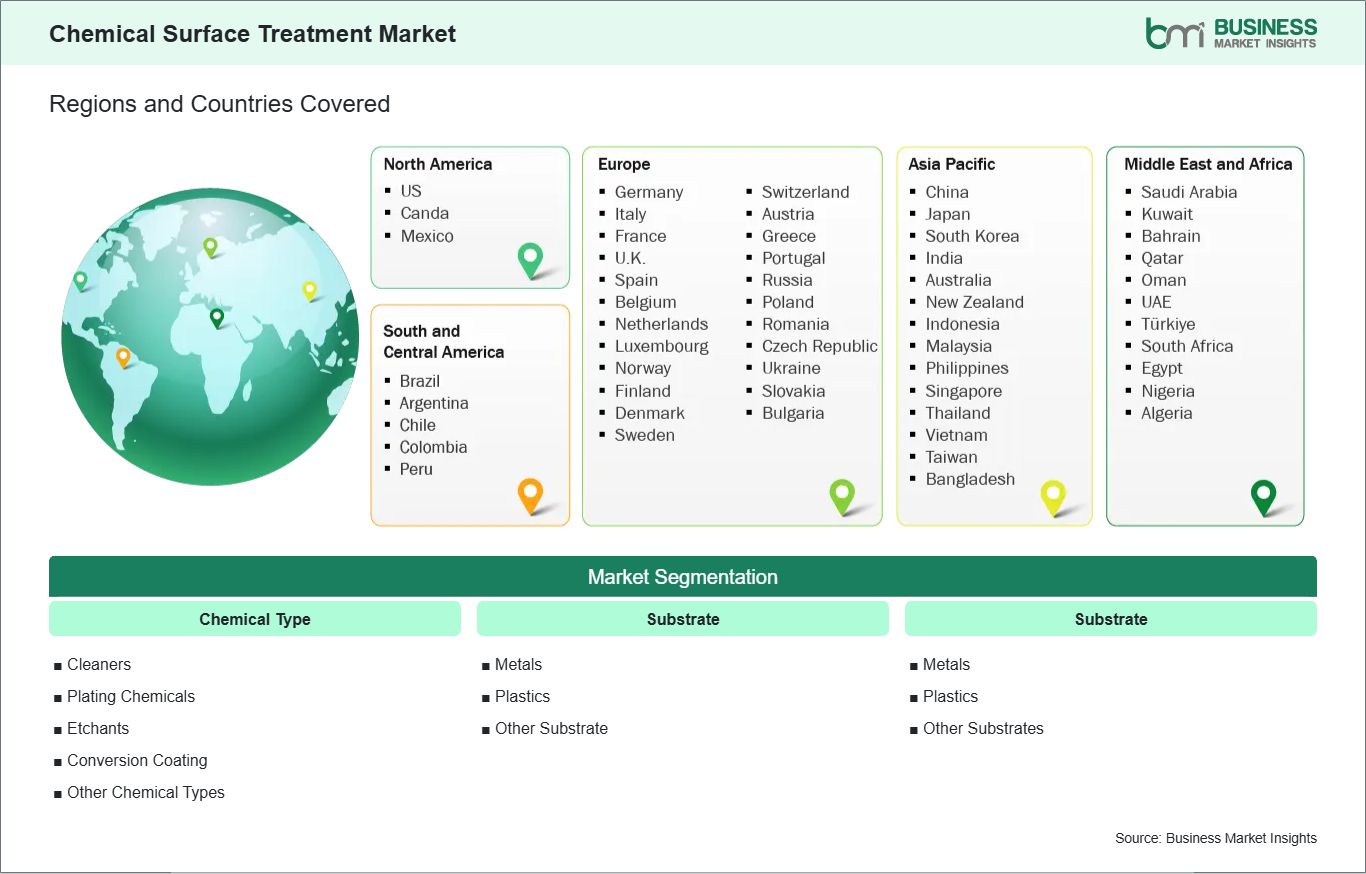
Key segments that contributed to the derivation of the chemical surface treatment market analysis are chemical type, substrate, end-use industry.
- By chemical type, the chemical surface treatment market is segmented into cleaners, plating chemicals, etchants, conversion coating, and others. The cleaners segment held the largest market share in 2025.
- By substrate, the market is segmented into metals, plastics, and others. The metals segment accounted for the largest share in 2025.
- By end-use industry, the market is segmented into automotive, building and construction, aerospace and defense, household appliances, electronics, industrial machinery, and others. The automotive segment held the largest market share in 2025.
Market Forces
Chemical Surface Treatment Market Drivers and Opportunities
Increasing Demand for Corrosion-Resistant and High-Performance Materials
One major driver of the chemical surface treatment market is the rising need for corrosion-resistant, durable, and high-performance materials in various industries. Sectors like automotive, aerospace, construction, and electronics need treated surfaces to keep functioning, extend service life, and improve safety. Components that face harsh environments, mechanical stress, or chemical exposure gain a lot from chemical surface treatments, which stop deterioration and boost material reliability. Rapid industrial growth and infrastructure development, especially in emerging economies, are increasing the demand for surface protection solutions.
Additionally, manufacturers are using more treatment techniques to meet strict quality and safety standards. By cutting maintenance costs, reducing material replacement, and promoting sustainable operations, chemical surface treatments remain essential for improving overall industrial efficiency and competitiveness in global manufacturing markets.
Development of Eco-Friendly and Sustainable Surface Treatments
A key growth opportunity in the chemical surface treatment market is the development and adoption of environmentally friendly and sustainable treatment solutions. Traditional chemical treatments often use hazardous chemicals that pose risks to the environment and health. This leads to stricter regulations. As a result, there is a growing demand for green alternatives such as water-based coatings, phosphate-free treatments, and bio-based conversion processes.
Innovations in eco-friendly formulations, process improvement, and waste reduction are helping manufacturers comply with regulations and meet customer demands for sustainability. Industries are placing greater importance on low-toxicity and recyclable surface treatments to lower their environmental impact while still performing well. Emerging markets also offer growth potential as governments encourage green manufacturing practices and industrial modernization. As manufacturers move towards responsible production and safe chemical treatments, the market is likely to see long-term growth in sustainable surface treatment technologies.
Size and Share Analysis
Chemical Surface Treatment Market Size and Share Analysis
The chemical surface treatment market demonstrates steady growth, with size and share analysis revealing evolving trends and competitive positioning among key players. The report examines subsegments categorized within chemical type, substrate, and end-use industry, offering insights into their contribution to overall market performance. By substrate, the metals segment holds the largest market share. Metals are the primary focus of surface treatment processes because they are widely used in automotive, aerospace, construction, and industrial applications. Surface treatments improve corrosion resistance, durability, and visual appeal, making metals better suited for long-term and high-performance uses. The growth of this segment is fueled by increasing industrialization, rising automotive production, and the need for strong and lightweight metal parts. Improvements in coating technologies and the use of eco-friendly processes also increase this segment's importance in the chemical surface treatment market.
Report Coverage
Chemical Surface Treatment Market Report Coverage and Deliverables
The " Chemical Surface Treatment Market Size and Forecast (2022 - 2033)" report provides a detailed analysis of the market covering below areas:
- Chemical surface treatment market size and forecast at global, regional, and country levels for all the key market segments covered under the scope
- Chemical surface treatment market trends, as well as market dynamics such as drivers, restraints, and key opportunities
- Chemical surface treatment market analysis covering key market trends, global and regional framework, major players, regulations, and recent market developments
- Industry landscape and competition analysis covering market concentration, heat map analysis, prominent players, and recent developments for the chemical surface treatment market
- Detailed company profiles, including SWOT analysis
Geographic Insights
Chemical Surface Treatment Market Geographic Insights
The geographical scope of the chemical surface treatment market report is divided into five regions: North America, Asia Pacific, Europe, the Middle East & Africa, and South & Central America. The Asia Pacific region has led the chemical surface treatment market in recent years. This is due to its large industrial base, growing manufacturing sectors, and high demand for corrosion-resistant materials. Countries like China, India, and Japan are key centers for automotive, electronics, and construction production. These industries depend on treated surfaces to ensure product longevity and performance. Rapid industrial growth, expanding infrastructure projects, and rising export-focused manufacturing are driving significant demand for chemical surface treatments.
The region also benefits from a strong presence of local chemical treatment companies, reliable supply chains, and ongoing investments in modern surface treatment technologies. Supportive government initiatives promote industrial growth, while environmental regulations encourage sustainable treatment methods. The increasing use of modern manufacturing processes further strengthens Asia-Pacific's position in the global chemical surface treatment market.
Industry Activity
Recent Developments
The chemical surface treatment market is evaluated by gathering qualitative and quantitative data post-primary and secondary research, which includes important corporate publications, association data, and databases. A few of the key developments in the chemical surface treatment market are:
- In February 2026, Freudenberg Medical launched LUBRITEQ, a hydrophilic coating for medical devices that improves lubricity, uniformity, and surface performance. This coating increases reliability and precision in minimally invasive procedures.
- In October 2025, Chemetall introduced Gardolene D, a passivation solution for copper foils that is free of chromium and fluoride. It provides better corrosion protection for electronics and EV battery applications.
Trust & Transparency
Research Methodology
The market analysis combines proprietary research with secondary data from government agencies, company disclosures, regulatory filings, industry databases and expert interviews. Market estimates are validated through data triangulation, cross-market benchmarking and analyst
review.
View Full Research Methodology
Key Sources Referred:
World Bank - Global Trade IndicatorsWorld Trade Organization (WTO)International Monetary Fund (IMF)International Trade Administration (ITA)Company WebsitesCompany Annual ReportsCompany Investor PresentationsSurface Engineering Association (SEA)International Federation for Surface Treatment (IFST)European Federation for Surface Treatment (EFST)