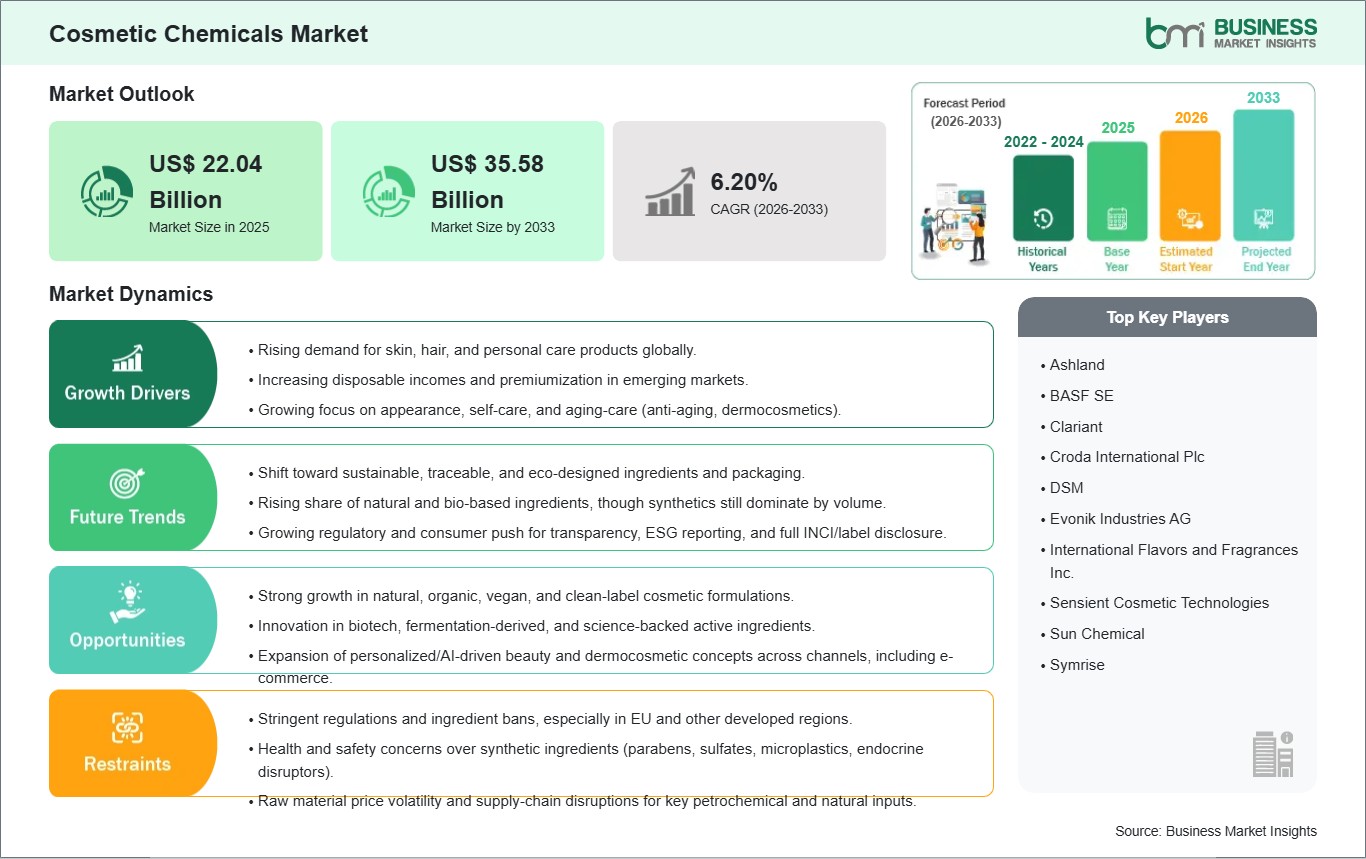
The Cosmetic Chemicals market size is expected to reach US$ 35.58 billion by 2033 from US$ 22.04 billion in 2025. The market is estimated to record a CAGR of 6.2% from 2026 to 2033.
Cosmetic chemicals are essential in the development of personal care products, improvement of skincare and haircare routines, and development of makeup products and fragrances since they allow the formation of stable emulsions, effective preservation of microbial growth, and colorful pigmentation of the world. They play a vital role in the cosmetics industry, personal care, fashion and entertainment, pharmaceuticals, and oral hygiene sectors. The benefits of cosmetic chemicals are that they are versatile, economical, and more efficient in their applications, such as emulsifying agents to create a smoother texture and better absorption ability, surfactants to gently cleanse the skin without depriving moisture, and preservatives to increase shelf life without endangering the skin. The booming demand is driving the market through the growing consumer awareness about beauty and wellness, rising disposable incomes and urbanization rates, and the rising demand for clean-label and organic formulations. Plant-based bio-based surfactants, green thickeners to reduce microplastics, new technologies in AI-personalized ingredients, and biotech-based actives are more sustainable and effective as well.
Nevertheless, the growth of the market can be limited by an array of factors, including fluctuating prices of raw materials, which are linked to petrochemical prices, strict environmental legislation regarding toxicity and allergens, and the risks of working with possible skin irritants or endocrine disruptors. Economic downturns also affect the industry by disrupting geopolitical events and supply chains. The market offers colossal opportunities despite these reasons because of the increasing popularity of natural and vegan production factors, high rates of industrialization in the Asia-Pacific region, and the development of multi-purpose grades in anti-aging serums and environmentally friendly packages. It will also be a tremendous investment in even sustainable chemistry and circular economy programs, which will make the market grow.

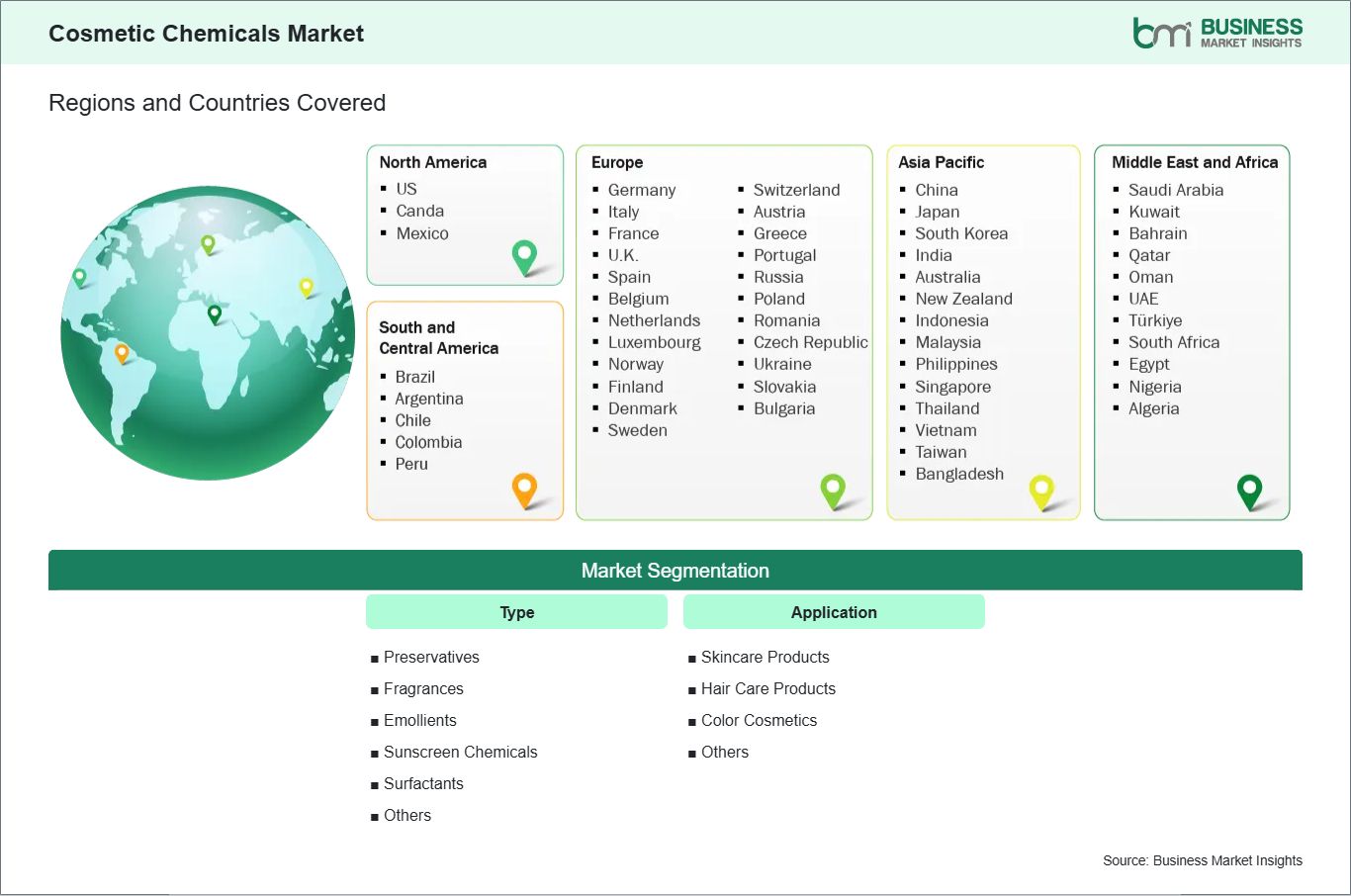
Key segments that contributed to the derivation of the Cosmetic Chemicals market analysis are type and application.
Increased demand in the skincare and personal care industry has proved to be a major catalyst that is positively impacting the cosmetic chemicals market. The growth of urbanization was extremely fast, and novel beauty routines and wellness lifestyles were created, so the formulators required efficient and highly functional processes in order to improve and preserve the quality of the skin, and cosmetic chemicals were required to emulsify and stabilize the formulations in the creams and lotions.
The expansion can be associated with expansive residential self-care, rising quantities of beauty product introductions, rapid urbanisation in the Asia-Pacific, government support in clean beauty, and wellness initiatives in North America and in the new market in spa, salons, and day to day life. This robust growth of skincare and personal care directly relates to the development of the cosmetic chemicals market, as the pressures of emulsification and preservation processes, which necessitate effective cosmetic chemicals to be used to provide high stability and effectiveness in skincare, haircare, and makeup applications, are constantly growing to satisfy beauty, wellness, and protective needs worldwide.
L'Oréal, Estée Lauder Companies Inc., and Unilever PLC, being leading players in the skincare and personal care industry, have not only diversified their businesses but also have re-invented the industry through emphasis on low-allergen regeneration systems with faster absorption. Cosmetic chemicals, which are also known to enhance the processing time and hydration efficiency in such systems, are in a better position to address these innovation imperatives. Cosmetic chemicals offer targeted delivery of actives precisely, in contrast to the conventional crude method, which is important to the skincare and personal care sector that depends on high-throughput production that is sustainable.
The application of natural and organic formulations in the market has become a growth force in the business of cosmetic chemicals. Given the fact that the beauty industry, wellness, and consumer goods industry need high-performance ingredients, the manufacturers are increasingly focusing on such multifunctional compounds that display a high degree of purity, scalability, and cost-effectiveness, and cosmetic chemicals are the secret to the synthesis and the end-product.
The developments in the compound formulation, combined with the increasing end-use opportunities in serum, shampoos, and clean makeup production, resulted in the expansion of market opportunities in the developed and emerging economies over the last several years. High-efficacy products with high natural resistance (moisturizers, organic cleansers, sustainable fragrances, and botanical enhancements) are also present. They are generally founded upon natural and organic systems and make use of the precision and efficacy of cosmetic chemicals. These are resources that are organized and implemented on a periodic basis. Their use is highly varied, and this has made the need to be able to develop some quality solutions to stabilization that are reliable, and would see to it that the stabilization will be carried out in sensitive environments.
Furthermore, the ingredient selection strategies of the world industries are further evolving in an effort to make them more efficient and sustainable because of the alterations in regulations and technologies. Also accompanying this is the need to possess cosmetic chemicals that will permit low-impact and high-speed formulations to facilitate complex and high-volume manufacturing on a continents scale. The natural cosmetic chemicals, too, are bound to continue rising, as the industries change to the lightweight and environmentally friendly to the environment designs and the new manufacturing technologies.

| Report Attribute | Details |
|---|---|
| Market size in 2025 | US$ 22.04 Billion |
| Market Size by 2033 | US$ 35.58 Billion |
| Global CAGR (2026 - 2033) | 6.20% |
| Historical Data | 2022 - 2024 |
| Forecast period | 2026-2033 |
| Segments Covered | By Type
|
| Regions and Countries Covered | North America
|
| Market leaders and key company profiles |
|
The Cosmetic Chemicals Market Size and Forecast (2022-2033) report provides a detailed analysis of the market covering below areas:
The geographical scope of the Cosmetic Chemicals market report is divided into five regions: North America, Asia Pacific, Europe, Middle East & Africa, and South & Central America. The Cosmetic Chemicals market in the Asia Pacific is expected to grow significantly during the forecast period.
The Asia-Pacific Cosmetic Chemicals market is segmented into China, Japan, South Korea, India, Australia, New Zealand, Indonesia, Malaysia, the Philippines, Singapore, Thailand, Vietnam, Taiwan, Bangladesh, and the Rest of Asia. The Asia-Pacific skincare products and cosmetic chemicals market has experienced good growth owing to increased personal care awareness, development of disposable incomes, and urbanization. The countries like China, India, Japan, and South Korea are among the major contributors to this growth with high demand for creams, lotions, sunscreens, serums, and anti-aging products.
The use of new technologies in formulations such as bio-based ingredients, dermatologically tested actives, and processes that are ecologically friendly has enhanced the efficacy of products and minimized environmental impact. Moreover, more investments in cosmetic production facilities, growing retail and online sales and trading systems, and favorable regional trading systems have enhanced supply chains and exports. Moreover, the increased demand is supported by the rising popularity of high-quality, organic, and multiselective skincare items. A combination of these factors, coupled with the growing regional production capacity, is making Asia-Pacific a significant center in the global cosmetic chemicals market global skincare products segment.

The Cosmetic Chemicals market is evaluated by gathering qualitative and quantitative data post-primary and secondary research, which includes important corporate publications, association data, and databases. A few of the key developments in the Cosmetic Chemicals market are:
The Cosmetic Chemicals Market is valued at US$ 22.04 Billion in 2025, it is projected to reach US$ 35.58 Billion by 2033.
As per our report Cosmetic Chemicals Market, the market size is valued at US$ 22.04 Billion in 2025, projecting it to reach US$ 35.58 Billion by 2033. This translates to a CAGR of approximately 6.20% during the forecast period.
The Cosmetic Chemicals Market report typically cover these key segments-
The historic period, base year, and forecast period can vary slightly depending on the specific market research report. However, for the Cosmetic Chemicals Market report:
The Cosmetic Chemicals Market is populated by several key players, each contributing to its growth and innovation. Some of the major players include:
The Cosmetic Chemicals Market report is valuable for diverse stakeholders, including:
Essentially, anyone involved in or considering involvement in the Cosmetic Chemicals Market value chain can benefit from the information contained in a comprehensive market report.
Please tell us your area of interest
(Market Segments/ Regions and Countries/ Companies)