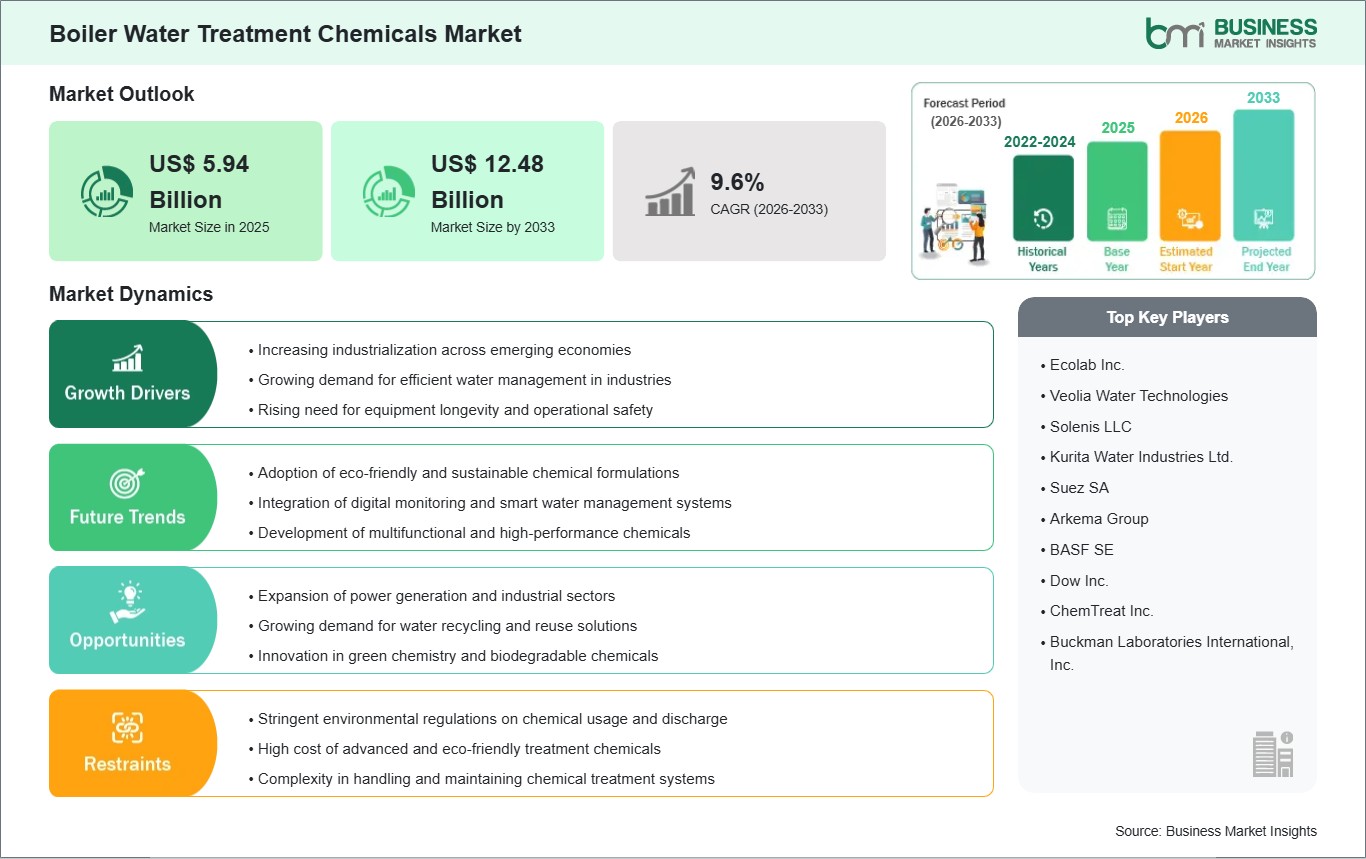
The Boiler Water Treatment Chemicals Market size is expected to reach US$ 12.48 billion by 2033 from US$ 5.94 billion in 2025. The market is estimated to record a CAGR of 9.6% from 2026 to 2033.
The global boiler water treatment chemicals market is driven by the increasing need for efficient water management, equipment longevity, and operational safety across industrial processes. These chemicals play a critical role in preventing corrosion, scaling, and microbial growth in boilers, ensuring optimal heat transfer efficiency and reducing maintenance costs. Industries such as power generation, oil & gas, and manufacturing heavily rely on boiler systems, thereby sustaining consistent demand for treatment solutions.
Growing industrialization, especially in emerging economies, is increasing the deployment of boilers, which in turn fuels demand for water treatment chemicals. Additionally, stricter environmental regulations and water discharge norms are pushing industries to adopt advanced chemical formulations that improve efficiency while minimizing environmental impact.
Competitive dynamics in this market are centered on product innovation, sustainability, and compliance with environmental standards. Manufacturers are investing in eco-friendly formulations, multifunctional chemicals, and digital monitoring solutions that optimize chemical dosing and performance. Partnerships with industrial operators and service providers are also becoming common to deliver integrated water treatment solutions. Regulatory frameworks emphasize safe handling, environmental compliance, and performance validation, shaping product development and commercialization strategies.

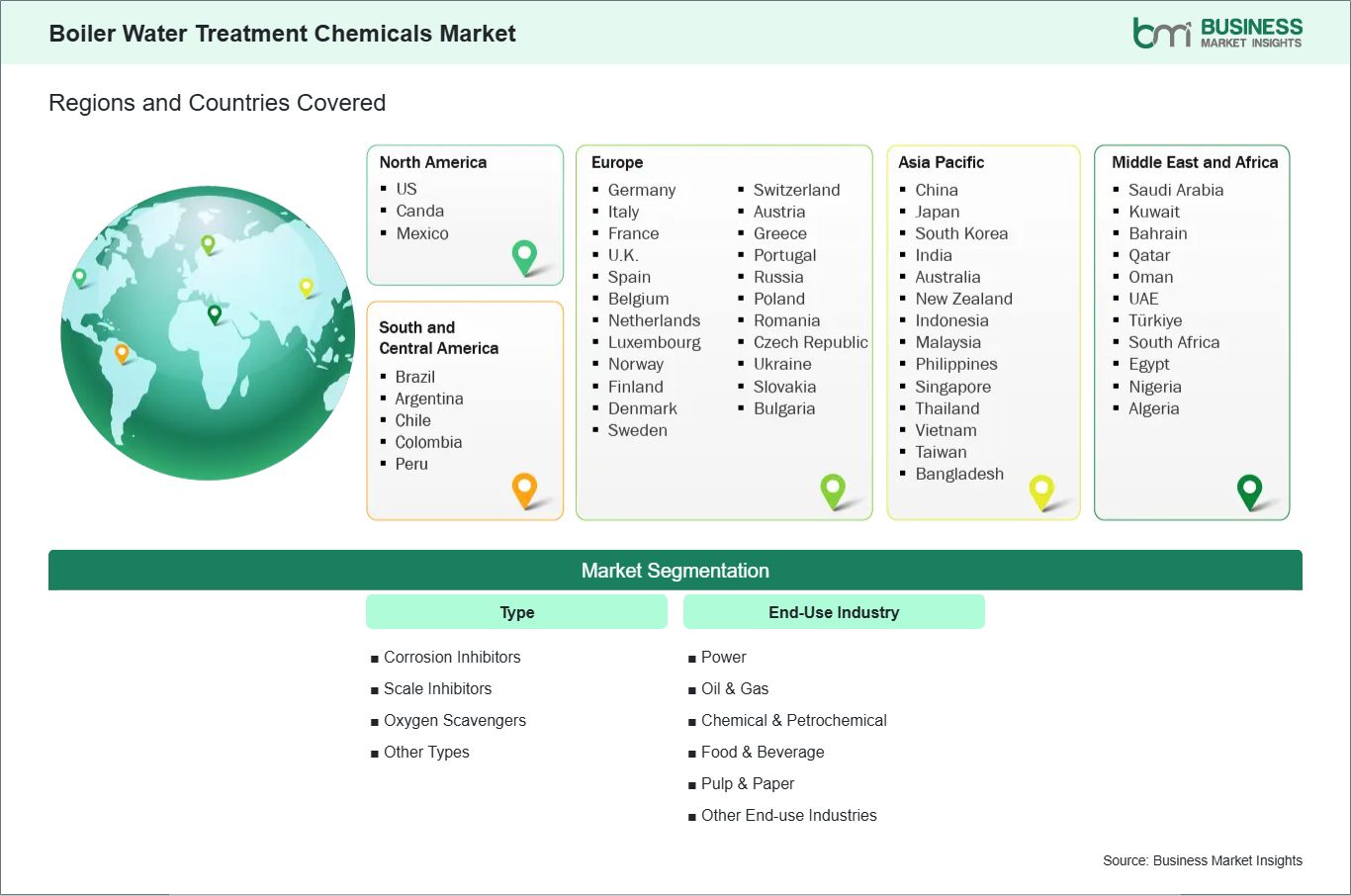
Key segments that contributed to the derivation of the boiler water treatment chemicals market analysis are type and end-use industry.
Industrialization is a primary factor leading to the growth of the boiler water treatment chemicals market. Various industries that produce steam or use steam in their thermal processes, including Power generation, Oil & Gas production, Chemical processing, and Food manufacturing, rely on boiler systems for these processes. Since boilers require high-quality water in order to work effectively, treatment chemicals are essential for ensuring efficient boiler operation through the avoidance of performance issues or system failure. Corrosion and scaling are two of the most widespread problems facing industrial boiler systems. The problems associated with these two types of damage can result in reduced efficiency of heat transfer through the boiler, increased energy usage, and excessive capital expenditures for replacement equipment that may have been prevented with the appropriate treatment program. To help ensure the integrity of a boiler system, many industrial operators apply corrosion inhibitors, scale inhibitors, and oxygen scavengers to their systems. As manufacturers continue to expand capacity, there will be increased demand for boiler water treatment chemicals.
Strong industrial and energy sector growth throughout the developing world, particularly in Asia Pacific, has been evident over the past several years. The installation of boilers has been accelerating as a result of various government initiatives to improve infrastructure and increase industrial output. Due to the growth in global energy consumption, the number of thermal power plants will also continue to grow, thereby continuing to support growth in the boiler water treatment chemicals market.
Increasing operational efficiency and reducing costs are also important factors driving demand for boiler water treatment chemicals. Industrial operations are utilizing these types of chemicals with increased frequency than in the past to meet these objectives.
Increasingly strict environmental regulation, sustainability initiatives and eco-friendly chemicals are offering tremendous potential for commercial development of the global market for chemicals used in the treatment of boiler feed water. Across the world, governments and regulating agencies are passing and enforcing very strict policies regarding water use, wastewater discharge and the chemical safety. These regulations create an incentive for all types of industries to develop and utilize advanced treatment solutions that will not only improve boiler operations but also reduce environmental harm.
Reducing the discharge of harmful chemicals into our water supplies is one of the most significant drivers of regulation related to boiler chemical treatment. Many of the traditional chemicals used to treat boiler feed water contain one or more materials that can either be hazardous to the environment and/or difficult to degrade, which has resulted in a greatly increased demand for "green" biodegradable alternatives. In response, many companies are working to develop "green chemistry" processes that are environmentally compliant and help maintain high levels of treatment, thereby creating opportunities for both innovation and product differentiation.
In addition to sustainable chemical treatment options, regulatory guidelines are also becoming more stringent regarding the efficient use of water. As more and more industries are required to recycle and reuse water, they must also adopt more advanced water treatment systems. The many companies developing advanced chemicals for the treatment of boiler feed water are designing those chemicals to perform effectively with recycled water systems so that they can maintain a consistent level of chemical treatment despite changes in the quality of the feed water to the system.
Another growth opportunity tied to regulatory compliance is the digital transformation. Companies are implementing "smart" water management systems, and increasingly, businesses of all sizes implementing IoT and digital technologies focused on the management of water and its use during boiler operations.

The Boiler Water Treatment Chemicals Market demonstrates steady growth, with size and share analysis highlighting evolving trends and competitive dynamics among key players. The report examines subsegments categorized within type and end-use industry, offering insights into their contribution to overall market performance.
By type, the corrosion inhibitors subsegment dominated the market in 2025, driven by their critical role in preventing metal degradation and extending boiler life.
Based on end-use industry, the power subsegment dominated the market in 2025, driven by the extensive use of boilers in thermal and nuclear power plants.
| Report Attribute | Details |
|---|---|
| Market size in 2025 | US$ 5.94 Billion |
| Market Size by 2033 | US$ 12.48 Billion |
| Global CAGR (2026 - 2033) | 9.6% |
| Historical Data | 2022-2024 |
| Forecast period | 2026-2033 |
| Segments Covered | By Type
|
|
Regions and Countries Covered
| |
| North America | US, Canada, Mexico |
| Europe | Belgium, Austria, Finland, Denmark, Greece, Poland, Romania, Russia, Ukraine, Czech Republic, Slovakia, Bulgaria, Italy, Luxembourg, Germany, Switzerland, France, Netherlands, Norway, Portugal, Spain, Sweden, United Kingdom |
| Asia-Pacific | Australia, China, India, Japan, South Korea, Indonesia, Malaysia, Philippines, Singapore, Thailand, Vietnam, Bangladesh, New Zealand, Taiwan |
| South and Central America | Brazil, Argentina, Peru, Chile, Colombia |
| Middle East and Africa | Bahrain, Kuwait, Oman, Qatar, Saudi Arabia, United Arab Emirates, Turkiye, South Africa, Egypt, Algeria, Nigeria |
| Market leaders and key company profiles |
|
The "Boiler Water Treatment Chemicals Market Size and Forecast (2022 - 2033)" report provides a detailed analysis of the market covering below areas:
The geographical scope of the Boiler Water Treatment Chemicals Market report is divided into North America, Asia Pacific, Europe, Middle East & Africa, and South & Central America. North America held the largest share in 2025.
North America represents a mature market characterized by advanced industrial infrastructure and strict environmental regulations. Industries in the United States and Canada are increasingly adopting high-performance and environmentally compliant treatment chemicals. The focus in this region is on sustainability, operational efficiency, and the integration of digital monitoring technologies for optimized chemical usage.
Europe also demonstrates steady growth, driven by stringent environmental policies and a strong emphasis on energy efficiency. Countries such as Germany, the UK, and France are focusing on reducing emissions and improving water management practices. This has led to increased adoption of eco-friendly and innovative boiler treatment solutions.
In Asia Pacific, countries such as China and India are witnessing strong growth in power generation, manufacturing, and infrastructure development. The increasing number of thermal power plants and industrial facilities is significantly boosting demand for boiler water treatment chemicals. Government initiatives supporting industrial expansion and energy security further contribute to market growth in this region.
In the Middle East & Africa, the market is supported by the expansion of oil & gas and desalination industries. Boiler systems are widely used in these sectors, creating demand for reliable treatment chemicals. Meanwhile, South & Central America is experiencing gradual growth due to rising industrial activities and investments in energy infrastructure.
Across all regions, factors such as regulatory compliance, water scarcity, and the need for energy-efficient operations are shaping market trends. Manufacturers are tailoring their products and strategies to meet regional requirements, ensuring sustained growth in the global market.

The Boiler Water Treatment Chemicals Market is evaluated by gathering qualitative and quantitative data post primary and secondary research, which includes important corporate publications, association data, and databases. A few of the key developments in the boiler water treatment chemicals market are:
The Boiler Water Treatment Chemicals Market is valued at US$ 5.94 Billion in 2025, it is projected to reach US$ 12.48 Billion by 2033.
As per our report Boiler Water Treatment Chemicals Market, the market size is valued at US$ 5.94 Billion in 2025, projecting it to reach US$ 12.48 Billion by 2033. This translates to a CAGR of approximately 9.6% during the forecast period.
The Boiler Water Treatment Chemicals Market report typically cover these key segments-
The historic period, base year, and forecast period can vary slightly depending on the specific market research report. However, for the Boiler Water Treatment Chemicals Market report:
The Boiler Water Treatment Chemicals Market is populated by several key players, each contributing to its growth and innovation. Some of the major players include:
The Boiler Water Treatment Chemicals Market report is valuable for diverse stakeholders, including:
Essentially, anyone involved in or considering involvement in the Boiler Water Treatment Chemicals Market value chain can benefit from the information contained in a comprehensive market report.
Please tell us your area of interest
(Market Segments/ Regions and Countries/ Companies)