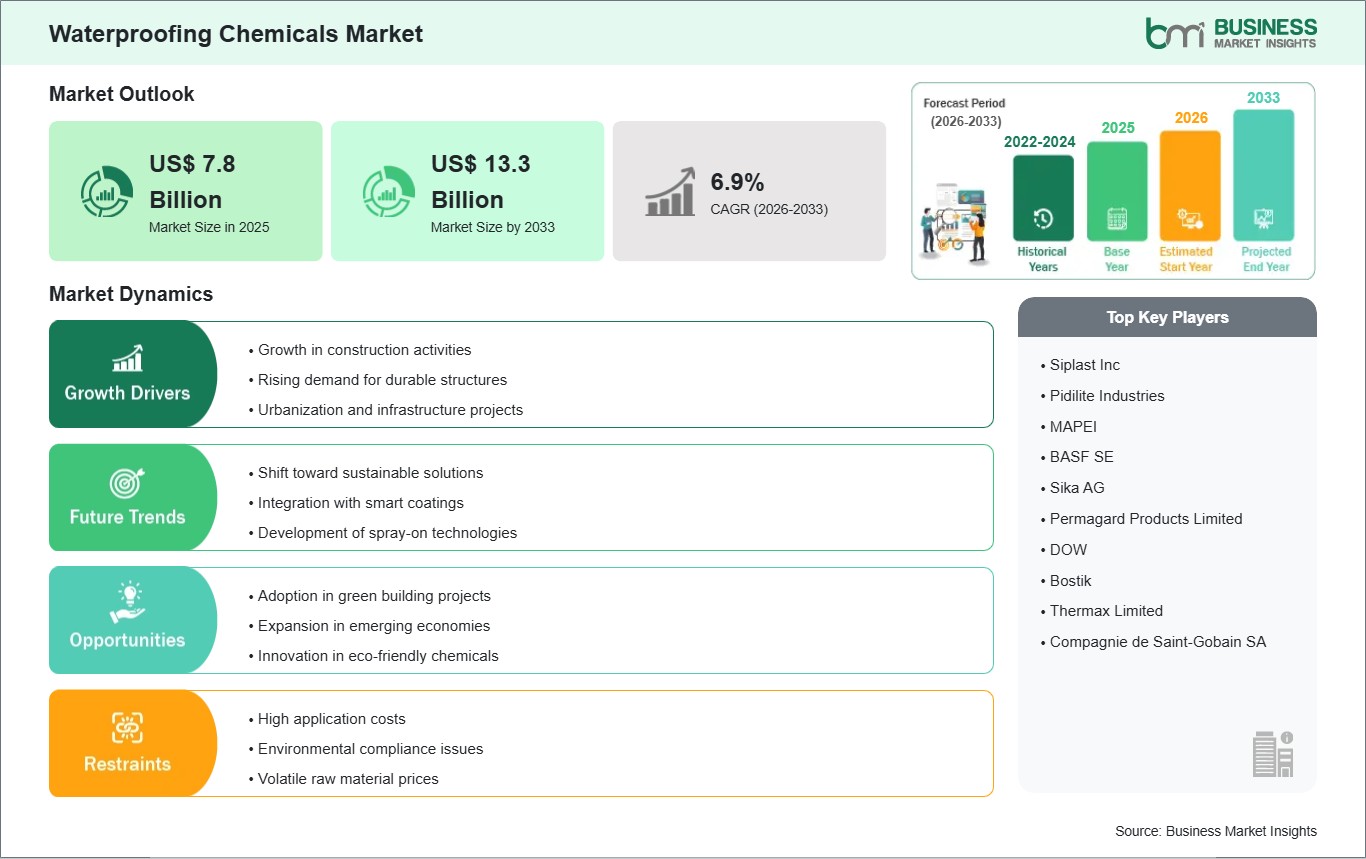
The Waterproofing Chemicals Market size is expected to reach US$ 13.3 billion by 2033 from US$ 7.8 billion in 2025. The market is estimated to record a CAGR of 6.9% from 2026 to 2033.
Waterproofing chemicals are specialized compounds designed to prevent water infiltration and protect structural integrity across a wide range of surfaces, including concrete, masonry, and metal. These substances, which include bitumen, elastomers, and various polymers such as PVC and TPO, work by creating an impervious barrier or sealing capillary pores within substrates to mitigate moisture-related damage such as corrosion, mold growth, and structural weakening. Market expansion is primarily attributed to the accelerating pace of global urbanization, increasingly stringent building codes focused on climate resilience, and rising awareness regarding the long-term benefits of preventive maintenance. Furthermore, the integration of AI-driven predictive formulation and nanotechnology-enhanced coatings, which offer self-healing properties and superior bond strength, is substantially improving procedural efficiency.
However, the market faces headwinds: raw material price volatility, driven by fluctuating petrochemical costs; fragmented application quality due to limited skilled labor, especially in emerging economies; and increasing regulatory pressure to reduce VOCs and solvent-based formulations. Despite these obstacles, significant opportunities remain. Demand for low-VOC, water-based, andbio-based solutions is rising with green building mandates, and functionalized systems, such as crystalline admixtures that self-seal micro-cracks in concrete, offer enhanced, long-lasting protection. Continued infrastructure investment and urbanization in Asia Pacific and emerging markets further drive the adoption of advanced waterproofing technologies.

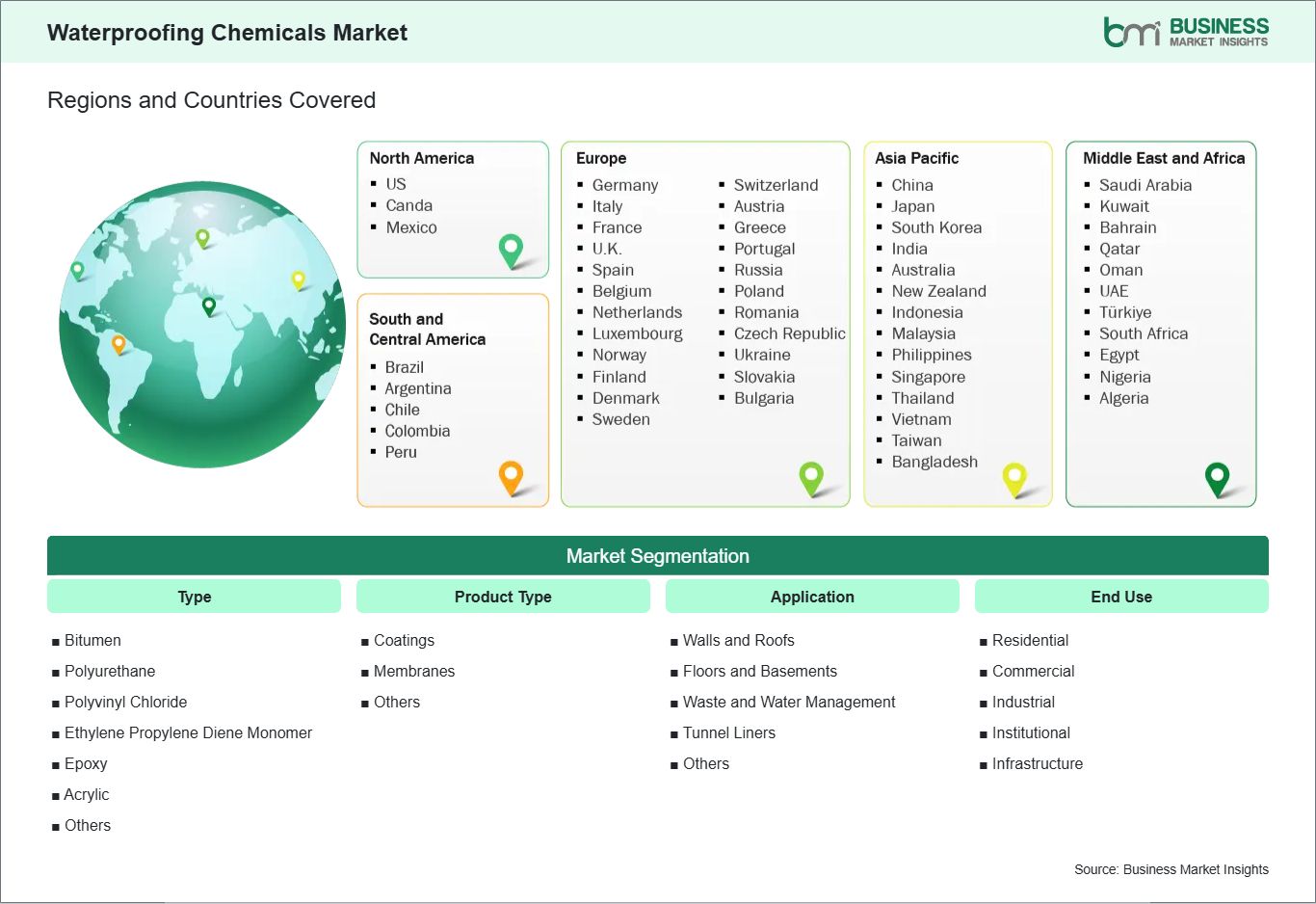
Key segments that contributed to the derivation of the Waterproofing Chemicals market analysis are type, product type, application, and end use.
The accelerated development of high-rise residential towers, commercial complexes, transportation corridors, and underground infrastructure demands advanced waterproofing solutions to ensure structural integrity and minimize long-term maintenance costs. Modern construction practices now integrate waterproofing at multiple stages, foundations, basements, roofs, and water-retaining structures, making these chemicals indispensable for durability and safety.
Government-backed initiatives such as smart city programs, affordable housing schemes, and large-scale infrastructure development projects further amplify this demand. Public investments in metro rail systems, expressways, bridges, tunnels, and water treatment facilities mandate the use of high-performance waterproofing systems to guarantee reliability, cost efficiency, and extended service life. In addition, stringent building codes and sustainability goals are pushing contractors and developers to adopt innovative, eco-friendly waterproofing solutions. As urban expansion continues at an unprecedented pace, the synergy between private construction and government-led infrastructure projects ensures robust growth for waterproofing chemicals across emerging economies.
Innovation in environmentally friendly and performance-enhancing formulations is opening significant growth avenues in the waterproofing chemicals market. The rising adoption of green building standards and sustainable construction practices has accelerated demand for low-VOC, water-based, and solvent-free coatings and membranes. These eco-friendly products are increasingly mandated in publicly funded projects and green-certified developments, allowing manufacturers to differentiate through strong sustainability credentials and compliance with global environmental norms.
Simultaneously, advanced functionalized waterproofing solutions such as crystalline admixtures are gaining traction. These materials chemically react with moisture and free lime within concrete to form insoluble crystals that seal micro-cracks, delivering self-healing properties and integral waterproofing. This technology ensures long-term durability and reduces maintenance costs, making it particularly valuable for critical infrastructure, tunnels, and water management facilities. By combining sustainability with superior performance, these innovations not only meet regulatory requirements but also enhance lifecycle efficiency, supporting higher market value growth. As urbanization and infrastructure investments surge, demand for such advanced waterproofing solutions is expected to rise sharply.

The Waterproofing Chemicals Market demonstrates steady growth, with size and share analysis revealing evolving trends and competitive positioning among key players. The report further examines subsegments categorized within type, product type, application, and end use to assess their contribution to overall market performance.
For instance, the Bitumen subsegment holds a significant market share. Bitumen-based solutions, specifically when utilized as Membranes, are indispensable for the Walls and Roofs of large-scale Infrastructure projects where extreme weather resistance is a priority. A notable trend in 2025 is the transition toward "cool-roof" bituminous membranes that incorporate reflective granules to meet new energy codes like California's Title 24. These innovations are particularly vital in urban infrastructure, where they provide long-term structural protection while simultaneously reducing the urban heat island effect.
| Report Attribute | Details |
|---|---|
| Market size in 2025 | US$ 7.8 Billion |
| Market Size by 2033 | US$ 13.3 Billion |
| Global CAGR (2026 - 2033) | 6.9% |
| Historical Data | 2022-2024 |
| Forecast period | 2026-2033 |
| Segments Covered | By Type
|
|
Regions and Countries Covered
| |
| North America | US, Canada, Mexico |
| Europe | Belgium, Austria, Finland, Denmark, Greece, Poland, Romania, Russia, Ukraine, Czech Republic, Slovakia, Bulgaria, Italy, Luxembourg, Germany, Switzerland, France, Netherlands, Norway, Portugal, Spain, Sweden, United Kingdom |
| Asia-Pacific | Australia, China, India, Japan, South Korea, Indonesia, Malaysia, Philippines, Singapore, Thailand, Vietnam, Bangladesh, New Zealand, Taiwan |
| South and Central America | Brazil, Argentina, Peru, Chile, Colombia |
| Middle East and Africa | Bahrain, Kuwait, Oman, Qatar, Saudi Arabia, United Arab Emirates, Turkiye, South Africa, Egypt, Algeria, Nigeria |
| Market leaders and key company profiles |
|
The "Waterproofing Chemicals Market Size and Forecast (2022–2033)" report provides a detailed analysis of the market covering below areas:
The geographical scope of the Waterproofing Chemicals Market report is divided into five regions: North America, Europe, Asia Pacific, the Middle East & Africa, and South & Central America.
The Waterproofing Chemicals Market exhibits diverse regional dynamics shaped by construction trends and regulatory frameworks. North America focuses on infrastructure renovation and compliance with stringent building codes, driving demand for advanced waterproofing systems. Europe emphasizes sustainability, with low-VOC and eco-friendly formulations gaining traction under green building mandates. Asia Pacific remains a hub of rapid urbanization and large-scale infrastructure projects, fueling the adoption of innovative waterproofing solutions. The Middle East & Africa are witnessing growing demand from commercial and residential developments in climate-sensitive areas. At the same time, South & Central America experience rising uptake in urban housing and infrastructure modernization initiatives.

The Waterproofing Chemicals Market is evaluated by gathering qualitative and quantitative data post-primary and secondary research, which includes important corporate publications, association data, and databases. A few of the key developments in the Waterproofing Chemicals market are:
The Waterproofing Chemicals Market is valued at US$ 7.8 Billion in 2025, it is projected to reach US$ 13.3 Billion by 2033.
As per our report Waterproofing Chemicals Market, the market size is valued at US$ 7.8 Billion in 2025, projecting it to reach US$ 13.3 Billion by 2033. This translates to a CAGR of approximately 6.9% during the forecast period.
The Waterproofing Chemicals Market report typically cover these key segments-
The historic period, base year, and forecast period can vary slightly depending on the specific market research report. However, for the Waterproofing Chemicals Market report:
The Waterproofing Chemicals Market is populated by several key players, each contributing to its growth and innovation. Some of the major players include:
The Waterproofing Chemicals Market report is valuable for diverse stakeholders, including:
Essentially, anyone involved in or considering involvement in the Waterproofing Chemicals Market value chain can benefit from the information contained in a comprehensive market report.
Please tell us your area of interest
(Market Segments/ Regions and Countries/ Companies)