Market Summary
Executive Summary and Global Market Analysis
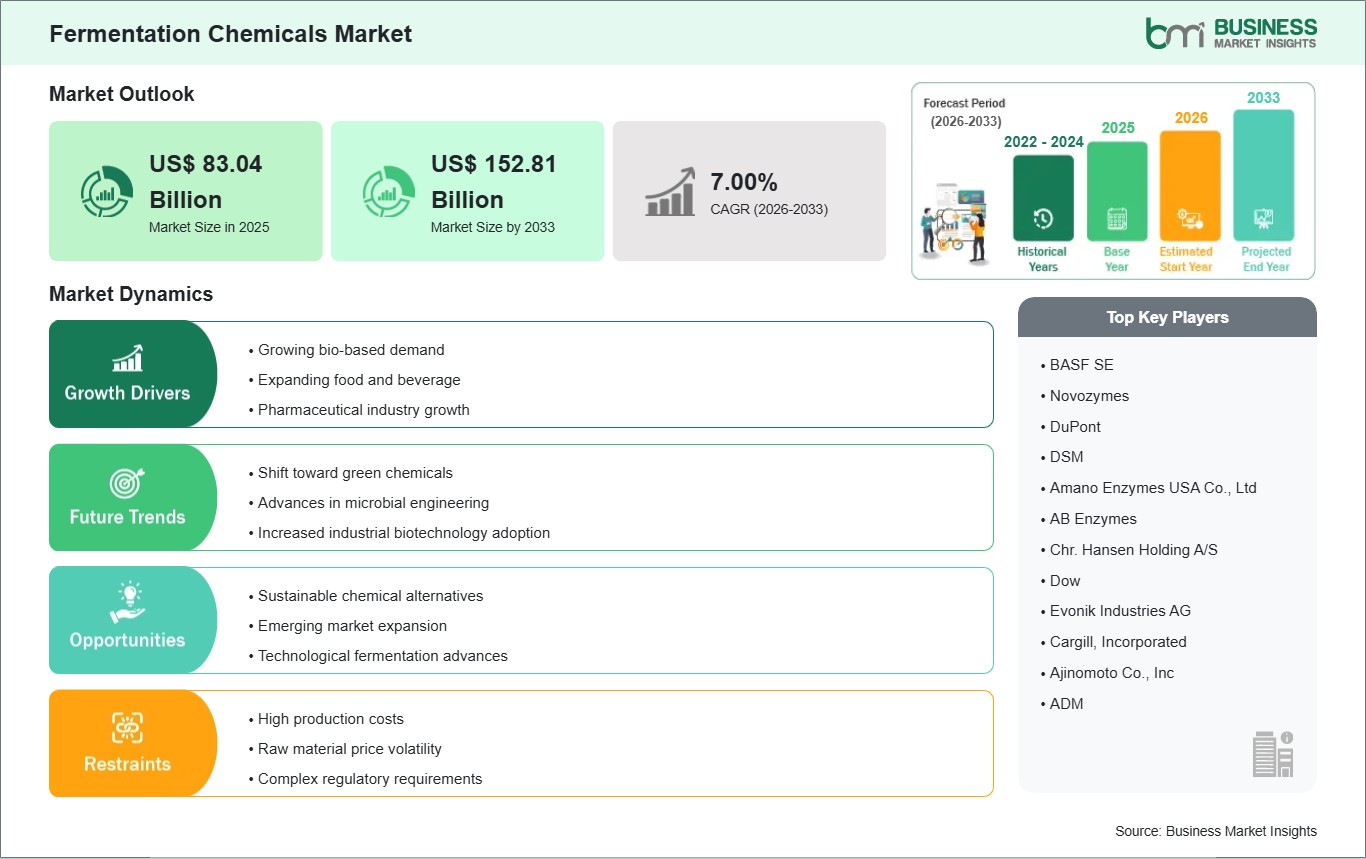
Fermentation chemicals are substances that are produced or used in fermentation processes, where the microorganisms, such as bacteria, yeast, or fungi, transform the organic materials into valuable chemical compounds under controlled conditions. These substances are organic acids (including lactic acid and citric acid), alcohols, enzymes, amino acids, vitamins, and bio-based solvents. These chemicals are widely used as they allow high-value products to be produced in an efficient, scalable, and sustainable manner using renewable raw materials, and in many cases, with a reduced environmental footprint than more traditional petrochemical technologies.
Fermentation chemicals are crucial in all industries because of their versatility and functional performance. They are also critical in the pharmaceutical and healthcare industries in the production of antibiotics, probiotics, vaccines, and active pharmaceutical ingredients. Fertilizers and pesticides generated by fermentation are applied in the agriculture industry to enhance crop productivity. In industrial applications, they support the production of biodegradable plastics, biofuels, and specialty chemicals. Moreover, the fermentation chemicals also tend to match the growing regulatory and consumer focus on sustainability, natural ingredients, and lower carbon footprints, as well as their application in a wide range of end-use sectors.
Segment Analysis
Fermentation Chemicals Market Segmentation
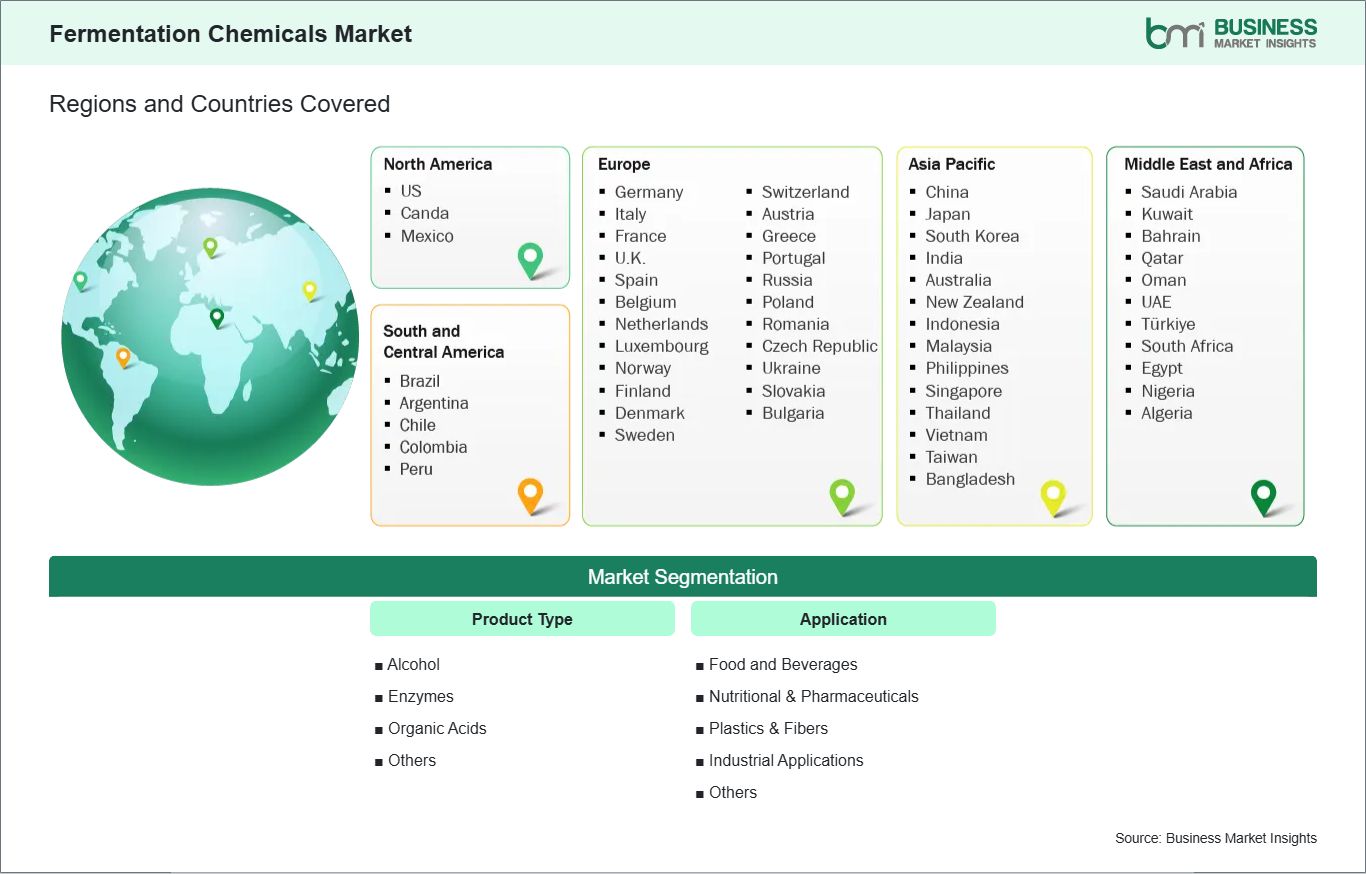
Key segments that contributed to the derivation of the fermentation chemicals market analysis are product type and application.
- By product type, the fermentation chemicals market is segmented into alcohol, enzymes, organic acids, and others. The alcohol segment held the largest share of the market in 2024.
- By application, the market is segmented into food and beverages, nutritional & pharmaceuticals, plastics & fibers, industrial applications, and others. The industrial applications segment held the largest market share in 2024.
Market Forces
Fermentation Chemicals Market Drivers and Opportunities
Technological Advancements in Fermentation Processes
The development of advanced technologies in the fermentation process has emerged as a key driver in the fermentation chemicals market. Innovations in the engineering of microbial strains, such as the engineering of high-performing and robust microbial cultures, have played a critical role in enhancing product yield and consistency. Optimization of bioprocesses, including control of pH, temperature, and nutrient feed with precision, has improved the efficiency and scalability of fermentation processes.
Moreover, scale-up technologies allow manufacturers to acquire the ability to shift the scale of production between laboratory scales and industry scales without causing significant loss of quality and lowering the costs of operation. The automation, real-time monitoring, and process analytics are also integrated, guaranteeing reproducibility and reducing resource usage. All these technological advances cumulatively enhance the economic competitiveness of fermentation chemicals in addition to broadening their industrial applications through adherence to high-quality and regulatory standards. As industries continue to seek reliable, sustainable, and high-quality bio-based solutions, such process innovations are expected to sustain market growth and facilitate adoption in new regions and sectors.
Growing Use of Agricultural Biologicals
Growing use of agricultural biologicals presents a substantial growth opportunity for fermentation-derived chemicals. The growing concern about environmental sustainability and the adverse consequences of synthetic agrochemicals has led to the transition to more sustainable options. Fermentation chemicals are used to manufacture biofertilizers, biopesticides, and soil conditioners, which increase crop output, a healthier soil, and less dependency on chemical additions. Such biologically based products provide accurate delivery of nutrients, enhance positive microbial growth in the soil, and reduce the environmental impact of contemporary agriculture.
In addition, sustainable farming practices are being adopted faster in both the developed and emerging markets due to government incentives and regulatory support on the same. The flexibility of fermentation chemicals enables customized solutions to meet individual crop requirements and regional farming issues such as pest resistance and soil degradation. As the world population continues to increase and food security has emerged as a major challenge, sustainable and high-performance agricultural input is set to continue their upward trend, which offers new opportunities to expand markets, innovate, and form strategic partnerships in the fermentation chemicals industry.
Report Coverage
Fermentation Chemicals Market Report Coverage and Deliverables
The Fermentation Chemicals Market Size and Forecast (2022-2033) report provides a detailed analysis of the market covering below areas:
- Fermentation Chemicals market size and forecast at global, regional, and country levels for all the key market segments covered under the scope
- Fermentation Chemicals market trends, as well as market dynamics such as drivers, restraints, and key opportunities
- Fermentation Chemicals market analysis covering key market trends, global and regional framework, major players, regulations, and recent market developments
- Industry landscape and competition analysis covering market concentration, heat map analysis, prominent players, and recent developments for the Fermentation Chemicals market
- Detailed company profiles, including SWOT analysis
Geographic Insights
Fermentation Chemicals Market Geographic Insights
Furthermore, government programs in support of biotechnology, sustainable agriculture, and renewable resources are providing additional momentum to market expansion. The development of microbial strains and fermentation processes has become more efficient, more productive, and more cost-effective due to technological advances, allowing manufacturers to increase the scale of production and satisfy the increasing demand. The increased significance of organic acids, enzymes, and bio-based solvents in food preservation, nutraceuticals, as well as in industrial uses also promotes market growth in the region. Moreover, expanding investments in research and development, as well as strategic partnerships between regional and global players, are enhancing product portfolios and strengthening the market landscape, positioning Asia Pacific as a significant contributor to the global fermentation chemicals market.
Report Guidance
Fermentation Chemicals Market Report Guidance
The report includes qualitative and quantitative data in the fermentation chemicals market, product type, application, and geography.
The report starts with the key takeaways (chapter 2), highlighting the key trends and outlook of the fermentation chemicals market.
Chapter 3 includes the research methodology of the study.
Chapter 4 further includes ecosystem analysis.
Chapter 5 highlights the major industry dynamics in the fermentation chemicals market, including factors that are driving the market, prevailing deterrents, potential opportunities, as well as future trends. Impact analysis of these drivers and restraints is also covered in this section.
Chapter 6 discusses the fermentation chemicals market scenario, in terms of historical market revenues, and forecast till the year 2033.
Chapters 7 to 10 cover the fermentation chemicals market segments by product type, application, and geography across North America, Europe, Asia Pacific, the Middle East and Africa, and South and Central America. They cover the market volume, revenue forecast, and factors driving the market.
Chapter 11 describes the competitive analysis along with the heat map analysis for the key players operating in the market.
Chapter 12 describes the industry landscape analysis. It provides detailed descriptions of business activities such as market initiatives, new developments, mergers, and joint ventures globally, along with a competitive landscape.
Chapter 13 provides detailed profiles of the major companies operating in the fermentation chemicals market. Companies have been profiled on the basis of their key facts, business descriptions, products and services, financial overview, SWOT analysis, and key developments.
Chapter 14, i.e., the appendix, is inclusive of a brief overview of the company, a list of abbreviations, and a disclaimer.
Industry Activity
Recent Developments
The fermentation chemicals market is evaluated by gathering qualitative and quantitative data post-primary and secondary research, which includes important corporate publications, association data, and databases. A few of the key developments in the fermentation chemicals market are:
- In May 2025, Amyris, Inc. acquired Ingredion's 31% stake in the RealSweet Joint Venture, gaining full ownership of an industrial precision fermentation plant in Brazil to strengthen production of fermentation-based ingredients.
- In November 2025, BASF and IFF announced a strategic collaboration to accelerate the development of next-generation enzyme and polymer technologies, advancing sustainability and innovation in bioscience and chemical production.
- In June 2025, Liberation Labs rebranded as Liberation Bioindustries to reflect its shift toward global biomanufacturing scale, signaling increased focus on industrial fermentation capacity and market positioning.
Trust & Transparency
Research Methodology
The market analysis combines proprietary research with secondary data from government agencies, company disclosures, regulatory filings, industry databases and expert interviews. Market estimates are validated through data triangulation, cross-market benchmarking and analyst
review.
View Full Research Methodology
Key Sources Referred:
World Bank – Global Trade Indicators
European Chemicals Agency
International Council of Chemical Associations
(International Monetary Fund )IMF
World Trade Organization (WTO)
International Trade Administration (ITA)
Company website
Company annual reports
Company investor presentations