
Specialty Fertilizers Market Outlook: Size, Share, Trends, Growth Analysis, Competitive Landscape & Forecast, 2026-2033

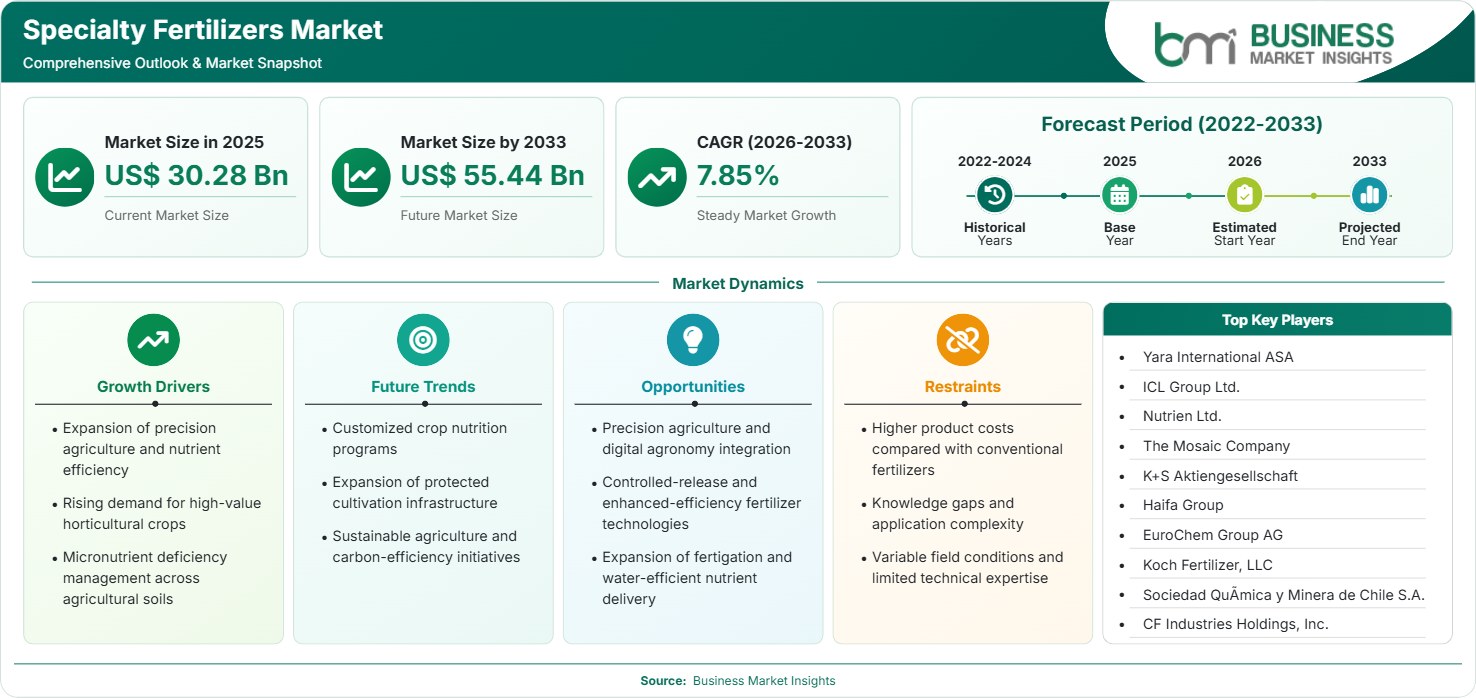
The Specialty Fertilizers Market size was valued at US$ 30.28 Billion in 2025 and is projected to reach US$ 55.44 Billion by 2033, growing at a CAGR of 7.85% during 2026–2033. Key drivers include precision agriculture adoption, nutrient-use efficiency mandates, micronutrient deficiency management, fertigation expansion, and sustainable crop productivity initiatives. Opportunities are emerging through customized formulations, digital farming integration, and high-value horticulture cultivation.

Report Coverage
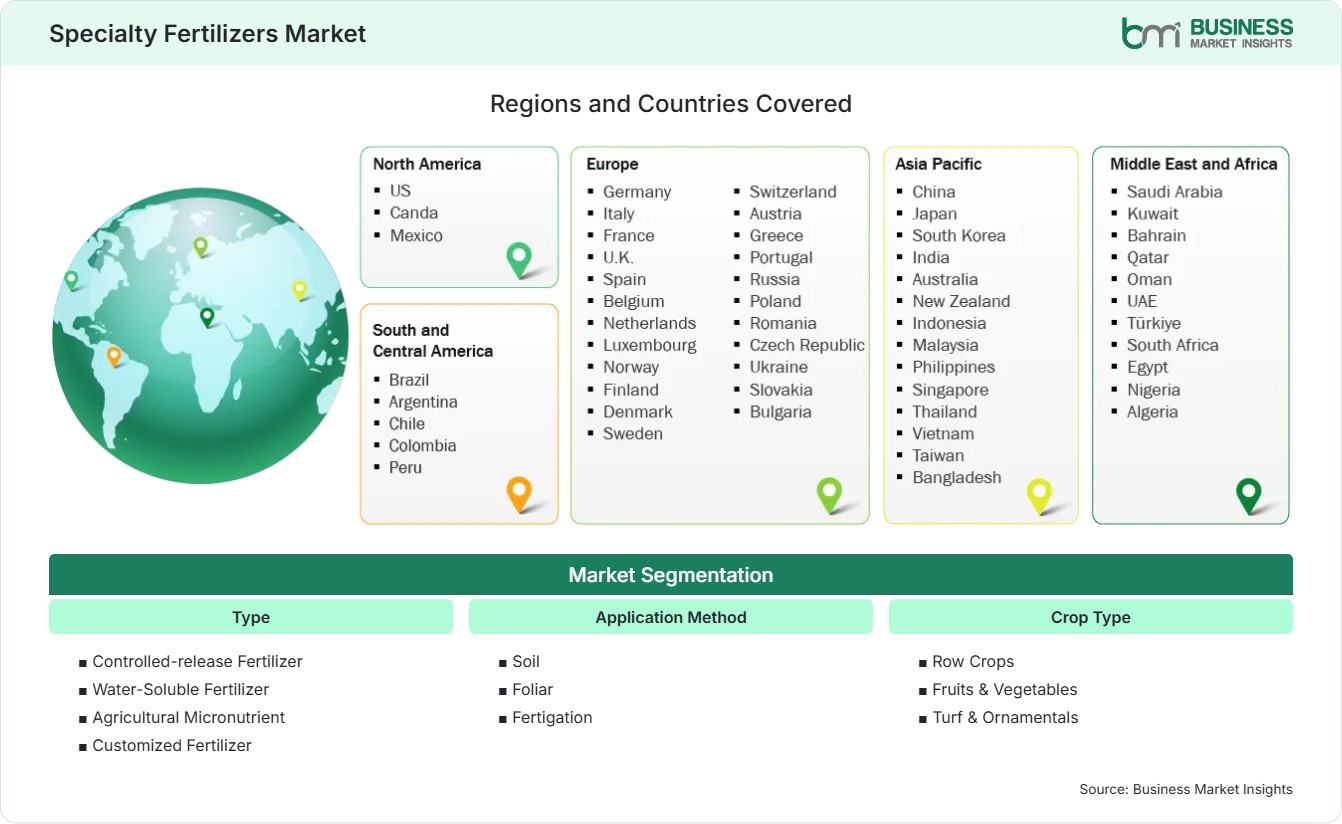
  • Type: Controlled-release Fertilizer, Water-Soluble Fertilizer, Agricultural Micronutrient, Customized Fertilizer
  • Application Method: Soil, Foliar, Fertigation
  • Crop Type: Row Crops, Fruits & Vegetables, Turf & Ornamentals
US$ 30.28 Bn Market size in 2025
US$ 55.44 Bn Market Size by 2033
7.85% CAGR, 2026 - 2033
2026-2033 Forecast Period

AI Overview

Specialty Fertilizers Market Summary

  • North America Region: Holds 32%–35% share in 2025, growing at 6.8%–7.3% CAGR during 2026–2033. Drivers include precision farming, advanced irrigation infrastructure, specialty crop cultivation, nutrient-efficiency regulations, and controlled-release product adoption. Opportunities arise from sustainable agriculture investments and digital agronomy platforms. US market benefits from strong horticulture demand and nutrient stewardship programs, advancing at 6.9%–7.4% CAGR.
  • Fastest Growing Region: Asia Pacific holds 28%–31% share in 2025 and expands at 8.8%–9.4% CAGR. Rising food demand, micronutrient-deficient soils, fertigation investments, protected cultivation growth, and government productivity initiatives support expansion while opportunities emerge from modernization across farming systems.
  • Leading Segment: Water-Soluble Fertilizer accounts for 34%–37% share in 2025 and records 8.0%–8.5% CAGR. Strong compatibility with fertigation systems, rapid nutrient availability, protected agriculture expansion, and yield-focused cultivation practices create sustained demand across intensive farming operations.
  • High Growth Segment: Customized Fertilizer represents 16%–19% share in 2025 and achieves 9.2%–9.8% CAGR. Site-specific nutrient management, precision farming adoption, soil health optimization, and digital advisory integration create opportunities for premium product differentiation and higher returns.
  • Key Market Opportunity: Expansion of crop-specific nutrition programs enables producers to improve nutrient efficiency, reduce runoff, enhance profitability, support sustainability goals, and penetrate high-value fruit, vegetable, and greenhouse cultivation markets.
  • Major Market Players: Yara International ASA, ICL Group Ltd., Nutrien Ltd., The Mosaic Company, K+S Aktiengesellschaft, Haifa Group, EuroChem Group AG, Koch Fertilizer, LLC, Sociedad Química y Minera de Chile S.A., CF Industries Holdings, Inc.
Strategic Insights

Specialty Fertilizers Market: Strategic Insights

Specialty Fertilizers Market Strategic Framework
FREE PDF
Request your free sample
Request free sample
Stakeholder View

Key Takeaways

  • The value chain is evolving toward integrated agronomy solutions combining nutrient products, irrigation systems, soil diagnostics, and digital advisory services, creating recurring revenue opportunities beyond fertilizer sales.
  • Fruits and vegetables remain among the most attractive application areas because growers prioritize quality, appearance, shelf life, and export standards, supporting premium pricing potential.
  • Innovation activity increasingly focuses on controlled-release technologies, stabilized nutrients, chelated micronutrients, and crop-specific formulations that improve nutrient uptake while reducing environmental losses.
  • Asia Pacific presents the strongest regional investment case due to expanding irrigation infrastructure, rising food consumption, micronutrient-deficient soils, and government programs encouraging yield enhancement.
  • Strategic partnerships, manufacturing expansions, and portfolio optimization initiatives are increasing as companies seek broader distribution networks and differentiated specialty nutrition offerings.
  • Digital farming ecosystems are accelerating demand for customized nutrient recommendations, creating opportunities for data-enabled fertilizer products and service-based business models.
Geographic Outlook

Specialty Fertilizers Market Regional Highlights

North America Specialty Fertilizers Market

North America accounts for 32%–35% of the Specialty Fertilizers Market share in 2025 and is projected to expand at 6.8%–7.3% CAGR through 2033. Strong precision agriculture adoption, advanced irrigation systems, and high-value crop cultivation support regional demand. Environmental compliance requirements encourage nutrient-efficiency solutions, while greenhouse and specialty crop production continue expanding. The region maintains significant innovation capabilities through agronomic research institutions and commercial distribution networks that facilitate adoption of premium nutrition products among professional farming operations.

  • Controlled-release fertilizers are increasingly adopted to support nutrient stewardship goals and reduce environmental losses.
  • Specialty crop producers continue investing in fertigation-compatible products to maximize water and nutrient efficiency.
  • Digital agronomy platforms support more precise nutrient recommendations, improving adoption rates among commercial farms.
  • Sustainability-focused policies encourage lower nutrient runoff and improved resource utilization practices.

US Specialty Fertilizers Market

The United States represents 72%–76% of regional demand and advances at 6.9%–7.4% CAGR. Large-scale farming operations increasingly integrate precision agriculture technologies with specialized nutrient management programs. Demand remains strong across fruits, vegetables, turf, ornamentals, and greenhouse production. Growers emphasize productivity, quality consistency, and environmental performance, supporting premium fertilizer adoption. Expanding use of soil testing, variable-rate application tools, and digital advisory solutions continues strengthening market penetration across major agricultural regions.

  • California and Florida remain significant demand centers due to intensive horticultural cultivation.
  • Precision nutrient management programs drive greater use of micronutrients and customized formulations.
  • Greenhouse production expansion supports water-soluble fertilizer consumption.
  • Sustainability initiatives encourage nutrient-use efficiency improvements across commercial agriculture.

Europe Specialty Fertilizers Market

Europe holds 24%–27% market share in 2025 and is expected to grow at 7.1%–7.7% CAGR. Nutrient efficacy and environmental sustainability have contributed to the use of new fertilizer technologies as per regulatory emphasis. Germany is the leader in demand for fertilizers in the region, whereas Spain is favored due to intensive horticulture farming. Growth opportunities in the Eastern European countries exist due to investment in modernization. Growers tend to use controlled-release and water-soluble fertilizers.

  • Germany remains a leading market supported by advanced farming technologies.
  • Spain records strong demand from greenhouse and horticulture sectors.
  • Poland exhibits high-growth potential with expanding commercial agriculture investments.
  • Nutrient-efficiency regulations accelerate specialty product adoption.
  • Precision farming integration supports premium product penetration across key markets.

Asia Pacific Specialty Fertilizers Market

Asia Pacific captures 28%–31% Specialty Fertilizers Market share in 2025 and records the fastest CAGR of 8.8%–9.4%. Growth in food intake, reduction in available land for agriculture, and soil devoid of micronutrients create the demand. China still represents the largest market in the region, while there is rapid growth in India owing to development in irrigation facilities and agriculture programs emphasizing productivity. Growth in the cultivation of fruits, vegetables, and export-oriented crops drives the premium fertilizer use.

  • China leads regional consumption due to large agricultural output requirements.
  • India represents one of the fastest-growing markets with expanding micro-irrigation adoption.
  • Protected cultivation growth supports demand for water-soluble formulations.
  • Government productivity initiatives encourage balanced nutrient application practices.
  • Horticulture exports strengthen demand for quality-focused crop nutrition products.

Rest of World Specialty Fertilizers Market

Rest of World contributes 11%–14% share and grows at 7.8%–8.4% CAGR. Expansion of commercial agriculture works well for South and Central America, particularly Brazil and Chile. Irrigation development and food security measures help the Middle East and Africa. Special nutrition programs are widely used to increase productivity in harsh climatic conditions. Improvement programs for agriculture, export-oriented horticulture, and the need for efficiency of resources will ensure future growth in demand in the regions.

  • Brazil leads Latin American demand through large-scale commercial agriculture.
  • Chile benefits from export-focused fruit production and quality requirements.
  • Gulf countries increase adoption through protected cultivation expansion.
  • South Africa represents a notable African market supported by commercial farming.
  • Water efficiency concerns strengthen demand for fertigation-compatible products.
Global Market Geography
FREE PDF
Request your free sample
Request free sample
Segment Analysis

Specialty Fertilizers Market Segmentation

Type

Type segment accounts for the broadest product differentiation within the market. Water-soluble products lead with 34%–37% share in 2025 and grow at 8.0%–8.5% CAGR. The Specialty Fertilizers Market scope continues expanding through crop-specific nutrition, enhanced nutrient delivery efficiency, and increasing compatibility with precision agriculture systems.

  • Controlled-release Fertilizer: Improves nutrient-release timing, reduces leaching losses, and supports sustainable farming practices across specialty crops and commercial agriculture.
  • Water-Soluble Fertilizer: Favored in irrigation-based farming systems due to rapid nutrient availability and compatibility with modern fertigation infrastructure.
  • Agricultural Micronutrient: Addresses deficiencies affecting crop quality, yield potential, and plant health, particularly in intensive cultivation environments.
  • Customized Fertilizer: Tailored nutrient blends support site-specific soil conditions and precision crop nutrition requirements.

Application Method

Application methods increasingly align with precision nutrient management strategies. Soil application retains the largest share at 46%–49% in 2025, while fertigation demonstrates the strongest growth trajectory at 8.7%–9.3% CAGR owing to irrigation modernization and resource-efficiency priorities.

  • Soil: Remains widely utilized because of operational familiarity, extensive coverage capabilities, and compatibility with diverse crop systems.
  • Foliar: Enables rapid nutrient correction and targeted application during critical crop growth stages.
  • Fertigation: Supports precise nutrient delivery through irrigation systems, improving uptake efficiency and reducing wastage.

Crop Type

Crop segmentation reflects varying nutrient intensity requirements. Row crops account for 39%–42% share in 2025, while fruits and vegetables generate higher value realization and robust expansion. Specialty Fertilizers Market trends increasingly favor premium nutrition programs for high-value horticultural cultivation.

  • Row Crops: Benefit from nutrient-efficiency solutions aimed at improving productivity and optimizing fertilizer utilization.
  • Fruits & Vegetables: Drive premium demand due to quality standards, appearance requirements, and intensive nutrient management practices.
  • Turf & Ornamentals: Require specialized formulations supporting aesthetics, consistency, and landscape performance.
Market Forces

Specialty Fertilizers Market Dynamics

Key Market Drivers

Expansion of Precision Agriculture and Nutrient Efficiency

Precision agriculture continues transforming fertilizer utilization across commercial farming. GPS-guided equipment, variable-rate application technologies, and digital agronomy platforms enable growers to match nutrient inputs with crop requirements more accurately. This trend supports Specialty Fertilizers Market growth through an increase in demand for controlled-release, water-soluble, and customizable products that can be used effectively with the data-enabled management systems. Precision agriculture technologies are becoming increasingly popular all over the world because of labor limitations and sustainability considerations. Farmers are becoming more concerned with efficient use of nutrients, increased yields, and reduced costs.

Rising Demand for High-Value Horticultural Crops

An increase in the consumption of fruits, vegetables, and high-quality agricultural produce is driving the need for sophisticated crop nutritional solutions. Nutrient management plays an important role in horticultural production in order to meet the quality, aesthetics, shelf life, and yield goals. Specialty fertilizers play an important role in meeting these goals through improved nutrient availability and application methods. Specialty Fertilizers Market growth remains closely linked to the expansion of high-value crop sectors where growers can justify premium input investments through higher returns and improved product quality outcomes.

Micronutrient Deficiency Management Across Agricultural Soils

Micronutrient deficiencies continue to pose a significant agronomic problem within various farming communities. The deficiencies of zinc, boron, iron, and other nutrients have a negative impact on productivity and quality. Specialty nutrition is the solution to these limitations. The use of soil tests has led to an increased need for specialty nutrition products. Specialty Fertilizers Market trends indicate stronger demand for micronutrient-enriched products integrated into broader crop management programs. This is particularly evident in intensively cultivated regions where maintaining soil productivity has become a strategic priority for long-term agricultural sustainability.

Key Market Opportunities

Customized Crop Nutrition Programs

Customized fertilizer solutions represent a high-value investment opportunity across modern agriculture. Growers increasingly seek site-specific recommendations based on soil conditions, crop requirements, and environmental factors. These products improve nutrient utilization while reducing unnecessary application. Specialty Fertilizers Market Forecasts increased use of personalized solutions, especially among regions that have already adopted the technologies of precision farming. Companies that can offer digital agronomy coupled with personalized nutrient application will earn premium margins. Increased access to soil analysis, remote sensing, and farm management systems will drive the commercial potential.

Expansion of Protected Cultivation Infrastructure

Greenhouses, shade-net facilities, and hydroponic production systems are expanding in numerous agricultural economies. The cultivation processes involved need highly soluble and well-managed nutrients. Fertilizers have played an important part here by providing means of controlled nutrient application and enabling intensive cultivation. With more instances of urban agriculture, food security projects, and other such ventures coming up, there is likely to be an increasing need for improved fertilizers. There is scope for companies that offer special fertilizers for such systems.

Sustainable Agriculture and Carbon-Efficiency Initiatives

Environmental targets and sustainability commitments are reshaping agricultural input markets. Resource-efficient use and loss reduction of nutrients have become important concerns for governments, food producers, and growers. The use of specialty fertilizers is one way to meet these needs because of their efficient nutrient release, efficient uptake, and lower environmental footprint. Innovations based on the concept of sustainability can offer additional commercial prospects in developed and developing countries alike. Those providers who can demonstrate sustainable advantages are expected to gain better positions in the future.

Market Restraints and Challenges

Higher Product Costs Compared with Conventional Fertilizers

Factor: Specialty formulations generally involve advanced manufacturing processes, coating technologies, micronutrient fortification, or customized blending requirements. Impact: The high cost of acquisitions may pose challenges to adoption in cases where growers are highly price sensitive. Although the specialty crops provide better agronomic performance, the need to invest initially poses some concerns for many farmers. The uncertainties in the economy, commodity price fluctuations, and changes in profitability on farms pose additional challenges in purchasing decisions. It is imperative that suppliers justify their investments in terms of productivity gains.

Knowledge Gaps and Application Complexity

Factor: Effective utilization often requires a detailed understanding of crop nutrition, soil conditions, irrigation management, and timing. Impact: Lack of adequate technical expertise can result in reduced performance and prevent future use. For farmers to switch from traditional nutrient management to more targeted methods, the provision of agronomic services is essential. In agricultural markets that are fragmented, the lack of extension facilities can hinder marketing efforts. Firms have been addressing this problem by providing training and field demonstrations to farmers.

Company Analysis

Competitive Landscape

The Specialty Fertilizers Market analysis indicates competition is centered on innovation, distribution reach, agronomic expertise, and differentiated nutrient technologies.

Company Name

Overview

Products and Services relevant to this market

Yara International ASA

Global crop nutrition leader with extensive presence across farming markets and advanced agronomy capabilities.

Water-soluble fertilizers, micronutrients, fertigation solutions, crop nutrition programs, digital farming services.

ICL Group Ltd.

Major specialty nutrition manufacturer with broad global production and distribution footprint.

Controlled-release fertilizers, specialty blends, micronutrients, fertigation products, crop-specific nutrition solutions.

Nutrien Ltd.

Large agricultural input supplier serving commercial and specialty crop producers worldwide.

Specialty fertilizers, plant nutrition products, agronomic services, customized nutrient management.

The Mosaic Company

Integrated crop nutrient producer with strong distribution and technical expertise.

Specialty crop nutrition, micronutrients, enhanced-efficiency fertilizers, agronomic support services.

K+S Aktiengesellschaft

European fertilizer producer with strong agricultural product portfolio.

Specialty nutrients, potassium products, crop nutrition formulations, agricultural services.

Haifa Group

Recognized specialist in premium plant nutrition technologies and advanced formulations.

Water-soluble fertilizers, controlled-release products, fertigation solutions, micronutrients.

EuroChem Group AG

International fertilizer producer expanding specialty nutrition capabilities.

Customized fertilizers, specialty nutrients, agricultural micronutrients, crop-specific products.

Koch Fertilizer, LLC

Major nutrient producer supporting agricultural productivity initiatives.

Enhanced-efficiency fertilizers, specialty nutrient products, agronomic support solutions.

Sociedad Química y Minera de Chile S.A.

Global supplier known for specialty plant nutrition offerings.

Potassium nitrate, specialty nutrition products, fertigation formulations, crop management solutions.

CF Industries Holdings, Inc.

Significant nitrogen producer leveraging advanced product development capabilities.

Enhanced-efficiency nutrients, specialty crop solutions, nitrogen-based fertilizer products.

Trust & Transparency

Research Methodology

The market analysis combines proprietary research with secondary data from government agencies, company disclosures, regulatory filings, industry databases and expert interviews. Market estimates are validated through data triangulation, cross-market benchmarking and analyst review.

View Full Research Methodology

Questions Answered

Frequently Asked Questions

What does a Specialty Fertilizers Market Report typically evaluate?

A Specialty Fertilizers Market Report generally examines market size, technology trends, segmentation, competitive positioning, regional opportunities, regulatory developments, and future demand patterns.

Which region presents the strongest long-term growth potential?

Asia Pacific offers the strongest growth outlook due to increasing food demand, irrigation investment, protected cultivation expansion, and productivity-focused agricultural policies.

How do controlled-release fertilizers create value?

They improve nutrient-use efficiency by synchronizing nutrient availability with crop uptake while reducing leaching, volatilization losses, and application frequency.

Which crop category generates the strongest value demand?

Fruits and vegetables generate strong value demand because growers prioritize quality, appearance, shelf life, and export compliance, supporting premium nutrition investments.

What factors are accelerating specialty fertilizer adoption?

Precision farming, high-value crop cultivation, nutrient-efficiency requirements, irrigation modernization, and growing demand for sustainable agriculture practices are key adoption drivers.

Access the Full Specialty Fertilizers Market Report

Get segment-level forecasts, regional estimates, competitive benchmarking, company profiles and downloadable Excel datasets.

Access the full Specialty Fertilizers Market Report
350 pages PDF & Excel | 2026-09-02