
Specialty Label Packaging Market Outlook: Size, Share, Trends, Growth Analysis, Competitive Landscape & Forecast, 2026-2033

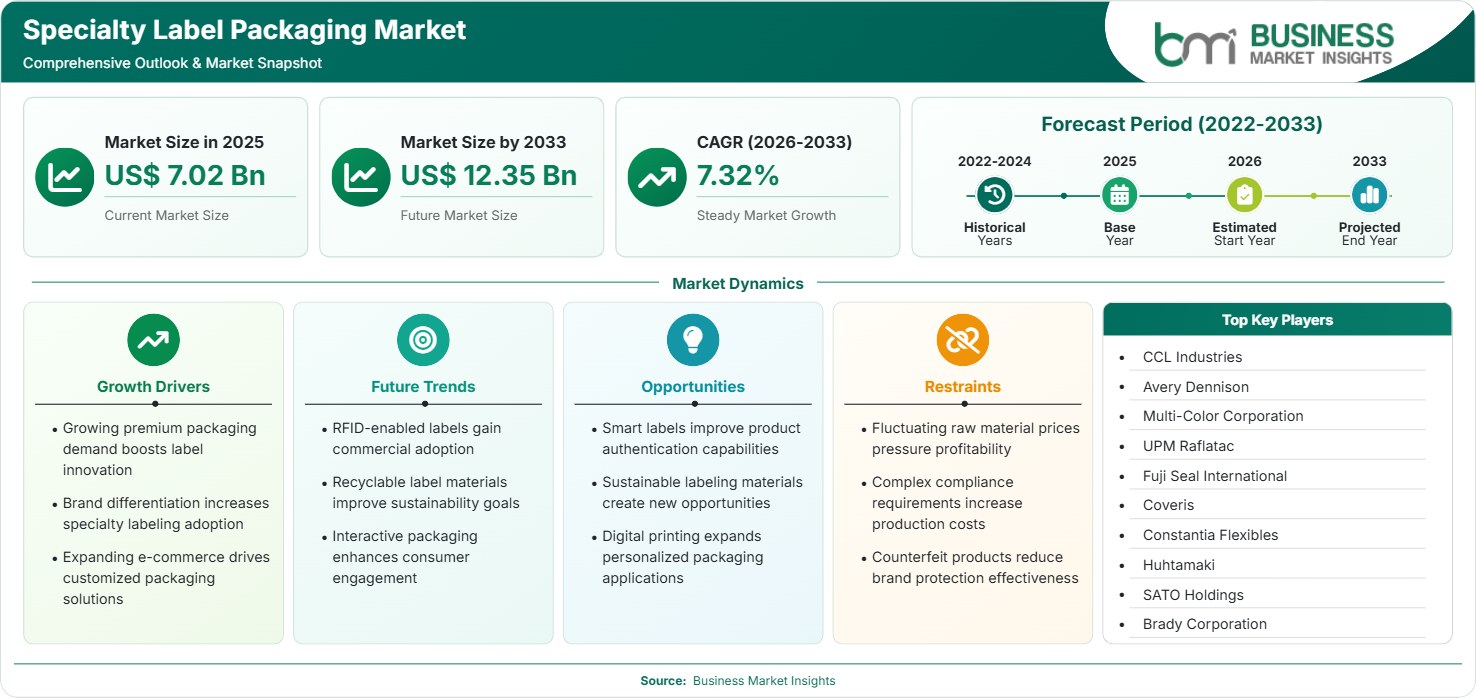
The Specialty Label Packaging Market size was valued at US$ 7.02 billion in 2025 and is projected to reach US$ 12.35 billion by 2033, growing at a CAGR of 7.32% during 2026–2033. Rising premium packaging demand, increasing brand differentiation requirements, and expanding customized packaging solutions are accelerating adoption across food, healthcare, personal care, and consumer product industries.

Report Coverage
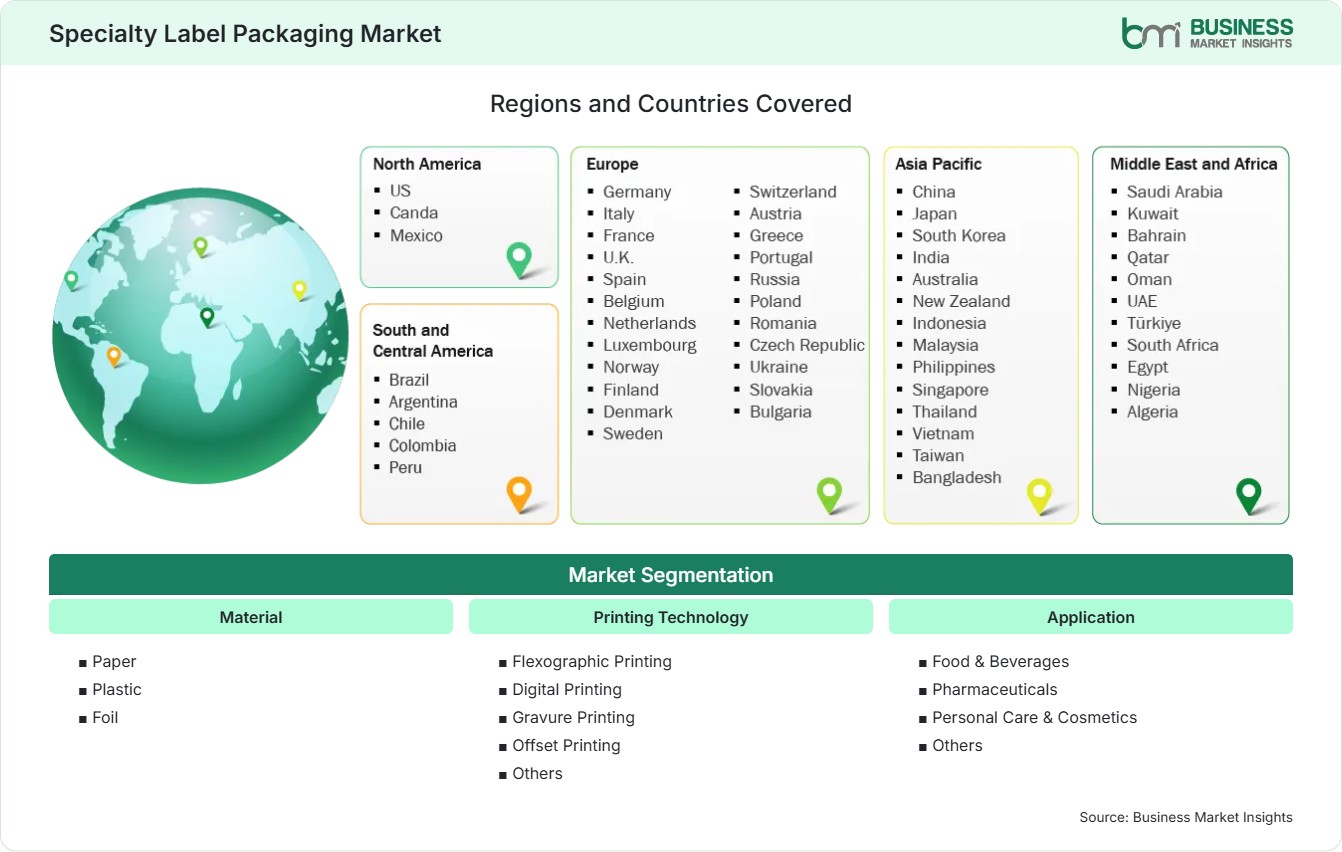
  • Material: Paper, Plastic, Foil
  • Printing Technology: Flexographic Printing, Digital Printing, Gravure Printing, Offset Printing, Others
  • Application: Food & Beverages, Pharmaceuticals, Personal Care & Cosmetics, Others
US$ 7.02 Bn Market size in 2025
US$ 12.35 Bn Market Size by 2033
7.32% CAGR, 2026 - 2033
2026-2033 Forecast Period

AI Overview

Specialty Label Packaging Market Summary

  • North America Region: North America holds 32%–35% market share in 2025 and is projected to grow at a CAGR of 6.9%–7.4% during 2026–2033. Strong demand from food, beverage, pharmaceutical, and personal care brands supports regional expansion. The U.S. market contributes significantly with a CAGR of 7.0%–7.5%, supported by premium branding initiatives, digital printing adoption, and customized packaging requirements.
  • Fastest Growing Region: Asia Pacific accounts for 35%–38% market share in 2025 and is expected to register a CAGR of 8.0%–8.6%, supported by expanding packaged food consumption, e-commerce growth, increasing pharmaceutical production, and rising investments in advanced labeling technologies.
  • Leading Segment: Paper material holds 42%–45% market share in 2025 and is anticipated to expand at a CAGR of 6.8%–7.3%, driven by sustainability initiatives, recyclable packaging preferences, and increasing demand for premium product presentation.
  • High Growth Segment: Digital Printing technology captures 28%–31% market share in 2025 and is projected to grow at a CAGR of 8.2%–8.8%, supported by short-run production, personalization requirements, variable data printing, and flexible packaging applications.
  • Key Market Opportunity: Increasing adoption of smart labels, sustainable substrates, and digital printing technologies is creating opportunities for manufacturers to deliver customized, traceable, and environmentally responsible labeling solutions.
  • Major Market Players: CCL Industries, Avery Dennison Corporation, Multi-Color Corporation, UPM Raflatac, Fuji Seal International, Inc., Coveris, Constantia Flexibles, Huhtamaki Oyj, SATO Holdings Corporation, and Brady Corporation.
Strategic Insights

Specialty Label Packaging Market: Strategic Insights

Specialty Label Packaging Market Strategic Framework
FREE PDF
Request your free sample
Request free sample
Stakeholder View

Key Takeaways

  • Specialty label manufacturers are increasingly integrating printing, material science, and digital technologies to provide value-added solutions beyond traditional product identification.
  • Food, beverages, and pharmaceutical applications offer strong growth potential due to increasing regulatory requirements, consumer engagement needs, and demand for premium product packaging.
  • Digital printing, smart labels, and sustainable substrates are becoming major innovation areas as brands seek flexible production and environmentally responsible packaging options.
  • Asia Pacific provides attractive investment opportunities due to expanding manufacturing capacity, rising consumer spending, and rapid development of organized retail channels.
  • Strategic partnerships between label producers, printing technology providers, and packaging companies are increasing to accelerate innovation and market expansion.
  • Companies focusing on recyclable materials and advanced authentication features are expected to gain competitive advantages as sustainability and product security become priorities.
Geographic Outlook

Specialty Label Packaging Market Regional Highlights

North America Specialty Label Packaging Market

North America represents 32%–35% Specialty Label Packaging Market share in 2025 and is expected to achieve a CAGR of 6.9%–7.4% from 2026–2033. The region benefits from strong demand for premium consumer goods packaging, advanced printing infrastructure, and increasing adoption of sustainable labeling materials. The U.S. remains the dominant market, supported by strong food, beverage, pharmaceutical, and personal care industries requiring innovative labeling solutions.

  • Premium beverage and food brands increasingly use specialty labels to improve shelf differentiation and consumer engagement.
  • Digital printing adoption is expanding due to demand for shorter production runs and customization.
  • Pharmaceutical companies require advanced labels supporting compliance, traceability, and product authentication.
  • Sustainable material adoption is increasing as brands focus on reducing packaging environmental impact.

US Specialty Label Packaging Market

The U.S. contributes 82%–85% of North American revenue and is projected to grow at a CAGR of 7.0%–7.5% during 2026–2033. Strong brand competition, advanced retail channels, and growing demand for customized packaging solutions continue driving market expansion across major consumer industries.

  • Food and beverage manufacturers increasingly invest in premium labels for improved product positioning.
  • Pharmaceutical packaging requirements support demand for specialized and compliant labeling solutions.
  • E-commerce growth increases demand for durable and customized packaging labels.
  • Brand owners continue adopting digital technologies for flexible packaging campaigns.

Europe Specialty Label Packaging Market

Europe accounts for 25%–28% market share in 2025 and is expected to grow at a CAGR of 6.7%–7.2% during the forecast period. Sustainability regulations, advanced packaging standards, and strong premium product markets continue supporting adoption. Germany remains the leading market, while France and Italy demonstrate steady expansion due to food, beverage, and luxury product packaging demand.

  • European brands increasingly prioritize recyclable label materials and sustainable printing methods.
  • Regulatory compliance requirements support demand for advanced pharmaceutical and healthcare labels.
  • Premium food and beverage industries continue adopting decorative labeling solutions.
  • Digital printing technologies are gaining popularity among small and medium packaging producers.

Asia Pacific Specialty Label Packaging Market

Asia Pacific holds 35%–38% market share in 2025 and is projected to register the fastest 8.0%–8.6% CAGR through 2026–2033. Expanding consumer markets, rising packaged food consumption, pharmaceutical manufacturing growth, and e-commerce expansion are strengthening regional demand. China leads regional adoption, while India and Southeast Asian countries are experiencing rapid growth through manufacturing expansion.

  • Increasing retail modernization supports demand for attractive and informative packaging labels.
  • Pharmaceutical production growth creates opportunities for specialized labeling solutions.
  • E-commerce expansion increases demand for customized and durable packaging formats.
  • Manufacturers are investing in advanced printing technologies to improve production efficiency.

Rest of World Specialty Label Packaging Market

The Rest of World region contributes 5%–8% market share in 2025 and is projected to grow at a CAGR of 7.1%–7.7% during 2026–2033. Latin America, the Middle East, and Africa are witnessing increasing demand due to expanding consumer industries, retail development, and pharmaceutical packaging requirements. Brazil, Mexico, and Gulf countries are emerging as important markets for specialty labeling solutions.

  • Growing packaged food industries are increasing adoption of decorative and functional labels.
  • Healthcare expansion supports demand for compliant and traceable packaging labels.
  • Retail modernization encourages brands to improve packaging presentation.
  • Manufacturers are developing cost-effective labeling solutions for emerging markets.
Global Market Geography
FREE PDF
Request your free sample
Request free sample
Segment Analysis

Specialty Label Packaging Market Segmentation

Material

The material segment plays a crucial role in determining label durability, appearance, recyclability, and compatibility with different packaging formats. The segment accounted for 42%–45% market share in 2025 and is projected to expand at a CAGR of 6.8%–7.3% during 2026–2033. Increasing sustainability initiatives, demand for premium finishes, and evolving packaging requirements are influencing material selection across industries. The Specialty Label Packaging Market scope continues expanding as manufacturers develop innovative substrates with improved performance and environmental benefits.

  • Paper: Remains widely used due to recyclability, cost efficiency, print compatibility, and suitability for premium food, beverage, personal care, and retail packaging applications.
  • Plastic: Gains adoption for applications requiring moisture resistance, durability, flexibility, and long-lasting performance, particularly in beverage, healthcare, and household product packaging.
  • Foil: Supports premium packaging applications through metallic appearance, enhanced barrier properties, and decorative appeal, making it suitable for luxury products, beverages, and specialty consumer goods.

Printing Technology

Printing technology advancement is transforming specialty label production by enabling improved customization, higher print quality, faster turnaround, and efficient short-run manufacturing. This segment accounted for 28%–31% market share in 2025 and is expected to register a CAGR of 8.2%–8.8% between 2026–2033. Growing personalization requirements, variable data printing demand, and increasing adoption of smart packaging solutions are accelerating technology investments. Current Specialty Label Packaging Market trends highlight the shift toward digital and hybrid printing methods that provide flexibility and operational efficiency.

  • Flexographic Printing: Maintains strong adoption for large-volume label production due to high-speed operation, cost efficiency, and compatibility with various substrates used in food and beverage packaging.
  • Digital Printing: Experiences rapid growth because of customization capabilities, reduced setup requirements, variable data printing support, and suitability for short production runs and personalized packaging campaigns.
  • Gravure Printing: Continues serving high-quality packaging applications requiring precise color reproduction, consistent output, and premium visual effects for large-scale label manufacturing.
  • Offset Printing: Provides excellent image quality and detailed graphics for specialty labels requiring sharp designs, complex artwork, and premium product presentation across multiple industries.

Application

Application diversity continues driving demand as brands use specialty labels to enhance product identification, strengthen consumer engagement, and comply with regulatory requirements. The application segment represented 44%–47% market share in 2025 and is projected to achieve a CAGR of 7.7%–8.2% during 2026–2033. Growing demand for attractive packaging, product authentication features, and sustainable labeling solutions continues creating opportunities across major end-use sectors.

  • Food & Beverages: Represents the leading application due to increasing demand for premium packaging, nutritional information labels, decorative designs, and product differentiation strategies among food and beverage brands.
  • Pharmaceuticals: Shows consistent demand as manufacturers require secure, compliant, and traceable labels supporting product identification, regulatory requirements, serialization, and anti-counterfeiting applications.
  • Personal Care & Cosmetics: Expands through rising demand for premium product presentation, customized packaging designs, luxury finishes, and visually attractive labels that strengthen brand recognition.
Market Forces

Specialty Label Packaging Market Dynamics

Key Market Drivers

Growing premium packaging demand boosts label innovation

High-end packaging has emerged as an area of great interest for brands that are looking to boost their consumer engagement, shelf visibility, and positioning. The use of specialty labels allows brands to distinguish themselves using sophisticated finishes, textures, decorations, and functions. Manufacturers of food products, beverages, cosmetics, and luxury products are now turning to personalized labeling solutions. The rising preference for visually appealing packaging formats continues supporting Specialty Label Packaging Market growth as manufacturers invest in innovative materials, advanced printing technologies, and value-added label solutions that address changing consumer expectations.

Brand differentiation increases specialty labeling adoption

Increasing competition across consumer markets is encouraging companies to use specialty labels as an effective tool for brand recognition and product differentiation. Besides basic identification, labels offer interactivity, improved aesthetics, valuable product information, and authenticity. Businesses are using unique label design, variable printing, and special finishing techniques to create better connections with their customers. Increasing importance of packaging as a marketing tool has resulted in increased investments in state-of-the-art label production equipment. Companies are emphasizing flexibility and customization options that help them launch specific campaigns while enhancing visibility of their products.

Expanding e-commerce drives customized packaging solutions

The increasing number of e-commerce channels is boosting demand for high-quality, visually appealing, and customizable packaging that will improve the delivery experience. E-commerce businesses and consumer brands are using specialty labels to make their packaging look good, promote their branding, and provide necessary product information. The direct-to-consumer model of conducting business gives way for customized labels and short run printing. These developments are influencing Specialty Label Packaging Market trends as digital commerce continues reshaping packaging requirements.

Key Market Opportunities

Smart labels improve product authentication capabilities

Smart labeling technologies are creating new opportunities by enabling product tracking, authentication, and consumer interaction across multiple industries. Innovations in RFID-tagged labels, QR-coded solutions, and connected packaging elements have been increasing among brands that wish to achieve better visibility in their supply chains and avoid counterfeiting. The manufacturers of pharmaceuticals, food and beverages, and luxury products have become increasingly interested in intelligent labels that will provide them with up-to-date information and enhanced customer interaction. The development of sensor technologies will offer even more options for smart labels in the future.

Sustainable labeling materials create new opportunities

Environmental awareness among customers and growing pressure for sustainable packaging have led to increased demand for sustainable label materials among manufacturing companies. More investments are being made in packaging materials that can easily be recycled and use sustainable substrates and adhesives. There is an increasing need for sustainable label materials from brand holders that do not compromise product performance or printing quality. The Specialty Label Packaging Market Forecasts indicate that sustainable labeling solutions will remain an important area of investment as industries move toward circular packaging models.

Digital printing expands personalized packaging applications

Digital printing technology is expanding the possibilities for customized packaging by enabling shorter production runs, faster design changes, and personalized label campaigns. Companies are adopting digital technologies to meet emerging consumer demands and market trends. This technology enables manufacturers to produce high-quality labels with changing graphics, regional variations, and limited-edition designs without any setup. Small and medium size companies are reaping benefits from the flexibility offered by digital printing technology and competing with large organizations by using novel packaging techniques.

Market Restraints and Challenges

Fluctuating raw material prices pressure profitability

Raw material price volatility remains a challenge for specialty label manufacturers due to fluctuations in paper, plastic films, adhesives, inks, and chemical inputs. Factor: Changes in commodity prices and supply chain disruptions increase production expenses and create uncertainty in procurement planning. Impact: Higher input costs can reduce profit margins, increase pricing pressure, and affect competitiveness among manufacturers operating in cost-sensitive markets. Companies are responding through supplier diversification, material optimization, and improved production efficiency to manage cost fluctuations while maintaining product quality.

Complex compliance requirements increase production costs

Increasing regulatory requirements across food, pharmaceutical, and consumer product industries are creating additional operational challenges for specialty label producers. Factor: Manufacturers must comply with strict standards related to labeling accuracy, material safety, traceability, and environmental regulations. Impact: Additional testing requirements, certification processes, and compliance investments increase production costs and extend development timelines for new labeling solutions. Companies are investing in advanced quality management systems and regulatory expertise to ensure compliance while continuing to deliver innovative specialty label products for global markets.

Company Analysis

Competitive Landscape

The competitive environment is shaped by innovation in printing technologies, sustainable material development, smart labeling solutions, and strategic collaborations between label manufacturers and packaging companies. Specialty Label Packaging Market analysis highlights that leading players are focusing on expanding production capabilities, improving recyclable label offerings, and integrating digital technologies to address changing brand requirements across food, beverage, pharmaceutical, personal care, and industrial applications.

Company Name

Overview

Products and Services Relevant to this Market

CCL Industries

Global specialty packaging and labeling company providing innovative identification and decorative solutions across multiple industries.

Pressure-sensitive labels, shrink sleeves, RFID labels, security labels, pharmaceutical labels, and customized specialty packaging solutions.

Avery Dennison Corporation

Global materials science company specializing in labeling, adhesives, and intelligent identification technologies.

Pressure-sensitive labels, smart labels, RFID solutions, sustainable label materials, adhesives, and digital identification technologies.

Multi-Color Corporation

Major global label manufacturer serving beverage, food, healthcare, and consumer product industries.

Premium labels, flexible packaging labels, shrink sleeves, decorative labels, and customized branding solutions.

UPM Raflatac

Sustainable labeling materials producer focused on renewable and recyclable label solutions.

Paper labels, film labels, adhesive materials, sustainable label stock, and specialty labeling products.

Fuji Seal International, Inc.

Packaging solutions provider specializing in labels, sleeves, and customized packaging technologies.

Shrink sleeve labels, functional labels, flexible packaging solutions, and decorative labeling systems.

Coveris

Sustainable packaging manufacturer offering flexible packaging and labeling solutions for global brands.

Specialty labels, flexible packaging materials, recyclable solutions, and high-performance packaging products.

Constantia Flexibles

International packaging company focused on flexible packaging and labeling solutions.

Pressure-sensitive labels, pharmaceutical labels, sustainable packaging materials, and customized labeling applications.

Huhtamaki Oyj

Global food packaging company providing sustainable packaging solutions across consumer markets.

Decorative labels, packaging materials, sustainable solutions, and specialty packaging technologies.

SATO Holdings Corporation

Provider of automatic identification and data collection solutions supporting supply chain applications.

Barcode labels, RFID labels, tracking solutions, printing systems, and industrial identification products.

Brady Corporation

Global manufacturer of identification and safety solutions for industrial and healthcare applications.

Specialty labels, safety labels, durable identification products, RFID solutions, and customized labeling systems.

Trust & Transparency

Research Methodology

The market analysis combines proprietary research with secondary data from government agencies, company disclosures, regulatory filings, industry databases and expert interviews. Market estimates are validated through data triangulation, cross-market benchmarking and analyst review.

View Full Research Methodology

Questions Answered

Frequently Asked Questions

What does the Specialty Label Packaging Market Report cover?

The Market Report provides insights into market dynamics, segmentation, competitive developments, regional trends, technological advancements, growth opportunities, and strategic factors influencing the global labeling industry.

What role do smart labels play in packaging?

Smart labels improve authentication, tracking, and consumer interaction through technologies such as RFID and QR codes, supporting supply chain transparency, anti-counterfeiting measures, and improved product engagement.

Why is digital printing important for specialty labels?

Digital printing enables faster production, customized designs, variable information printing, and efficient short-run manufacturing, allowing brands to respond quickly to changing consumer preferences and marketing requirements.

How are sustainable materials influencing specialty labeling development?

Manufacturers are increasingly adopting recyclable papers, bio-based materials, and environmentally friendly adhesives to meet sustainability goals while maintaining label performance, print quality, and compatibility with modern packaging formats.

What industries are driving demand for specialty labels?

Food and beverages, pharmaceuticals, personal care, cosmetics, and consumer goods industries are major contributors due to increasing demand for premium presentation, product information, traceability, and brand differentiation.

Access the Full Specialty Label Packaging Market Report

Get segment-level forecasts, regional estimates, competitive benchmarking, company profiles and downloadable Excel datasets.

Access the full Specialty Label Packaging Market Report
350 pages PDF & Excel | 2026-08-21
Similar Research

Related Market Reports