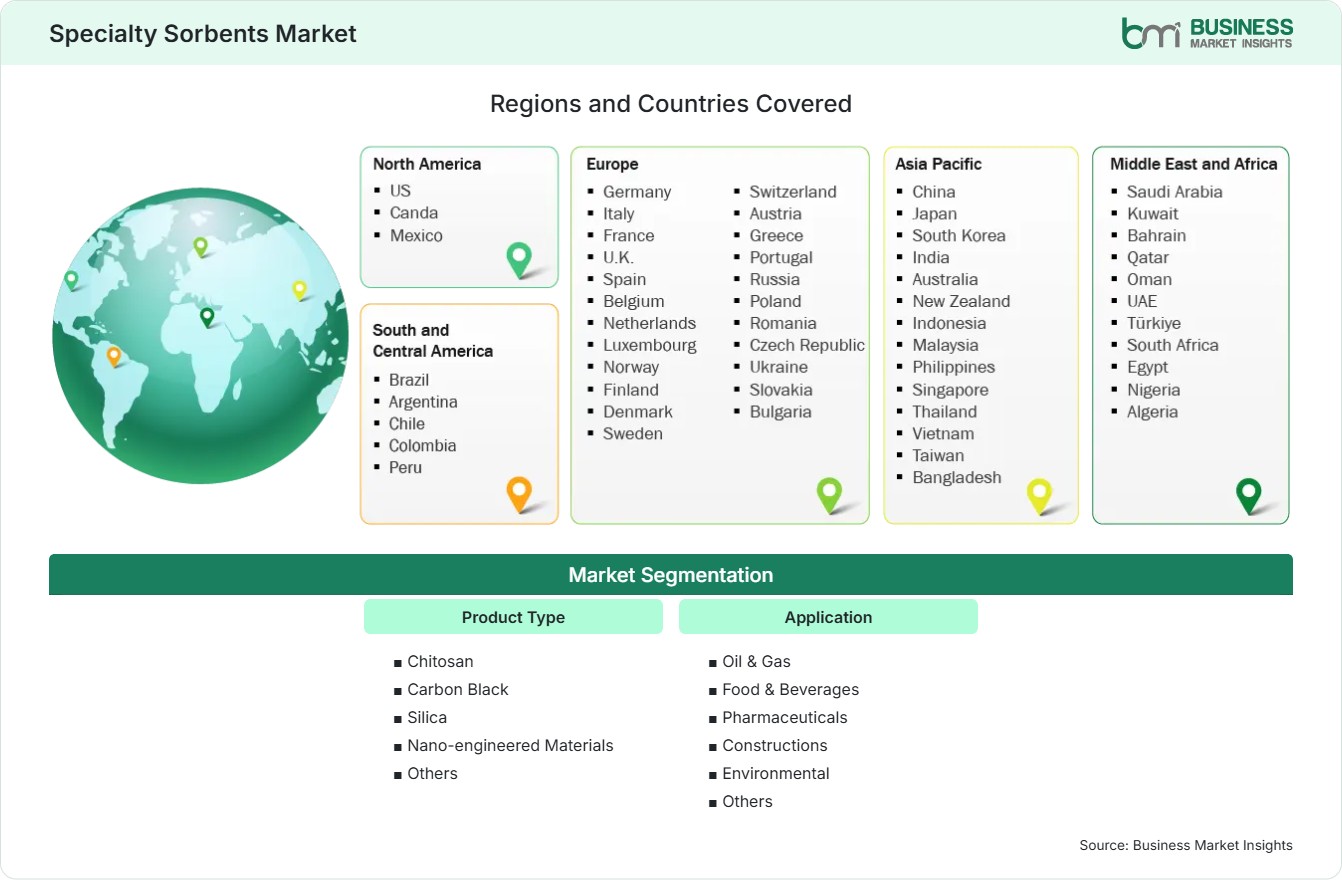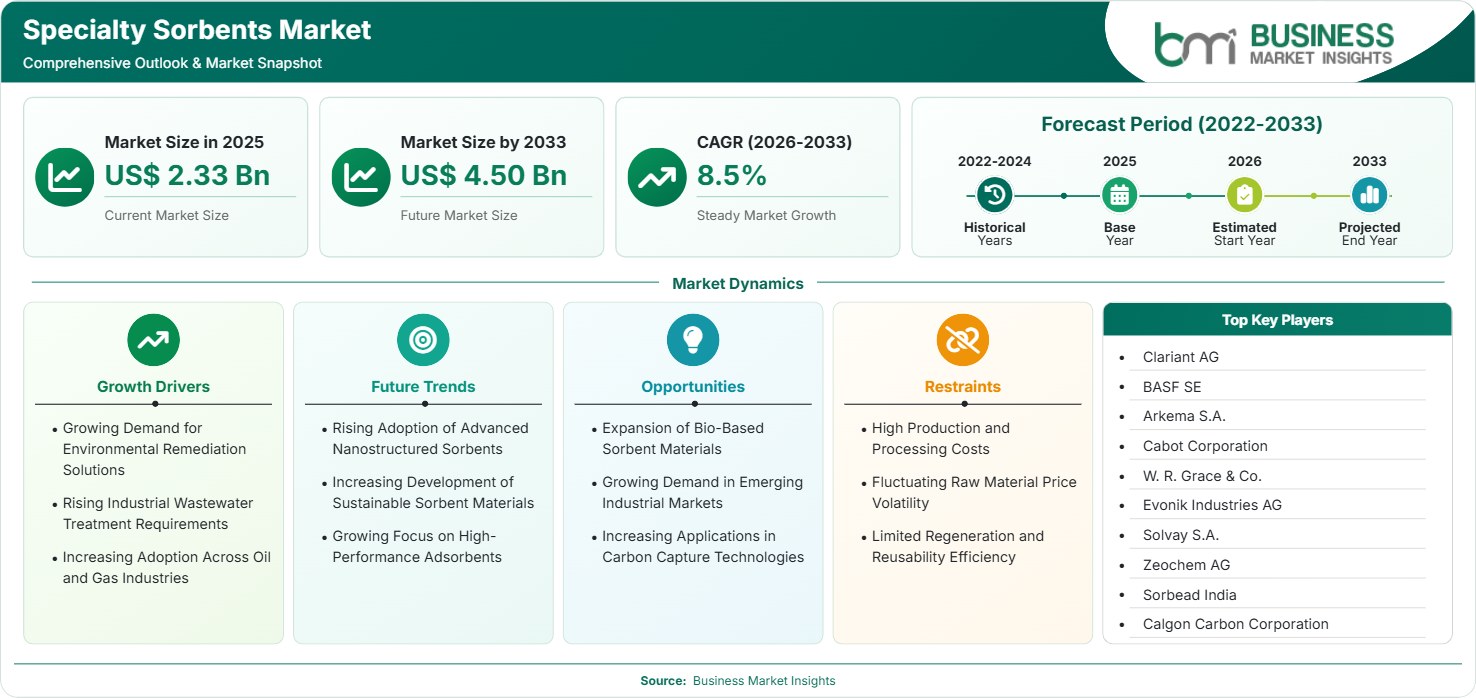
Specialty Sorbents Market Regional Highlights
North America Specialty Sorbents Market
North America accounted for 34%–36% of the Specialty Sorbents Market share in 2025 and is projected to grow at a CAGR of 8.1%–8.5% during 2026–2033. Stringent environmental regulations, advanced industrial infrastructure, and growing investments in water treatment and emissions control continue supporting regional market leadership.
- Industrial wastewater treatment facilities continue increasing demand for high-performance adsorption materials.
- Environmental remediation projects support wider deployment of specialty sorbents across contaminated industrial sites.
- Oil and gas companies increasingly utilize advanced sorbents for hydrocarbon purification and separation processes.
- Investments in carbon capture and industrial sustainability continue strengthening market demand.
US Specialty Sorbents Market
The United States represented 28%–30% of global market revenue in 2025 and is projected to register a CAGR of 8.0%–8.4% during the forecast period. Industrial pollution control initiatives, advanced manufacturing, and wastewater treatment modernization continue supporting robust demand.
- Chemical processing industries continue adopting customized adsorption materials for purification applications.
- Federal environmental regulations encourage increased investment in industrial treatment technologies.
- Pharmaceutical manufacturing supports growing demand for high-purity separation materials.
- Industrial sustainability initiatives continue accelerating adoption of advanced sorbent technologies.
Europe Specialty Sorbents Market
Europe accounted for 26%–28% of global revenue in 2025 and is projected to grow at a CAGR of 8.3%–8.7% during the forecast period. Strong sustainability policies, circular economy initiatives, and industrial decarbonization programs continue supporting regional demand. Germany leads the regional market, while Poland records strong growth.
- Germany remains the leading regional consumer through advanced manufacturing and environmental technologies.
- France and the Netherlands continue investing in industrial wastewater treatment infrastructure.
- Carbon capture projects create additional opportunities for high-performance adsorption materials.
- Sustainable chemical manufacturing encourages adoption of bio-based sorbent technologies.
Asia Pacific Specialty Sorbents Market
Asia Pacific accounted for 28%–30% of global revenue in 2025 and is projected to register the fastest CAGR of 9.4%–9.8% during 2026–2033. Industrial expansion, environmental regulation enforcement, and manufacturing growth continue driving regional adoption.
- China remains the largest regional market through expanding industrial production and environmental investments.
- India records the fastest regional growth supported by wastewater treatment infrastructure expansion.
- Japan continues investing in advanced materials and industrial purification technologies.
- Southeast Asia increasingly adopts sorbent technologies for environmental protection and industrial processing.
- Growing manufacturing output supports expanding demand across multiple industrial sectors.
Rest of World Specialty Sorbents Market
The Rest of the World accounted for 10%–12% of global market revenue in 2025 and is expected to grow at a CAGR of 8.6%–9.0% during the forecast period.
South & Central America continue investing in industrial water treatment, while the Middle East & Africa strengthen environmental compliance through expanding industrial infrastructure and resource management projects.
- Brazil leads regional adoption through mining, environmental remediation, and industrial processing applications.
- Mexico continues expanding wastewater treatment infrastructure supporting industrial sustainability.
- Saudi Arabia invests in advanced industrial water treatment technologies.
- South Africa increases environmental remediation projects supporting specialty sorbent demand.
- Resource-intensive industries continue adopting advanced adsorption materials to improve operational sustainability