
Insect Fertilizers Market Outlook: Size, Share, Trends, Growth Analysis, Competitive Landscape & Forecast, 2026-2033

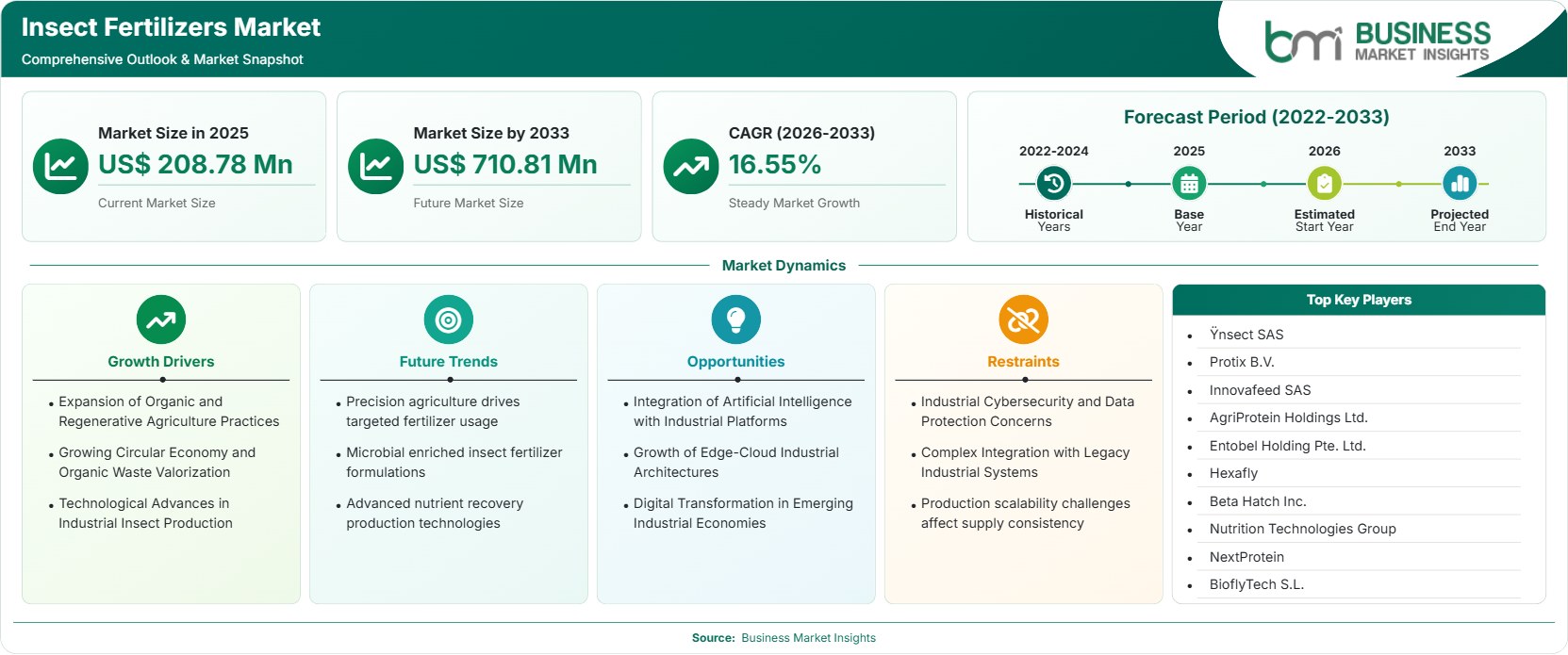
The Insect Fertilizers Market size was valued at US$ 208.78 Million in 2025 and is projected to reach US$ 710.81 Million by 2033, growing at a CAGR of 16.55% during 2026–2033. Increasing need for regenerative agriculture, circular bioeconomy activities, increased organic farming practices, and sustainable nutrient recycling practices have led to the rapid uptake of insect biomass, along with developments in technology and favorable environmental regulations.

Report Coverage
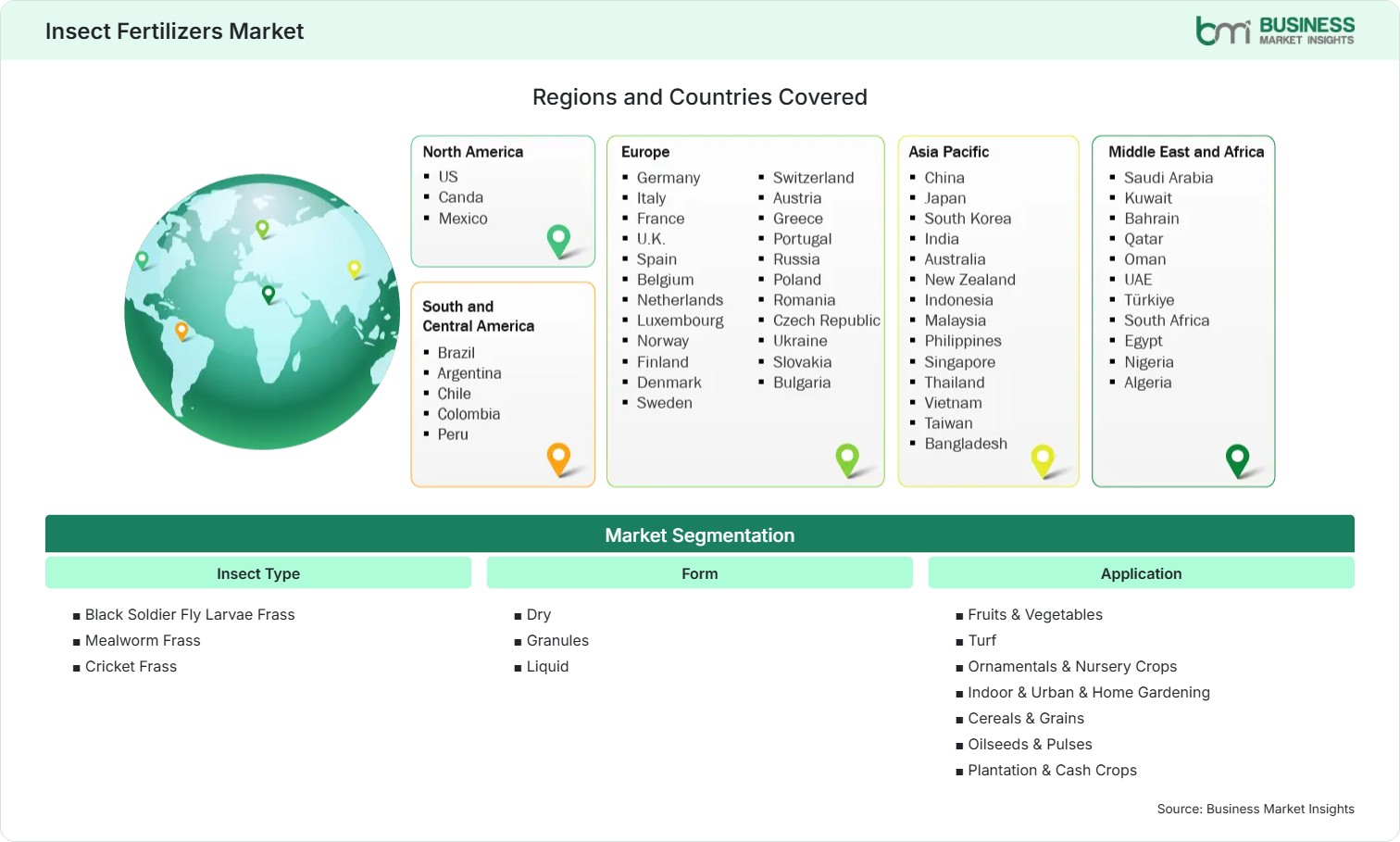
  • Insect Type: Black Soldier Fly Larvae Frass, Mealworm Frass, Cricket Frass
  • Form: Dry, Granules, Liquid
  • Application: Fruits & Vegetables, Turf, Ornamentals & Nursery Crops, Indoor & Urban & Home Gardening, Cereals & Grains, Oilseeds & Pulses, Plantation & Cash Crops
US$ 208.78 Mn Market size in 2025
US$ 710.81 Mn Market Size by 2033
16.55% CAGR, 2026 - 2033
2026-2033 Forecast Period

AI Overview

Insect Fertilizers Market Summary

  • North America Region: North America holds a 34%–37% share in 2025, growing at a 15.2%–15.9% CAGR during 2026–2033, supported by expanding organic cultivation, livestock waste valorization, regulatory encouragement for sustainable agriculture, commercial insect farming investments, precision nutrient management, and increasing demand for low-carbon crop inputs across professional farming systems. The U.S. benefits from expanding commercial insect farming infrastructure, favorable organic agriculture adoption, and investments supporting bio-based fertilizer innovation, registering a CAGR of 15.4%–16.0%.
  • Fastest Growing Region: Asia Pacific holds a 24%–27% share in 2025, advancing at a 17.8%–18.5% CAGR during 2026–2033, driven by rapid agricultural modernization, government sustainability initiatives, expanding insect production facilities, increasing soil health awareness, circular economy investments, and rising demand for environmentally responsible agricultural nutrient solutions.
  • Leading Segment: Black Soldier Fly Larvae Frass accounts for a 46%–49% share in 2025 while expanding at a 16.8%–17.4% CAGR through 2026–2033, supported by efficient organic waste conversion, high nutrient concentration, broad crop compatibility, scalable industrial production, improved soil microbial activity, and increasing commercial availability across agricultural markets.
  • High Growth Segment: Liquid formulations represent a 17%–20% insect fertilizers market share in 2025 and are projected to grow at a 18.2%–18.9% CAGR during 2026–2033, driven by compatibility with precision irrigation, rapid nutrient absorption, controlled application efficiency, greenhouse cultivation expansion, and increasing adoption in high-value horticultural production systems.
  • Key Market Opportunity: Growing integration of insect-derived fertilizers into regenerative farming programs, carbon farming initiatives, and circular agricultural supply chains enables premium organic nutrient solutions while strengthening soil biodiversity, resource efficiency, and sustainable food production globally.
  • Major Market Players: Ynsect SAS, Protix B.V., Innovafeed SAS, Darling Ingredients Inc., The Sentari Group Sdn. Bhd., Entomo Farms Inc., Bioflytech S.L., nextProtein SA, Hexafly Biotech Ltd., and Beta Hatch Inc.
Strategic Insights

Insect Fertilizers Market: Strategic Insights

Insect Fertilizers Market Strategic Framework
FREE PDF
Request your free sample
Request free sample
Stakeholder View

Key Takeaways

  • Supply chains are advancing fast towards fully integrated circular production systems in which agricultural residues, food waste, insect farming, nutrient recovery, and organic fertilizers production happen in an ecosystem that improves the efficiency of resources use while decreasing expenses for disposal and environmental pollution.
  • Applications of fruits and vegetables, protected cultivation, and urban farming provide the best options for business development as farmers increasingly value soil restoration, superior quality of crops, absence of residues in their growth, and environmentally friendly nutrient management rather than traditional reliance on synthetic fertilizers.
  • Constant innovations in the field of automation of insect breeding technologies, microbial technology, nutrient stabilization, and formulation help to improve product uniformity, scalability, regulatory compliance, and commercial success in diverse agricultural markets.
  • Asia Pacific region provides one of the most attractive investments due to sustainable development policies, growth of insect farming sector, rise of organic farming practices, increasing food scraps recycling activities and growing demand for sustainable productivity improvement in agriculture.
  • Partnership programs, venture capital investments, and business acquisitions target mainly expansion of the capacity of industrial production, integration of waste management and insect bioconversion process, as well as enhancement of proprietary processing technology.
Geographic Outlook

Insect Fertilizers Market Regional Highlights

North America Insect Fertilizers Market

North America accounted for 34%–37% of the global Insect Fertilizers Market share in 2025 and is projected to expand at a 15.2%–15.9% CAGR during 2026–2033. Regional leadership is supported by strong organic farming adoption, commercial insect farming investments, favorable sustainability policies, and increasing utilization of circular agricultural inputs. Growing emphasis on soil carbon restoration, nutrient-use efficiency, and reducing dependence on synthetic fertilizers continues encouraging manufacturers and agricultural producers to integrate insect-derived fertilizers into commercial crop production and regenerative farming practices.

  • The United States remains the regional revenue leader owing to expanding commercial insect farming capacity, increasing investments in biological crop nutrition, and supportive sustainability initiatives encouraging environmentally responsible nutrient management across large-scale farming operations.
  • Canada continues strengthening regional production through government-backed bioeconomy programs, agricultural waste recycling initiatives, and expanding organic farming acreage, creating favorable conditions for industrial insect farming and commercial fertilizer manufacturing.
  • Precision agriculture technologies are increasingly combined with biological nutrient products, allowing growers to improve fertilizer application efficiency while enhancing soil microbial diversity and reducing nutrient losses through optimized farm management systems.
  • Strategic partnerships between waste management companies, agricultural cooperatives, and insect producers continue improving feedstock availability, lowering production costs, and strengthening integrated circular economy business models throughout the regional agricultural ecosystem.

US Insect Fertilizers Market

The United States represents approximately 73%–76% of North American revenue in 2025 and is expected to register a 15.4%–16.0% CAGR through 2026–2033. Commercial investment continues accelerating as insect farming companies expand production facilities serving horticulture, specialty crops, regenerative agriculture, and greenhouse cultivation. Federal sustainability programs, increasing venture capital funding, and growing adoption of biological crop inputs continue strengthening long-term commercialization opportunities throughout the domestic agricultural value chain.

  • Commercial insect production facilities continue expanding near major food processing clusters, enabling efficient utilization of organic by-products while supporting localized fertilizer manufacturing and reducing transportation-related emissions throughout integrated supply chains.
  • Universities and agricultural research institutions increasingly validate improvements in soil microbial activity, nutrient retention, and crop productivity associated with insect-derived fertilizers, strengthening confidence among commercial growers considering biological nutrient alternatives.
  • Greenhouse vegetable producers increasingly incorporate insect-based fertilizers into precision irrigation programs to improve nutrient uptake efficiency, enhance root development, and support higher-value crop production under controlled environmental conditions.
  • Strong venture capital participation and corporate sustainability commitments continue supporting innovation in automated insect breeding technologies, scalable production systems, and advanced nutrient processing capabilities that improve commercial competitiveness.

Europe Insect Fertilizers Market

Europe captures 29%–32% insect fertilizers market share of global market revenue in 2025 and is forecast to expand at a 16.3%–16.9% CAGR during 2026–2033. The region is also characterized by advanced legislation in the circular economy model, climate goals, and significant investment in sustainable agriculture. Legislation promoting the use of organic fertilizers, recycling of food waste, and efficient resource usage has resulted in commercialization of insect-based fertilizers while spurring constant technological advancements.

  • France leads regional production through well-established commercial insect farming companies, advanced bioconversion technologies, and significant public and private investment supporting sustainable agricultural innovation, expanding at approximately 16.6%–17.2% CAGR.
  • Germany continues strengthening demand through increasing organic farming acreage, strong environmental regulations, and growing adoption of biological soil improvement products across commercial horticulture and specialty crop production.
  • The Netherlands remains a technology hub for industrial insect farming, supporting highly automated production systems, advanced breeding technologies, and export-oriented fertilizer manufacturing serving multiple European agricultural markets.
  • European Union sustainability policies encouraging nutrient recycling, biodiversity conservation, and greenhouse gas reduction continue creating favorable regulatory conditions supporting long-term industry expansion and commercialization.

Asia Pacific Insect Fertilizers Market

Asia Pacific accounted for 24%–27% insect fertilizers market share of global revenue during 2025 and is projected to record the fastest regional expansion at a 17.8%–18.5% CAGR between 2026 and 2033. Rapid agricultural modernization, increasing government support for circular bioeconomy initiatives, expanding organic farming, and rising investment in industrial insect production continue strengthening regional competitiveness. Growing awareness regarding sustainable soil fertility and agricultural waste management further accelerates commercial adoption across both developed and emerging agricultural economies.

  • China remains the largest regional market owing to substantial investments in circular agriculture, expanding insect farming infrastructure, and increasing government emphasis on reducing chemical fertilizer dependence across commercial farming operations.
  • India demonstrates the highest regional growth, supported by expanding organic agriculture, startup investment in insect biotechnology, increasing awareness of soil regeneration, and projected growth of approximately 18.6%–19.2% CAGR.
  • Japan and South Korea continue investing in advanced automation technologies, controlled insect breeding systems, and resource-efficient agricultural production supporting premium horticultural and greenhouse cultivation markets.
  • Southeast Asian countries increasingly integrate food waste recycling with insect farming to improve resource utilization, generate sustainable agricultural inputs, and strengthen domestic circular economy development initiatives.
  • Rising export demand for sustainably produced agricultural products encourages growers to adopt biological fertilizers that improve environmental performance while supporting international sustainability certification requirements.

Rest of World Insect Fertilizers Market

The Rest of World region contributes 8%–11% of global revenue in 2025 and is anticipated to expand at a 16.7%–17.3% CAGR during the forecast period. South and Central America continue benefiting from expanding commercial agriculture, while the Middle East and Africa increasingly invest in sustainable farming technologies addressing soil degradation and water scarcity.

Growing governmental support for climate-resilient agriculture, organic production, and resource-efficient nutrient management encourages broader adoption of insect-derived fertilizers. International development initiatives, technology transfer programs, and private investments continue strengthening production capabilities while supporting long-term agricultural sustainability across emerging economies.

  • Brazil leads regional demand through expanding commercial soybean, coffee, and horticultural production, increasing adoption of biological inputs, and greater emphasis on sustainable nutrient management practices across large agricultural enterprises.
  • Mexico continues experiencing robust commercialization as growers increasingly adopt environmentally responsible fertilizers supporting export-oriented fruit and vegetable production while improving long-term soil productivity and environmental compliance.
  • South Africa represents the leading African market, benefiting from increasing investment in sustainable agriculture, biological crop nutrition, and circular resource management supporting agricultural productivity improvements.
Global Market Geography
FREE PDF
Request your free sample
Request free sample
Segment Analysis

Insect Fertilizers Market Segmentation

Insect Type

The insect type segment accounted for the largest proportion of industry revenue, with Black Soldier Fly Larvae Frass leading adoption due to superior nutrient composition and efficient organic waste conversion. The segment represented approximately 46%–49% of total revenue in 2025 and is projected to expand at a 16.8%–17.4% CAGR through 2033. The Insect Fertilizers Market scope continues broadening as diversified insect species address varying agronomic requirements and soil restoration objectives.

  • Black Soldier Fly Larvae Frass: Widely adopted because of balanced nitrogen, phosphorus, potassium, and beneficial microbial content, making it suitable for horticulture, cereals, vegetables, and regenerative farming systems seeking sustainable soil improvement.
  • Mealworm Frass: Increasingly utilized in greenhouse cultivation and organic farming owing to high organic matter content, enhanced microbial stimulation, and compatibility with premium fruit and vegetable production requiring consistent nutrient availability.
  • Cricket Frass: Gains commercial acceptance through favorable chitin concentration that promotes soil microbial diversity and plant resilience, particularly across specialty crops, ornamental cultivation, and high-value agricultural production systems.

Form

The dry form segment maintained the largest revenue contribution, accounting for approximately 51%–54% of market revenue in 2025 while advancing at a 16.2%–16.8% CAGR through 2033. Strong adoption reflects easier storage, lower transportation costs, extended shelf life, and compatibility with conventional fertilizer application equipment. Granules and liquid formulations continue gaining popularity as precision agriculture and controlled-environment cultivation expand worldwide.

  • Dry: Preferred by commercial growers because of long storage stability, economical transportation, simple application methods, and compatibility with broad-acre agriculture, making it the dominant commercial formulation across multiple farming systems.
  • Granules: Experiencing rising demand as controlled nutrient release, reduced handling losses, and compatibility with mechanized fertilizer spreaders improve operational efficiency across plantation crops and commercial field agriculture.
  • Liquid: Adoption continues accelerating through fertigation systems, greenhouse cultivation, hydroponic operations, and precision irrigation where rapid nutrient absorption and application flexibility support premium crop productivity.

Application

Application diversity continues expanding as biological nutrient management becomes increasingly integrated across commercial agriculture. Fruits & Vegetables represented approximately 31%–34% of industry revenue in 2025 and is projected to register a 17.1%–17.8% CAGR through 2033, supported by premium crop cultivation, soil health initiatives, and increasing organic farming investments. Adoption continues expanding into broad-acre crops, landscaping, and controlled-environment agriculture.

  • Fruits & Vegetables: Represents the largest application owing to intensive nutrient requirements, increasing organic cultivation, improved soil biological activity, and growing consumer demand for sustainably produced fresh agricultural products.
  • Turf: Utilized across sports facilities, golf courses, and landscaping projects where gradual nutrient release, improved root development, and environmentally responsible maintenance practices support long-term vegetation health.
  • Ornamentals & Nursery Crops: Growing adoption reflects increasing preference for premium biological inputs that enhance plant vigor, root establishment, and flowering performance while minimizing environmental impacts in commercial nurseries.
  • Indoor, Urban & Home Gardening: Expanding consumer awareness regarding sustainable gardening encourages household adoption of odor-controlled, organic nutrient products suitable for container gardening, balconies, rooftop cultivation, and indoor plant production.
  • Cereals & Grains: Commercial producers increasingly evaluate insect-derived fertilizers to improve soil fertility, organic matter retention, and nutrient-use efficiency while supporting sustainable cereal production under regenerative farming practices.
  • Oilseeds & Pulses: Adoption increases as growers seek biologically derived nutrient sources capable of improving soil structure, supporting nitrogen efficiency, and enhancing long-term productivity across rotational farming systems.
  • Plantation & Cash Crops: Coffee, cocoa, tea, sugarcane, and other plantation producers increasingly integrate insect-derived fertilizers into soil management programs to improve crop quality, maintain soil biodiversity, and strengthen sustainable certification initiatives.
Market Forces

Insect Fertilizers Market Dynamics

Key Market Drivers

Expansion of Organic and Regenerative Agriculture Practices

The expansion of organic and regenerative agriculture is a major growth driver for the Market. According to the FAO, organic farmland is increasing as governments and growers prioritize sustainable farming and soil health. Insect-derived fertilizers improve soil microbial activity, nutrient cycling, and organic matter while reducing reliance on synthetic fertilizers. Rising demand for residue-free food and stricter environmental regulations are encouraging adoption of sustainable biological fertilizers, supporting Insect Fertilizers Market growth.

Growing Circular Economy and Organic Waste Valorization

Circular economy initiatives are boosting the use of insect-derived fertilizers by converting food waste and agricultural residues into valuable biological inputs. Insect farming for commercial purposes minimizes waste management and generates nutrient-enriched frass for agricultural use. Favorable policies in Europe, North America, and Asia encourage recycling of resources and waste valorization for efficient production and logistics.

Technological Advances in Industrial Insect Production

Improvements in automation, artificial intelligence, robotics, and controlled breeding are enhancing the efficiency of commercial insect farming. The process of automation, monitoring through sensors, and effective breeding improve efficiency and fertilizer production while reducing the cost. Innovation in the area of breeding, harvesting, and processing allows producers to develop standard biological fertilizers.

Key Market Opportunities

Expansion into Carbon Farming and Sustainable Agriculture Programs

Carbon Farming and Regenerative Agriculture have emerged as some of the key trends in the Insect Fertilizers Market, owing to the rising focus on sustainable agriculture. Insect fertilizers help in increasing soil organic carbon content, increase the biological diversity of soils and promote long-term soil health by reducing emissions of greenhouse gases from conventional fertilizers.

Increasing Adoption in Precision Agriculture and Protected Cultivation

Insect-based fertilizers are being used due to the increasing practice of precision agriculture, greenhouse agriculture, and controlled environment farming. The liquid and granular forms of insect-based fertilizers provide easy nutrient application through fertigation techniques. Investment in vegetables grown under greenhouses, vertical farming, and specialized crops will create an increasing demand for insect-based fertilizers.

Commercial Growth Across Emerging Agricultural Economies

Emerging economies across Asia Pacific, Latin America, the Middle East, and Africa present significant growth opportunities, positively shaping the Insect Fertilizers Market forecast. Industrial farming of insects is gaining momentum due to modernizing agriculture, developing more sustainable agriculture practices, and greater government involvement in organic agriculture, circular economy, and waste recycling. Growing investments in the establishment of production facilities locally, technology transfer, research and development, and distribution networks are likely to help drive market growth.

Market Restraints and Challenges

Regulatory Variability and Product Standardization

Factor: Regulations for insect-derived fertilizers vary across countries in approval processes, labeling, quality standards, and permitted feedstocks, increasing compliance complexity.

Impact: Regulatory differences raise compliance costs, delay commercialization, and create uncertainty regarding product quality and market acceptance, particularly for smaller manufacturers.

Production Scalability and Feedstock Availability

Factor: Industrial insect fertilizer production depends on consistent feedstock availability, efficient processing, and scalable farming infrastructure, while seasonal and supply chain variations affect production.

Impact: Feedstock constraints and scalability challenges increase production costs, limit manufacturing capacity, and slow market expansion despite growing demand.

Company Analysis

Competitive Landscape

The competitive environment is characterized by investments in industrial insect farming, automation, waste valorization technologies, and biological fertilizer innovation. The Insect Fertilizers Market analysis indicates that companies are focusing on scaling Black Soldier Fly and mealworm production, improving nutrient consistency, expanding international distribution networks, and developing circular economy partnerships that integrate organic waste recycling with sustainable agricultural inputs.

Company Name

Overview

Products and Services Relevant to this Market

Ynsect SAS

French biotechnology company specializing in industrial insect farming, with expertise in mealworm cultivation and biological agricultural solutions.

Insect-derived fertilizers, mealworm frass, soil health solutions, biological crop inputs, sustainable insect production technologies.

Protix B.V.

Netherlands-based insect ingredient producer operating large-scale Black Soldier Fly production with strong emphasis on circular agriculture.

Black Soldier Fly frass fertilizers, organic soil amendments, insect-based agricultural inputs, nutrient recycling solutions.

Innovafeed SAS

Global insect biotechnology company utilizing industrial-scale insect production for sustainable agriculture and resource recovery.

Insect frass fertilizers, organic nutrient products, biological soil enhancement solutions, sustainable insect farming technologies.

Darling Ingredients Inc.

International sustainability company converting organic residuals into value-added ingredients supporting circular economy initiatives.

Organic nutrient recycling solutions, sustainable agricultural products, bio-based soil amendments, resource recovery services.

The Sentari Group Sdn. Bhd.

Malaysian biotechnology company focused on Black Soldier Fly production and circular agricultural solutions across Southeast Asia.

Black Soldier Fly frass, organic fertilizers, agricultural waste conversion services, sustainable farming inputs.

Entomo Farms Inc.

Canadian insect farming company emphasizing sustainable insect production and agricultural innovation.

Organic insect frass fertilizers, soil conditioning products, sustainable agricultural nutrient solutions.

Bioflytech S.L.

Spain-based biotechnology company specializing in Black Soldier Fly production for agricultural and industrial applications.

Biological fertilizers, insect frass products, circular waste management solutions, sustainable nutrient products.

nextProtein SA

French biotechnology company developing industrial Black Soldier Fly bioconversion technologies for sustainable agriculture.

nextGrow insect fertilizer, organic nutrient products, waste valorization technologies, biological crop nutrition.

Hexafly Biotech Ltd.

Irish insect biotechnology company developing sustainable insect ingredients through advanced production technologies.

Insect-derived agricultural inputs, frass fertilizers, biological soil enhancement products, insect farming technologies.

Beta Hatch Inc.

U.S.-based biotechnology company specializing in mealworm genetics and scalable insect production systems.

Mealworm frass fertilizers, sustainable agricultural inputs, insect breeding technologies, biological nutrient products.

Trust & Transparency

Research Methodology

The market analysis combines proprietary research with secondary data from government agencies, company disclosures, regulatory filings, industry databases and expert interviews. Market estimates are validated through data triangulation, cross-market benchmarking and analyst review.

View Full Research Methodology

Questions Answered

Frequently Asked Questions

What are the biggest commercialization challenges for manufacturers?

Major challenges include regulatory differences across countries, maintaining consistent feedstock quality, scaling industrial insect production economically, achieving product standardization, and increasing farmer awareness regarding biological fertilizer performance.

What information does an Insect Fertilizers Market Report typically include?

A comprehensive Market Report generally covers market sizing, competitive benchmarking, technology developments, regional analysis, segmentation, regulatory trends, investment outlook, company profiles, and long-term industry forecasts supporting strategic business decisions.

How does insect farming contribute to agricultural sustainability?

Industrial insect farming converts food and agricultural residues into valuable fertilizer products, reducing organic waste disposal, lowering environmental impact, supporting circular economy objectives, and improving resource efficiency across agricultural value chains.

Which agricultural crops are expected to generate the highest demand?

High-value fruits and vegetables are projected to remain the largest application, followed by cereals, plantation crops, ornamentals, and greenhouse cultivation where growers increasingly prioritize biological soil health and premium crop quality.

What makes insect-derived fertilizers different from conventional organic fertilizers?

Insect-derived fertilizers contain frass enriched with organic nutrients, beneficial microorganisms, and chitin that can improve soil biological activity, nutrient availability, and long-term soil structure while supporting sustainable nutrient recycling.

Access the Full Insect Fertilizers Market Report

Get segment-level forecasts, regional estimates, competitive benchmarking, company profiles and downloadable Excel datasets.

Access the full Insect Fertilizers Market Report
350 pages PDF & Excel | 2026-08-18
Similar Research

Related Market Reports