
Fertilizer Mixtures Market Outlook: Size, Share, Trends, Growth Analysis, Competitive Landscape & Forecast, 2026–2033

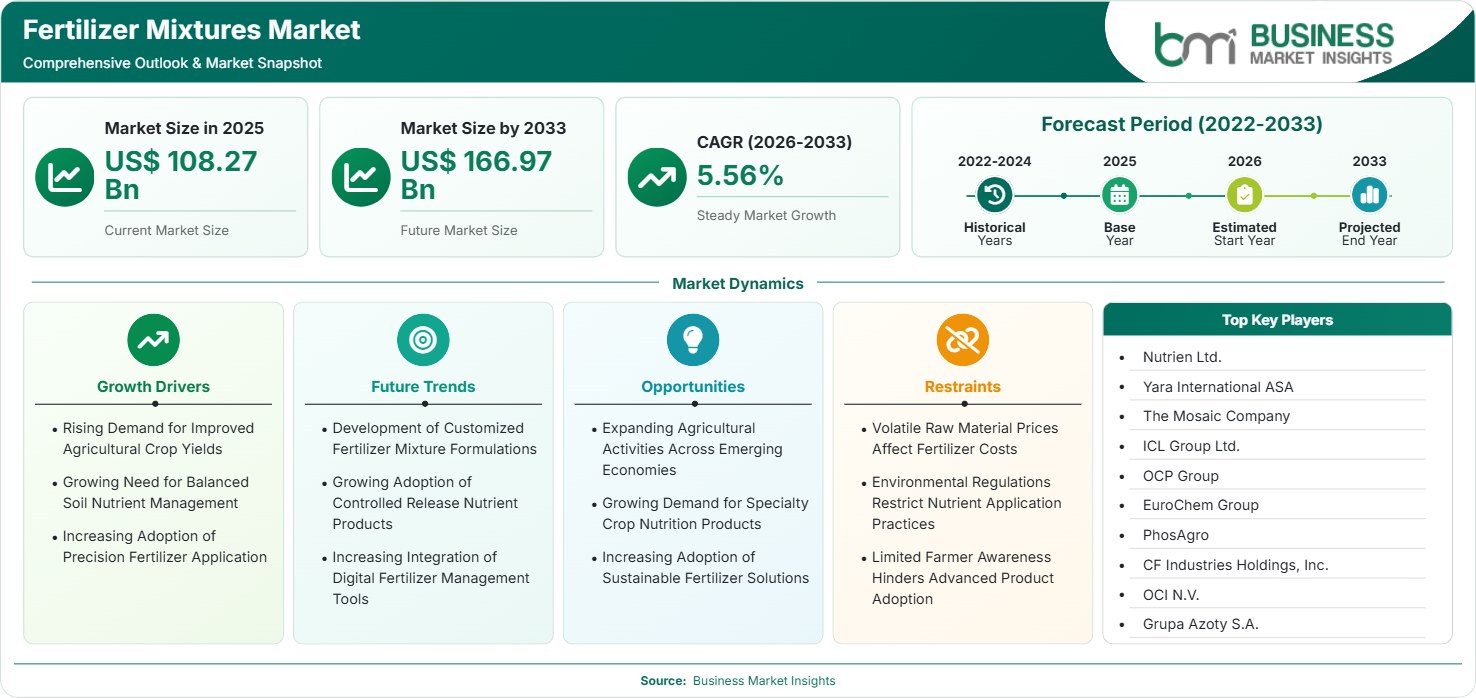
The Fertilizer Mixtures Market size was valued at US$ 108.27 Billion in 2025 and is projected to reach US$ 166.97 Billion by 2033, growing at a CAGR of 5.56% during 2026–2033, supported by precision nutrient management, rising crop productivity requirements, customized formulations, expanding agricultural modernization, and opportunities in specialty crop nutrition and efficient application technologies.

Report Coverage
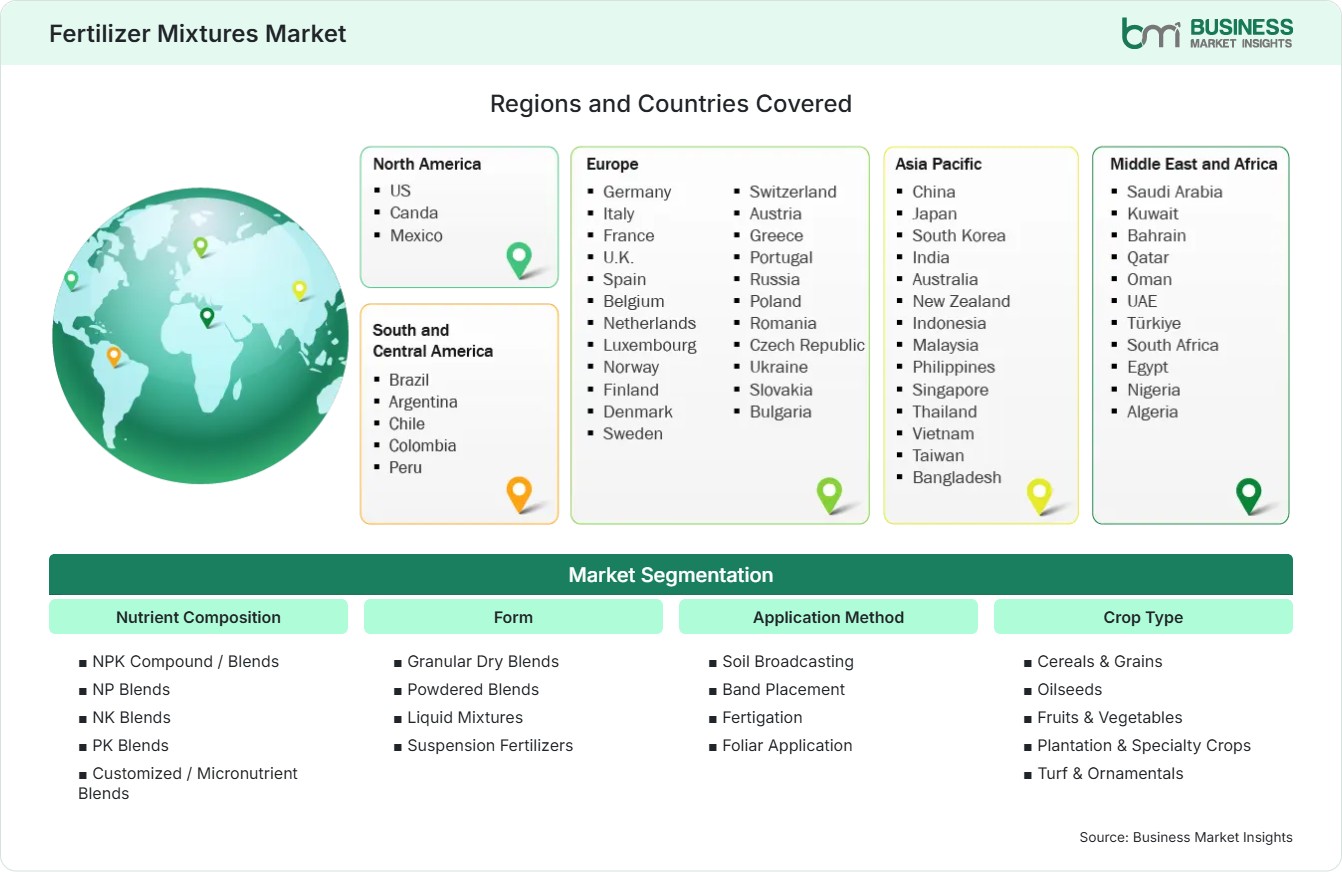
  • Nutrient Composition: NPK Compound / Blends, NP Blends, NK Blends, PK Blends, Customized / Micronutrient Blends
  • Form: Granular Dry Blends, Powdered Blends, Liquid Mixtures, Suspension Fertilizers
  • Application Method: Soil Broadcasting, Band Placement, Fertigation, Foliar Application
  • Crop Type: Cereals & Grains, Oilseeds, Fruits & Vegetables, Plantation & Specialty Crops, Turf & Ornamentals
US$ 108.27 Bn Market size in 2025
US$ 166.97 Bn Market Size by 2033
5.56% CAGR, 2026 - 2033
2026-2033 Forecast Period

AI Overview

Fertilizer Mixtures Market Summary

  • North America Region: North America holds an estimated 28%–31% share in 2025 and is projected to grow at a 4.8%–5.3% CAGR during 2026–2033. Demand is supported by precision agriculture, large-scale farming, soil nutrient management, customized formulations, advanced blending infrastructure, and opportunities in data-driven application, specialty nutrition, and sustainable crop productivity. The US market is projected to grow at a 4.9%–5.4% CAGR.
  • Fastest Growing Region: Asia Pacific holds an estimated 30%–33% share in 2025 and is projected to expand at a 6.2%–6.9% CAGR through 2033. Agricultural modernization, improving nutrient awareness, specialty crop expansion, government support, and increasing adoption of balanced fertilization create opportunities for localized blending, efficient distribution, and precision nutrient management solutions.
  • Leading Segment: NPK Compound / Blends hold an estimated 39%–43% share in 2025 and are projected to grow at a 5.7%–6.2% CAGR, supported by their balanced nutrient profile, broad crop applicability, simplified application, and continued demand for formulations tailored to varying soil and crop requirements.
  • High Growth Segment: Fertigation holds an estimated 17%–21% share in 2025 and is projected to advance at a 6.5%–7.2% CAGR, driven by expanding irrigation infrastructure, precision farming practices, water-efficiency requirements, high-value crop cultivation, and demand for controlled nutrient delivery directly to crop root zones.
  • Key Market Opportunity: Customized nutrient blends, micronutrient-enriched formulations, precision application systems, and fertigation-compatible products provide opportunities to improve nutrient-use efficiency, address soil variability, and support higher-value agricultural production across emerging farming regions.
  • Major Market Players: Nutrien Ltd., Yara International ASA, The Mosaic Company, ICL Group Ltd., OCP Group, EuroChem Group, PhosAgro, CF Industries Holdings, Inc., OCI N.V., and Grupa Azoty S.A.
Strategic Insights

Fertilizer Mixtures Market: Strategic Insights

Fertilizer Mixtures Market Strategic Framework
FREE PDF
Request your free sample
Request free sample
Stakeholder View

Key Takeaways

  • Agricultural value chains are moving toward localized nutrient solutions, creating opportunities for manufacturers, distributors, agronomists, and technology providers to collaborate around crop-specific formulation and application requirements.
  • High-value fruits, vegetables, plantation crops, and specialized farming systems offer strong upside because growers increasingly require targeted nutrient programs rather than uniform fertilizer application across entire fields.
  • Innovation is shifting from standard nutrient combinations toward customized blends, micronutrient incorporation, enhanced compatibility with precision equipment, and formulations designed for more controlled nutrient delivery.
  • Asia Pacific provides a compelling investment case due to agricultural modernization, expanding irrigation systems, growing commercial farming activity, and increasing awareness of balanced crop nutrition.
  • Investment and consolidation are likely to focus on strengthening raw material access, blending capacity, regional distribution networks, agronomic advisory capabilities, and technologies supporting differentiated fertilizer formulations.
  • Competitive advantage will increasingly depend on formulation flexibility, reliable sourcing, efficient logistics, agronomic expertise, and the ability to align nutrient products with specific crops, soils, and application systems.
Geographic Outlook

Fertilizer Mixtures Market Regional Highlights

North America Fertilizer Mixtures Market

North America accounted for 28%–31% share in 2025 and is projected to expand at a 4.8%–5.3% CAGR through 2033. Large commercial farms, precision agriculture, and advanced distribution infrastructure support regional demand. Market share remains influenced by growers seeking crop-specific nutrient programs and improved application efficiency.

  • Precision agriculture supports more targeted nutrient planning by allowing growers to adjust formulations and application practices according to field conditions, crop requirements, and changing productivity objectives.
  • Large-scale farming operations continue to favor efficient dry and liquid formulations that can be integrated with mechanized equipment and established agricultural distribution systems.
  • Agronomic advisory services are becoming increasingly important because growers require guidance on nutrient balance, soil conditions, application timing, and crop-specific fertilizer selection.
  • Specialty agriculture provides opportunities for micronutrient-enriched products and customized blends designed to address localized soil deficiencies and higher-value crop production requirements.

US Fertilizer Mixtures Market

The US represents approximately 22%–25% of global share in 2025 and is expected to grow at a 4.9%–5.4% CAGR through 2033. Demand is supported by large commercial farms and widespread adoption of mechanized nutrient application. Producers are increasingly focused on formulation flexibility and efficient distribution.

  • Precision farming practices encourage growers to use nutrient formulations that better match localized soil requirements and reduce unnecessary application across variable field conditions.
  • Broadacre crops continue to support substantial demand for blended products that combine major nutrients and simplify large-scale agricultural application programs.
  • Distribution efficiency remains strategically important because seasonal demand requires reliable inventory management, regional storage, blending capacity, and timely delivery to farming operations.
  • Specialty crop producers create additional opportunities for customized formulations designed around nutrient intensity, irrigation practices, crop quality objectives, and specific soil conditions.

Europe Fertilizer Mixtures Market

Europe held an estimated 21%–24% share in 2025 and is projected to grow at a 4.6%–5.1% CAGR through 2033. Germany and France remain leading agricultural markets, while Eastern Europe provides additional expansion potential. Fertilizer Mixtures Market growth is influenced by nutrient efficiency objectives, environmental considerations, and increasing interest in precision application.

  • Germany remains an important market because advanced farming practices support demand for precise nutrient planning, customized formulations, and efficient fertilizer application technologies.
  • France provides opportunities across cereals, oilseeds, vineyards, and specialty agriculture, supporting demand for nutrient programs adapted to diverse cropping systems.
  • Poland and other Eastern European markets offer stronger expansion potential as agricultural modernization and investment improve access to advanced inputs and blending services.
  • Environmental and nutrient management requirements are encouraging greater interest in formulations that improve application accuracy and support more efficient use of major and secondary nutrients.

Asia Pacific Fertilizer Mixtures Market

Asia Pacific accounted for 30%–33% share in 2025 and is expected to expand at a 6.2%–6.9% CAGR through 2033. China and India represent major demand centers, while Southeast Asia offers strong growth potential. Fertilizer Mixtures Market growth is supported by agricultural modernization, increasing commercial crop production, and wider awareness of balanced nutrition.

  • China supports demand through large agricultural production systems, modernization initiatives, and increasing interest in improving nutrient management across diverse crop categories.
  • India offers substantial opportunities for customized formulations as growers adopt improved farming practices and seek products better suited to local soil and crop conditions.

Rest of World Fertilizer Mixtures Market

Rest of World represented approximately 14%–17% share in 2025 and is projected to advance at a 5.4%–6.0% CAGR through 2033. The Middle East and Africa are supported by irrigation development and agricultural modernization. Fertilizer Mixtures Market share is expanding where governments and private investors are strengthening farm productivity, irrigation access, and agricultural input distribution.

  • Brazil remains a major opportunity due to extensive production of cereals, oilseeds, sugar crops, and other commercial agricultural commodities requiring structured nutrient programs.
  • Argentina and neighboring agricultural economies support demand for products that can improve productivity across large cultivated areas and diverse soil conditions.
  • Middle Eastern markets are creating opportunities through controlled-environment agriculture, irrigation investment, and production systems requiring efficient nutrient application.
Global Market Geography
FREE PDF
Request your free sample
Request free sample
Segment Analysis

Fertilizer Mixtures Market Segmentation

Nutrient Composition

Nutrient Composition is led by NPK Compound / Blends, accounting for an estimated 39%–43% share in 2025 and projected to grow at a 5.7%–6.2% CAGR through 2033. Fertilizer Mixtures Market scope increasingly includes customized products addressing soil deficiencies, crop-specific nutrient requirements, and demand for more precise agricultural input strategies.

  • NPK Compound / Blends: These formulations remain widely adopted because they combine major nutrients in practical ratios, supporting balanced crop nutrition and simplifying application across diverse agricultural production systems.
  • NP Blends: NP blends support crops and soils requiring focused nitrogen and phosphorus management, particularly where potassium availability is adequate or addressed through separate nutrient programs.
  • NK Blends: NK blends serve agricultural systems where nitrogen and potassium requirements are prioritized, supporting crop development, nutrient balance, and flexible formulation strategies for specific growing conditions.
  • PK Blends: PK blends are used where phosphorus and potassium supplementation is required, supporting root development, crop quality, and nutrient management without additional nitrogen application.
  • Customized / Micronutrient Blends: Customized and micronutrient blends are gaining importance as growers address localized deficiencies and seek formulations tailored to specific crops, soils, productivity targets, and application methods.

Form

Granular Dry Blends account for an estimated 46%–50% share in 2025 and are expected to grow at a 5.1%–5.7% CAGR through 2033. Their storage convenience and compatibility with mechanized application support widespread use.

  • Granular Dry Blends: Granular products remain popular because they are practical to store, transport, blend, and apply using established farm equipment across broad agricultural areas.
  • Powdered Blends: Powdered formulations support applications requiring rapid preparation, blending flexibility, and compatibility with agricultural systems where dry nutrient handling remains operationally suitable.
  • Liquid Mixtures: Liquid mixtures are gaining adoption through precision application and irrigation-based nutrient delivery, offering flexibility for controlled dosing and integration with modern farming systems.
  • Suspension Fertilizers: Suspension fertilizers provide concentrated nutrient delivery options and support specialized application programs requiring formulation stability, controlled handling, and compatibility with selected agricultural equipment.

Application Method

Soil Broadcasting remains the leading application method, accounting for an estimated 41%–45% share in 2025 and projected to grow at a 4.9%–5.5% CAGR through 2033. Fertigation represents the high-growth approach, advancing at 6.5%–7.2% CAGR, as irrigation systems support controlled nutrient delivery. Fertilizer Mixtures Market trends increasingly favor application methods that improve nutrient placement and operational efficiency.

  • Soil Broadcasting: Broadcasting remains widely used because it enables efficient fertilizer distribution across large areas and integrates effectively with established mechanized farming practices.
  • Band Placement: Band placement supports more targeted nutrient delivery by positioning fertilizer closer to crop root zones, potentially improving nutrient availability and application efficiency.
  • Fertigation: Fertigation is gaining traction as irrigation systems enable controlled nutrient application, particularly across high-value crops, protected cultivation, and water-managed agricultural environments.
  • Foliar Application: Foliar application supports targeted nutrient supplementation during crop growth, particularly where rapid correction of specific nutrient deficiencies is required.

Crop Type

Cereals & Grains represent the leading crop category, accounting for an estimated 44%–48% share in 2025 and growing at a 5.2%–5.8% CAGR through 2033. Large cultivation areas support consistent nutrient requirements.

  • Cereals & Grains: Large cultivated areas and recurring nutrient requirements sustain demand for balanced formulations that support yield development and efficient mechanized application.
  • Oilseeds: Oilseed cultivation supports demand for crop-specific nutrient programs designed around soil conditions, nutrient uptake patterns, and commercial productivity requirements.
  • Fruits & Vegetables: High-value horticultural production encourages specialized nutrient formulations and controlled application practices supporting crop quality, growth consistency, and intensive cultivation systems.
  • Plantation & Specialty Crops: Plantation and specialty crops require differentiated nutrient management, creating opportunities for customized blends aligned with long production cycles and localized soil conditions.
  • Turf & Ornamentals: Turf and ornamental applications support demand for specialized formulations designed to maintain plant appearance, growth quality, nutrient balance, and controlled application performance.
Market Forces

Fertilizer Mixtures Market Dynamics

Key Market Drivers

Rising Demand for Balanced Crop Nutrition

The agricultural sector now needs a nutrient regime that considers much more than just the application of simple nitrogen. The formulations are balanced and thus allow for more than one nutrient to be applied in a coordinated manner so that the producer can match the inputs with the demands of his crop and the soil. The growth of the Fertilizer Mixtures market is due to the need to maximize production from the available land while optimizing the use of inputs. Custom formulations also offer a degree of flexibility within various crop systems and varying geographic regions. As agriculture becomes more science-based, there is an increasing need for custom formulations based on agronomic advice and formulation flexibility.

Precision Agriculture Expands Targeted Fertilizer Use

Precision agriculture has brought significant changes to the purchasing and application of fertilizers by bringing about a focus on the variability of the fields and nutrient placement. Using digital means, soil information, and applicator equipment will allow the usage of the blends in a more focused manner. Consequently, the tendencies on the Fertilizer Mixtures Market will shift to formulas that can be customized according to specific production needs, instead of being applied uniformly everywhere. It is important now to emphasize the products that fit the variable rate and controlled application techniques. The overall trend towards precision farming increases the importance of data and agronomy, as well as the application technology that accompanies fertilizers.

Specialty Crop Production Supports Customized Formulations

The increased planting of fruits, vegetables, plantation crops, and other valuable agricultural crops creates a demand for nutrient mixes that can be customized to suit each crop. This is because the crops have different nutrient demands compared to the broadacre farming, since quality, visual appeal, and consistent yield are factors of importance when growing crops commercially. Customization allows suppliers to cater to the specific nutrient needs of crops while being flexible in terms of nutrient mixes. Intensive crop farming also allows for easy and repeatable application of nutrients. Demand for nutrient mixes with micronutrients, among others, is likely to increase. The current trend promotes product differentiation and increases the importance of agronomic skills.

Key Market Opportunities

Expansion of Localized Fertilizer Blending Networks

Regional mixing plants provide chances for formulating blends that match the local cropping patterns, soil, and season. Building up such a network would increase flexibility while cutting down on reliance on generic products, which might not cater to the local agricultural needs. The Fertilizer Mixtures Market Forecast indicates an increased value in flexible production systems, which could accommodate custom orders. Business opportunities will lie in regional storage, blending, quality control, and distribution. These include regional storage, automated mixing, quality control, and distribution networks. Manufacturers who offer both manufacturing and agronomic services would be better placed in areas with diverse nutrient requirements.

Micronutrient-Enriched Products Create Premium Growth Potential

Deficiencies in micronutrients present a chance for formulation differentiation based on the needs of the soil and crops. Enriched forms could provide more value to suppliers than ordinary nutrient mixes, especially in intensive farming and valuable crop production. Opportunities for product development would be better compatibility, balanced nutrient delivery, and locally-tailored formulations. The business opportunity would be not only formulation but also advice on how to detect nutrient deficiencies and suggest appropriate mixtures. The increasing interest of farmers in high-quality crop production and optimal input management might drive demand for micronutrient supplements.

Fertigation-Compatible Mixtures Support Modern Agriculture

The development of irrigation facilities opens up possibilities for developing nutrients specifically intended for use in delivering nutrients via water channels. The process of fertigation would enable regular and precise fertilization of plants, thus being highly useful for horticulture, protected cropping, and water-managed agriculture. Companies would be able to design products with better solubility and functionality when used on irrigation machines. There will also be opportunities for consulting, planning, and other related nutrient management services. Development in this area could lead to cooperation between fertilizer producers, irrigation facilities, and agrotechnology firms.

Market Restraints and Challenges

Raw Material Price Volatility Pressures Blending Economics

Factor: Fertilizer mixtures depend on major nutrient inputs and other materials whose costs can fluctuate because of supply conditions, energy markets, logistics, and international trade dynamics. Impact: Price volatility can increase production expenses and create uncertainty for manufacturers, distributors, and farmers. Blending companies may face difficulty maintaining predictable margins when input costs change rapidly. Higher prices can also influence farmer purchasing decisions and application rates. Flexible procurement arrangements and diversified supply networks can help reduce exposure, but managing cost variability remains a persistent commercial challenge.

Environmental Concerns Increase Compliance Requirements

Factor: Concerns surrounding nutrient runoff, inefficient application, and environmental impacts are increasing scrutiny of fertilizer use across agricultural systems. Impact: Manufacturers and distributors may face stricter requirements related to product stewardship, application practices, and nutrient management. Compliance can increase operational complexity while encouraging farmers to reconsider conventional fertilizer practices. At the same time, these pressures create demand for improved nutrient-use efficiency and more precise application technologies. Suppliers unable to adapt product portfolios to changing sustainability expectations may face competitive disadvantages.

Company Analysis

Competitive Landscape

The Fertilizer Mixtures Market analysis is shaped by large integrated fertilizer producers, regional nutrient suppliers, phosphate and potash specialists, and companies with broad agricultural distribution capabilities.

Company Name

Overview

Products and Services relevant to this market

Nutrien Ltd.

Global agricultural inputs and services company with extensive fertilizer production, retail distribution, agronomic support, and farm-focused product capabilities.

Nitrogen, phosphate, potash, blended fertilizers, crop nutrient solutions, agricultural retail services, customized recommendations, and distribution capabilities supporting diverse farming operations.

Yara International ASA

Global crop nutrition company focused on mineral fertilizer production, agronomic knowledge, digital farming solutions, and nutrient management.

Nitrogen fertilizers, NPK formulations, specialty crop nutrition products, micronutrients, fertigation solutions, digital farming tools, and agronomic support services.

The Mosaic Company

Major producer and marketer of concentrated phosphate and potash crop nutrients serving agricultural markets through broad production and distribution networks.

Phosphate and potash products, blended crop nutrients, specialty fertilizers, micronutrient products, soil health solutions, and agricultural nutrient management offerings.

ICL Group Ltd.

Global specialty minerals and agricultural solutions company with capabilities across potash, phosphate, specialty fertilizers, and crop nutrition.

Specialty fertilizers, controlled-release products, water-soluble fertilizers, micronutrients, potash and phosphate products, and customized crop nutrition solutions.

OCP Group

Major phosphate producer with integrated mining, processing, fertilizer manufacturing, and agricultural development capabilities serving global agricultural markets.

Phosphate fertilizers, NPK products, customized nutrient formulations, soil-specific fertilizer solutions, agricultural services, and products supporting balanced crop nutrition.

EuroChem Group

Global fertilizer producer with vertically integrated operations across nitrogen, phosphate, potash, mining, manufacturing, and agricultural distribution.

Nitrogen, phosphate, potash, NPK fertilizers, specialty nutrient products, blended formulations, and agricultural solutions for broadacre and specialty crop production.

PhosAgro

Integrated fertilizer company focused primarily on phosphate-based products and agricultural nutrient solutions for domestic and international markets.

Phosphate fertilizers, NPK products, compound fertilizers, feed phosphates, specialty formulations, and crop nutrition products supporting different soil and crop requirements.

CF Industries Holdings, Inc.

Major nitrogen fertilizer producer with extensive manufacturing capabilities and a strong position in agricultural and industrial nitrogen products.

Ammonia, urea, ammonium nitrate, UAN solutions, nitrogen products, and raw nutrient inputs used within agricultural fertilizer and blending programs.

OCI N.V.

Global producer of nitrogen-based products serving agricultural and industrial customers through international manufacturing and distribution operations.

Ammonia, urea, nitrogen fertilizers, nitrogen solutions, agricultural nutrient products, and raw materials supporting blended fertilizer formulations.

Grupa Azoty S.A.

European chemical and fertilizer producer with operations spanning nitrogen products, compound fertilizers, chemicals, and agricultural inputs.

Nitrogen fertilizers, compound fertilizers, NPK products, specialty agricultural inputs, nutrient formulations, and products supporting crop-specific fertilizer programs.

Trust & Transparency

Research Methodology

The market analysis combines proprietary research with secondary data from government agencies, company disclosures, regulatory filings, industry databases and expert interviews. Market estimates are validated through data triangulation, cross-market benchmarking and analyst review.

View Full Research Methodology

Questions Answered

Frequently Asked Questions

What does a Fertilizer Mixtures Market Report help stakeholders understand?

The report helps manufacturers, investors, distributors, and agricultural stakeholders assess regional demand patterns, formulation trends, application methods, crop opportunities, competitive conditions, and future strategic priorities.

How do micronutrients influence fertilizer formulation?

Micronutrients address specific nutritional requirements that major nutrients alone may not meet. Their inclusion can support targeted crop nutrition, particularly where soil deficiencies or intensive cultivation create additional nutrient demands.

Which application method has strong future potential?

Fertigation has strong potential because it enables nutrients to be delivered through irrigation systems. It is particularly relevant for horticulture, specialty crops, and agricultural systems using controlled water management.

Why are customized fertilizer blends becoming more important?

Customized blends allow nutrient ratios to be adjusted according to crop requirements and localized soil conditions. Their value is increasing as farmers adopt more precise nutrient management and seek to avoid unnecessary application.

What are fertilizer mixtures used for?

Fertilizer mixtures are used to provide crops with combinations of nutrients suited to particular soil conditions, crop types, growth stages, and agricultural practices. They can help simplify nutrient application and support more balanced crop nutrition.

Access the Full Fertilizer Mixtures Market Report

Get segment-level forecasts, regional estimates, competitive benchmarking, company profiles and downloadable Excel datasets.

Access the full Fertilizer Mixtures Market Report
350 pages PDF & Excel | 2026-08-31