Market Summary
Executive Summary and Global Market Analysis
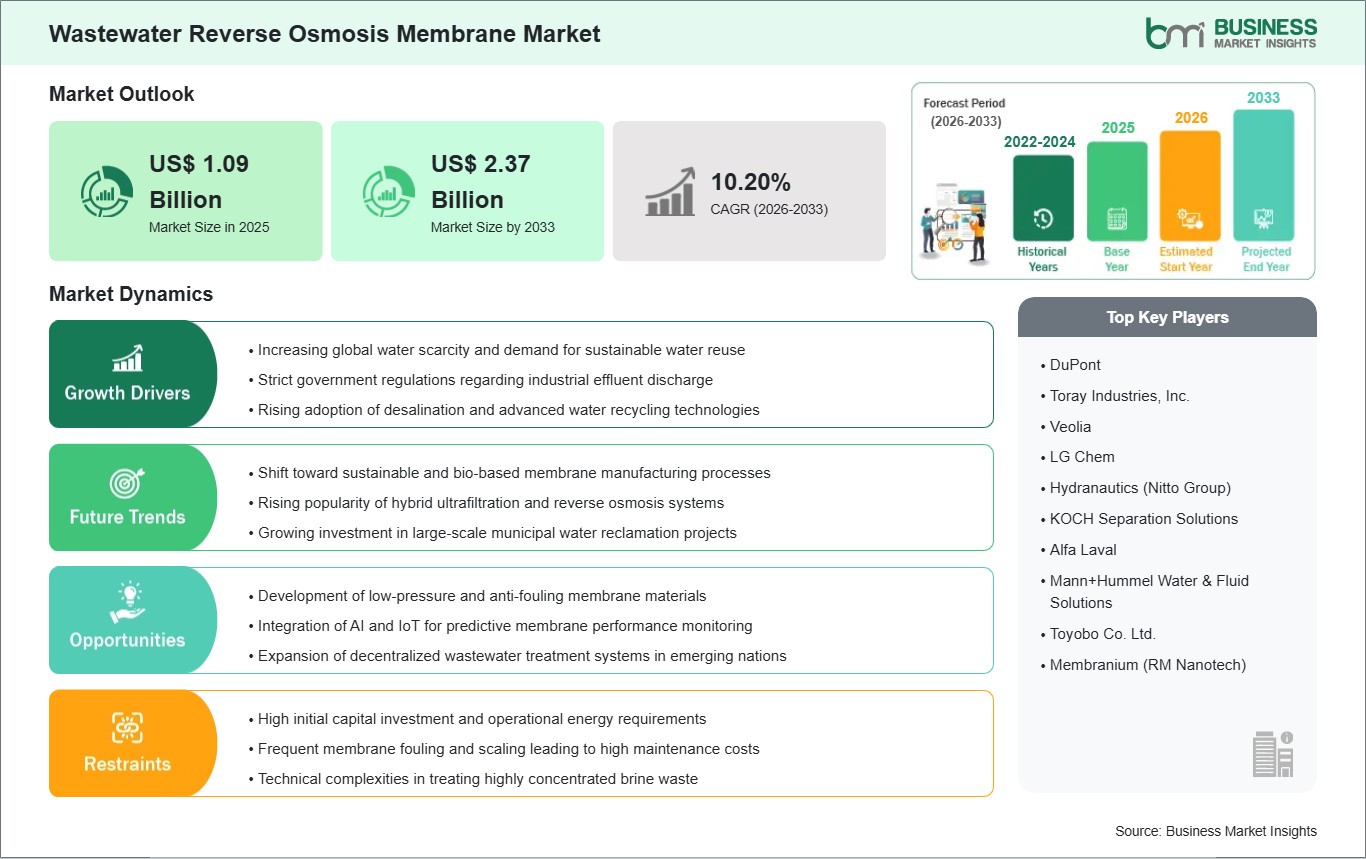
The wastewater reverse osmosis market has witnessed tremendous technology development and growth in the market due to the increasing demand for sustainable practices worldwide. Facing the challenge of water stress in the world, the ability to purify wastewater to a high level of purity has made reverse osmosis a vital component in modern environmental science. Thin composite films dominate the market, as they provide the necessary efficiency for the large-scale processes needed in the market. Industrial and municipal applications are the major consumers of reverse osmosis membranes, used to meet the increasingly stringent discharge regulations and provide alternative sources of water for growing populations and industrial bases.
Innovation in terms of membrane arrangement and composition is also changing the competitive environment. The spiral wound membrane modules have traditionally dominated due to their cost-performance characteristics. However, innovation in anti-fouling membrane technology is also overcoming historical pain points in terms of maintenance and energy costs. Although capital costs and technical difficulties associated with brine management are major challenges for reverse osmosis technology, the shift towards a circular water economy offers a robust growth outlook. Strategic investments in terms of research and development activities, along with the incorporation of digital monitoring technologies, are also expected to enhance performance characteristics. Reverse osmosis is therefore expected to play an important role in the global water security agenda.
Segment Analysis
Wastewater Reverse Osmosis Membrane Market Segmentation
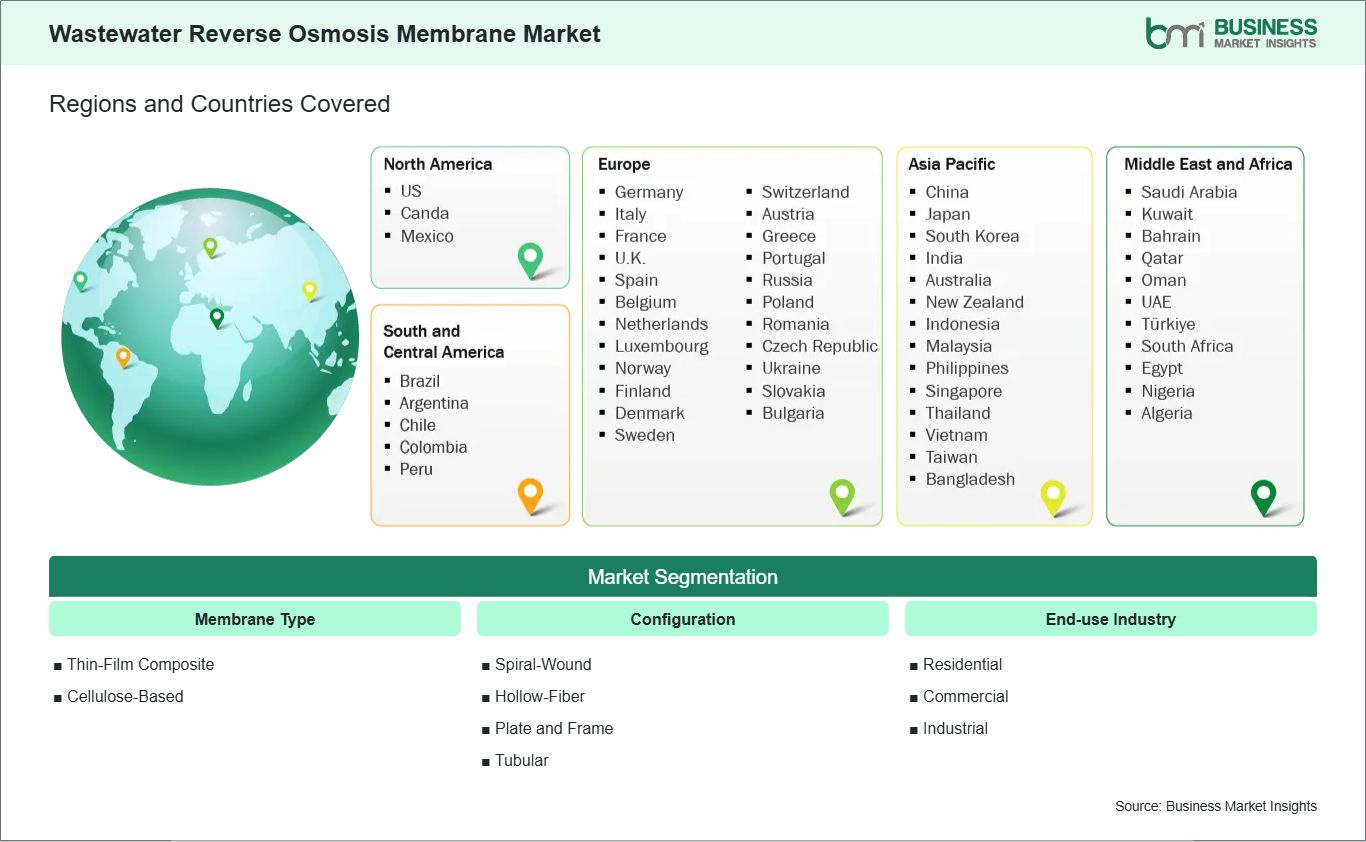
Key segments that contributed to the derivation of the Wastewater Reverse Osmosis Membrane market analysis are membrane type, configuration, and end-use industry.
- By membrane type, the wastewater reverse osmosis membrane market is segmented into Thin-Film Composite and Cellulose-Based. The Thin-Film Composite segment dominated the market in 2025.
- By configuration, the wastewater reverse osmosis membrane market is segmented into Spiral-Wound, Hollow-Fiber, Plate and Frame, and Tubular. The Spiral-Wound segment dominated the market in 2025.
- By end-use industry, the wastewater reverse osmosis membrane market is segmented into Residential, Commercial, and Industrial. The Industrial segment dominated the market in 2025.
Market Forces
Wastewater Reverse Osmosis Membrane Market Drivers and Opportunities
Increasing global water scarcity and demand for sustainable water reuse
The rising water crisis in the world is considered the main driving force behind the wastewater reverse osmosis market. As the water tables and rivers are being depleted at unprecedented rates due to the effects of climate change, the only option for many municipalities and industries is to view wastewater as a resource. Reverse osmosis has become the go-to solution in this process because it is one of the only technologies available to effectively remove dissolved solids, heavy metals, and micro-pollutants to provide high-quality water. This is especially true in arid environments, where "toilet to tap" programs have become the only option for survival.
Furthermore, the economic incentive to reuse water has grown as the cost of raw water procurement rises. Industrial facilities, especially in water-intensive sectors like food and beverage and power generation, are implementing internal circular water loops. These systems rely on high-performance membranes to treat process water for multiple cycles, thereby reducing their reliance on municipal supplies and insulating themselves from local water shortages. The necessity to secure a reliable water supply for continuous operations ensures that reverse osmosis membranes remain a critical investment for modern infrastructure, driving consistent market growth across both developed and developing economies.
Development of low-energy and anti-fouling membrane materials
One of the most significant opportunities in the market lies in the advancement of material science to address the twin challenges of energy consumption and membrane fouling. Traditionally, reverse osmosis is an energy-intensive process requiring high-pressure pumps to overcome osmotic pressure. The development of next-generation membranes featuring nanomaterial coatings or biomimetic structures allows for higher water permeability at lower operating pressures. This innovation directly reduces the carbon footprint and operational costs of treatment plants, making advanced wastewater recycling more accessible to smaller municipalities and price-sensitive industrial operators.
Additionally, the rise of anti-fouling and chlorine-resistant membrane chemistries presents a massive growth avenue. Fouling remains the leading cause of system downtime and premature membrane replacement, especially when treating complex industrial effluents. By integrating hydrophilic layers or specialized spacers that minimize the accumulation of organic and biological matter, manufacturers can significantly extend the operational lifespan of the membrane elements. This shift toward "smart" materials not only improves the overall return on investment for end users but also opens new markets in treating highly challenging wastewater streams that were previously considered too difficult or expensive for reverse osmosis treatment.
Size and Share Analysis
Wastewater Reverse Osmosis Membrane Market Size and Share Analysis
The global Wastewater Reverse Osmosis Membrane market is experiencing steady growth, with market size and share analysis reflecting evolving treatment preferences and competitive dynamics among key players. The report evaluates important subsegments categorized within membrane type, configuration, and end-use industry, highlighting their respective contributions to overall market performance.
By membrane type, the Thin-Film Composite subsegment dominated the market in 2025 due to its superior salt rejection rates exceeding 99% and high chemical stability. These membranes provide high water flux at lower pressures, significantly reducing energy consumption in large-scale wastewater reclamation facilities compared to traditional alternatives.
By configuration, the Spiral-Wound subsegment dominated the market in 2025 because it offers the highest membrane packing density and an efficient footprint for high-volume processing. Its well-established manufacturing standards and ease of replacement make it the most cost-effective solution for both municipal and industrial water recycling plants.
By end-use industry, the Industrial subsegment dominated the market in 2025 due to stringent environmental regulations regarding zero liquid discharge and effluent treatment. Sectors like pharmaceuticals, electronics, and chemicals require ultra-pure water for processes, driving massive adoption of reverse osmosis for onsite wastewater recovery and reuse.
Report Coverage
Wastewater Reverse Osmosis Membrane Market Report Coverage and Deliverables
The "Wastewater Reverse Osmosis Membrane Market Size and Forecast (2022 - 2033)" report provides a detailed analysis of the market covering below areas:
- Wastewater Reverse Osmosis Membrane market size and forecast at the regional and country levels for segments covered under the scope
- Wastewater Reverse Osmosis Membrane market trends, as well as drivers, restraints, and opportunities
- Wastewater Reverse Osmosis Membrane market analysis covering key trends, regional framework, major players, regulations, and recent developments
- Industry landscape and competition analysis covering market concentration, heat map analysis, prominent players, and recent developments for the Wastewater Reverse Osmosis Membrane market
- Detailed company profiles, including SWOT analysis
Geographic Insights
Wastewater Reverse Osmosis Membrane Market Geographic Insights
The geographical scope of the Wastewater Reverse Osmosis Membrane market report is divided into: North America, Asia Pacific, Europe, Middle East & Africa, and South & Central America. North America held the largest share in 2025.
North America maintains the largest share of the wastewater reverse osmosis membrane market, a position solidified by its advanced industrial base and early adoption of stringent environmental protection policies. In the United States, the Clean Water Act and various state-level regulations, particularly in water-stressed regions like California and Texas, have mandated high standards for wastewater treatment and reclamation. This regulatory pressure, combined with significant federal and private investment in aging water infrastructure, drives a continuous demand for high-performance membrane replacements and new system installations. The region is also home to several leading membrane manufacturers and research institutions, fostering a culture of innovation that keeps North America at the forefront of the global market.
The dominance of the region is further supported by the rapid growth of the shale gas and semiconductor industries, both of which require massive volumes of treated water and produce complex wastewater streams. North American operators are increasingly turning to advanced reverse osmosis systems to manage these effluents efficiently while minimizing environmental impact. Additionally, the presence of a mature residential and commercial water purification market contributes to the overall regional share. While the Asia-Pacific region is catching up due to rapid urbanization, North America’s established technical expertise, robust supply chains, and consistent capital flow into sustainable water projects ensure its continued leadership in the global landscape.
Industry Activity
Recent Developments
The Wastewater Reverse Osmosis Membrane market is evaluated by gathering qualitative and quantitative data post primary and secondary research, which includes important corporate publications, association data, and databases. A few of the key developments in the Wastewater Reverse Osmosis Membrane market are:
- In October 2025, Toray Industries, Inc., announced the launch of its TLF-400ULD reverse osmosis membrane, designed to deliver ultra-low energy consumption and improved performance for water and wastewater treatment applications.
- In May 2025, Aquaporin A/S, announced that it supplied 500 CLEAR series membranes to a Beijing-based company to enhance energy-efficient wastewater treatment in industrial facilities, while also expanding partnerships across China and Latin America.
- In January 2025, Aqua Membranes, announced a distribution and investment partnership with Osmoflo to commercialize its 3D-printed spacer RO membranes for industrial and municipal water and wastewater treatment markets across Australia, New Zealand, and the Pacific.
Trust & Transparency
Research Methodology
The market analysis combines proprietary research with secondary data from government agencies, company disclosures, regulatory filings, industry databases and expert interviews. Market estimates are validated through data triangulation, cross-market benchmarking and analyst
review.
View Full Research Methodology
Key Sources Referred:
American Chemistry Council (ACC)International Council of Chemical Associations (ICCA)European Chemical Industry Council (Cefic)China Petroleum and Chemical Industry Federation (CPCIF)Indian Chemical Council (ICC)Japan Chemical Industry Association (JCIA)Brazilian Chemical Industry Association (ABIQUIM)Company WebsitesCompany Annual ReportsCompany Investor Presentations