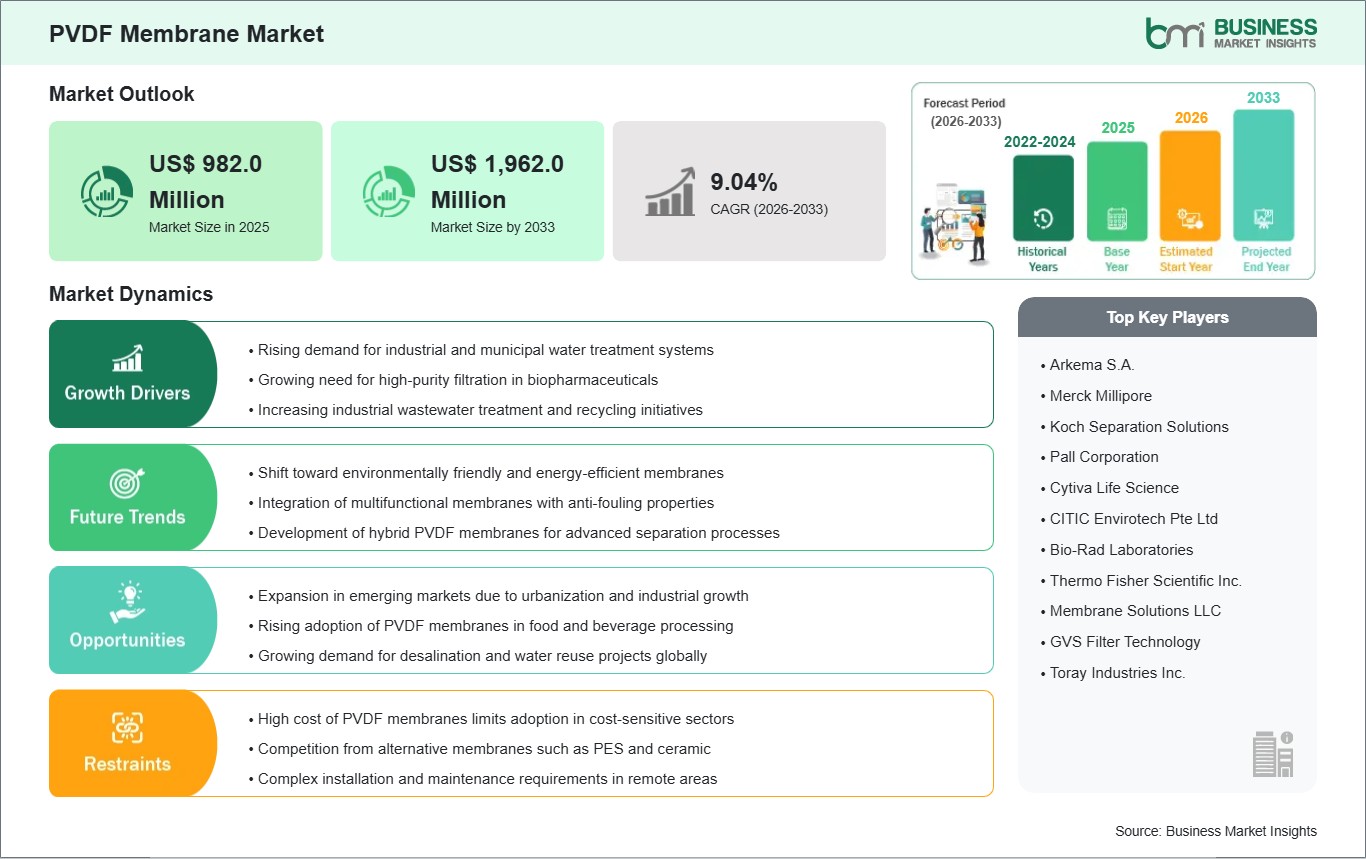
The PVDF Membrane Market size is expected to reach US$ 1,962. million by 2033 from US$ 982. million in 2025. The market is estimated to record a CAGR of 9.04% from 2026 to 2033.
The global market for PVDF (polyvinylidene fluoride) membranes functions as a vital part of the specialty materials market because PVDF exhibits unique physicochemical characteristics that include high chemical resistance, excellent mechanical strength, superior thermal stability and remarkable fouling resistance. The performance characteristics of PVDF membranes make them ideal for industrial separation and filtration operations that operate in essential industrial sectors.PVDF membranes, which people first developed for water and wastewater treatment, now serve multiple industries, which include pharmaceutical and biotechnology, food and beverage processing, microelectronics and chemical processing.
The ability of PVDF membranes to deliver consistent performance in harsh conditions has broadened their appeal and driven diversified adoption globally. The primary global growth driver exists because people increasingly prioritize water quality and environmental sustainability. Worldwide industrial and municipal stakeholders now treat water as essential because they need it for consumption and processing and reuse. PVDF membranes serve as the preferred material for microfiltration and ultrafiltration systems because their durability enables extended operational life while requiring less maintenance than conventional polymer membranes. Investment in water purification infrastructure has increased across emerging economies, which also requires developed regions to modernize their outdated facilities. The combination of strict regulations for effluent discharge and potable water quality and industrial process effluent standards has created stronger market demand for PVDF membrane technologies, which provide high performance and regulatory compliance solutions while decreasing energy and chemical requirements in filtration processes.
The biopharmaceutical and life sciences industry continues to grow and serve as a primary market driver. PVDF membranes function as essential components that enable sterile filtration and virus removal and high‑purity separations that serve vital purposes in vaccine production, biologics manufacturing and laboratory scale‑ups. The material demonstrates multiple applications through its entry into high‑value markets, which allow PVDF membranes to function as premium products for advanced separation processes that extend beyond standard water treatment methods. Market conditions present obstacles to the industry.
The higher expense of PVDF membranes when compared to other membrane materials creates a financial obstacle that limits their use in budget-driven situations and in regions where inexpensive filtration systems are common. PVDF membranes face competition from membrane technologies, which include polyethersulfone (PES) and ceramic systems that deliver equivalent performance in specific, specialized use cases. Buyers in developing markets must evaluate both technical expertise requirements and infrastructure needs when selecting membrane system integration solutions. The global PVDF membrane market pattern shows that strong demand from regulations and performance needs conflicts with the requirement to reduce expenses while achieving seamless system integration. This conflict limits market growth across various global industries.

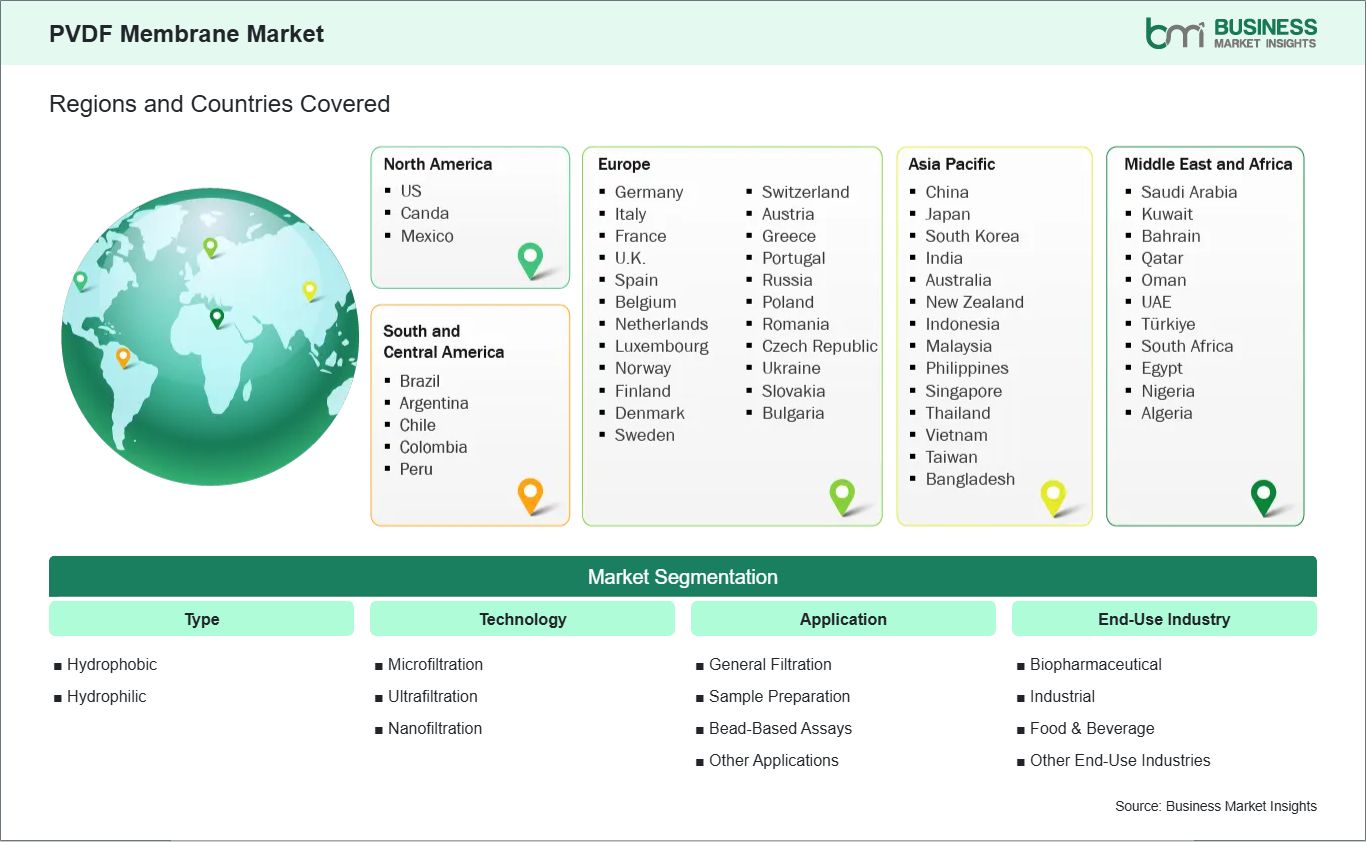
Key segments that contributed to the derivation of the PVDF membrane market analysis are type, technology, application, and end-use industry.
The global PVDF membrane market experiences major growth because industrial and municipal water treatment systems need better operational efficiency. Worldwide municipal authorities need to develop better drinking water standards because urban populations continue to grow, and advanced filtration systems will provide them with effective solutions. The applications use PVDF membranes because they maintain their microfiltration and ultrafiltration capabilities through chemical resistance and mechanical strength. The replacement of conventional materials with PVDF membranes benefits developed regions because it improves operational performance during equipment upgrading.
The PVDF market experiences strong growth through industrial wastewater treatment, which constitutes a major market segment. Petrochemical, textile and food processing industries produce complicated waste streams that need effective separation methods. PVDF membranes provide exceptional protection against fouling and harsh chemicals, resulting in extended membrane durability and decreased maintenance expenses. The implementation of PVDF-based systems at industrial facilities throughout the Asia Pacific and Europe has enabled these facilities to meet more stringent effluent discharge regulations. Sustainability initiatives drive businesses to invest more in water recycling and reuse systems.
PVDF membranes function in reclamation systems throughout the Middle East and African regions that require water reclamation because these membranes create high-quality water from wastewater treatment processes. Emerging markets are investing substantial resources into building decentralized water purification systems, which will provide services to their remote areas and peri-urban communities. The growing need for PVDF membranes in industrial and municipal water treatment facilities will continue to drive worldwide market expansion because environmental regulations have become stricter and water security has turned into a vital government and corporate priority.
Emerging markets are becoming pivotal arenas for PVDF membrane deployment as urbanization and industrial growth intensify the demand for advanced filtration solutions. Countries in Asia Pacific such as China, India, and Indonesia are investing heavily in urban infrastructure, including water treatment facilities, industrial parks, and smart city projects. These expansions require reliable, high‑performance membrane technologies that can handle diverse operational challenges, making PVDF membranes a preferred choice. PVDF’s robust chemical resistance and temperature tolerance are particularly valuable in large‑scale municipal and industrial filtration applications.
Industrial growth in Latin America and Southeast Asia is also contributing to PVDF membrane demand. Manufacturing sectors in Brazil, Mexico, Vietnam, and Thailand are expanding, creating greater need for wastewater treatment and process filtration systems. For example, food and beverage processors in these regions are increasingly opting for PVDF ultrafiltration membranes to ensure product purity, safety, and regulatory compliance. This trend reflects a broader shift toward higher quality standards and technological upgrades across processing industries.
The expansion of desalination infrastructure in water‑stressed regions such as the Middle East further supports PVDF membrane adoption. Desalination plants often integrate PVDF membrane modules for pretreatment and brine management due to their durability and fouling resistance. Additionally, African nations with growing urban populations are investing in both centralized and decentralized water treatment systems, leveraging PVDF membranes to improve water access and reliability. Overall, urbanization and industrial growth in emerging markets are creating robust opportunities for PVDF membrane technologies, driving adoption beyond traditional strongholds and contributing to the market’s global expansion.
The PVDF membrane market demonstrates steady growth, with size and share analysis highlighting evolving trends and competitive dynamics among key players. The report examines subsegments categorized within type, technology, application, and end-use industry, offering insights into their contribution to overall market performance.
By type, the hydrophobic subsegment dominated the market in 2025, driven by its excellent chemical and heat resistance, making it suitable for a broad range of filtration environments.
Based on technology, the ultrafiltration subsegment dominated the market in 2025, driven by its high efficiency in separating macromolecules, making it essential in both industrial and pharmaceutical filtration.
On the basis of application, the general filtration subsegment dominated the market in 2025, driven by the widespread need for basic filtration across industries requiring PVDF membranes.
In terms of end-use industry, the biopharmaceutical subsegment dominated the market in 2025, driven by rigorous purity and performance requirements that favor PVDF membranes in drug and biologics processing.
| Report Attribute | Details |
|---|---|
| Market size in 2025 | US$ 982.0 Million |
| Market Size by 2033 | US$ 1,962.0 Million |
| Global CAGR (2026 - 2033) | 9.04% |
| Historical Data | 2022-2024 |
| Forecast period | 2026-2033 |
| Segments Covered | By Type
|
|
Regions and Countries Covered
| |
| North America | US, Canada, Mexico |
| Europe | Belgium, Austria, Finland, Denmark, Greece, Poland, Romania, Russia, Ukraine, Czech Republic, Slovakia, Bulgaria, Italy, Luxembourg, Germany, Switzerland, France, Netherlands, Norway, Portugal, Spain, Sweden, United Kingdom |
| Asia-Pacific | Australia, China, India, Japan, South Korea, Indonesia, Malaysia, Philippines, Singapore, Thailand, Vietnam, Bangladesh, New Zealand, Taiwan |
| South and Central America | Brazil, Argentina, Peru, Chile, Colombia |
| Middle East and Africa | Bahrain, Kuwait, Oman, Qatar, Saudi Arabia, United Arab Emirates, Turkiye, South Africa, Egypt, Algeria, Nigeria |
| Market leaders and key company profiles |
|
The "PVDF Membrane Market Size and Forecast (2022 - 2033)" report provides a detailed analysis of the market covering below areas:
The geographical scope of the PVDF Membrane Market report is divided into North America, Asia Pacific, Europe, Middle East & Africa, and South & Central America. North America held the largest share in 2025.
North America leads the worldwide PVDF membrane market because it has established water treatment systems and advanced biopharmaceutical development, and uses high-performance filtration systems. The United States government drives water treatment facility upgrades, wastewater recycling initiatives and industrial effluent treatment projects, which use PVDF membranes because of their chemical resistance and extended lifespan. Canada achieves market growth through its developing industrial sector and biopharmaceutical market, which increasingly applies PVDF membranes for sterile filtration, virus elimination and high-purity separation processes.
The Asia Pacific market experiences rapid growth because China, India, Japan and South Korea expand their urban areas and industries while implementing stricter water quality standards, which drive PVDF membrane usage in municipal water treatment facilities, food and beverage processing and chemical manufacturing. The region supports ultrafiltration and microfiltration membrane adoption through its commitment to sustainable water reclamation and efficient industrial operations.
The European PVDF membrane market operates at full capacity, with Germany, France and the United Kingdom focusing on regulatory compliance and sustainable production methods. PVDF membranes find extensive application in wastewater treatment facilities, pharmaceutical production and food and beverage manufacturing processes, which require high chemical and thermal resistance. The Middle East and Africa region experiences moderate growth because large-scale desalination projects, industrial wastewater treatment facilities and high-purity filtration systems for extreme weather conditions create demand for PVDF membranes, which protect against fouling and chemical damage.
The South and Central American region experiences continuous development through Brazilian and Mexican investments, which support municipal water treatment facilities and industrial water reuse systems and chemical processing operations, although economic changes and insufficient domestic manufacturing capacity slow down adoption rates. North America maintains technological supremacy because it enforces strict water quality regulations and creates advanced biopharmaceutical technologies, while the Asia Pacific emerges as the fastest expanding market because of urban development and industrial growth.
Europe maintains its dedication to sustainable high-performance filtration technologies, while the Middle East, Africa and South and Central America present new markets for PVDF membranes, which deliver dependable chemical resistance and operational effectiveness according to different patterns of global market implementation.

The PVDF Membrane Market is evaluated by gathering qualitative and quantitative data post primary and secondary research, which includes important corporate publications, association data, and databases. A few of the key developments in the PVDF membrane market are:
The PVDF Membrane Market is valued at US$ 982.0 Million in 2025, it is projected to reach US$ 1,962.0 Million by 2033.
As per our report PVDF Membrane Market, the market size is valued at US$ 982.0 Million in 2025, projecting it to reach US$ 1,962.0 Million by 2033. This translates to a CAGR of approximately 9.04% during the forecast period.
The PVDF Membrane Market report typically cover these key segments-
The historic period, base year, and forecast period can vary slightly depending on the specific market research report. However, for the PVDF Membrane Market report:
The PVDF Membrane Market is populated by several key players, each contributing to its growth and innovation. Some of the major players include:
The PVDF Membrane Market report is valuable for diverse stakeholders, including:
Essentially, anyone involved in or considering involvement in the PVDF Membrane Market value chain can benefit from the information contained in a comprehensive market report.
Please tell us your area of interest
(Market Segments/ Regions and Countries/ Companies)