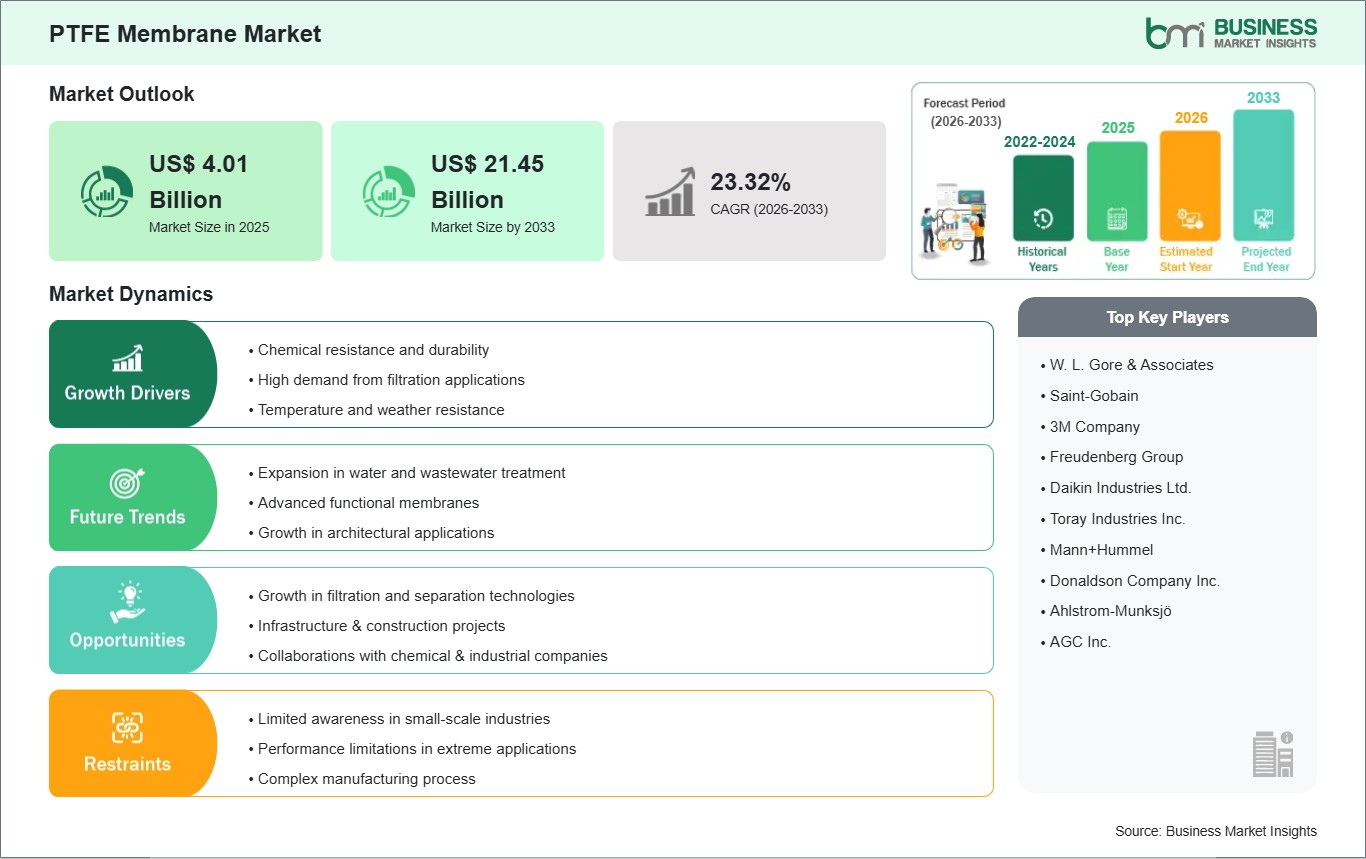
The PTFE Membrane Market size is expected to reach US$ 21.45 billion by 2033 from US$ 4.01 billion in 2025. The market is estimated to record a CAGR of 23.32% from 2026 to 2033.
The global PTFE (polytetrafluoroethylene) membrane market is experiencing steady growth as industries increasingly seek high-performance filtration, separation, and protective solutions. PTFE membranes are widely recognized for their exceptional chemical resistance, thermal stability, and hydrophobicity, making them suitable for diverse applications, including air and liquid filtration, protective clothing, architectural fabrics, and chemical processing.
The growing emphasis on clean air and water, industrial safety, and environmental compliance is driving demand, particularly in sectors such as pharmaceuticals, biotechnology, electronics, and chemical manufacturing. Moreover, advancements in PTFE membrane technology, such as enhanced porosity control, multi-layer construction, and reinforced mechanical strength, are broadening their applicability across more challenging industrial processes.
The key growth drivers include the increasing need for pollution control solutions, rising awareness about workplace safety, and the expansion of high-tech industries requiring precision filtration. At the same time, the market faces restraints related to the high production cost of PTFE membranes and the complexity of scaling manufacturing without compromising material properties.
Additionally, processing PTFE into thin, durable membranes requires specialized expertise, which can limit adoption in smaller industrial markets. Despite these challenges, innovations in functional coatings, customized membrane design, and the development of hybrid PTFE systems are strengthening market potential, positioning PTFE membranes as essential components in industrial efficiency, environmental protection, and product quality globally.

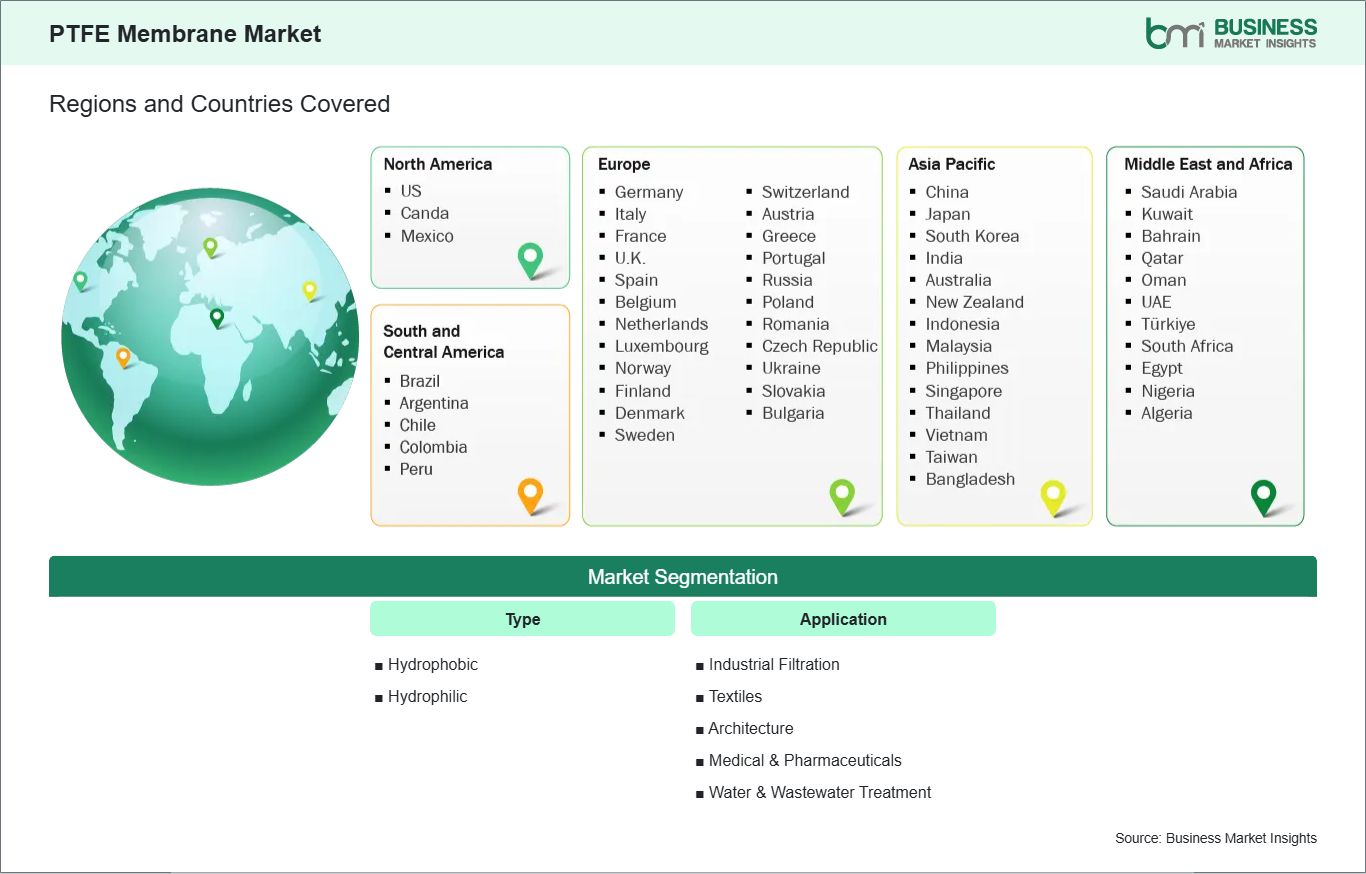
Key segments that contributed to the derivation of the PTFE membrane market analysis are type and application
The growth of the Western Europe PTFE membrane market is largely influenced by strong product demand from industrial and environmental applications. In this region, Germany, France, and the UK are some of the most regulated industrial environments, particularly in terms of chemicals, food processing industries, and waste disposal facilities. In these industries, PTFE membranes are increasingly being adopted in air and liquid filtration systems.
In Western Europe, industrial applications of PTFE membranes are estimated to contribute close to 40 to 45 percent of total product sales. This is primarily because this region is keenly interested in maintaining strict emission norms and ensuring a high level of industrial safety. In Germany, particularly in industrial clusters like North Rhine Westphalia, PTFE-based filters are being actively implemented in high-temperature exhaust systems.
The water and wastewater treatment plants in Western Europe are also contributing significantly towards this demand. Aging water and wastewater treatment plants in Italy and Spain are being upgraded in phases. In recent times, there has been a shift towards membrane filter technology due to better efficiency and longer life. Membranes made of PTFE are being used in advanced filter systems because they can sustain constant flow rates even under heavy contamination. In France, water and wastewater treatment plants have reportedly experienced a reduction of nearly 20% in the replacement cycles of membranes due to the incorporation of PTFE.
The healthcare and life sciences industries are further drivers of demand for filtration in this region. Western Europe has a well-established pharmaceutical industry, especially in Ireland, Switzerland, and Belgium. These industries require PTFE membranes for sterile filtration and air venting. These membranes are preferred for their purity. These membranes are used in biologic and vaccine production. Pharmaceutical production in Western Europe is increasing steadily. Therefore, it is expected that high-grade membranes used for this purpose will increase by an estimated rate of 6 - 7%, further emphasizing the role of PTFE membranes in this industry.
Technological progress in filtration and separation systems is playing a crucial role in expanding the PTFE membrane market across Western Europe. Research centers and industrial firms in countries like the Netherlands, Sweden, and Germany are focusing on improving membrane efficiency through better pore structure control and enhanced permeability. These advancements allow PTFE membranes to handle more complex separation tasks, such as fine particle removal and gas purification, which are increasingly required in high-tech industries. As a result, advanced filtration systems using PTFE membranes are being adopted in sectors like microelectronics and specialty chemicals, where process precision is essential.
In addition, sustainability initiatives in Western Europe are also driving the adoption of PTFE membranes in separation technologies. Industries in the region are embracing closed-loop production systems where membranes are being utilized for solvent recovery, water recycling, and emissions management. In Denmark and the Netherlands, industries are using membrane separation systems in their production units to minimize waste generation. PTFE membranes are being utilized in such systems owing to their thermal and chemical resistance properties. This has enabled industries in the region to achieve sustainability while maintaining operational efficiency.
In addition, new applications in the field of energy and environment-related technologies are also contributing to the growth of the market. Western European countries are also increasingly investing in the development of hydrogen fuel and carbon capture plants, where gas separation technology has a major role to play. In Germany, hydrogen fuel plants in the development stage are making use of advanced technology in the field of membranes to enhance the purity of the gases used in the plants, while in the UK, carbon capture plants in the nascent stage are making use of PTFE technology for the separation of gases in the plants. New applications in the field of energy-related technologies are expected to contribute 10-12% to the growth of the demand for PTFE membranes in the region in the coming five years.

The global PTFE membrane market is experiencing steady growth, with market size and share analysis reflecting evolving treatment preferences and competitive dynamics among key players. The report evaluates important subsegments categorized within type and application highlighting their respective contributions to overall market performance.
By type, the hydrophobic segment subsegment dominated the market in 2025 because they can resist water while allowing air and gases to pass through, making them more practical in real industrial conditions. They also perform well in harsh chemical and high-temperature environments, so industries prefer them as a reliable, multi-purpose option.
By application, the industrial filtration subsegment dominated the market in 2025 because industries require large-scale, continuous filtration systems to maintain product quality and meet safety standards. PTFE membranes are widely used here due to their durability, chemical resistance, and long service life, which reduces downtime and replacement costs.
| Report Attribute | Details |
|---|---|
| Market size in 2025 | US$ 4.01 Billion |
| Market Size by 2033 | US$ 21.45 Billion |
| Global CAGR (2026 - 2033) | 23.32% |
| Historical Data | 2022-2024 |
| Forecast period | 2026-2033 |
| Segments Covered | By Type
|
|
Regions and Countries Covered
| |
| North America | US, Canada, Mexico |
| Europe | Belgium, Austria, Finland, Denmark, Greece, Poland, Romania, Russia, Ukraine, Czech Republic, Slovakia, Bulgaria, Italy, Luxembourg, Germany, Switzerland, France, Netherlands, Norway, Portugal, Spain, Sweden, United Kingdom |
| Asia-Pacific | Australia, China, India, Japan, South Korea, Indonesia, Malaysia, Philippines, Singapore, Thailand, Vietnam, Bangladesh, New Zealand, Taiwan |
| South and Central America | Brazil, Argentina, Peru, Chile, Colombia |
| Middle East and Africa | Bahrain, Kuwait, Oman, Qatar, Saudi Arabia, United Arab Emirates, Turkiye, South Africa, Egypt, Algeria, Nigeria |
| Market leaders and key company profiles |
|
The "PTFE membrane market Size and Forecast (2022 - 2033)" report provides a detailed analysis of the market covering below areas:
The geographical scope of the PTFE membrane market report is divided into: North America, Asia Pacific, Europe, Middle East & Africa, and South & Central America. North America held the largest share in 2025.
North America dominates the global PTFE membrane market due to its advanced industrial infrastructure, stringent environmental regulations, and early adoption of high-performance filtration technologies.
The United States is the primary driver, leveraging PTFE membranes extensively in pharmaceutical manufacturing, biotechnology, chemical processing, and microelectronics industries. In pharmaceuticals and biotech, PTFE membranes are used for sterile filtration, air purification, and high-purity liquid processing, ensuring compliance with stringent quality and safety standards. The chemical industry relies on PTFE membranes for aggressive chemical filtration and separation processes, benefiting from the material’s resistance to extreme temperatures and corrosive substances.
The region’s leadership is reinforced by strong R&D capabilities and collaborations between membrane manufacturers and industrial users, which drive product innovation and process optimization. Additionally, the demand for environmental compliance solutions, such as air and water filtration systems for industrial and municipal applications, further accelerates adoption. Challenges include high manufacturing costs, the need for skilled technicians, and the complexity of scaling PTFE membrane production while maintaining consistency in performance. Despite these challenges, North America continues to set global benchmarks in PTFE membrane technology, combining innovation, industrial expertise, and regulatory compliance to maintain leadership in high-performance filtration and separation solutions.

The PTFE membrane market is evaluated by gathering qualitative and quantitative data post primary and secondary research, which includes important corporate publications, association data, and databases. A few of the key developments in the PTFE membrane market are:
The PTFE Membrane Market is valued at US$ 4.01 Billion in 2025, it is projected to reach US$ 21.45 Billion by 2033.
As per our report PTFE Membrane Market, the market size is valued at US$ 4.01 Billion in 2025, projecting it to reach US$ 21.45 Billion by 2033. This translates to a CAGR of approximately 23.32% during the forecast period.
The PTFE Membrane Market report typically cover these key segments-
The historic period, base year, and forecast period can vary slightly depending on the specific market research report. However, for the PTFE Membrane Market report:
The PTFE Membrane Market is populated by several key players, each contributing to its growth and innovation. Some of the major players include:
The PTFE Membrane Market report is valuable for diverse stakeholders, including:
Essentially, anyone involved in or considering involvement in the PTFE Membrane Market value chain can benefit from the information contained in a comprehensive market report.
Please tell us your area of interest
(Market Segments/ Regions and Countries/ Companies)