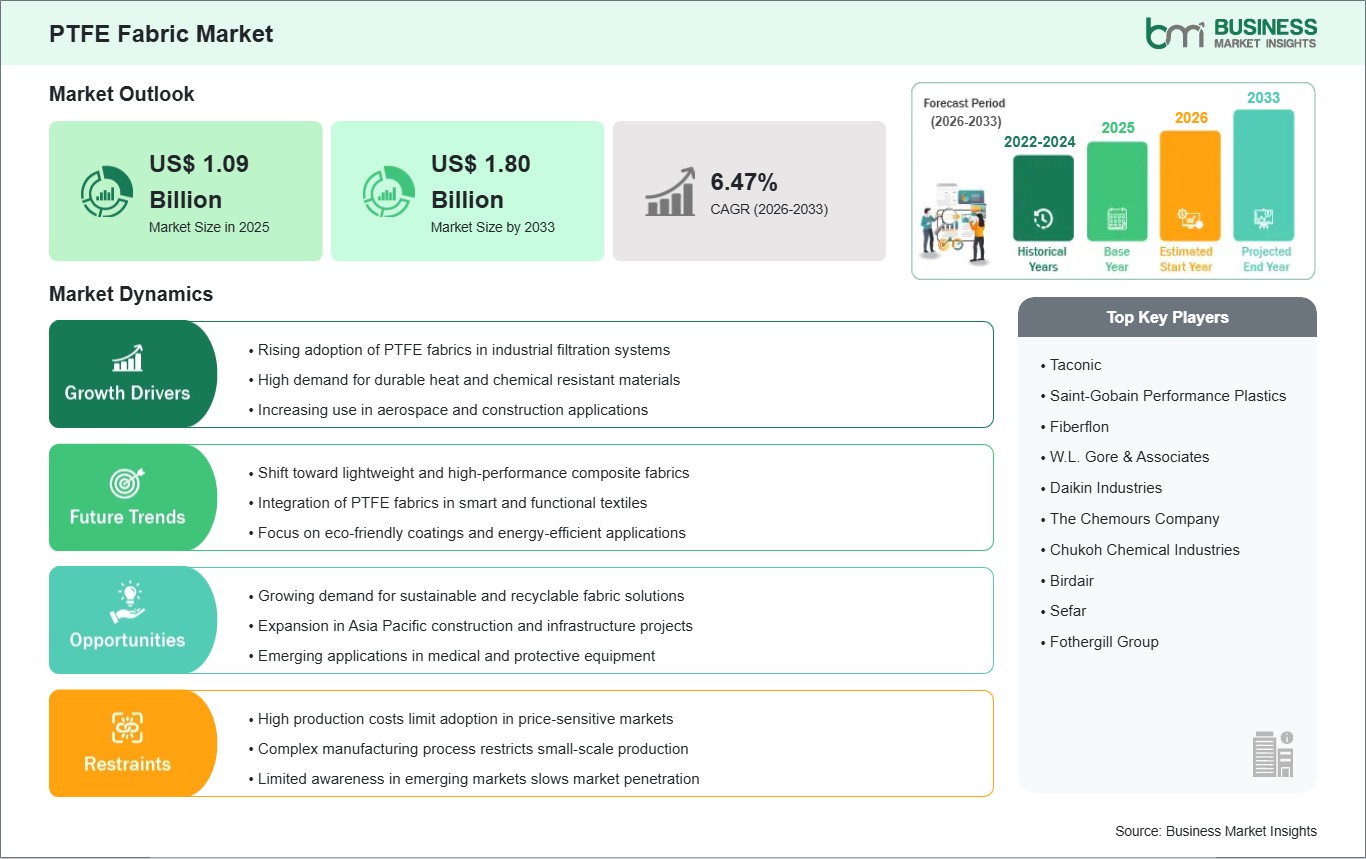
The PTFE Fabric Market size is expected to reach US$ 1.8 billion by 2033 from US$ 1.09 billion in 2025. The market is estimated to record a CAGR of 6.47% from 2026 to 2033.
The global PTFE (Polytetrafluoroethylene) fabric market is witnessing steady expansion, driven by its superior chemical resistance, thermal stability, low friction, and long service life across diverse industrial applications. PTFE fabrics serve as essential materials for advanced manufacturing processes and infrastructure construction projects because they are used in filtration systems, conveyor belts, architectural membranes, industrial gaskets, protective coverings and electrical insulation. The market benefits from continuous demand across multiple end-use sectors such as chemical processing and automotive, aerospace, electronics and construction because the fabric maintains operational efficiency and safety and durability through its special characteristics.
The global market experiences primary growth because industries now use PTFE fabrics to create high-performance filtration systems and environmental control systems. The fabric enables industries to boost production uptime and decrease maintenance needs through its ability to withstand extreme temperatures, corrosive chemicals and mechanical stress. The expanding infrastructure and construction activities in emerging economies are driving up demand for tensile architectural solutions, which include PTFE-coated fiberglass membranes that stadiums, airports and public buildings use, thereby creating market growth. The protective applications of PTFE fabrics, which include fire-resistant clothing and high-performance industrial covers, are expanding their potential applications.
The market operates under specific limitations. Price-sensitive industries in emerging markets face difficulties because PTFE raw material expenses and the intricate procedures needed to produce and finish coatings for fabrics create problems for their operations. The use of PTFE fabrics in cost-sensitive areas faces obstacles because smaller industrial sectors lack both technical knowledge and awareness of this material. The production and disposal of fluoropolymer-based materials present environmental issues that manufacturers must handle because they need to achieve both performance targets and sustainable practices.
The global PTFE fabric market maintains continuous growth because of its exceptional technical characteristics, which enable specialized applications and industrial adoption in construction and protective industries. The combination of high-performance demand, technological advancements in coating and fabrication, and emerging applications across new geographies ensures that PTFE fabrics remain an indispensable material in global industrial operations.

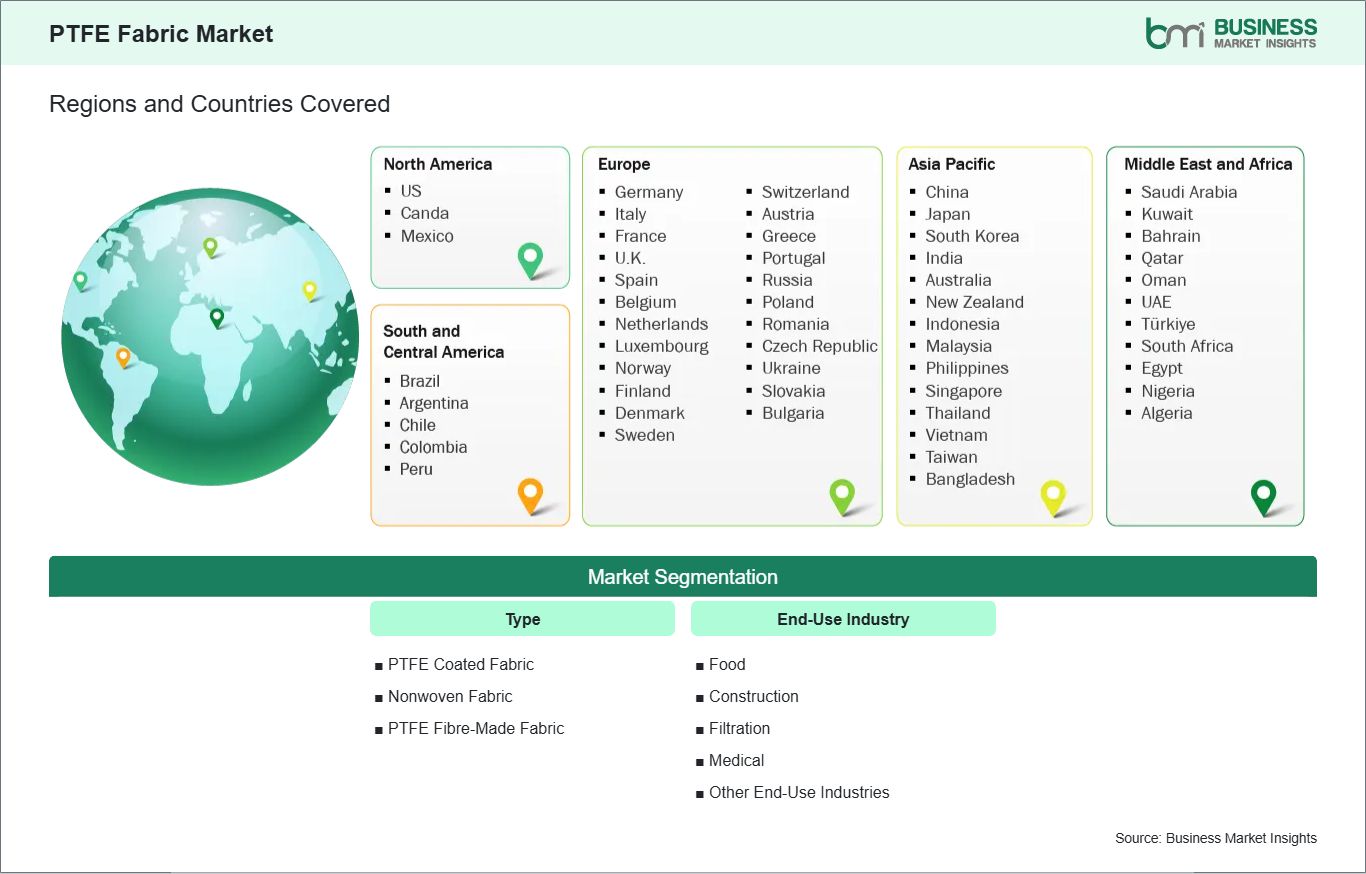
Key segments that contributed to the derivation of the PTFE fabric market analysis are type and end-use industry.
The global PTFE fabric market is experiencing significant growth because multiple sectors use PTFE material for industrial filtration systems. PTFE fabrics serve as optimal solutions for aggressive chemical environments and high-temperature applications because they maintain chemical purity, thermal resistance and corrosion protection. The chemical processing industry, the pharmaceutical sector and the metallurgy field depend on PTFE fabrics for filters, belts and membranes which protect their operations and maintain product quality.
Emerging markets in the Asia Pacific and South America are developing their industrial sectors, which leads to increased requirements for PTFE-based filtration solutions. Manufacturers are establishing extensive manufacturing plants in these areas to provide tailored PTFE fabrics that satisfy particular operational needs. The North American and European markets, which have reached maturity, concentrate their resources on developing advanced solutions for cleanroom gas filtration and particulate removal applications, resulting in stable market demand.
Advanced PTFE materials are becoming part of global supply chain systems, which will enable industrial filters to deliver both consistent performance and extended lifespan. The fabric maintains its stability when exposed to extreme temperatures and chemical conditions, which makes it suitable for use in industrial environments that require extended operation periods. The world market for PTFE fabrics in filtration systems has grown because this material has become essential for filtration system applications.
Sustainability has emerged as a critical factor influencing the global PTFE fabric market, with manufacturers and end-users increasingly prioritizing eco-friendly materials. PTFE fabrics are now being engineered for recyclability and reduced environmental impact, appealing to industries focused on sustainable operations. Regions such as Europe and North America are leading the push for green manufacturing practices, encouraging the integration of recyclable PTFE fabrics in industrial, construction, and transportation applications.
Simultaneously, Asia Pacific presents significant opportunities for sustainable PTFE adoption, particularly in construction and packaging sectors where environmental compliance and energy efficiency are increasingly mandated. Companies are exploring innovative production methods that minimize chemical waste and allow PTFE fabrics to be reused or repurposed without compromising performance. Such efforts also enhance corporate responsibility and align with global climate goals, making sustainable PTFE solutions a strategic market differentiator.
Furthermore, growing consumer and industrial awareness of sustainability drives demand for PTFE fabrics in specialized applications such as water treatment, protective coverings, and filtration systems. By combining high-performance attributes with environmental benefits, PTFE fabrics are positioned to support global industrial growth while adhering to evolving ecological standards, offering both profitability and compliance advantages.

The PTFE fabric market demonstrates steady growth, with size and share analysis highlighting evolving trends and competitive dynamics among key players. The report examines subsegments categorized within type and end-use industry, offering insights into their contribution to overall market performance.
By type, the PTFE coated fabric subsegment dominated the market in 2025, driven by its superior non-stick properties and widespread use in high-performance industrial and architectural applications.
In terms of end-use industry, the food subsegment dominated the market in 2025, driven by extensive usage of PTFE fabrics in conveyor belts and processing equipment due to their heat resistance and hygiene benefits.
| Report Attribute | Details |
|---|---|
| Market size in 2025 | US$ 1.09 Billion |
| Market Size by 2033 | US$ 1.80 Billion |
| Global CAGR (2026 - 2033) | 6.47% |
| Historical Data | 2022-2024 |
| Forecast period | 2026-2033 |
| Segments Covered | By Type
|
|
Regions and Countries Covered
| |
| North America | US, Canada, Mexico |
| Europe | Belgium, Austria, Finland, Denmark, Greece, Poland, Romania, Russia, Ukraine, Czech Republic, Slovakia, Bulgaria, Italy, Luxembourg, Germany, Switzerland, France, Netherlands, Norway, Portugal, Spain, Sweden, United Kingdom |
| Asia-Pacific | Australia, China, India, Japan, South Korea, Indonesia, Malaysia, Philippines, Singapore, Thailand, Vietnam, Bangladesh, New Zealand, Taiwan |
| South and Central America | Brazil, Argentina, Peru, Chile, Colombia |
| Middle East and Africa | Bahrain, Kuwait, Oman, Qatar, Saudi Arabia, United Arab Emirates, Turkiye, South Africa, Egypt, Algeria, Nigeria |
| Market leaders and key company profiles |
|
The "PTFE Fabric Market Size and Forecast (2022 - 2033)" report provides a detailed analysis of the market covering below areas:
The geographical scope of the PTFE Fabric Market report is divided into North America, Asia Pacific, Europe, Middle East & Africa, and South & Central America. North America held the largest share in 2025.
North America has become the leading region in the PTFE fabric market because of its industrial capabilities and high-performance product applications that use PTFE fabrics extensively.
The United States leads regional demand, driven by extensive use of PTFE fabrics in aerospace, food processing, construction membranes, and industrial filtration. The presence of technologically advanced manufacturing facilities and a strong emphasis on product quality and regulatory compliance support the widespread use of PTFE-coated materials. The increasing industrial demand for materials that can withstand extreme heat and chemical exposure while maintaining their structural integrity drives market expansion across this area.
The Asia Pacific region shows fast market growth because industrialization, infrastructure development and manufacturing sector expansion continue to progress in China, India and Japan. The region is witnessing increased adoption of PTFE fabrics in conveyor belts, architectural structures and insulation applications, supported by cost-effective production capabilities and rising export-oriented industries.
Europe maintains a stable position in the market, which shows strong demand from the construction, automotive and environmental engineering industries. The region promotes sustainability through regulatory standards that drive building materials and advanced filtration systems to use PTFE fabrics for energy-efficient construction.
The Middle East and Africa market is experiencing gradual growth because infrastructure projects and industrial activities are increasing, with particular emphasis on the oil and gas sector, which requires PTFE fabrics to withstand extreme temperatures and corrosive environments.
The South and Central American regions exhibit moderate growth potential because industrialization continues to expand while investments in food processing and mining operations increase. The industrial sector in Brazil has started to adopt PTFE fabrics in increasing amounts, yet market expansion faces obstacles from both economic instability and insufficient technological development. North America leads in technological progress and diverse application development, while the Asia Pacific emerges as a major growth force, and other regions advance through specific market needs in niche sectors.

The PTFE Fabric Market is evaluated by gathering qualitative and quantitative data post primary and secondary research, which includes important corporate publications, association data, and databases. A few of the key developments in the PTFE fabric market are:
The PTFE Fabric Market is valued at US$ 1.09 Billion in 2025, it is projected to reach US$ 1.80 Billion by 2033.
As per our report PTFE Fabric Market, the market size is valued at US$ 1.09 Billion in 2025, projecting it to reach US$ 1.80 Billion by 2033. This translates to a CAGR of approximately 6.47% during the forecast period.
The PTFE Fabric Market report typically cover these key segments-
The historic period, base year, and forecast period can vary slightly depending on the specific market research report. However, for the PTFE Fabric Market report:
The PTFE Fabric Market is populated by several key players, each contributing to its growth and innovation. Some of the major players include:
The PTFE Fabric Market report is valuable for diverse stakeholders, including:
Essentially, anyone involved in or considering involvement in the PTFE Fabric Market value chain can benefit from the information contained in a comprehensive market report.
Please tell us your area of interest
(Market Segments/ Regions and Countries/ Companies)