Hybrid Fabric Market Outlook (2022-2033)

Historic Data: 2022-2024   |   Base Year: 2025   |   Forecast Period: 2026-2033
Report Content: Market Scope, Market Segmentation, Market Dynamics, and Competitive Analysis

Report Coverage:
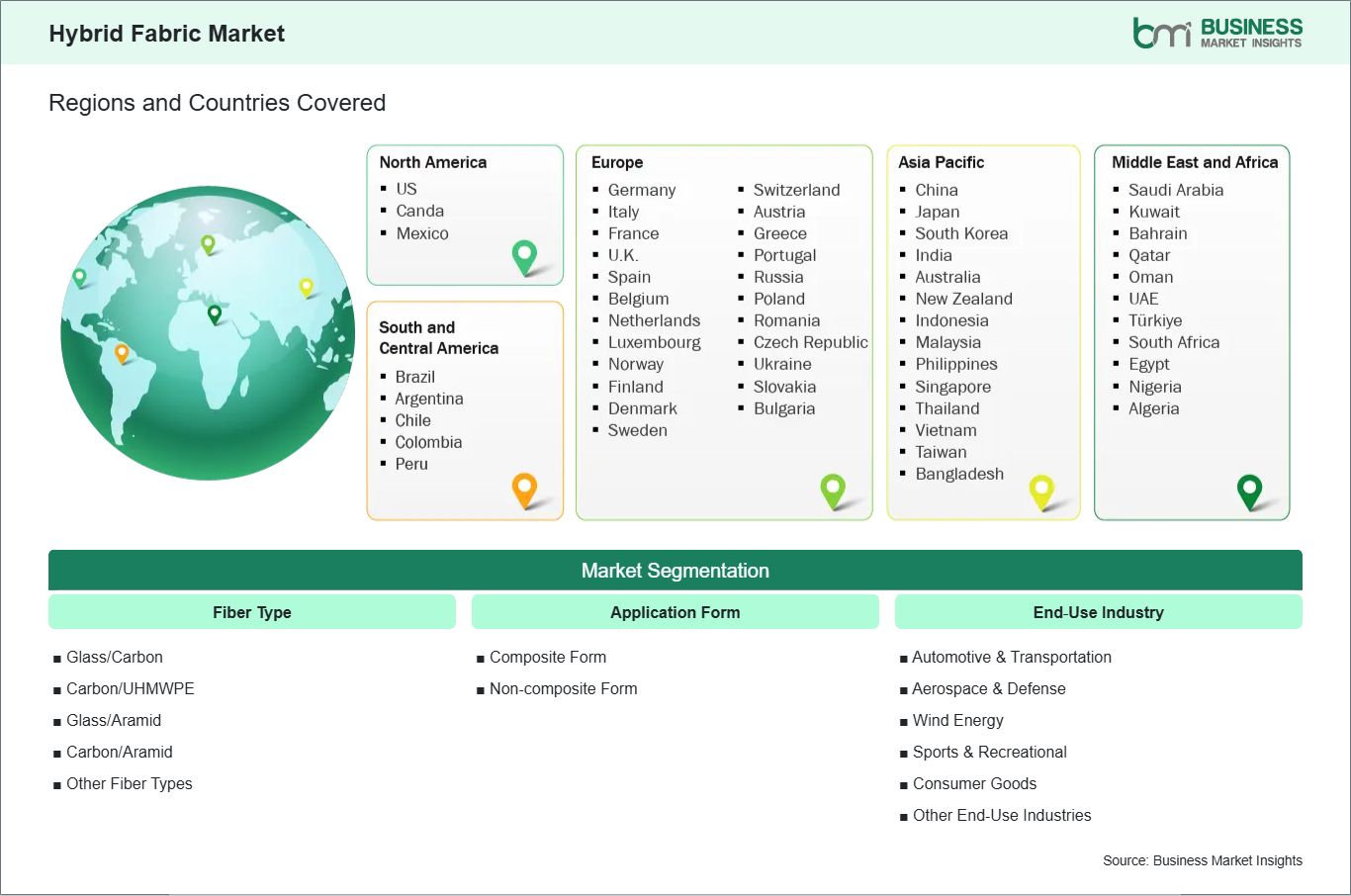
  • Fiber Type (Glass/Carbon, Carbon/UHMWPE, Glass/Aramid, Carbon/Aramid, Other Fiber Types)
  • Application Form (Composite Form, Non-composite Form)
  • End-Use Industry (Automotive & Transportation, Aerospace & Defense, Wind Energy, Sports & Recreational, Consumer Goods, Other End-Use Industries)

No. of Pages: 380
Report Code: BMIPUB00033979
Category: Chemicals and Materials
Hybrid Fabric Market

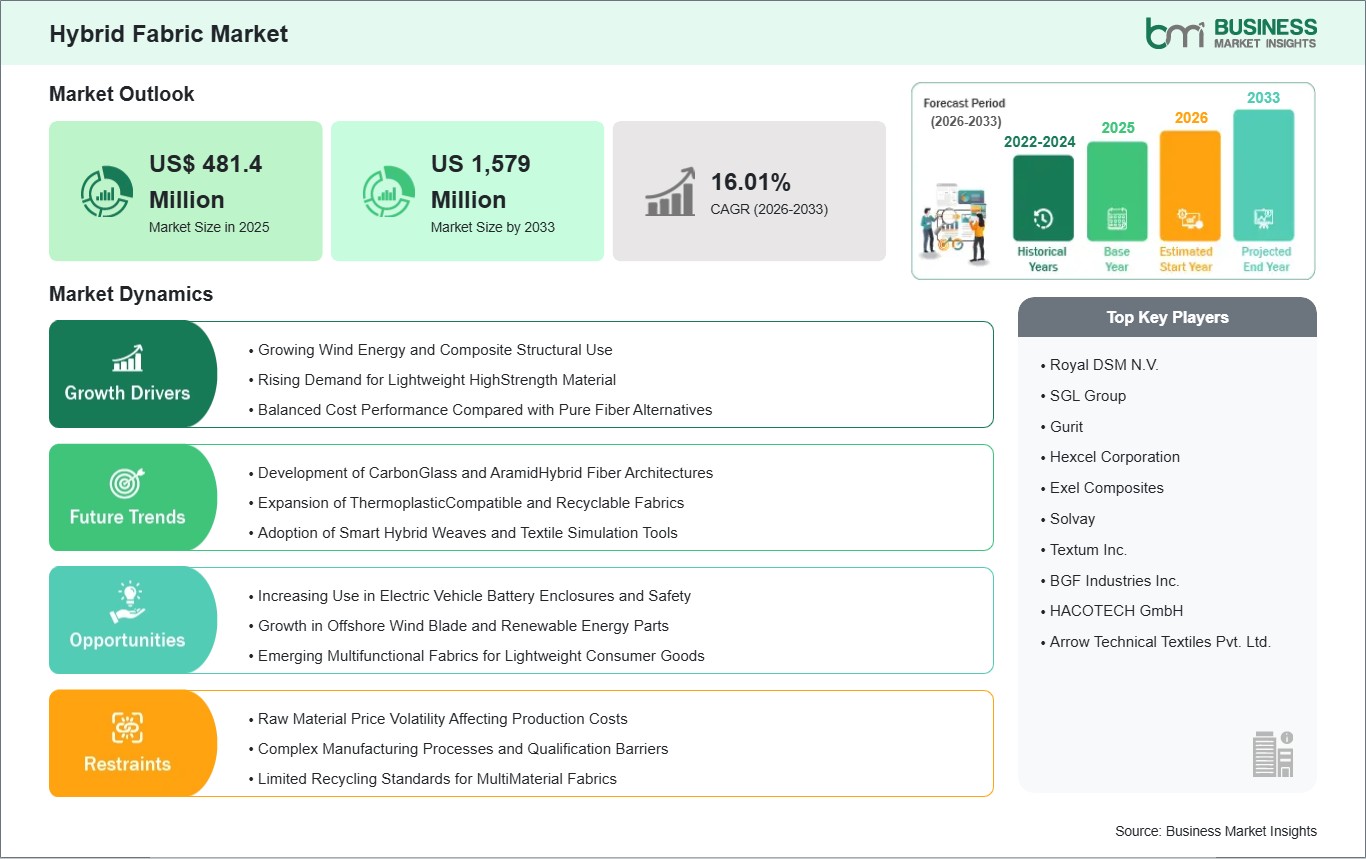
The Hybrid Fabric Market size is expected to reach US$ 1,579 Million by 2033 from US$ 481.4 Million in 2025. The market is estimated to record a CAGR of 16.01% from 2026 to 2033.

Executive Summary and Global Market Analysis:

The global hybrid fabric market represents a dynamic segment of the textile and materials industry, combining different fibers or materials to achieve properties that are not possible with a single fabric type. Hybrid fabrics are engineered to integrate characteristics such as strength, elasticity, breathability, moisture management, and thermal regulation into one material, making them highly versatile for multiple applications. Industries leveraging hybrid fabrics range from apparel, sportswear, and outdoor gear to automotive interiors, industrial safety equipment, and healthcare textiles. The unique combination of natural and synthetic fibers, or layered and coated materials, enables manufacturers to create fabrics that meet specific functional and aesthetic requirements while providing durability and comfort.

The market for performance-oriented textile products and the increasing trend towards multi-functional materials are the key factors driving the market. Consumers, as well as industries, are looking for textile products that not only provide comfort, durability, and protection but also help in the optimization of product efficiency through the development of lightweight, breathable, and robust hybrid textile materials. The development of better fiber technology, weaving techniques, and fabric finishing has also improved the ability of hybrid textile materials to provide solutions for niche applications. However, the complex nature of the manufacturing process and the increased cost of production may also create challenges for the development of hybrid textile materials, as the integration of various materials may require sophisticated machinery. Nevertheless, the product is gaining popularity due to its multi-functionality.

Hybrid Fabric Market - Strategic Insights:

global-market-strategic-framework
Get more information on this report

Hybrid Fabric Market Segmentation Analysis:

Key segments that contributed to the derivation of the hybrid fabric market analysis are fiber type, application form, and end‑user industry.

  • By fiber type, the hybrid fabric market is segmented into Glass/Carbon, Carbon/UHMWPE, Glass/Aramid, Carbon/Aramid, and Other Fiber Types. The Glass/Carbon subsegment dominated the market in 2025.
  • Based on application form, the hybrid fabric market is classified into Composite Form and Non‑composite Form. The Composite Form subsegment dominated the market in 2025.
  • In terms of end‑use industry, the hybrid fabric market is divided into Automotive & Transportation, Aerospace & Defense, Wind Energy, Sports & Recreational, Consumer Goods, and Other End‑Use Industries. The Automotive & Transportation subsegment dominated the market in 2025.

Hybrid Fabric Market Drivers and Opportunities:

Growing Wind Energy and Composite Structural Use

The global demand for hybrid fabrics is being significantly driven by the wind energy sector and the expanding use of composite structural components across industries. Hybrid fabrics, which combine the strength and flexibility of multiple fibers, are increasingly applied in wind turbine blades to improve mechanical performance, reduce weight, and enhance durability. The lightweight yet strong nature of these fabrics enables turbines to achieve greater efficiency and withstand high wind loads, extending operational life and reducing maintenance requirements. This has made hybrid fabrics a preferred material for manufacturers of next-generation wind energy infrastructure worldwide.

Beyond renewable energy, the use of hybrid fabrics is also seen in a wide range of composite materials, which are used for a number of applications, including aerospace, marine, and industrial uses. The high strength-to-weight ratio of the composite materials enables the replacement of other materials, including metals, with composite materials, which are lighter and more robust. This enables the enhancement of energy efficiency in a number of applications. For example, the composite materials, including hybrid fabrics, are used in aircraft interiors, protective panels, and marine vessels, which offer high impact resistance and flexibility while maintaining structural integrity at extreme operating conditions.

The adoption of hybrid fabrics is further supported by global trends toward sustainable construction and lightweight engineering. Hybrid fabrics enable designers to create complex geometries, optimize material usage, and achieve high performance with reduced environmental impact. Their ability to integrate seamlessly with resins and other composite matrices also allows for innovative solutions in modular construction, protective equipment, and industrial frameworks. As industries worldwide increasingly focus on efficiency, durability, and sustainability, hybrid fabrics have become a critical material for reinforcing composite structures across diverse sectors.

Increasing Use in Electric Vehicle Battery Enclosures and Safety

The electric vehicle (EV) revolution is driving growing adoption of hybrid fabrics in battery enclosures and safety-critical components. EVs require materials that can combine structural rigidity with energy absorption to protect high-voltage battery packs and ensure passenger safety during collisions. Hybrid fabrics are used to reinforce battery housings, crash zones, and impact-resistant panels, providing lightweight yet highly durable solutions that help manufacturers meet stringent safety regulations. Their ability to absorb energy while maintaining form under stress is essential for protecting both battery systems and vehicle occupants.

In addition to battery enclosures, hybrid fabrics are being integrated into various EV components, including door panels, interior reinforcements, and underbody protection. Their lightweight properties help reduce overall vehicle mass, contributing to extended driving range and improved efficiency without compromising structural integrity. The adaptability of hybrid fabrics to different resin systems and manufacturing processes, such as injection molding or resin transfer molding, allows automotive engineers to design components with precise mechanical performance tailored to EV requirements. This flexibility is critical as automakers strive to balance safety, performance, and efficiency in next-generation vehicles.

Moreover, the global expansion of EV manufacturing and battery technologies is creating broader opportunities for hybrid fabrics in energy storage and transport safety applications. Beyond cars, hybrid fabrics are used in electric buses, commercial delivery vehicles, and battery modules for stationary energy storage, highlighting their versatility in protecting energy-dense systems. By providing high strength, impact resistance, and weight reduction, hybrid fabrics are emerging as an essential material for the safe, efficient, and sustainable development of electric mobility solutions worldwide.

Hybrid Fabric Market Size and Share Analysis:

The hybrid fabric market is experiencing steady growth, with market size and share analysis reflecting evolving treatment preferences and competitive dynamics among key players. The report evaluates important subsegments categorized within fiber type, application form, and end‑user industry, highlighting their respective contributions to overall market performance.

By fiber type, the Glass/Carbon subsegment dominated the Hybrid Fabric market in 2025. Glass/Carbon fibers offer an optimal combination of strength, stiffness, and lightweight properties, making them highly suitable for advanced engineering and industrial applications, driving their widespread adoption.

Based on application form, the Composite Form subsegment dominated the Hybrid Fabric market in 2025. Composite forms provide enhanced mechanical performance, durability, and design flexibility, supporting strong demand in structural and high-performance applications.

In terms of end-use industry, the Automotive & Transportation subsegment dominated the Hybrid Fabric market in 2025. Automotive and transportation applications require lightweight, high-strength materials to improve fuel efficiency and safety, reinforcing the dominance of this segment in the market.

Hybrid Fabric Market Report Highlights:

Report Attribute Details
Market size in 2025 US$ 481.4 Million
Market Size by 2033 US 1,579 Million
Global CAGR (2026 - 2033)16.01%
Historical Data 2022-2024
Forecast period 2026-2033
Segments Covered By Fiber Type
  • Glass/Carbon
  • Carbon/UHMWPE
  • Glass/Aramid
  • Carbon/Aramid
  • Other Fiber Types
By Application Form
  • Composite Form
  • Non-composite Form
By End-Use Industry
  • Automotive & Transportation
  • Aerospace & Defense
  • Wind Energy
  • Sports & Recreational
  • Consumer Goods
  • Other End-Use Industries
Regions and Countries Covered
North America US, Canada, Mexico
Europe Belgium, Austria, Finland, Denmark, Greece, Poland, Romania, Russia, Ukraine, Czech Republic, Slovakia, Bulgaria, Italy, Luxembourg, Germany, Switzerland, France, Netherlands, Norway, Portugal, Spain, Sweden, United Kingdom
Asia-Pacific Australia, China, India, Japan, South Korea, Indonesia, Malaysia, Philippines, Singapore, Thailand, Vietnam, Bangladesh, New Zealand, Taiwan
South and Central America Brazil, Argentina, Peru, Chile, Colombia
Middle East and Africa Bahrain, Kuwait, Oman, Qatar, Saudi Arabia, United Arab Emirates, Turkiye, South Africa, Egypt, Algeria, Nigeria
Market leaders and key company profiles
  • Royal DSM N.V.
  • SGL Group
  • Gurit
  • Hexcel Corporation
  • Exel Composites
  • Solvay
  • Textum Inc.
  • BGF Industries Inc.
  • HACOTECH GmbH
  • Arrow Technical Textiles Pvt. Ltd.
Get more information on this report

Hybrid Fabric Market Report Coverage and Deliverables:

The "Hybrid Fabric Market Size and Forecast (2022 - 2033)" report provides a detailed analysis of the market covering below areas:

  • Hybrid Fabric market size and forecast at global, regional, and country levels for all the key market segments covered under the scope
  • Hybrid Fabric market trends, as well as drivers, restraints, and opportunities
  • Hybrid Fabric market analysis covering key trends, regional framework, major players, regulations, and recent developments
  • Industry landscape and competition analysis covering market concentration, heat map analysis, prominent players, and recent developments for the Hybrid Fabric market
  • Detailed company profiles, including SWOT analysis

Hybrid Fabric Market Geographic Insights:

The geographical scope of the Hybrid Fabric market report is divided into five regions: North America, Asia Pacific, Europe, Middle East & Africa, and South & Central America. The Hybrid Fabric market in North America is expected to grow during the forecast period.

North America leads the global market for hybrid fabric, owing to its high demand, coupled with advanced textile manufacturing capabilities. Hybrid fabric has a wide range of applications, including clothing and sportswear. In clothing, hybrid fabric has become popular for sportswear, clothing for outdoor activities, and other specialized clothing for athletes. Hybrid fabric provides a competitive advantage for sportswear due to its moisture-wicking and stretchable properties. In addition, high-end clothing utilizes hybrid fabrics for fashion clothing, meeting consumer demands for functional clothing. In the automotive sector, for instance, automotive interior parts such as car seats, headliners, and insulation materials are made using hybrid fabrics.

The healthcare and safety sector also uses hybrid materials for clothing, drapes, and surfaces, where the performance of the fabric is of utmost importance. The presence of research centers and textile innovation hubs in the region ensures the development of new types of hybrids, making the North American market an important player in the global hybrid fabric market. The rise of the concept of sustainability has also affected the development of hybrids, with manufacturers seeking to develop environmentally friendly hybrids. The diversity of the market, the level of technology, and the level of consumer demand make the North American market the leader in the global market.

global-market-geography
Get more information on this report

Hybrid Fabric Market Research Report Guidance:

  • The report includes qualitative and quantitative data in the Hybrid Fabric market across fiber type, application form, end‑user industry, and geography.
  • The report starts with the key takeaways (chapter 2), highlighting the key trends and outlook of the Hybrid Fabric market.
  • Chapter 3 focuses on the research methodology of the study.
  • Chapter 4 includes ecosystem analysis.
  • Chapter 5 highlights the major industry dynamics in the Hybrid Fabric market, including factors that are driving the market, prevailing deterrents, potential opportunities, as well as future trends. Impact analysis of these drivers and restraints is also covered in this section.
  • Chapter 6 discusses the Hybrid Fabric market scenario, in terms of historical market revenues, and forecast till the year 2033.
  • Chapters 7 to 10 cover the Hybrid Fabric market segments by fiber type, application form, end‑user industry, and geography across North America, Europe, Asia Pacific, Middle East and Africa, and South and Central America. They cover the market volume, revenue forecast, and factors driving the market.
  • Chapter 11 describes the competitive analysis with the heat map analysis for the key players operating in the market.
  • Chapter 12 describes the industry landscape analysis. It provides detailed descriptions of business activities such as market initiatives, new developments, mergers, and joint ventures globally, along with a competitive landscape.
  • Chapter 13 provides detailed profiles of the major companies operating in the Hybrid Fabric market. Companies have been profiled on the basis of their key facts, business descriptions, products, financial overview, SWOT analysis, and key developments.
  • Chapter 14, i.e., the appendix, is inclusive of a brief overview of the company, list of abbreviations, and disclaimer.

Hybrid Fabric Market News and Key Development:

The hybrid fabric market is evaluated by gathering qualitative and quantitative data post primary and secondary research, which includes important corporate publications, association data, and databases. A few of the key developments in the hybrid fabric market are:

  • In May 2025, Hexcel Corporation and Specialty Materials announced that they introduced a new high modulus, high‑compression unidirectional prepreg material by combining Hexcel’s high‑modulus carbon fiber with boron fiber (Hy‑Bor technology), significantly enhancing compression strength and opening up expanded applications in aerospace, defense, and space composite systems.
  • In September 2024, Hexcel Corporation announced that it launched its new HexForce 1K woven reinforcement fabric, a lightweight composite fabric leveraging proprietary HexTow AS4C carbon fiber to enable high‑strength, low‑weight composites for aerospace, automotive, and industrial applications.

Key Sources Referred:

  • International Organization for Standardization (ISO)
  • American Society for Testing and Materials (ASTM International)
  • Bureau of Indian Standards (BIS)
  • Environmental Protection Agency (EPA), USA
  • European Chemicals Agency (ECHA)
  • Central Pollution Control Board (CPCB), India
  • Ministry of Chemicals and Fertilizers, India
  • American Chemistry Council (ACC)
  • Indian Chemical Council (ICC)
  • European Chemical Industry Council (Cefic)
  • Specialty Chemical Association of India (SCAI)
  • Company Websites
  • Company Annual Reports
  • Company Investor Presentations
The List of Companies - Hybrid Fabric Market
  • Royal DSM N.V.
  • SGL Group
  • Gurit
  • Hexcel Corporation
  • Exel Composites
  • Solvay
  • Textum Inc.
  • BGF Industries Inc.
  • HACOTECH GmbH
  • Arrow Technical Textiles Pvt. Ltd.
Frequently Asked Questions
How big is the Hybrid Fabric Market?

The Hybrid Fabric Market is valued at US$ 481.4 Million in 2025, it is projected to reach US 1,579 Million by 2033.

What is the CAGR for Hybrid Fabric Market by (2026 - 2033)?

As per our report Hybrid Fabric Market, the market size is valued at US$ 481.4 Million in 2025, projecting it to reach US 1,579 Million by 2033. This translates to a CAGR of approximately 16.01% during the forecast period.

What segments are covered in this report?

The Hybrid Fabric Market report typically cover these key segments-

  • Fiber Type (Glass/Carbon, Carbon/UHMWPE, Glass/Aramid, Carbon/Aramid, Other Fiber Types)
  • Application Form (Composite Form, Non-composite Form)
  • End-Use Industry (Automotive & Transportation, Aerospace & Defense, Wind Energy, Sports & Recreational, Consumer Goods, Other End-Use Industries)

What is the historic period, base year, and forecast period taken for Hybrid Fabric Market?

The historic period, base year, and forecast period can vary slightly depending on the specific market research report. However, for the Hybrid Fabric Market report:

  • Historic Period : 2022-2024
  • Base Year : 2025
  • Forecast Period : 2026-2033
  • Who are the major players in Hybrid Fabric Market?

    The Hybrid Fabric Market is populated by several key players, each contributing to its growth and innovation. Some of the major players include:

  • Royal DSM N.V.
  • SGL Group
  • Gurit
  • Hexcel Corporation
  • Exel Composites
  • Solvay
  • Textum Inc.
  • BGF Industries Inc.
  • HACOTECH GmbH
  • Arrow Technical Textiles Pvt. Ltd.
  • Who should buy this report?

    The Hybrid Fabric Market report is valuable for diverse stakeholders, including:

    • Investors: Provides insights for investment decisions pertaining to market growth, companies, or industry insights. Helps assess market attractiveness and potential returns.
    • Industry Players: Offers competitive intelligence, market sizing, and trend analysis to inform strategic planning, product development, and sales strategies.
    • Suppliers and Manufacturers: Helps understand market demand for components, materials, and services related to concerned industry.
    • Researchers and Consultants: Provides data and analysis for academic research, consulting projects, and market studies.
    • Financial Institutions: Helps assess risks and opportunities associated with financing or investing in the concerned market.

    Essentially, anyone involved in or considering involvement in the Hybrid Fabric Market value chain can benefit from the information contained in a comprehensive market report.

    Available Report Formats

    pdf-format excel-format pptx-format
    Buy Now
    Sales Assistance
    +1 646 791 7070 (US & UK)
    Customization Form

    Please tell us your area of interest
    (Market Segments/ Regions and Countries/ Companies)