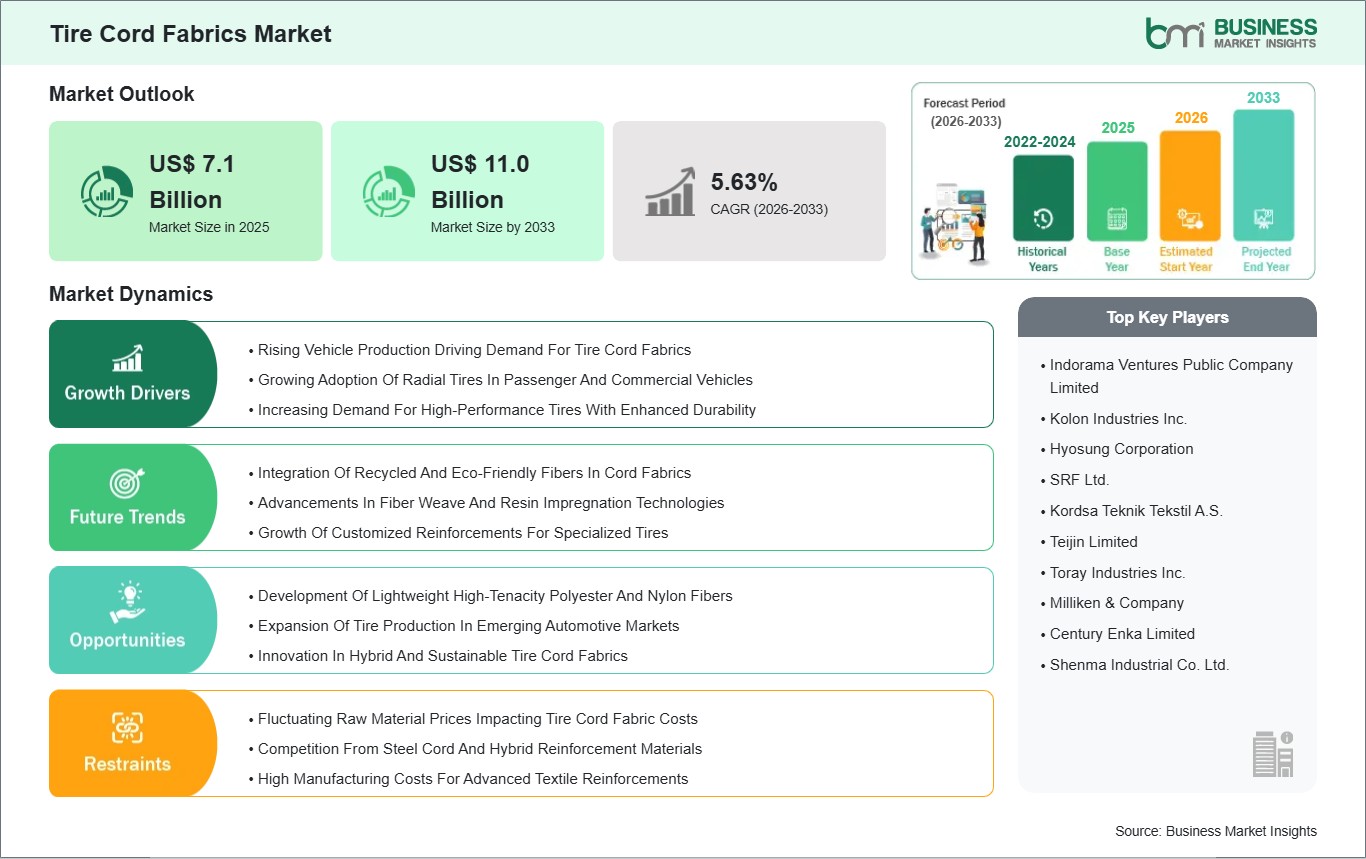
The Tire Cord Fabrics Market size is expected to reach US$ 11. billion by 2033 from US$ 7.1 billion in 2025. The market is estimated to record a CAGR of 5.63% from 2026 to 2033.
The global tire cord fabrics market includes high-strength textile reinforcements, which tire manufacturers use to construct tire carcass and belt plies that deliver structural integrity, load-bearing capacity and resistance to fatigue and dimensional stability. Tire cord fabrics, which use polyester, nylon and aramid as materials, serve as crucial components in contemporary tires because they determine tire durability, rolling resistance and driving performance and safety features. The fabrics serve as the essential foundation for radial tires, which manufacturers use in passenger cars, light trucks, heavy vehicles and off-the-road (OTR) applications. Tire manufacturers create tire cord fabrics that enable tires to handle increasing forces while developing lighter tires that provide better fuel efficiency.
North America emerges as a dominant region within the global market, supported by a robust automotive manufacturing base, high vehicle ownership, and early adoption of performance‑oriented tire technology. The United States and Canada are key contributors, with significant demand from light vehicles, commercial fleets, and specialty tires for industrial and agricultural applications. Tire manufacturers in the region focus on performance features, which include better mileage, reduced rolling resistance and increased durability, so they require advanced polyester and nylon cord fabrics that meet their performance needs.
The regional market experiences strong demand because vehicle owners search for tires that last longer and provide dependable performance, while the established service network supports this demand throughout the area. The global tire cord fabrics market shows growth because vehicle production increases, and emerging markets develop their automotive fleets, and the industry adopts radial tires, which need stronger materials than cross-ply tires. The demand for tire solutions that provide both performance and cost efficiency has increased because of urban growth and higher consumer travel needs, and changes in freight transportation requirements.
The market experiences challenges because of unpredictable raw material prices and the need to compete with other reinforcement methods, which use steel cord for specific high-performance situations and new hybrid materials. Manufacturers are responding by investing in research and development to enhance the mechanical properties, durability, and thermal stability of textile reinforcements. The development of high‑tenacity polyester materials, polyamide alternatives and hybrid fiber designs has created tire cord fabrics that satisfy all safety requirements and performance standards for different tire types. The material selection process now includes sustainability factors as some companies investigate recycling and bio-based fiber options, which provide performance benefits and lower environmental effects throughout the product's life span.
The tire cord fabrics market continues to play a crucial role in developing tire performance throughout the world, despite facing various obstacles.

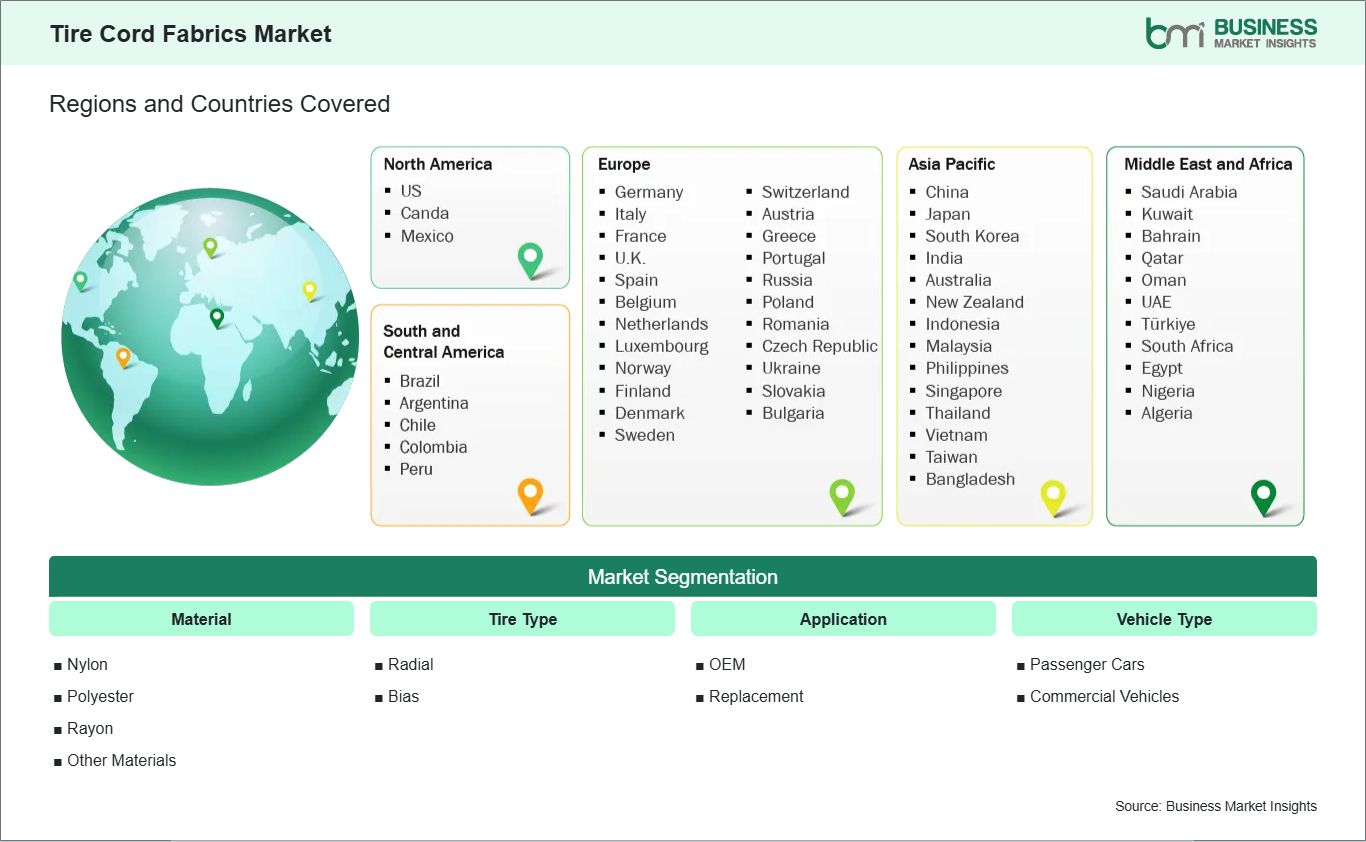
Key segments that contributed to the derivation of the tire cord fabrics market analysis are material, tire type, application, and vehicle type.
The global increase in vehicle production has significantly elevated demand for tire cord fabrics, as these reinforcements are essential in radial tire construction for passenger cars, commercial trucks, and specialty off‑the‑road vehicles. As automotive manufacturers ramp up output in response to growing consumer mobility needs in developed and emerging markets alike, the demand for high‑strength, durable textile reinforcements grows in parallel. Radial tire designs — now standard in most regions due to their superior performance and fuel efficiency — require advanced polyester and nylon cord fabrics to maintain load‑bearing capacity and dimensional stability under varied driving conditions.
In Asia Pacific, where China, India, and Southeast Asian countries lead vehicle production growth, OEMs and tire manufacturers are increasingly sourcing tire cord fabrics locally to support just‑in‑time production and reduce supply chain lead times. This regional production expansion aligns with growing exports of vehicles and automotive components, amplifying internal demand for reliable cord fabric supplies. North America and Europe also contribute substantially to global demand, driven by established automotive hubs that emphasize performance and safety standards in tire design.
Emerging markets in Latin America, the Middle East, and Africa are catching up as vehicle ownership rates rise and infrastructure investments advance. In these regions, the demand for commercial vehicles, agricultural machinery, and motorcycle tires — all of which utilize cord‑reinforced designs — supports broader market growth. Across global automotive sectors, rising production directly translates into higher volumes of tire cord fabrics, underlying the material’s critical role in tire manufacturing worldwide.
Innovation in high‑tenacity polyester and nylon fibers is reshaping the global tire cord fabrics market by enabling the production of reinforcements that offer superior strength, durability, and reduced weight. Lightweight but high‑performance fibers contribute to overall tire efficiency by lowering unsprung mass and improving fuel economy without compromising safety or load‑bearing capabilities. Material scientists and manufacturers in North America and Europe have been refining fiber structures, molecular orientation, and polymer blends to achieve optimal tensile strength and elongation profiles tailored for demanding tire applications.
In Asia Pacific, tire cord producers are investing in advanced fiber technologies that cater to the region’s rapid automotive and commercial vehicle growth. China and Japan, in particular, are home to specialized fiber manufacturers collaborating with tire OEMs to fine‑tune polyester and nylon grades that deliver consistent performance across various climatic conditions and road surfaces. These developments help tires maintain integrity under thermal stress and cyclic loading, which are critical parameters for durability and tread life.
Additionally, hybrid fiber formulations — such as polyester‑nylon blends or fibers combined with reinforcing coatings — are gaining traction as they balance cost, mechanical performance, and processability in high‑volume production environments. By improving fiber compatibility with rubber matrices and resin systems, manufacturers can enhance adhesion and fatigue resistance in cord‑reinforced tire structures. Advances in fiber chemistry and manufacturing processes are thus pivotal in expanding the capabilities of modern tire cord fabrics, enabling tires that meet increasingly stringent performance, weight, and longevity requirements across global markets.

The tire cord fabrics market demonstrates steady growth, with size and share analysis highlighting evolving trends and competitive dynamics among key players. The report examines subsegments categorized within material, tire type, application, and vehicle type, offering insights into their contribution to overall market performance.
By material, the polyester subsegment dominated the market in 2025, driven by its high strength, dimensional stability, and suitability for radial tire reinforcement.
Based on tire type, the radial subsegment dominated the market in 2025, driven by superior performance, longer life, fuel efficiency, and better ride comfort compared to bias tires.
By application, the OEM subsegment dominated the market in 2025, driven by increasing vehicle production and the integration of advanced tire technologies by manufacturers.
In terms of vehicle type, the passenger cars subsegment dominated the market in 2025, driven by growing vehicle ownership and rising consumer demand for comfort and efficiency.
| Report Attribute | Details |
|---|---|
| Market size in 2025 | US$ 7.1 Billion |
| Market Size by 2033 | US$ 11.0 Billion |
| Global CAGR (2026 - 2033) | 5.63% |
| Historical Data | 2022-2024 |
| Forecast period | 2026-2033 |
| Segments Covered | By Material
|
|
Regions and Countries Covered
| |
| North America | US, Canada, Mexico |
| Europe | Belgium, Austria, Finland, Denmark, Greece, Poland, Romania, Russia, Ukraine, Czech Republic, Slovakia, Bulgaria, Italy, Luxembourg, Germany, Switzerland, France, Netherlands, Norway, Portugal, Spain, Sweden, United Kingdom |
| Asia-Pacific | Australia, China, India, Japan, South Korea, Indonesia, Malaysia, Philippines, Singapore, Thailand, Vietnam, Bangladesh, New Zealand, Taiwan |
| South and Central America | Brazil, Argentina, Peru, Chile, Colombia |
| Middle East and Africa | Bahrain, Kuwait, Oman, Qatar, Saudi Arabia, United Arab Emirates, Turkiye, South Africa, Egypt, Algeria, Nigeria |
| Market leaders and key company profiles |
|
The "Tire Cord Fabrics Market Size and Forecast (2022 - 2033)" report provides a detailed analysis of the market covering below areas:
The geographical scope of the Tire Cord Fabrics Market report is divided into North America, Asia Pacific, Europe, Middle East & Africa, and South & Central America. North America held the largest share in 2025.
The global tire cord fabrics market sees North America as its top market region because of its developed automotive sector and multiple original equipment manufacturers and extensive automobile ownership, while the United States and Canada markets require high-performance radial tires that use polyester, nylon and aramid cord materials. The light vehicle and commercial truck and off-the-road sectors of the region maintain constant demand for advanced textile reinforcements because they need products that provide durability, load-bearing capacity and fuel efficiency.
The Asia Pacific region experiences growth because of rapid urbanization and increased vehicle production in China, India and Japan and the growing adoption of radial tires which focus on lightweight and cost-efficient cord fabrics for both passenger cars and commercial fleets. The region gains advantages from its increasing automotive export activities, which create a need for standardized tire reinforcements that match international market requirements.
European countries show strong adoption of high-performance tire cord fabrics because safety and environmental regulations demand strict compliance, while German, French, and Italian premium automotive production, together with consumer demand for durable, fuel-efficient tires, drive market growth. European manufacturers now use high-tenacity fibers and hybrid cord structures to create products that meet different performance needs found in passenger vehicles, commercial vehicles and specialty vehicles.
The Middle East & Africa region, which possesses a lower total market size, experiences expansion because of infrastructure projects, increasing off-road vehicle usage and growing needs for durable tires that can handle desert and rugged environments, which benefit from local tire production that serves industrial and agricultural needs.
The automotive industry in South & Central America, which Brazil and Mexico lead, experiences growth from increasing automotive manufacturing together with rising demand for aftermarket products, especially for radial truck and passenger car tires that need dependable and affordable textile materials. Manufacturers in all regions pursue new developments through their research on different fiber materials and weaving methods and resin transmission methods, which will improve material strength, fatigue resistance and dimensional stability, while they also investigate sustainable solutions that utilize recycled fibers.
North America leads the market because its regional dynamics create a competitive edge, while other regions drive global market growth through their specific requirements and uses.

The Tire Cord Fabrics Market is evaluated by gathering qualitative and quantitative data post primary and secondary research, which includes important corporate publications, association data, and databases. A few of the key developments in the tire cord fabrics market are:
The Tire Cord Fabrics Market is valued at US$ 7.1 Billion in 2025, it is projected to reach US$ 11.0 Billion by 2033.
As per our report Tire Cord Fabrics Market, the market size is valued at US$ 7.1 Billion in 2025, projecting it to reach US$ 11.0 Billion by 2033. This translates to a CAGR of approximately 5.63% during the forecast period.
The Tire Cord Fabrics Market report typically cover these key segments-
The historic period, base year, and forecast period can vary slightly depending on the specific market research report. However, for the Tire Cord Fabrics Market report:
The Tire Cord Fabrics Market is populated by several key players, each contributing to its growth and innovation. Some of the major players include:
The Tire Cord Fabrics Market report is valuable for diverse stakeholders, including:
Essentially, anyone involved in or considering involvement in the Tire Cord Fabrics Market value chain can benefit from the information contained in a comprehensive market report.
Please tell us your area of interest
(Market Segments/ Regions and Countries/ Companies)