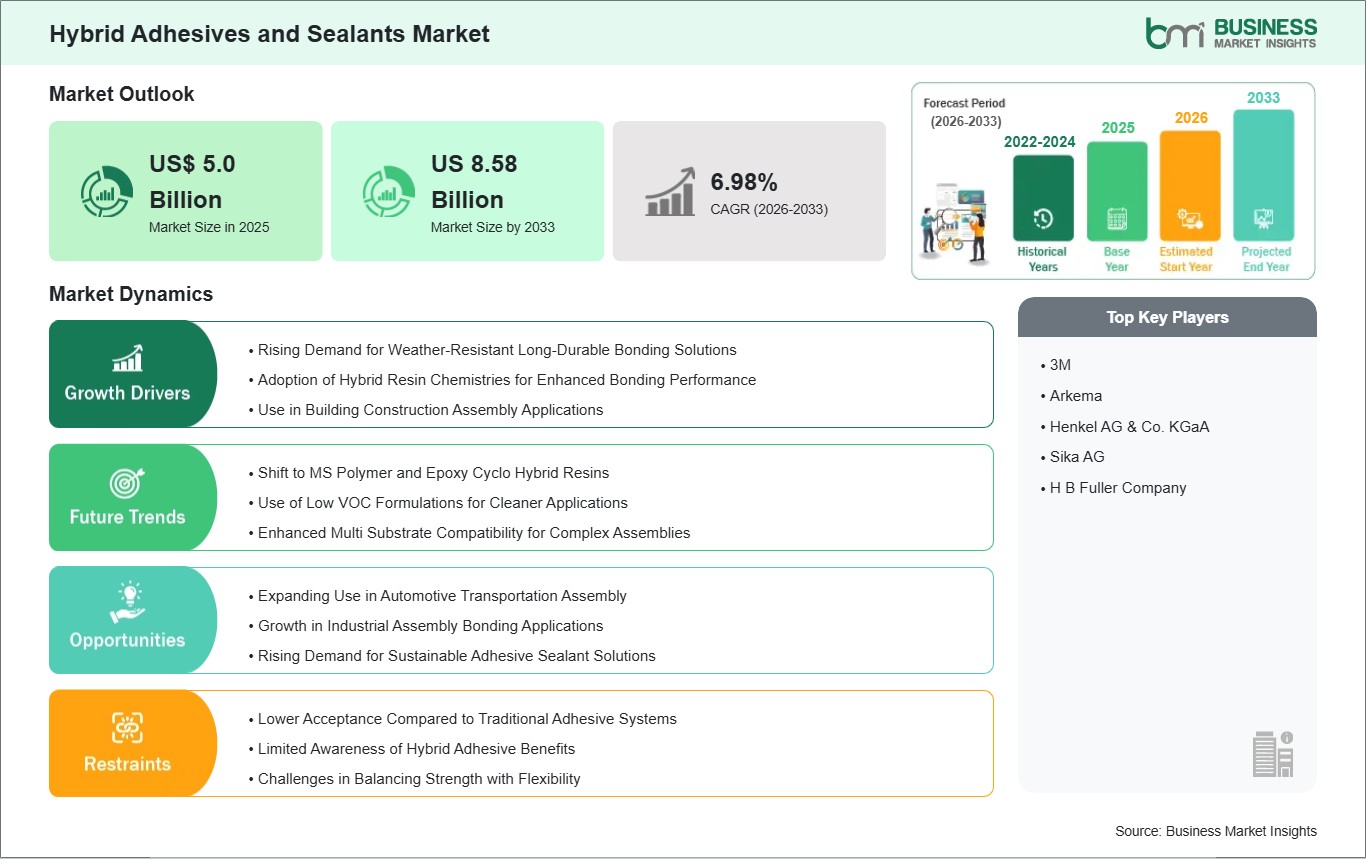
The Hybrid Adhesives and Sealants Market size is expected to reach US$ 8.58 Billion by 2033 from US$ 5.0 Billion in 2025. The market is estimated to record a CAGR of 6.98% from 2026 to 2033.
The global hybrid adhesives and sealants market is an advanced segment of modern bonding and sealing products that provide enhanced benefits of various chemistries to achieve high-performance bonding in various applications. Hybrid adhesives combine the advantages of various adhesives, such as polyurethane, silane-modified polymer, or epoxy components, to offer high bonding strength, chemical resistance, thermal stability, and flexibility. Similarly, hybrid sealants offer high bonding strength, bonding capabilities, and gap-filling properties while maintaining adhesion to various substrates. These products find extensive application in various industries such as construction, automotive, aerospace, electronics, and manufacturing industries, where conventional adhesives or sealants fail to provide sufficient bonding strength, durability, and resistance to various environmental factors.
The driving factor for this market can be attributed to the increasing need for diverse products that can offer structural reliability along with ease of application, especially for industries that are increasingly using light materials and module-based construction techniques. Hybrid adhesives and sealants provide manufacturers with the scope to simplify the bonding process, reduce the number of materials used, and ensure reliability across various materials. Technological advancements have also helped these materials improve their overall functionality, including curing time, UV and moisture resistance, and the use of eco-friendly materials. However, the limitations associated with these materials include their high cost and complexity, as the chemical composition of these materials must be perfectly balanced to ensure consistency. Furthermore, users must be able to properly utilize these materials by understanding the application process, which may require specific training. Nevertheless, the overall advantages offered by these materials have ensured their increased acceptance across various sectors.

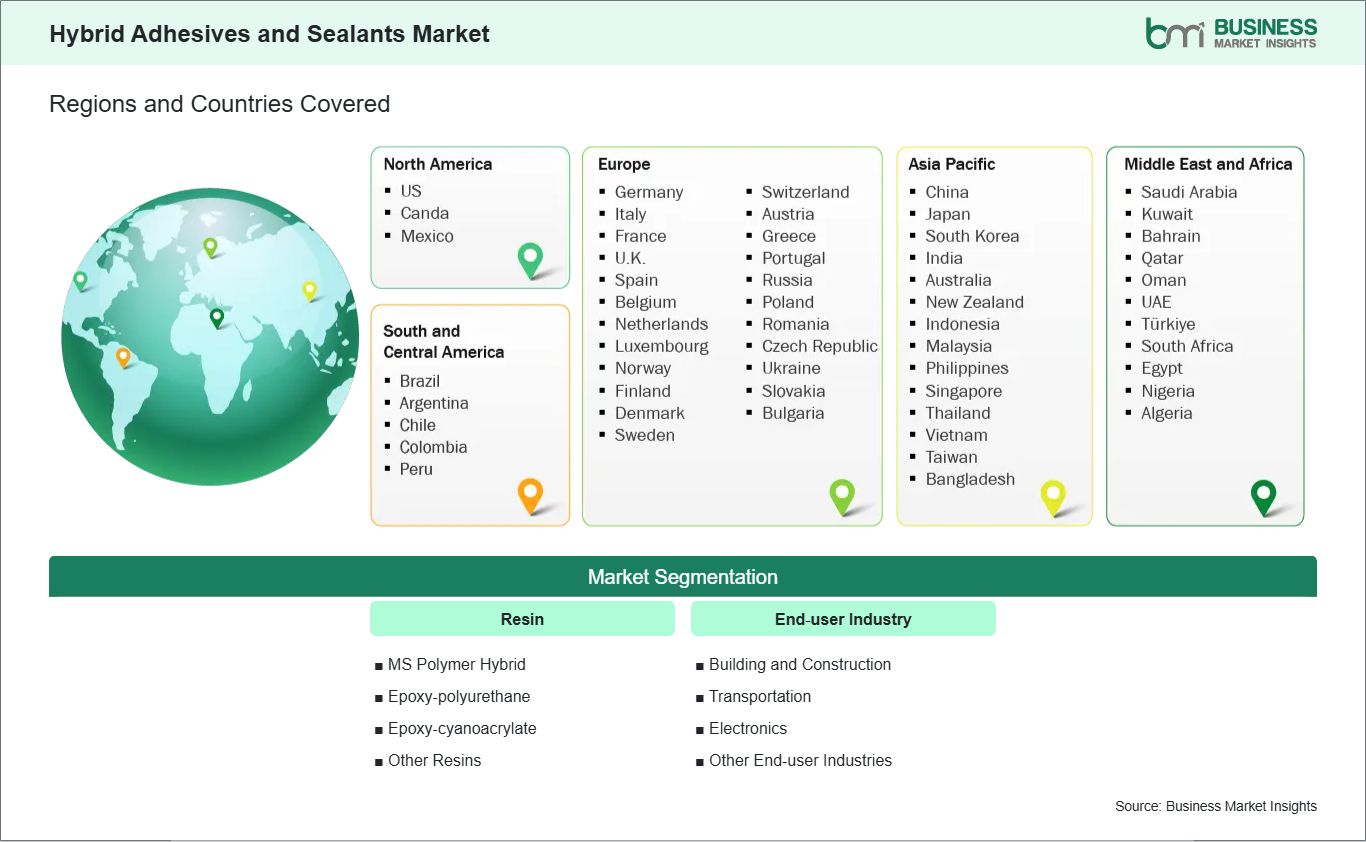
Key segments that contributed to the derivation of the hybrid adhesives and sealants market analysis are resin and end‑user industry.
The global market for hybrid adhesives and sealants has seen a rise in demand due to the necessity of using bonding agents that are resistant to environmental conditions. In the field of construction, marine, and infrastructure development, there is a need to use adhesives and bonding agents that are capable of withstanding extreme environmental conditions. In this regard, hybrid adhesives have proven to have the best bonding characteristics on different materials such as metals, plastics, and composites. This has seen the rise of the use of hybrid adhesives and sealants in different applications, especially in conditions where conventional adhesives are not able to withstand the environmental conditions.
In addition to this, these adhesives and sealants offer better mechanical properties and durability, which are important for both industrial and consumer applications. For example, in the construction industry, these products are used to bond façade materials, roof coverings, and window sections. In this case, the products offer the necessary durability required for the construction process. In other applications, like the marine industry, the products are used to offer resistance against water and chemical infiltration. This helps to ensure the products are used for applications like ship hulls, offshore structures, and recreational boats. In addition, the global need for resilient infrastructure and sustainable construction has increased the use of hybrid adhesives as a reliable solution for long-term performance.
Moreover, the focus on energy efficiency and the development of ‘green’ buildings has also helped the cause of hybrid adhesives. This is because these adhesives have the capacity to replace mechanical fasteners, thus eliminating the scope of leakage and the like. In the field of industrial manufacture, hybrid adhesives have also helped in the reduction of maintenance costs, as these adhesives are capable of withstanding vibrations and adverse weather conditions. As the world’s industries focus on the development of safe, sustainable, and durable products, hybrid adhesives and sealants are seen as the future of adhesives and sealants technology.
Hybrid adhesives and sealants are also gaining traction in the global automotive and transportation sectors due to their ability to enable lightweight, durable, and high-performance assembly. Modern vehicles require materials that can bond diverse substrates such as metals, plastics, and composites while providing structural strength, vibration damping, and corrosion resistance. Hybrid adhesives are increasingly replacing traditional mechanical fasteners, offering manufacturers a way to reduce vehicle weight, improve fuel efficiency, and maintain design flexibility. Their strong adhesion under dynamic loads ensures safety and reliability across automotive assemblies, including body panels, interior trim, and structural reinforcements.
The development of electric vehicles and advanced transportation solutions has further increased the rate of adoption of hybrid adhesives and sealants. The battery enclosures, chassis, and energy-absorbing areas of the vehicles are made with adhesives, which must possess both mechanical and environmental durability, such as resistance to temperature, moisture, and chemicals. The development of hybrid adhesives has provided the automotive sector with the perfect solution, as it allows the integration of components with the required durability for the protection of the vehicle’s electronics. The development of hybrid adhesives has, therefore, played an important role in the automotive sector’s shift towards energy-efficient, lighter, and safer vehicles.
In addition, the use of these adhesives is spreading to other transportation modes, including rail, aerospace, and commercial fleets. In these modes of transport, the light weight and durability of these adhesives play a crucial role. In addition, the capability of these adhesives to bond two different materials without affecting their integrity has shown immense benefits, especially in high-performance applications where materials are exposed to vibrations, thermal stress, and environmental elements. In all these modes of transport, the importance of using these adhesives and sealants has been acknowledged as a necessary part of modern assembly technologies.

The hybrid adhesives and sealants market is experiencing steady growth, with market size and share analysis reflecting evolving treatment preferences and competitive dynamics among key players. The report evaluates important subsegments categorized within resin and end‑user industry, highlighting their respective contributions to overall market performance.
By resin, the MS Polymer Hybrid subsegment dominated the Hybrid Adhesives and Sealants market in 2025. MS Polymer Hybrid resins offer excellent adhesion, flexibility, and durability across a wide range of substrates, driving their widespread adoption in industrial and commercial applications.
In terms of end-user industry, the Building and Construction subsegment dominated the Hybrid Adhesives and Sealants market in 2025. Building and construction applications demand strong, durable, and weather-resistant bonding solutions, reinforcing the dominance of this segment in the market.
| Report Attribute | Details |
|---|---|
| Market size in 2025 | US$ 5.0 Billion |
| Market Size by 2033 | US 8.58 Billion |
| Global CAGR (2026 - 2033) | 6.98% |
| Historical Data | 2022-2024 |
| Forecast period | 2026-2033 |
| Segments Covered | By Resin
|
|
Regions and Countries Covered
| |
| North America | US, Canada, Mexico |
| Europe | Belgium, Austria, Finland, Denmark, Greece, Poland, Romania, Russia, Ukraine, Czech Republic, Slovakia, Bulgaria, Italy, Luxembourg, Germany, Switzerland, France, Netherlands, Norway, Portugal, Spain, Sweden, United Kingdom |
| Asia-Pacific | Australia, China, India, Japan, South Korea, Indonesia, Malaysia, Philippines, Singapore, Thailand, Vietnam, Bangladesh, New Zealand, Taiwan |
| South and Central America | Brazil, Argentina, Peru, Chile, Colombia |
| Middle East and Africa | Bahrain, Kuwait, Oman, Qatar, Saudi Arabia, United Arab Emirates, Turkiye, South Africa, Egypt, Algeria, Nigeria |
| Market leaders and key company profiles |
|
The "Hybrid Adhesives and Sealants Market Size and Forecast (2022 - 2033)" report provides a detailed analysis of the market covering below areas:
The geographical scope of the Hybrid Adhesives and Sealants market report is divided into five regions: North America, Asia Pacific, Europe, Middle East & Africa, and South & Central America. The Hybrid Adhesives and Sealants market in North America is expected to grow during the forecast period.
North America dominates the global market for hybrid adhesives and sealants due to its advanced industrial base, strong R&D facilities, and wide range of end-use applications. The automotive segment, especially in the US and Canadian markets, demands high-performance hybrid adhesives and sealants, which are used for bonding light metals, composites, and plastic parts. This helps to reduce the overall weight of the automobile, increase its efficiency, and meet the growing need for modular designs and electric cars. In addition, the aerospace and defense industries utilize hybrid sealants for bonding applications where the materials are exposed to extreme environmental conditions. This includes high temperatures, humidity, and mechanical stress, requiring materials that are extremely flexible and durable.
In addition to transportation, construction and industrial manufacturing in North America also contribute to market dominance. Hybrid adhesives and sealants find applications in building facades, glazing, insulation, and mechanical assemblies, ensuring bonding capability for various substrates, including concrete, metal, and glass. The region offers a favorable market environment for innovative construction and industrial manufacturing sectors, which enhance hybrid adhesives and sealants formulations to deliver better results, faster drying times, and greater environmental stewardship. Although cost and ease of application may pose concerns for hybrid adhesives and sealants, North America’s focus on quality, technological advancements, and customization for various industries ensures market dominance for hybrid adhesives and sealants in the global market.

The hybrid adhesives and sealants market is evaluated by gathering qualitative and quantitative data post primary and secondary research, which includes important corporate publications, association data, and databases. A few of the key developments in the hybrid adhesives and sealants market are:
The Hybrid Adhesives and Sealants Market is valued at US$ 5.0 Billion in 2025, it is projected to reach US 8.58 Billion by 2033.
As per our report Hybrid Adhesives and Sealants Market, the market size is valued at US$ 5.0 Billion in 2025, projecting it to reach US 8.58 Billion by 2033. This translates to a CAGR of approximately 6.98% during the forecast period.
The Hybrid Adhesives and Sealants Market report typically cover these key segments-
The historic period, base year, and forecast period can vary slightly depending on the specific market research report. However, for the Hybrid Adhesives and Sealants Market report:
The Hybrid Adhesives and Sealants Market is populated by several key players, each contributing to its growth and innovation. Some of the major players include:
The Hybrid Adhesives and Sealants Market report is valuable for diverse stakeholders, including:
Essentially, anyone involved in or considering involvement in the Hybrid Adhesives and Sealants Market value chain can benefit from the information contained in a comprehensive market report.
Please tell us your area of interest
(Market Segments/ Regions and Countries/ Companies)