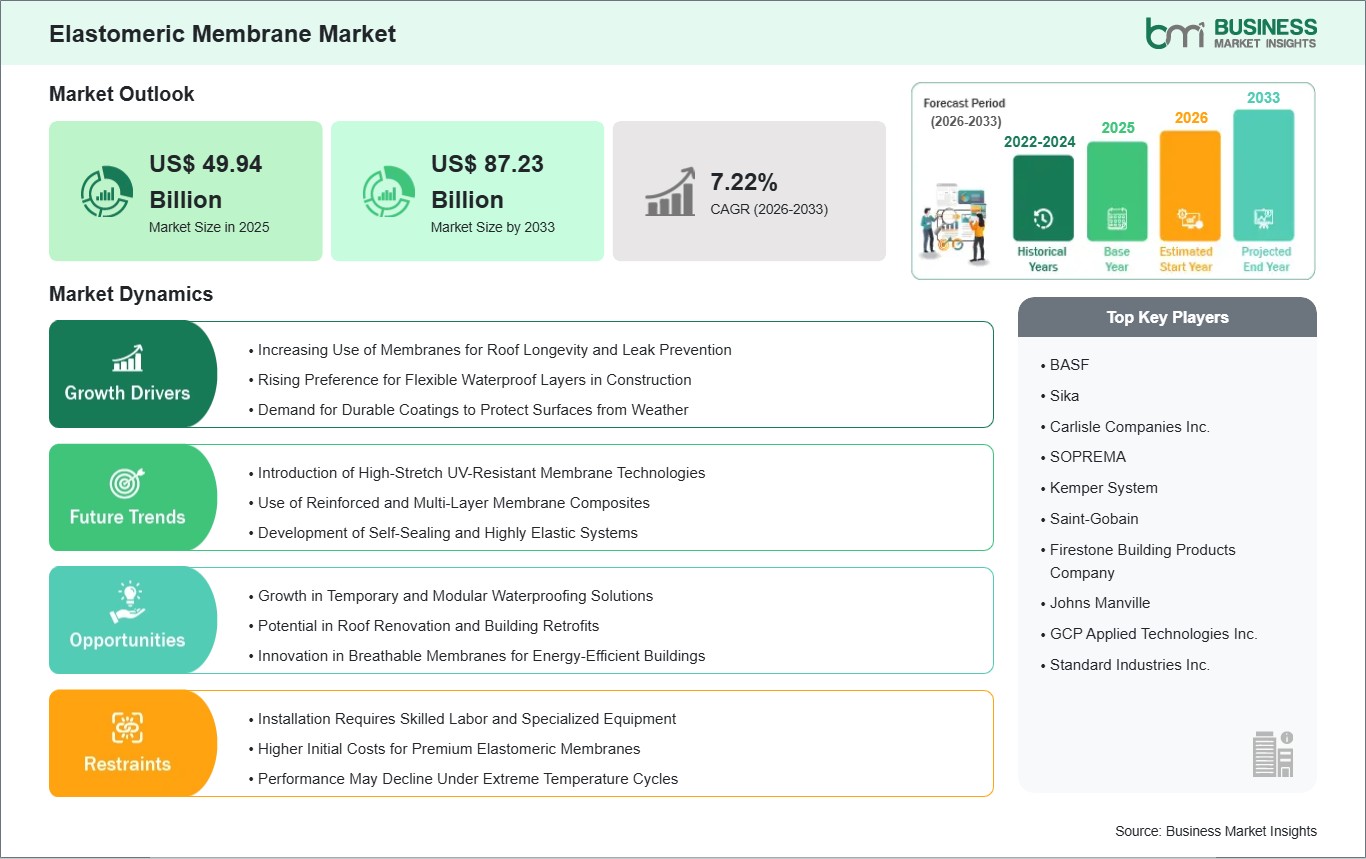
The Elastomeric Membrane Market size is expected to reach US$ 87.23 Billion by 2033 from US$ 49.94 Billion in 2025. The market is estimated to record a CAGR of 7.22% from 2026 to 2033.
The global elastomeric membrane market has expanded as a niche segment of waterproofing materials, roofing materials, and protective building constructions. The material is valued for its potential to deliver long-lasting and flexible protective barriers. The elastomeric membrane is composed of synthetic materials that can stretch and recover to adapt to building movements. The material is commonly used in commercial building rooftops, building facades, terraces, and other constructions. The elastomeric membrane market is driven by the need for long-lasting waterproofing materials, energy-efficient roofing materials, and maintenance reduction in residential and industrial constructions. The awareness of the economic and environmental advantages of long-lasting roofing materials is increasing. A major growth influence in the elastomeric membrane market is based on the fact that these membranes can provide waterproofing along with resistance to UV, chemical, and thermal factors. However, there are certain restraining factors in the elastomeric membrane market, such as high installation costs and the expertise needed to achieve a uniform installation. In addition, substrate suitability and adhesive longevity in extreme weather are other factors that may act as a restraint. Nevertheless, the increasing emphasis on sustainable and energy-efficient building practices, along with advancements in multi-layer membrane technology, is improving the outlook for the elastomeric membrane market.

Key segments that contributed to the derivation of the elastomeric membrane market analysis are type, application, and end user.
Elastomeric membranes are becoming an essential solution for enhancing the durability of roofs in modern construction. Their ability to form continuous, flexible layers protects structures from water ingress and structural movement, preventing common issues like cracking, ponding, and leaks. This makes them especially valuable for large commercial buildings, industrial facilities, and high-rise constructions where long-term reliability is critical.
Property owners are increasingly choosing elastomeric membranes for their proven performance in extreme weather conditions. The membranes resist UV radiation, heavy rainfall, and temperature fluctuations, which helps maintain roof integrity over many years. This durability reduces the need for frequent repairs, translating to lower maintenance costs and less disruption for building occupants.
In addition to performance, these membranes are versatile in application. They can be applied on flat, sloped, and even irregular surfaces, seamlessly adapting to complex roof designs. Their combination of strength, flexibility, and water-tight performance is driving adoption across commercial and institutional projects, positioning elastomeric membranes as a long-term investment in building resilience.
The rise of temporary and modular structures is creating new avenues for elastomeric membranes. From construction site shelters to event tents and portable storage units, these membranes provide quick, reliable waterproofing that can be deployed and removed with ease. Their lightweight yet durable nature allows them to protect structures without adding significant weight or requiring extensive installation effort.
Modular construction is another area of opportunity. As prefabricated panels and modular building components become more common, ensuring seamless waterproofing during transport and assembly is critical. Elastomeric membranes can be integrated into these systems to maintain performance and prevent leaks, supporting faster build times and higher quality in off-site construction methods.
Innovation in product design is further expanding applications. New formulations offer enhanced elasticity, faster curing times, and improved adhesion, making them suitable for a broader range of temporary and semi-permanent structures. As global construction trends continue to favor flexible, rapid-deploy solutions, elastomeric membranes are poised to play a pivotal role in both temporary and permanent waterproofing strategies.

The elastomeric membrane market is experiencing steady growth, with market size and share analysis reflecting evolving treatment preferences and competitive dynamics among key players. The report evaluates important subsegments categorized within type, application, and end user, highlighting their respective contributions to overall market performance.
By type, the Sheet subsegment dominated the Elastomeric Membrane market in 2025. Sheet membranes offer excellent waterproofing, durability, and ease of installation, making them highly suitable for large-scale construction applications, which drives their widespread adoption.
Based on application, the Roofs & Walls subsegment dominated the Elastomeric Membrane market in 2025. Roofs and walls benefit from elastomeric membranes’ superior weather resistance, flexibility, and long-term protection, supporting strong market demand.
In terms of end user, the Non‑Residential Construction subsegment dominated the Elastomeric Membrane market in 2025. Non-residential construction projects require high-performance materials for commercial buildings and infrastructure, reinforcing the dominance of this segment.
| Report Attribute | Details |
|---|---|
| Market size in 2025 | US$ 49.94 Billion |
| Market Size by 2033 | US$ 87.23 Billion |
| Global CAGR (2026 - 2033) | 7.22% |
| Historical Data | 2022-2024 |
| Forecast period | 2026-2033 |
| Segments Covered | By Type
|
|
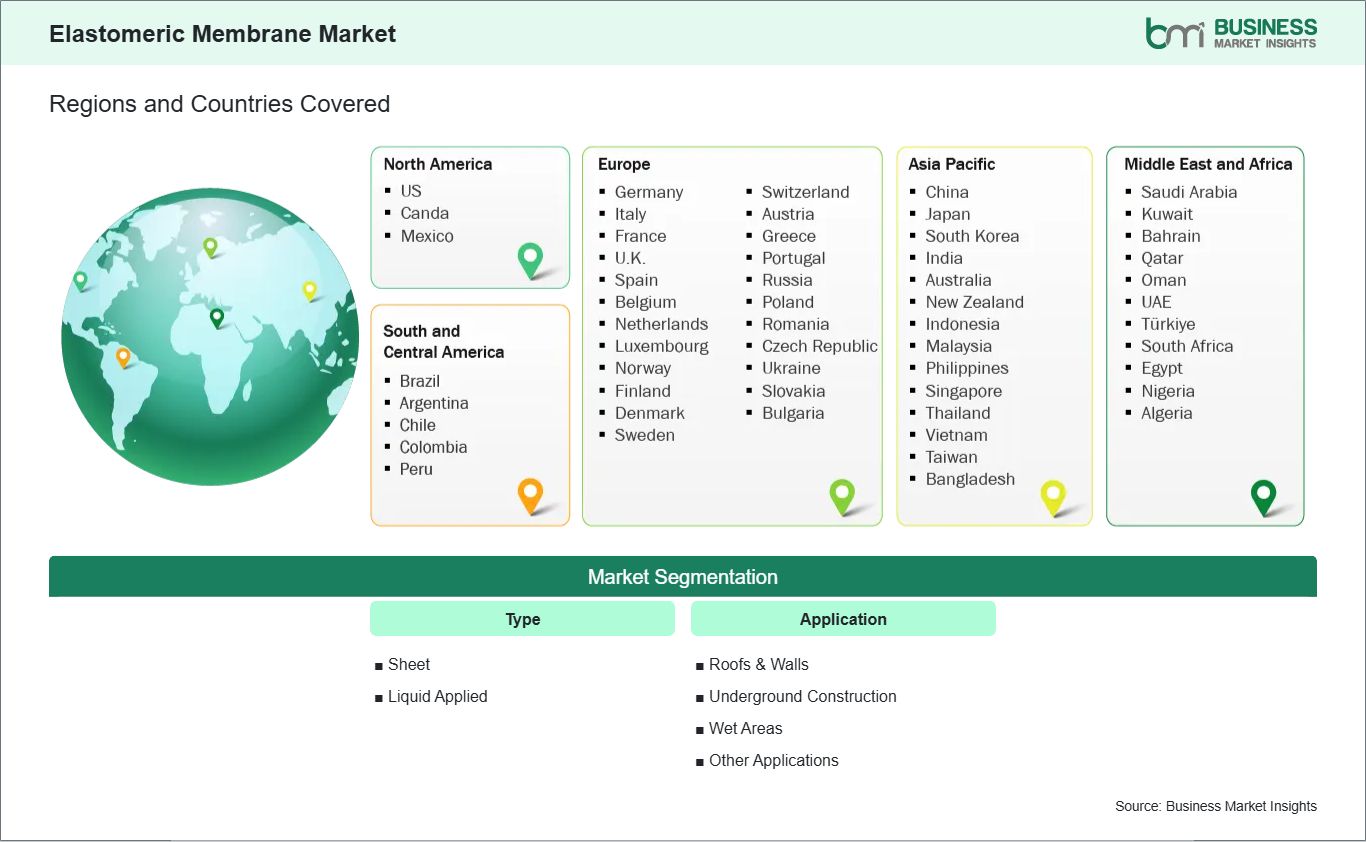
Regions and Countries Covered
| |
| North America | US, Canada, Mexico |
| Europe | Belgium, Austria, Finland, Denmark, Greece, Poland, Romania, Russia, Ukraine, Czech Republic, Slovakia, Bulgaria, Italy, Luxembourg, Germany, Switzerland, France, Netherlands, Norway, Portugal, Spain, Sweden, United Kingdom |
| Asia-Pacific | Australia, China, India, Japan, South Korea, Indonesia, Malaysia, Philippines, Singapore, Thailand, Vietnam, Bangladesh, New Zealand, Taiwan |
| South and Central America | Brazil, Argentina, Peru, Chile, Colombia |
| Middle East and Africa | Bahrain, Kuwait, Oman, Qatar, Saudi Arabia, United Arab Emirates, Turkiye, South Africa, Egypt, Algeria, Nigeria |
| Market leaders and key company profiles |
|
The "Elastomeric Membrane Market Size and Forecast (2022 - 2033)" report provides a detailed analysis of the market covering below areas:
The geographical scope of the Elastomeric Membrane market report is divided into five regions: North America, Asia Pacific, Europe, Middle East & Africa, and South & Central America. The Elastomeric Membrane market in North America is expected to grow during the forecast period.
The geographical area with the highest share in the global elastomeric membrane market is North America, owing to its high-grade construction practices, infrastructure development, and focus on long-term product durability. In this part of the world, there is a high usage of elastomeric membranes in commercial roofing, industry, and specialty projects, where the product`s resistance to harsh weather, thermal efficiency, and low-maintenance features are of high importance. The product`s capacity to extend and contract with structures, along with its resistance to UV rays and water, makes it suitable for use in areas with fluctuating climates and temperature changes. The North American market has access to an established network of manufacturers, contractors, and suppliers to support high-quality applications and innovation in membrane formulations, such as reinforced and multi-layer technologies. The adoption is further driven by building codes, sustainability ratings, and incentive programs to promote energy efficiency and long-lasting building envelope solutions. Although higher costs for installation and labor are adoption challenges, reliability, energy efficiency, and long-term building performance are key drivers for the North American market, making it one of the world`s leaders in elastomeric membrane technology, with design and application standards influencing markets globally.

The elastomeric membrane market is evaluated by gathering qualitative and quantitative data post primary and secondary research, which includes important corporate publications, association data, and databases. A few of the key developments in the elastomeric membrane market are:
The Elastomeric Membrane Market is valued at US$ 49.94 Billion in 2025, it is projected to reach US$ 87.23 Billion by 2033.
As per our report Elastomeric Membrane Market, the market size is valued at US$ 49.94 Billion in 2025, projecting it to reach US$ 87.23 Billion by 2033. This translates to a CAGR of approximately 7.22% during the forecast period.
The Elastomeric Membrane Market report typically cover these key segments-
The historic period, base year, and forecast period can vary slightly depending on the specific market research report. However, for the Elastomeric Membrane Market report:
The Elastomeric Membrane Market is populated by several key players, each contributing to its growth and innovation. Some of the major players include:
The Elastomeric Membrane Market report is valuable for diverse stakeholders, including:
Essentially, anyone involved in or considering involvement in the Elastomeric Membrane Market value chain can benefit from the information contained in a comprehensive market report.
Please tell us your area of interest
(Market Segments/ Regions and Countries/ Companies)