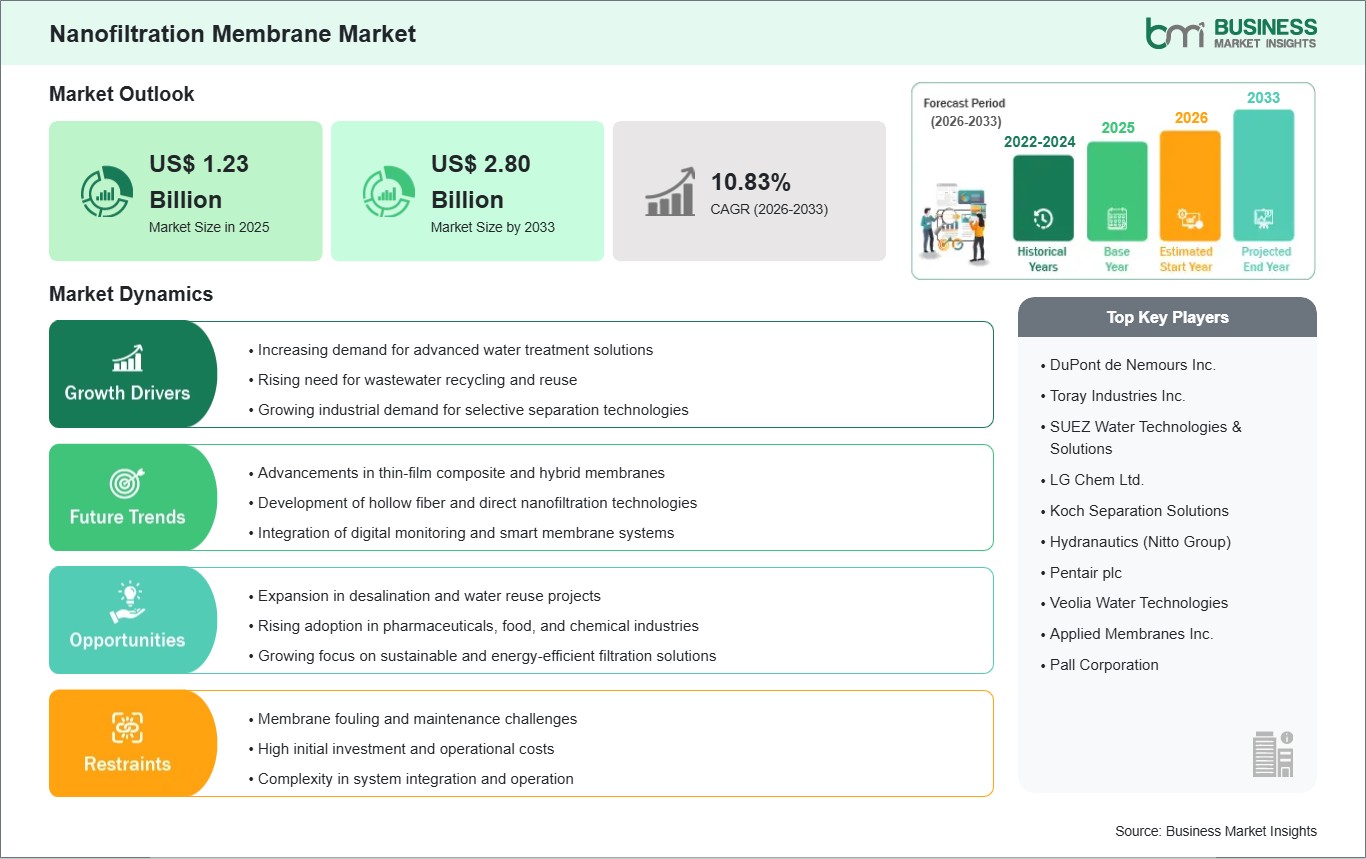
The Nanofiltration Membrane Market size is expected to reach US$ 2.80 Billion by 2033 from US$ 1.23 Billion in 2025. The market is estimated to record a CAGR of 10.83% from 2026 to 2033.
The nanofiltration membrane market is experiencing rapid expansion, driven by increasing global demand for efficient water treatment technologies, industrial process optimization, and sustainable separation solutions. Nanofiltration (NF) membranes are semi-permeable filtration systems that operate between ultrafiltration and reverse osmosis, enabling selective removal of divalent ions, organic compounds, and contaminants while maintaining relatively low energy consumption. This balance of efficiency and performance is positioning NF membranes as a preferred solution across municipal and industrial applications.
One of the primary growth drivers is the rising global demand for clean and safe drinking water. Rapid urbanization, industrialization, and population growth have significantly increased pressure on freshwater resources, leading governments and industries to invest heavily in advanced water treatment infrastructure. Nanofiltration membranes play a critical role in desalination pre-treatment, wastewater recycling, and potable water production, making them indispensable in modern water management systems.
From a material perspective, polymeric membranes dominate the market due to their cost-effectiveness, scalability, and adaptability across diverse applications. However, ceramic and hybrid membranes are gaining traction in harsh industrial environments due to their superior chemical resistance, thermal stability, and longer lifespan. These advanced materials are particularly useful in sectors such as pharmaceuticals, chemicals, and food processing.
Technological advancements are further accelerating market growth. Innovations such as thin-film composite membranes, hollow fiber configurations, and direct nanofiltration technologies are improving filtration efficiency, reducing fouling, and enhancing durability. Additionally, nanofiltration systems are increasingly being integrated into circular economy models, enabling resource recovery and wastewater reuse.
Despite strong growth prospects, challenges such as membrane fouling, high initial investment costs, and operational complexity persist. However, ongoing research and development efforts aimed at improving membrane performance and reducing lifecycle costs are expected to mitigate these issues. Overall, the nanofiltration membrane market is poised for robust growth, driven by sustainability goals, regulatory pressures, and technological innovation.

Key segments that contributed to the derivation of the nanofiltration membrane market analysis are ype, module, and application.
Nanofiltration membrane demand is primarily driven by the increasing need for advanced water treatment systems. Water scarcity combined with ever-tightening environmental regulations means that both governments and industry are being forced to implement highly efficient water purification technologies. Municipal water treatment systems utilize nanofiltration membranes to remove hardness, organic impurities, and pathogens from the water supply, so that sufficient safe drinking water can be supplied to an ever-expanding number of people.
In industrial settings, nanofiltration membranes are becoming more popular due to the selective separation of valuable components and hence less waste produced. More industry sectors, such as food & beverage; pharmaceutical; chemical; and textile; are utilizing NF membranes for concentration, purification, and by-product resource recovery. Examples of this would be the use of nanofiltration to concentrate protein and remove lactose during milk processing and to recover solvents and other valuable by-products in the chemical industry.
Another important driver for increased NF membrane usage is the emphasis being placed on reusing/recycling wastewater. Industrial facilities are more frequently being pressured to reduce their consumption of water and to comply with wastewater discharge regulations. Effluent from industrial processes can be treated using nanofiltration membranes, with resulting water being reused within those processes and contributing to lower overall environmental impact.
Additionally, NF membranes will provide energy savings in comparison to reverse osmosis systems because NF membranes operate at reduced pressures. Because NF membranes are thus more energy efficient they are a much more appealing alternative.
Technological progress has provided a huge opportunity for the nanofiltration (NF) membrane market and continues to evolve. Innovations in membrane material, design, production methods, and functionality have all improved the performance, longevity, and cost effectiveness of NF membranes.
A major breakthrough has occurred with the introduction of hybrid and/or nanocomposite membranes, which combine the benefits of both polymeric and ceramic materials. The hybrid membranes optimise selectivity, facilitate greater permeability, and enhance resistance against fouling and chemical deterioration. Hybrid membranes have great potential for industrial applications, particularly when traditional materials fail to perform adequately.
Hollow-fibre nanofiltration membranes are another area of significant progress. Their large surface area and compact dimensions make them highly effective for filtration in applications where space is limited. Direct nanofiltration technology is also being pursued; dNF eliminates the need for pre-treatment steps and achieves improved operational efficiency.
Membrane coatings and surface modifications will continue to develop, resulting in improved antifouling characteristics, reduced maintenance, and enhanced membrane durability. These advancements address one of the greatest obstacles facing NF systems—membrane fouling—and improve long-term system reliability.
Digitalisation and smart monitoring devices are increasingly being applied to membrane operations, allowing for real-time performance monitoring and predictive maintenance. This increases operational efficiency and decreases overall operational downtime for nanofiltration.

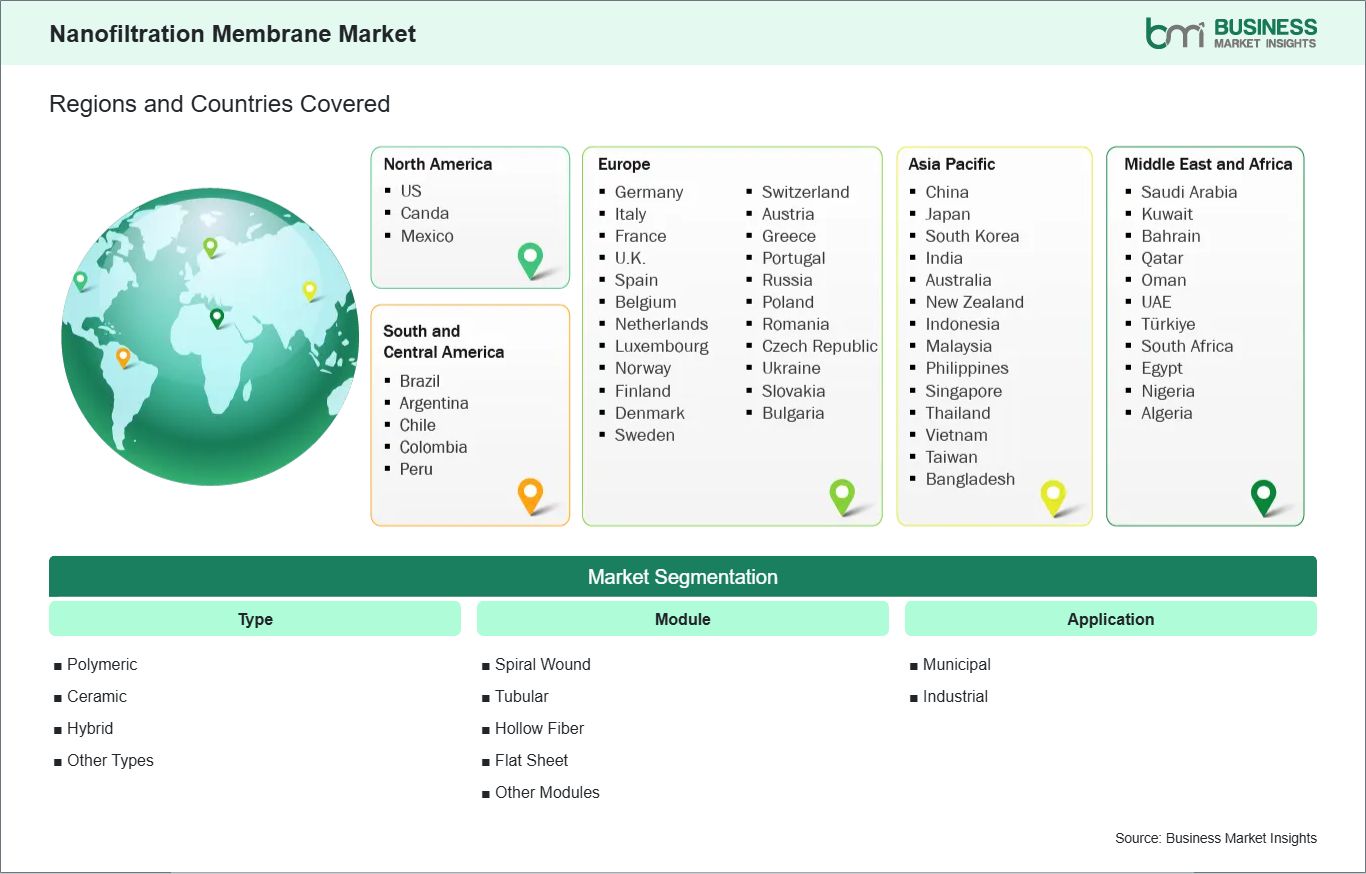
The Nanofiltration Membrane Market demonstrates steady growth, with size and share analysis highlighting evolving trends and competitive dynamics among key players. The report examines subsegments categorized within type, module, and application, offering insights into their contribution to overall market performance.
By Type, the polymeric subsegment dominated the market in 2025, driven by its cost efficiency and widespread adoption across municipal and industrial applications.
On the Basis of Module, the spiral wound subsegment dominated the market in 2025, owing to its high packing density, efficiency, and suitability for large-scale operations.
On the Basis of Application, the industrial subsegment dominated the market in 2025, supported by increasing adoption in sectors such as pharmaceuticals, chemicals, and food processing.
| Report Attribute | Details |
|---|---|
| Market size in 2025 | US$ 1.23 Billion |
| Market Size by 2033 | US$ 2.80 Billion |
| Global CAGR (2026 - 2033) | 10.83% |
| Historical Data | 2022-2024 |
| Forecast period | 2026-2033 |
| Segments Covered | By Type
|
|
Regions and Countries Covered
| |
| North America | US, Canada, Mexico |
| Europe | Belgium, Austria, Finland, Denmark, Greece, Poland, Romania, Russia, Ukraine, Czech Republic, Slovakia, Bulgaria, Italy, Luxembourg, Germany, Switzerland, France, Netherlands, Norway, Portugal, Spain, Sweden, United Kingdom |
| Asia-Pacific | Australia, China, India, Japan, South Korea, Indonesia, Malaysia, Philippines, Singapore, Thailand, Vietnam, Bangladesh, New Zealand, Taiwan |
| South and Central America | Brazil, Argentina, Peru, Chile, Colombia |
| Middle East and Africa | Bahrain, Kuwait, Oman, Qatar, Saudi Arabia, United Arab Emirates, Turkiye, South Africa, Egypt, Algeria, Nigeria |
| Market leaders and key company profiles |
|
The "Nanofiltration Membrane Market Size and Forecast (2022 - 2033)" report provides a detailed analysis of the market covering below areas:
The geographical scope of the Nanofiltration Membrane Market report is divided into North America, Asia Pacific, Europe, Middle East & Africa, and South & Central America. North America held the largest share in 2025.
North America dominates the nanofiltration membrane market, driven by advanced water treatment infrastructure, stringent environmental regulations, and high adoption of innovative filtration technologies. The United States, in particular, has witnessed significant investments in municipal water treatment and industrial wastewater recycling, supporting the widespread use of nanofiltration membranes. The presence of leading market players, strong R&D capabilities, and government initiatives promoting sustainable water management further reinforce the region’s leadership position.
Europe represents a mature and environmentally conscious market, characterized by strict regulations governing water quality and industrial discharge. Countries such as Germany, France, and the UK are активно adopting nanofiltration technologies to meet sustainability goals and improve resource efficiency. The region also emphasizes the use of advanced membrane materials, including ceramic and hybrid membranes.
Asia Pacific is the fastest-growing region, driven by rapid industrialization, urbanization, and increasing water scarcity. Countries such as China and India are investing heavily in water treatment infrastructure to address rising demand and environmental challenges. The region’s large population base and expanding industrial sector are key factors contributing to market growth.
The Middle East & Africa region is experiencing steady growth due to increasing desalination projects and water reuse initiatives. Meanwhile, South & Central America is witnessing moderate growth, supported by expanding industrial activities and improving water infrastructure.
Overall, while Asia Pacific leads in growth rate, North America remains the largest market due to its technological advancement, regulatory framework, and strong adoption of nanofiltration solutions.

The Nanofiltration Membrane Market is evaluated by gathering qualitative and quantitative data post primary and secondary research, which includes important corporate publications, association data, and databases. A few of the key developments in the nanofiltration membrane market are:
The Nanofiltration Membrane Market is valued at US$ 1.23 Billion in 2025, it is projected to reach US$ 2.80 Billion by 2033.
As per our report Nanofiltration Membrane Market, the market size is valued at US$ 1.23 Billion in 2025, projecting it to reach US$ 2.80 Billion by 2033. This translates to a CAGR of approximately 10.83% during the forecast period.
The Nanofiltration Membrane Market report typically cover these key segments-
The historic period, base year, and forecast period can vary slightly depending on the specific market research report. However, for the Nanofiltration Membrane Market report:
The Nanofiltration Membrane Market is populated by several key players, each contributing to its growth and innovation. Some of the major players include:
The Nanofiltration Membrane Market report is valuable for diverse stakeholders, including:
Essentially, anyone involved in or considering involvement in the Nanofiltration Membrane Market value chain can benefit from the information contained in a comprehensive market report.
Please tell us your area of interest
(Market Segments/ Regions and Countries/ Companies)