Market Summary
Executive Summary and Global Market Analysis
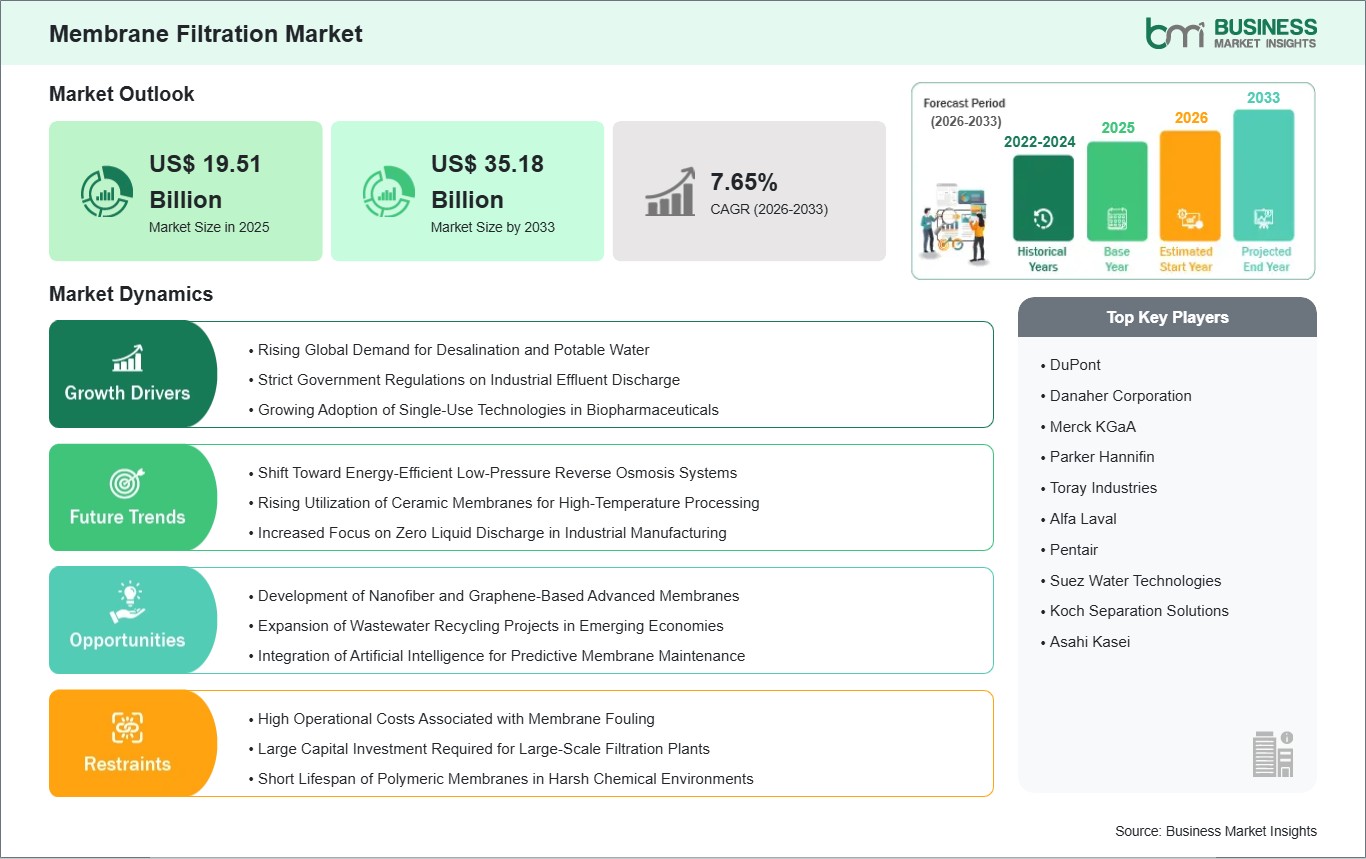
The Global Membrane Filtration market can be regarded as the foundation of modern Environmental Engineering and Industrial Processing, offering the essential technology to deliver precise Liquid-Solid and Liquid-Liquid separation. The driving forces behind the Membrane Filtration market can be regarded as the pressing need to deliver precise flow assurance in water-stressed environments and the ever-increasing intricacy of liquid purification in the life sciences and food sectors. Membrane filtration has advanced significantly from basic mechanical straining to sophisticated separation techniques based on molecular interactions, employing cutting-edge technologies like reverse osmosis and ultrafiltration. The flexibility of these technologies ensures their application in a wide range of scenarios, from large-scale municipal water treatment to small, sterile filtration systems used in vaccine production.
Strategic growth in this sector is currently defined by material innovation and the pursuit of energy efficiency. While polymeric membranes remain the volume leaders, the industry is witnessing a steady shift toward more durable ceramic alternatives and the integration of smart sensors for real-time performance monitoring. Despite challenges such as high energy consumption in high-pressure systems and the ongoing management of membrane fouling, the market remains on a strong upward trajectory. The transition toward a circular water economy and the expansion of industrial capacity in emerging markets ensure that membrane filtration will remain a critical technology for global sustainability and industrial advancement.
Segment Analysis
Membrane Filtration Market Segmentation
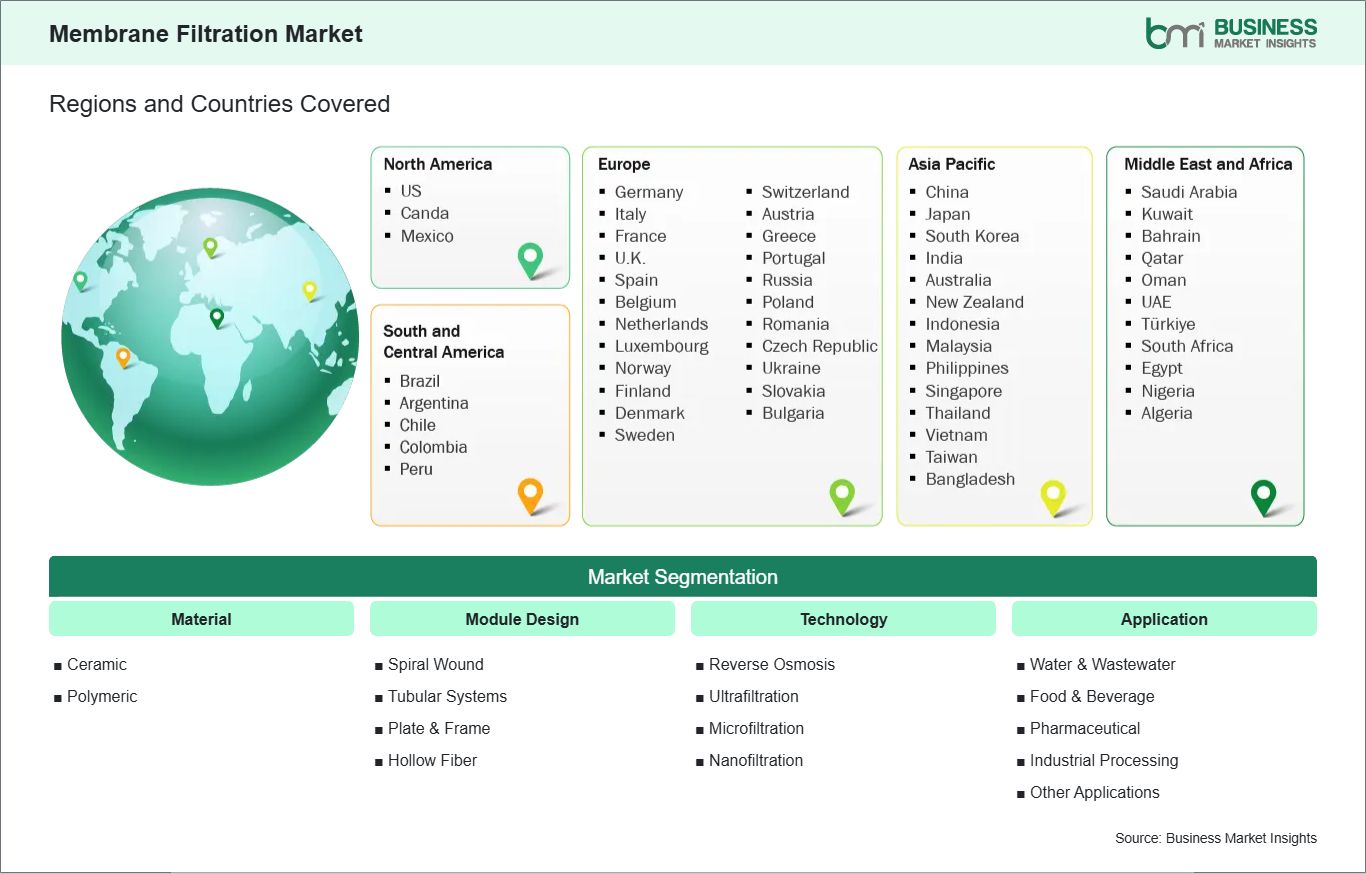
Key segments that contributed to the derivation of the Membrane Filtration market analysis are material, module design, technology, and application.
- By material, the Membrane Filtration market is segmented into Ceramic and Polymeric. The Polymeric segment dominated the market in 2025.
- By module design, the Membrane Filtration market is segmented into Spiral Wound, Tubular Systems, Plate & Frame, and Hollow Fiber. The Spiral Wound segment dominated the market in 2025.
- By technology, the Membrane Filtration market is segmented into Reverse Osmosis, Ultrafiltration, Microfiltration, and Nanofiltration. The Reverse Osmosis segment dominated the market in 2025.
- By application, the Membrane Filtration market is segmented into Water & Wastewater, Food & Beverage, Pharmaceutical, Industrial Processing, and Other Applications. The Water & Wastewater segment dominated the market in 2025.
Market Forces
Membrane Filtration Market Drivers and Opportunities
Rising Global Demand for Desalination and Potable Water
The most important driving factor in the market for membrane filtration is the pressing need in the world for fresh, sustainable water sources. The unprecedented demand for water, driven by increasing population and urbanization, has made existing water sources insufficient in many arid and coastal areas. This has created a huge boom in seawater and brackish water desalination plants. Membrane filtration, specifically reverse osmosis, has emerged as the technology of choice for these installations because of its energy efficiency compared to thermal distillation. The capacity of modern membranes to deliver potable water from highly saline or contaminated sources is essential to water security in these areas.
Apart from the municipal requirements, the industrial segment is also fueling the demand as the facilities demand enormous amounts of treated water for cooling purposes, as well as product formulation. In many countries, the law prohibits the drawing of groundwater from the tables for the operation of such facilities, which then requires the purchase and implementation of membrane-based systems. The efficiency of the membrane-based systems in removing contaminants such as pathogens, metals, and dissolved solids ensures that the final product is of the highest quality for consumption as well as for industrial purposes.
Development of Nanofiber and Graphene-Based Advanced Membranes
The next big opportunity in membrane filtration will come from the commercialization of new materials, such as electrospun nanofibers and those containing graphene. The traditional polymeric membrane suffers from a phenomenon in which, in order to increase its permeability, its selectivity is lowered, which is a major drawback in membrane filtration processes. Nanomaterials, on the other hand, are a breakthrough in this regard, as they are capable of achieving a high level of pore regularity and surface area, which is a significant advantage over traditional membrane materials. Another breakthrough material is graphene, which enables the development of atomic-scale sieves capable of filtering out salts and other contaminants with minimal friction, thereby reducing energy consumption in membrane filtration processes, which is a huge opportunity for companies to provide their customers with a next-generation product with a lower total cost of ownership.
Moreover, these high-tech materials may be designed to have special surface characteristics that will help overcome the longstanding problem of biofouling. With the integration of antimicrobial nanoparticles or hydrophilic materials on a molecular level, these materials are able to resist bacterial and organic matter buildup. This will result in longer intervals between cleanings and an overall longer life for these filtration modules. With the drive towards a more sustainable and energy-efficient process, companies that are able to transition from traditional materials to these high-tech materials will find a lucrative market for the high-end pharmaceutical, semiconductor, and chemical processing industries.
Size and Share Analysis
Membrane Filtration Market Size and Share Analysis
The global Membrane Filtration market is experiencing steady growth, with market size and share analysis reflecting evolving treatment preferences and competitive dynamics among key players. The report evaluates important subsegments categorized within material, module design, technology, and application, highlighting their respective contributions to overall market performance.
By material, the Polymeric subsegment dominated the market in 2025 due to its superior cost-to-performance ratio, ease of high-volume manufacturing, and extreme versatility in chemical composition, allowing for tailored pore sizes across diverse municipal and industrial liquid separation processes.
By module design, the Spiral Wound subsegment dominated the market in 2025 because it offers the highest membrane surface area per unit volume, which maximizes permeate throughput while maintaining a compact footprint, essential for large-scale desalination and industrial purification facilities.
By technology, the Reverse Osmosis subsegment dominated the market in 2025 due to its unrivaled efficiency in removing dissolved salts and micro-contaminants, making it the indispensable standard for global seawater desalination and the production of ultra-pure water for critical electronics manufacturing.
By application, the Water & Wastewater subsegment dominated the market in 2025 driven by intensifying global water scarcity and the enforcement of stringent environmental discharge mandates, necessitating advanced tertiary treatment solutions to facilitate safe water reclamation and sustainable resource management.
Report Coverage
Membrane Filtration Market Report Coverage and Deliverables
The "Membrane Filtration Market Size and Forecast (2022 - 2033)" report provides a detailed analysis of the market covering below areas:
- Membrane Filtration market size and forecast at the regional and country levels for segments covered under the scope
- Membrane Filtration market trends, as well as drivers, restraints, and opportunities
- Membrane Filtration market analysis covering key trends, regional framework, major players, regulations, and recent developments
- Industry landscape and competition analysis covering market concentration, heat map analysis, prominent players, and recent developments for the Membrane Filtration market
- Detailed company profiles, including SWOT analysis
Geographic Insights
Membrane Filtration Market Geographic Insights
The geographical scope of the Membrane Filtration market report is divided into: North America, Asia Pacific, Europe, Middle East & Africa, and South & Central America. North America held the largest share in 2025.
North America is the current leader in the membrane filtration market, and this is largely because the region is the first to adapt to the latest technology in water treatment. Moreover, the region is the leader in the production of biopharmaceuticals. It is also the leader in the production of specialty chemicals. It is noteworthy to point out the fact that the production of these two products requires the purest form of water. Moreover, the United States is facing water infrastructure challenges. As a result, the aging water infrastructure is being systematically upgraded with membrane bioreactors and advanced filtration trains to meet the stringent standards set by the Environmental Protection Agency.
The dominance is further reinforced by the significant investments being made in the "Blue Economy" and industrial water reuse projects. High labor costs in North America drive the demand for automated, high-efficiency filtration systems that require minimal manual intervention and feature long-term reliability. While the Asia-Pacific region is expanding rapidly due to industrialization, North America’s established regulatory framework and the high concentration of technology-intensive end-users ensure its continued leadership in revenue and innovation. Furthermore, the regional focus on reducing the carbon footprint of industrial processes is accelerating the adoption of low-energy membrane solutions and zero-liquid-discharge systems across the manufacturing landscape.
Industry Activity
Recent Developments
The Membrane Filtration market is evaluated by gathering qualitative and quantitative data post primary and secondary research, which includes important corporate publications, association data, and databases. A few of the key developments in the Membrane Filtration market are:
- In February 2026, Pullner, announced the launch of an advanced membrane filter cartridge system designed to improve filtration precision, durability, and efficiency across industries such as pharmaceuticals, desalination, and food & beverage.
- In June 2025, GKN Powder Metallurgy, announced the introduction of new metallic membrane cartridge filters, offering enhanced fine filtration performance and improved efficiency for chemical, pharmaceutical, and food processing applications.
- In April 2024, Asahi Kasei, announced the commercialization of a new membrane-based system for producing Water for Injection (WFI), reducing energy consumption and CO₂ emissions compared to traditional distillation processes.
Trust & Transparency
Research Methodology
The market analysis combines proprietary research with secondary data from government agencies, company disclosures, regulatory filings, industry databases and expert interviews. Market estimates are validated through data triangulation, cross-market benchmarking and analyst
review.
View Full Research Methodology
Key Sources Referred:
International Water Association (IWA)American Water Works Association (AWWA)European Water Association (EWA)Central Pollution Control Board (CPCB)International Dairy Federation (IDF)Institute of Food Technologists (IFT)European Federation of Food Science and Technology (EFFoST)Company WebsitesCompany Annual ReportsCompany Investor Presentations