Virtual Power Plant Market Regional Highlights
North America Virtual Power Plant Market
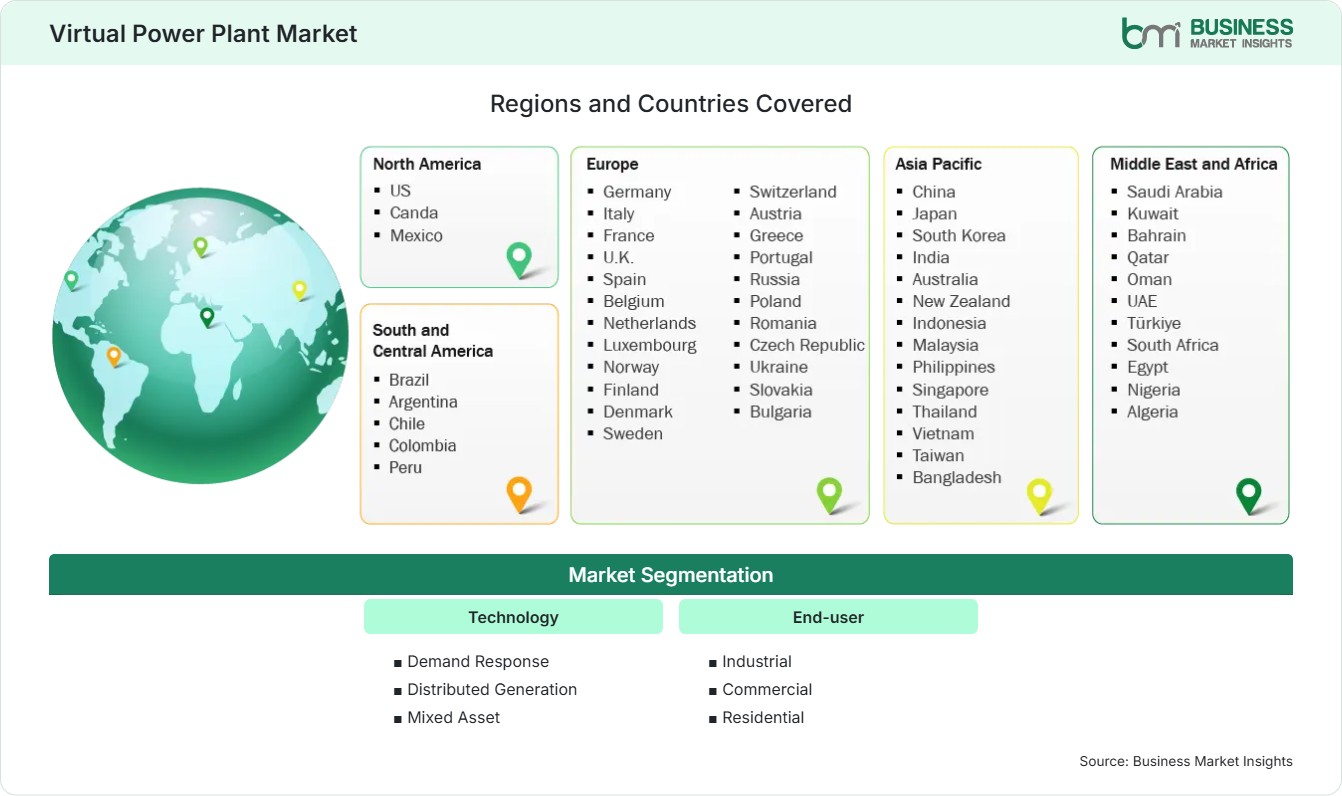
North America holds a 35%–38% share in 2025 and is projected to expand at 11%–13% CAGR through 2033. The region benefits from mature demand-response markets, growing battery installations, utility procurement, and increasingly sophisticated distributed-energy aggregation. U.S. programs provide the largest commercial foundation, while Canada contributes through distributed generation and flexibility initiatives. Grid congestion and rising peak demand are encouraging utilities to evaluate controllable customer resources alongside conventional infrastructure. DOE analysis identifies VPPs as an important mechanism for addressing rising peak requirements and improving utilization of existing grid assets.
- Battery aggregation is expanding as utilities seek flexible capacity without relying exclusively on centralized generation, creating stronger demand for dispatch software, customer incentives, telemetry, and automated controls.
- Commercial and industrial customers are increasingly valuable because generators, batteries, HVAC systems, and controllable processes can deliver measurable peak reduction and ancillary services while maintaining operational continuity.
- Wholesale-market participation is becoming more accessible as regional market structures implement distributed-resource aggregation requirements, although interconnection, telemetry, retail coordination, and participation rules remain important deployment considerations.
- Data centers, electrification, and industrial load growth are increasing the value of flexible capacity, encouraging utilities and aggregators to combine demand response with batteries and on-site generation.
US Virtual Power Plant Market
The U.S. accounts for approximately 70%–74% of North America's Virtual Power Plant Market capacity in 2025 and is expanding at a 11%–13% CAGR. Adoption is supported by utility programs, organized wholesale markets, federal financing initiatives, and rapidly increasing electricity demand. DOE reported North American VPP scale of approximately 33 GW and identified 80–160 GW as a potential 2030 deployment range.
- Utility programs increasingly combine residential batteries, smart thermostats, electric vehicles, and flexible loads, creating scalable portfolios that can respond to peak events while preserving customer backup requirements.
- Commercial aggregation is gaining relevance as generators, storage, building controls, and industrial loads provide capacity and demand-response value without requiring equivalent investment in centralized generation.
- Regional market implementation remains critical because participation rules, interconnection procedures, compensation mechanisms, telemetry requirements, and coordination between aggregators and utilities vary across jurisdictions.
Europe Virtual Power Plant Market
Europe represents a 27%–30% share in 2025 and is developing at 12%–14% CAGR. Renewable penetration, balancing requirements, negative-price periods, and market-based flexibility are supporting VPP deployment. Germany, the United Kingdom, and the Nordic markets remain important commercial centers, while Spain and Italy are developing additional opportunities for flexibility. European aggregators increasingly combine wind, solar, batteries, flexible industrial loads, and smaller generators to optimize market participation and balancing services.
- Germany remains a major VPP market because distributed renewable generation and balancing-market participation create strong requirements for aggregation, forecasting, automated dispatch, and portfolio optimization.
- The United Kingdom is developing opportunities around batteries, flexible demand, smart charging, and distributed generation as market participants seek additional revenue streams from controllable assets.
- Spain and Italy offer high-growth potential because solar generation growth increases intraday variability, strengthening demand for storage, flexible consumption, and software capable of coordinating distributed resources.
- Nordic markets provide opportunities for frequency-response aggregation because flexible batteries, electric vehicles, heating systems, and renewable generation can support balancing requirements.
Asia Pacific Virtual Power Plant Market
The Asia Pacific region has a market share of 23%–26% in 2025 and is projected to grow at a 14%–16% CAGR, making it the leading market by growth rate. Adoption in the Asia Pacific region occurs in countries such as China, Japan, South Korea, and Australia, whereas market development in India is driven by renewable energy integration, smart metering, distributed solar power generation, and electrification.
- Australia provides an established residential VPP environment because distributed solar and home batteries create large pools of controllable capacity capable of supporting grid balancing and household energy optimization.
- Japan is developing distributed flexibility around residential storage, solar generation, demand management, and energy resilience, supporting demand for sophisticated aggregation and energy-management platforms.
- China presents extensive long-term opportunities because large renewable additions, industrial electricity consumption, storage deployment, and digital grid investment increase the need for flexible distributed resources.
- India offers emerging opportunities through rooftop solar, smart meters, storage, electric mobility, and digital distribution infrastructure, particularly where utilities seek alternatives to costly network reinforcement.
Rest of World Virtual Power Plant Market
Rest of World Virtual Power Plant Market accounts for approximately 9%–12% of global demand in 2025 and is advancing at 10%–12% CAGR. South and Central America are developing distributed flexibility through solar, batteries, microgrids, and commercial energy management. Brazil represents an important opportunity because renewable generation and distributed solar are expanding rapidly. Chile and Mexico also offer opportunities where solar resources, industrial loads, and grid constraints support flexible-energy investment.
The Middle East and Africa regions are seeing selective market development, with the most significant prospects tied to solar plus storage, microgrids, commercial buildings, and resiliency use cases. Saudi Arabia, the UAE, and South Africa are promising growth hubs as projects in renewables and digital energy infrastructure expand.
- Brazil and Chile offer opportunities for solar-plus-storage aggregation where variable renewable output creates increasing requirements for balancing and flexible dispatch.
- Mexico can benefit from distributed generation and industrial demand-response applications, particularly where large electricity users require resilience and energy-cost optimization.
- Saudi Arabia and the United Arab Emirates provide opportunities around solar generation, batteries, microgrids, and digitally managed commercial energy systems.
- South Africa presents demand for distributed flexibility because electricity reliability requirements encourage commercial and industrial customers to combine storage, generation, and intelligent energy controls.