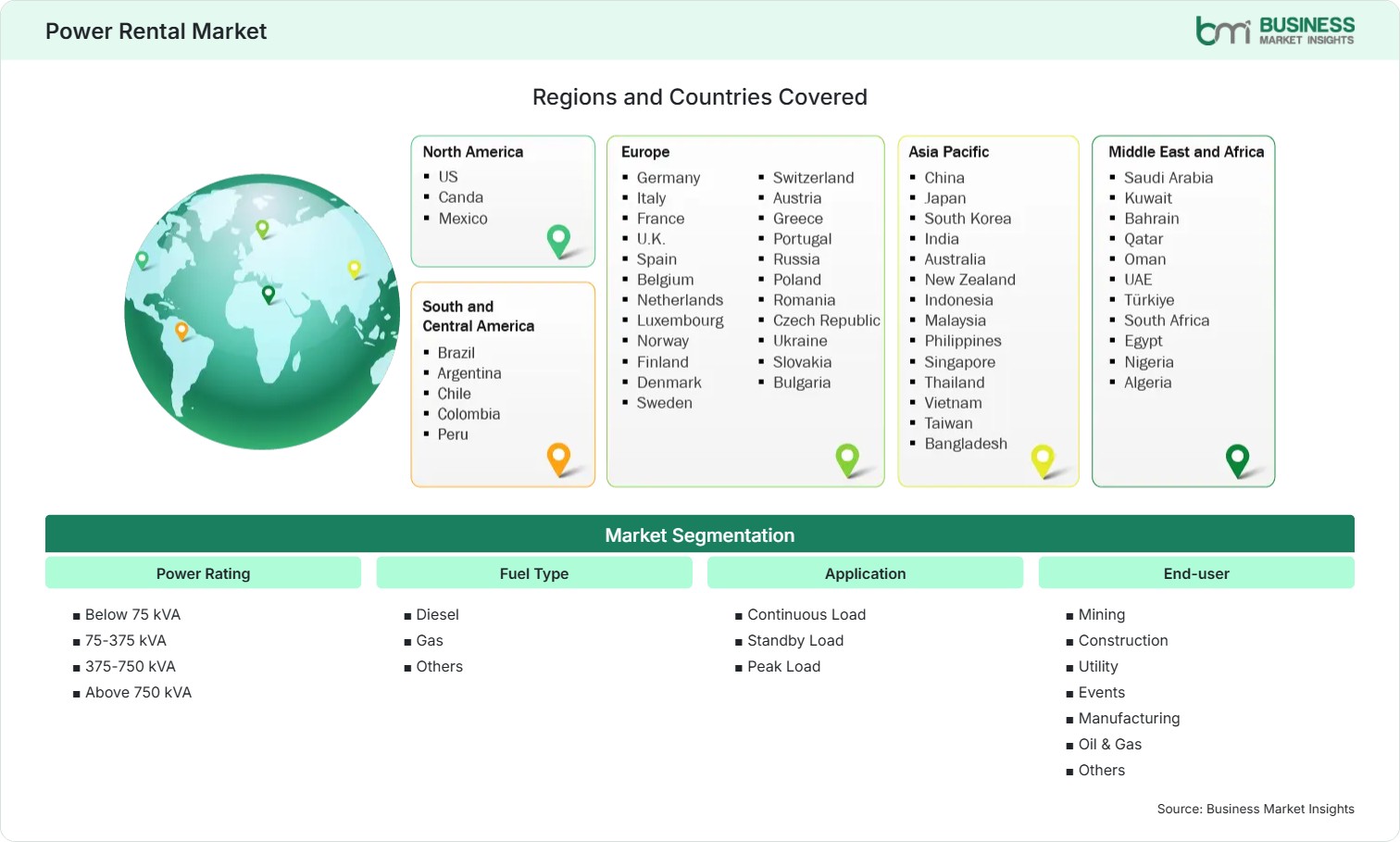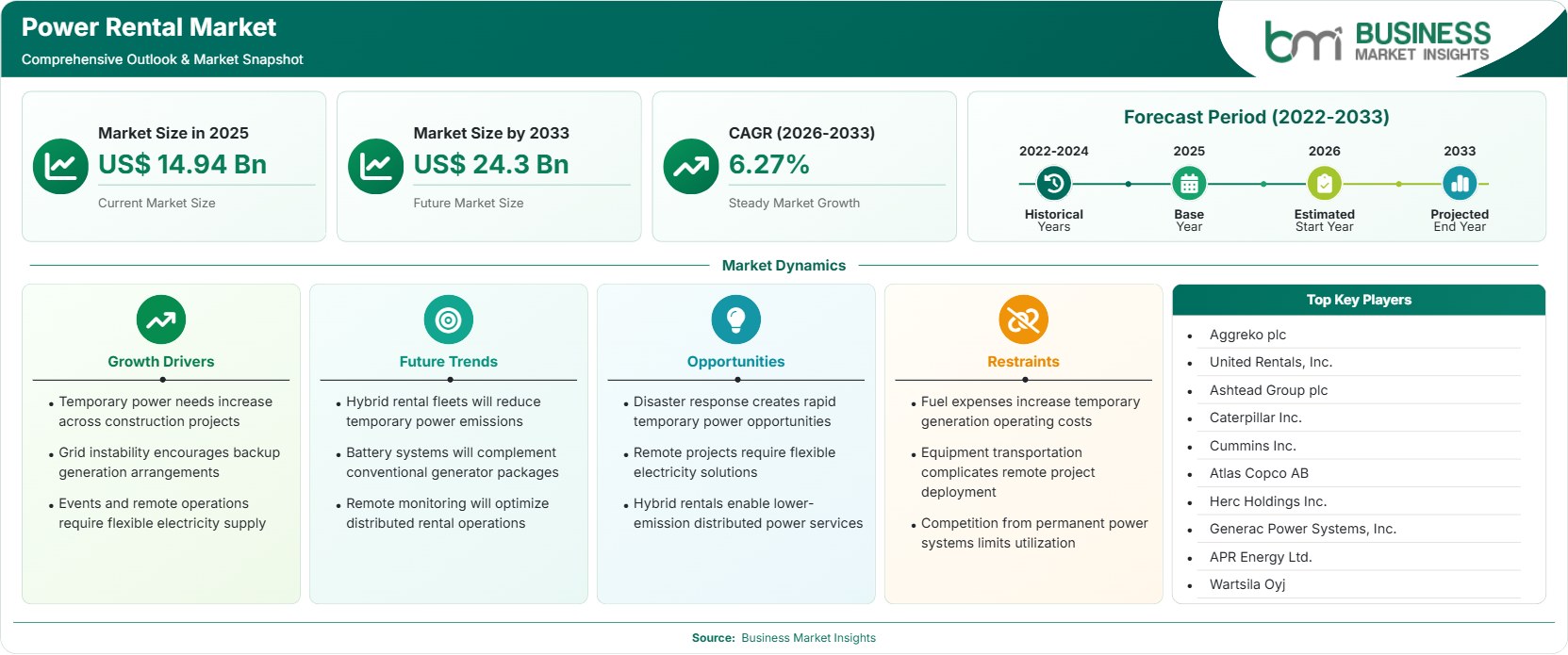
Power Rental Market Regional Highlights
North America Power Rental Market
North America Power Rental Market held a 40%–43% share in 2025 and is projected to expand at a 6.8%–7.2% CAGR during 2026–2033. Demand is anchored by infrastructure upgrades, data centers, manufacturing investment, weather-related resilience requirements, and industrial projects. The United States represents the principal regional demand center, while Canada contributes through resource development, construction, utilities, and remote-site requirements.
- The development of data centers is driving greater demand for high-capacity standby and bridging power, especially when timelines for connecting to the utility network cannot keep pace with project schedules.
- Mobile generators are still needed for construction and infrastructure projects to handle multiple phases, varying loads, temporary facilities, and remote sites without permanent electrical infrastructure.
- The requirements for utility resilience provide rental fleets with opportunities to carry out planned maintenance, support emergency restoration, respond to extreme weather, and address temporary shortfalls in capacity across regional grids.
- As urban developments and areas subject to regulation place increasing emphasis on emissions, noise, fuel efficiency, and compliance with operating requirements, lower-emission equipment is becoming more relevant.
US Power Rental Market
The United States Power Rental Market represented 84%–87% of North American demand in 2025 and is projected to grow at a 6.7%–7.1% CAGR during 2026–2033. Demand spans construction, utilities, manufacturing, oil and gas, mining, events, and data centers. Industry sources identify grid resilience, weather disruptions, aging infrastructure, and hybrid technologies as important demand factors.
- Texas, California, Florida, and New York contain significant demand areas due to their industrial activity, large-scale projects, events, and susceptibility to power disruptions.
- Because permanent utility connections are being set up, data centres need reliable temporary capacity, which in turn leads to the need for scalable generation, distribution, monitoring, and redundancy.
- Increasingly, rental companies are combining generators with batteries, load management, and remote monitoring to reduce fuel consumption while maintaining reliability under varying loads.
Europe Power Rental Market
Europe held a 16%–19% share in 2025 and is projected to grow at a 5.8%–6.4% CAGR during 2026–2033. Germany, the United Kingdom, France, Italy, and Spain remain important demand centers, while Poland and selected Eastern European markets offer higher-growth opportunities. Industrial continuity, construction, events, utility maintenance, and emissions requirements support adoption.
- Germany and the United Kingdom have well-developed rental systems that are supported by industrial operations, infrastructure projects, events, and existing equipment-rental networks.
- Poland represents a higher Power Rental Market growth as infrastructure investment and industrial development increase demand for temporary electricity across construction and manufacturing.
- The European emission standards promote investment in lower-emission generators, battery systems, more efficient engines, and digital controls that are capable of optimizing varying loads.
- Utilities and industrial operators make use of temporary generation when carrying out maintenance or to cover capacity gaps, thus decreasing their reliance on permanent standby assets.
Asia Pacific Power Rental Market
Asia Pacific held a 28%–31% share in 2025 and is projected to grow at a 7.8%–8.4% CAGR during 2026–2033. China, India, Japan, Australia, Indonesia, and South Korea form major demand centers, while India and Indonesia provide Power Rental Market scope opportunities. Industrialization, infrastructure development, construction, mining, manufacturing, utility expansion, and remote operations create recurring temporary-power requirements across diverse operating environments.
- The demand for scalable diesel and gas rental packages is caused by India's involvement in infrastructure investment, manufacturing expansion, construction, events, utilities, and industrial activity.
- Indonesia and Australia provide opportunities in the areas of mining, remote operations, infrastructure development, and locations where permanent grid access is restricted.
- China and South Korea have large industrial systems that provide temporary power for use in manufacturing, construction, maintenance, and for emergency continuity.
- Rental companies that have their own local service networks can increase the level of utilization by repositioning their fleets among various projects and cutting down the time taken to transport the equipment.
Rest of World Power Rental Market
Rest of World Power Rental Market represented 8%–11% in 2025 and is projected to expand at a 5.6%–6.3% CAGR during 2026–2033. South and Central America benefit from mining, construction, utilities, and industrial projects, with Brazil providing the largest regional opportunity. Middle Eastern and African demand is supported by oil and gas, mining, infrastructure, remote operations, and utility development.
- There is demand in Brazil for flexible generation capacity in the areas of construction, mining, events, manufacturing, agriculture-related infrastructure, and for utility requirements.
- The markets in the Gulf region place a focus on providing temporary power for use in construction projects, for industrial facilities, for events, for oil and gas operations, and for large-scale infrastructure developments.
- There are opportunities in Africa for mining, telecom infrastructure, construction, and remote industrial projects, all of which need a reliable supply of electricity beyond what the existing grid can provide.
- Regional providers may distinguish themselves by means of their logistics, fuel management, multilingual technical support, ability to carry out rapid deployment, and by offering maintenance coverage in difficult operating environments.