
Power Inverter Market Outlook: Size, Share, Trends, Growth Analysis, Competitive Landscape & Forecast, 2026-2033

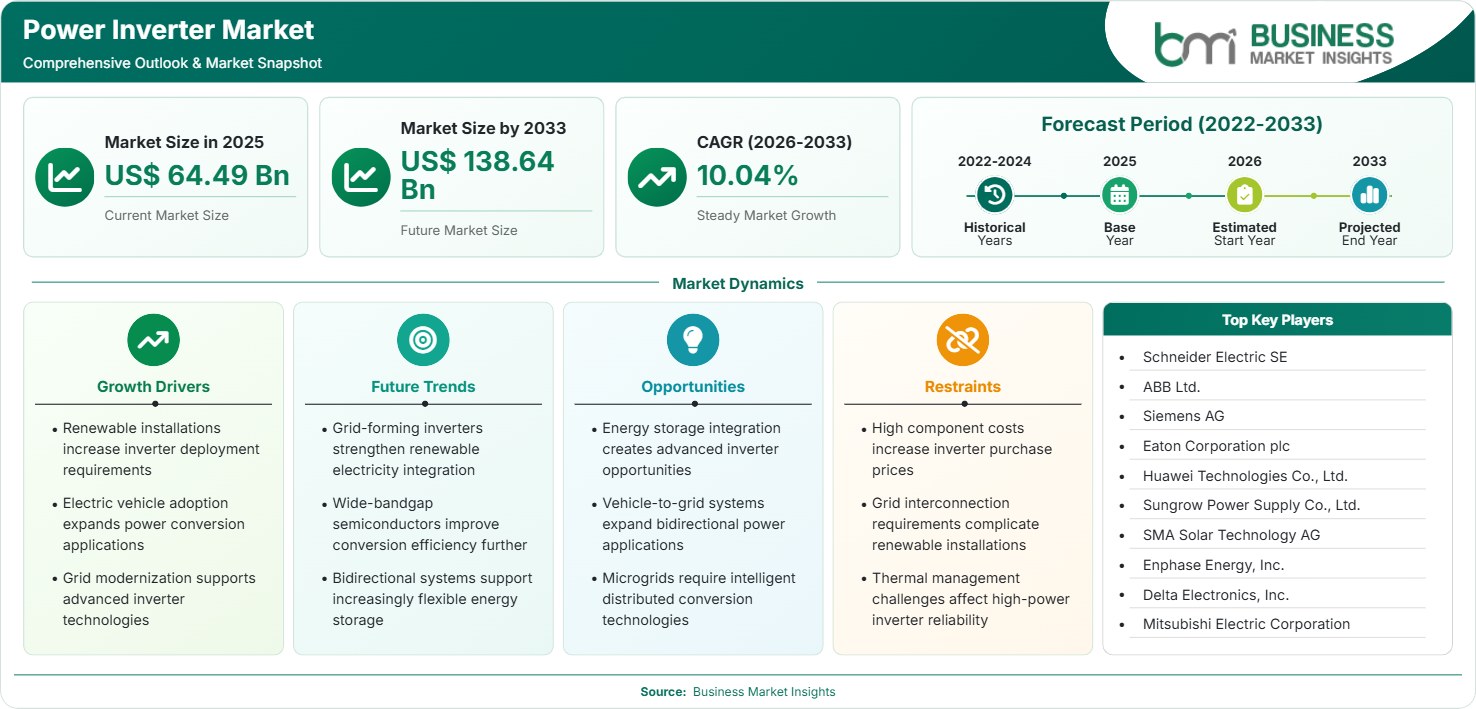
The Power Inverter Market size was valued at US$ 64.49 Billion in 2025 and is projected to reach US$ 138.64 Billion by 2033, growing at a CAGR of 10.04% during 2026–2033, supported by renewable energy deployment, grid modernization, EV electrification, energy storage integration, and rising demand for reliable backup power systems worldwide.

Report Coverage
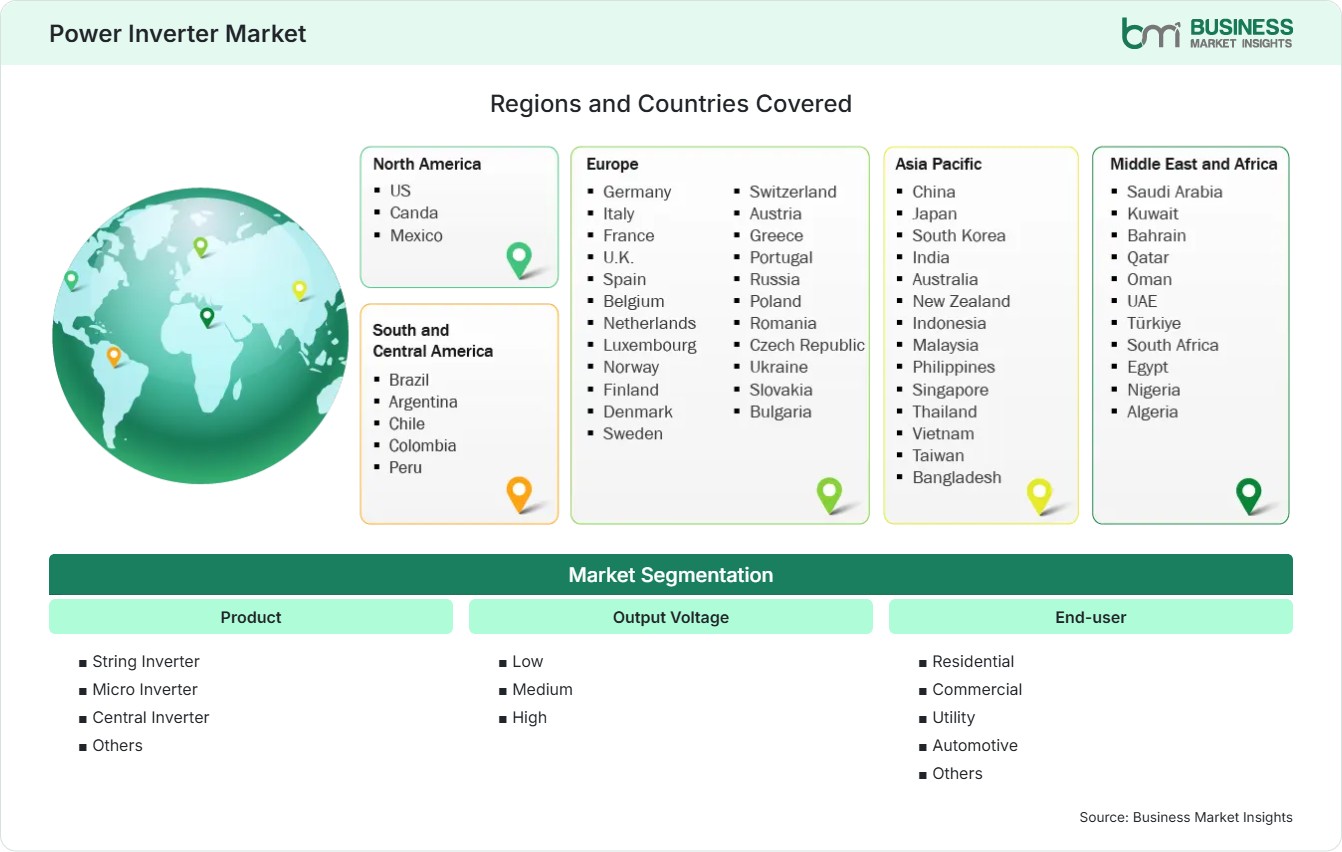
  • Product: String Inverter, Micro Inverter, Central Inverter, Others
  • Output Voltage: Low, Medium, High
  • End-user: Residential, Commercial, Utility, Automotive, Others
US$ 64.49 Bn Market size in 2025
US$ 138.64 Bn Market Size by 2033
10.04% CAGR, 2026 - 2033
2026-2033 Forecast Period

AI Overview

Power Inverter Market Summary

  • North America Region: North America holds a Power Inverter Market share of 28%–31% in 2025, growing with a CAGR of 8.5%–9.5% during 2026–2033. Growth is supported by distributed solar installations, energy storage adoption, grid resilience investments, electrification initiatives, utility modernization programs, commercial backup power requirements, and accelerating residential renewable energy integration opportunities. The U.S. accounts for the majority regional demand, advancing at an estimated 8.8%–9.8% CAGR through 2033.
  • Fastest Growing Region: Asia Pacific holds a market share of 37%–40% in 2025 and expands at a CAGR of 11.5%–12.5%. Demand is fueled by solar deployment, manufacturing investments, electrification programs, smart grid expansion, industrial energy requirements, improving transmission networks, and government-backed renewable infrastructure development.
  • Leading Segment: String Inverter represents 34%–37% market share in 2025 and grows at 9.8%–10.8% CAGR. Adoption benefits from cost efficiency, modular deployment, expanding rooftop solar installations, easier maintenance, improved conversion efficiency, commercial project flexibility, and increasing distributed generation investments.
  • High Growth Segment: Automotive accounts for 12%–15% Power Inverter Market share in 2025 and advances at 12.8%–13.8% CAGR. Expansion is driven by EV proliferation, vehicle electrification, onboard power conversion needs, auxiliary system applications, charging infrastructure growth, efficient energy management requirements, and advanced mobility technologies.
  • Key Market Opportunity: Integration of power electronics with battery storage, smart grids, bidirectional energy flow capabilities, microgrids, and EV charging ecosystems creates substantial revenue potential across both developed and emerging energy markets.
  • Major Market Players: Schneider Electric SE, ABB Ltd., Siemens AG, Eaton Corporation plc, Huawei Technologies Co., Ltd., Sungrow Power Supply Co., Ltd., SMA Solar Technology AG, Enphase Energy, Inc., Delta Electronics, Inc., Mitsubishi Electric Corporation.
Strategic Insights

Power Inverter Market: Strategic Insights

Power Inverter Market Strategic Framework
FREE PDF
Request your free sample
Request free sample
Stakeholder View

Key Takeaways

  • The industry value chain increasingly integrates semiconductor suppliers, power electronics specialists, software providers, energy storage developers, and renewable energy project operators.
  • Automotive electrification and distributed solar installations represent the strongest medium-term revenue opportunities due to rapid capacity additions and energy transition investments.
  • Product development is shifting toward smart inverters with remote diagnostics, predictive maintenance, cybersecurity features, and AI-enabled energy optimization.
  • Asia Pacific presents the most compelling regional investment case due to manufacturing scale, supportive policies, and accelerating renewable energy construction.
  • Strategic acquisitions continue to focus on software-enabled energy management, storage integration, and next-generation power conversion technologies.
  • Increased deployment of microgrids across industrial facilities, campuses, and remote locations is creating specialized demand for advanced inverter systems.
Geographic Outlook

Power Inverter Market Regional Highlights

North America Power Inverter Market

North America represents approximately 28%–31% of global revenue in 2025 and is projected to expand at a CAGR of 8.5%–9.5% through 2033. The region benefits from strong solar deployment, grid modernization initiatives, growing battery storage capacity, and resilient infrastructure investments. The Power Inverter Market share remains supported by utility-scale renewable projects and commercial backup systems. Increasing electrification of transportation and rising demand for decentralized power generation further strengthen long-term market fundamentals.

  • U.S. utilities continue investing in grid-support technologies, enhancing advanced inverter deployment across solar and storage facilities.
  • Commercial facilities prioritize power quality and backup reliability, supporting adoption of higher-capacity systems.
  • Energy storage installations create new demand for bidirectional and hybrid inverter technologies.
  • Renewable portfolio standards encourage integration of intelligent energy conversion infrastructure.

US Power Inverter Market

The United States contributes nearly 74%–78% of North American demand and records an estimated CAGR of 8.8%–9.8% through 2033. Federal clean-energy incentives, expanding solar capacity additions, and battery-storage deployment continue strengthening demand. Utilities increasingly require smart grid-compatible systems, while residential consumers seek energy independence through rooftop solar and storage configurations.

  • Solar-plus-storage projects drive procurement of advanced conversion technologies.
  • Data centers require stable power management solutions supporting efficiency goals.
  • Electrified transportation infrastructure expands demand for power conversion equipment.
  • Industrial facilities upgrade legacy systems to improve energy productivity.

Europe Power Inverter Market

Europe accounts for approximately 24%–27% market share in 2025 and is expected to grow at 9.2%–10.2% CAGR through 2033. Energy security priorities, ambitious carbon reduction targets, and distributed renewable deployment create favorable conditions. Germany remains the largest regional market, while Eastern European countries register faster expansion as renewable capacity investments accelerate.

  • Germany leads regional deployment through strong solar and industrial demand.
  • Spain and Italy continue expanding commercial and utility-scale installations.
  • Energy efficiency directives stimulate modernization of existing power systems.
  • Battery-storage integration enhances operational flexibility across energy networks.

Asia Pacific Power Inverter Market

Asia Pacific represents 37%-40% of the global market share by revenue in 2025 and shows the highest CAGR, between 11.5% and 12.5%, from 2023 to 2033 in the Power Inverter Market. China is considered the largest market because of its manufacturing base and investment in renewables, whereas India shows the fastest growth momentum. Rapid urbanization, industrialization, and additions of renewable power capacity sustain demand across diverse end-use sectors.

  • China dominates production and consumption of power conversion equipment.
  • India benefits from expanding solar targets and infrastructure spending.
  • Southeast Asian nations accelerate electrification and distributed generation projects.
  • Industrial automation increases demand for reliable power electronics solutions.
  • Regional manufacturing ecosystems support cost competitiveness and scaling.

Rest of World Power Inverter Market

The Rest of World accounts for 9%-2% of market revenue in 2025 and grows at a 10.0%-11.0% CAGR through 2033. Latin America leverages rising solar power capacity, and the mining sector uses it. The Middle East & Africa leverage renewable energy projects to diversify the energy mix and expand electricity access.

  • Brazil remains the leading Latin American market due to solar expansion.
  • Chile benefits from renewable energy investments supporting mining operations.
  • Saudi Arabia advances renewable infrastructure diversification initiatives.
  • UAE supports intelligent energy projects and storage-enabled installations.
  • South Africa records increasing demand linked to grid reliability challenges.
Global Market Geography
FREE PDF
Request your free sample
Request free sample
Segment Analysis

Power Inverter Market Segmentation

Product

It represents 40%-43% of overall market revenue in 2025 and is increasing at a 10.2%-11.2% CAGR. The scope of the Power Inverter Market increases as more renewable energy sources and energy storage come into use. Product innovation revolves around higher efficiency, digital controls, and improved grid integration.

  • String Inverter: Widely adopted across residential and commercial solar installations due to modular architecture, cost efficiency, scalability, and simplified maintenance requirements.
  • Micro Inverter: Gains traction through panel-level optimization, improved safety performance, better energy harvesting, and increasing rooftop solar adoption.
  • Central Inverter: Preferred for utility-scale deployments requiring high capacity, operational efficiency, centralized monitoring, and large-project economics.

Output Voltage

Output voltage categories address varying application requirements, representing an essential technology differentiation factor. The segment maintains steady adoption supported by industrial electrification, infrastructure upgrades, and renewable energy deployment.

  • Low: Common in residential systems, portable applications, small commercial installations, and distributed renewable energy setups.
  • Medium: Supports commercial buildings, manufacturing sites, institutional facilities, and medium-scale energy infrastructure projects.
  • High: Utilized in utility networks, industrial operations, large renewable parks, and transmission-related applications.

End-user

End-user demand remains diverse, and the utility and commercial segments make significant contributions to revenue in 2025. It is expected that the market will grow at a CAGR of about 10.5%-11.5%. The Power Inverter Market trends include growing penetration in transportation and distributed energy systems.

  • Residential: Growth stems from rooftop solar installations, storage deployment, and increasing consumer interest in energy resilience.
  • Commercial: Businesses invest in power quality management, energy optimization, and sustainability initiatives.
  • Utility: Large-scale renewable projects and grid modernization programs sustain dominant procurement volumes.
  • Automotive: Electrification and EV ecosystem expansion support rapid adoption of specialized inverter technologies.
Market Forces

Power Inverter Market Dynamics

Key Market Drivers

Accelerating Renewable Energy Deployment Worldwide

Additions to renewable energy capacity worldwide continue to fuel the growing demand for sophisticated power converter technology. Solar photovoltaic installations have continued to be among the fastest-growing electricity generation sources, thereby sustaining demand for effective inverters in residential, commercial, and utility-scale installations. Increased penetration rates have made the synchronization and voltage control functionalities more relevant. Moreover, the fast growth of solar-plus-storage systems has been facilitating increased purchases of hybrid and smart inverters. With governments targeting decarbonization and utilities increasing the share of renewables in their portfolios, inverter use has become a critical part of electricity infrastructure.

Expansion of Energy Storage Infrastructure

Increasing capital investments in battery-based energy storage have created many opportunities for inverters. Current battery energy storage systems require bidirectional power flow, efficient energy management, and grid support services to function properly. Utilities are increasingly adopting storage solutions to address intermittency and improve reliability, while commercial establishments are using them to reduce peak demand charges. Lower costs and increased battery efficiency are making installations quicker. As storage capacity increases across utilities, commerce, and households, there will be a need for inverters capable of controlling charging and discharging to the grid.

Industrial Automation and Electrification Trends

Automation, digital controls, and electrical production processes are being adopted across industrial sectors to increase efficiency and productivity. These changes have called for power conversion components capable of maintaining power quality and supporting critical electrical loads. Industrial sectors such as manufacturing, logistics, processing, and infrastructure organizations require highly advanced inverter technology to increase equipment reliability and reduce downtime. The rise in the use of connected devices, smart controls, and energy-efficient equipment has increased power consumption and the need for power management. Demand for efficient inverters is expected to be high during the forecast period.

Key Market Opportunities

Smart Grid Modernization Programs

Power Inverter Market forecasts that large-scale grid modernization programs offer significant growth potential for technology companies working within the inverter value chain. Utility companies are now investing in intelligent grid systems to integrate distributed generation and energy storage into the grid. Modern inverters, which have voltage regulation and demand response capabilities, are a critical part of modernization programs. The governments of several major economies are also setting aside funds to upgrade their outdated grids to accommodate more renewable energy generation. This makes it easy for inverter manufacturers to design intelligent inverter platforms through software.

EV Charging and Vehicle-to-Grid Integration

The accelerating adoption of electric vehicles is creating new avenues for demand for specialized inverter technologies. Modern EV charging infrastructure requires efficient power conversion systems to support fast charging, energy management, and grid connectivity. Further growth in market size can be achieved through vehicle-to-grid use cases that allow for bidirectional energy flow from vehicles to the power grid. These capabilities are being explored by utilities and fleet managers to optimize grid stability and energy usage patterns. With the growing trend towards electric mobility across various transport sectors, there is room for inverter makers to develop more innovative products to meet emerging charging and energy exchange requirements.

Microgrid Deployment Across Remote and Critical Facilities

Microgrids are becoming a significant part of energy solutions focused on resilience across various industries, institutions, and even remote areas. Hospitals, military bases, university campuses, mining companies, and isolated communities are becoming increasingly interested in localized energy supplies to ensure reliability and reduce their dependence on central grids. Efficient microgrid operation requires modern inverters capable of integrating renewable energy, batteries, and other power sources. Growing awareness of grid failures, energy security issues, and continuity of operations is pushing further adoption of microgrids.

Market Restraints and Challenges

Semiconductor Supply Volatility and Manufacturing Costs

Semiconductors, controls, and power components are among the components whose availability largely depends on global supply chain dynamics. Political differences, production issues, and material shortages can drive up the cost of these components and cause procurement delays. This will result in higher production costs, delivery delays, and strained profitability. Small businesses may find it harder due to a lack of bargaining power and limited flexibility in inventory. Despite improved semiconductor availability, prevailing market dynamics still pose operational risks for manufacturers' scheduling, customer commitments, and overall business performance.

Price Competition and Margin Compression

Fierce competition among international and regional suppliers continues to put pressure on product prices across a variety of application sectors. Standardized inverter classes, especially those used in cost-conscious applications, are vulnerable to intense price competition. Lowering prices may lead to lower profit margins, limit the funds available for research and development, and hinder innovation projects. In response to this threat, companies have begun to differentiate themselves through software capabilities, monitoring systems, services, and energy solutions. Even so, profitability remains difficult to achieve in a competitive market environment.

Company Analysis

Competitive Landscape

The Power Inverter Market analysis indicates competition centered on efficiency improvements, smart-grid compatibility, storage integration, and international distribution capabilities.

Company Name

Overview

Products and Services relevant to this market

Schneider Electric SE

Global energy management and automation leader serving residential, commercial, and industrial customers.

Power inverters, energy management systems, storage integration solutions, and grid-support technologies.

ABB Ltd.

Major electrification and automation provider with extensive global presence.

Industrial inverters, renewable energy solutions, power conversion technologies, and automation systems.

Siemens AG

Diversified technology company focused on infrastructure and electrification.

Grid-connected power systems, industrial inverters, smart grid platforms, and energy solutions.

Eaton Corporation plc

Power management specialist supporting multiple industrial sectors.

Backup power systems, industrial inverters, power quality equipment, and electrical infrastructure.

Huawei Technologies Co., Ltd.

Leading technology provider with significant renewable energy presence.

Smart photovoltaic inverters, energy storage integration, and digital monitoring platforms.

Sungrow Power Supply Co., Ltd.

Global renewable energy technology manufacturer with strong solar footprint.

String inverters, central inverters, storage systems, and utility-scale solutions.

SMA Solar Technology AG

Established inverter specialist serving global renewable markets.

Residential, commercial, and utility-scale inverter products and monitoring services.

Enphase Energy, Inc.

Microinverter technology leader focused on distributed energy systems.

Microinverters, energy storage products, software platforms, and home energy management.

Delta Electronics, Inc.

Power electronics manufacturer with diversified energy portfolio.

Renewable energy inverters, industrial power solutions, and energy infrastructure products.

Mitsubishi Electric Corporation

Industrial technology leader with advanced power electronics expertise.

Industrial inverters, automation equipment, and high-performance energy conversion systems.

Trust & Transparency

Research Methodology

The market analysis combines proprietary research with secondary data from government agencies, company disclosures, regulatory filings, industry databases and expert interviews. Market estimates are validated through data triangulation, cross-market benchmarking and analyst review.

View Full Research Methodology

Access the Full Power Inverter Market Report

Get segment-level forecasts, regional estimates, competitive benchmarking, company profiles and downloadable Excel datasets.

Access the full Power Inverter Market Report
350 pages PDF & Excel | 2026-09-17
Similar Research

Related Market Reports