
Inverter Market Outlook: Size, Share, Trends, Growth Analysis, Competitive Landscape & Forecast, 2026-2033

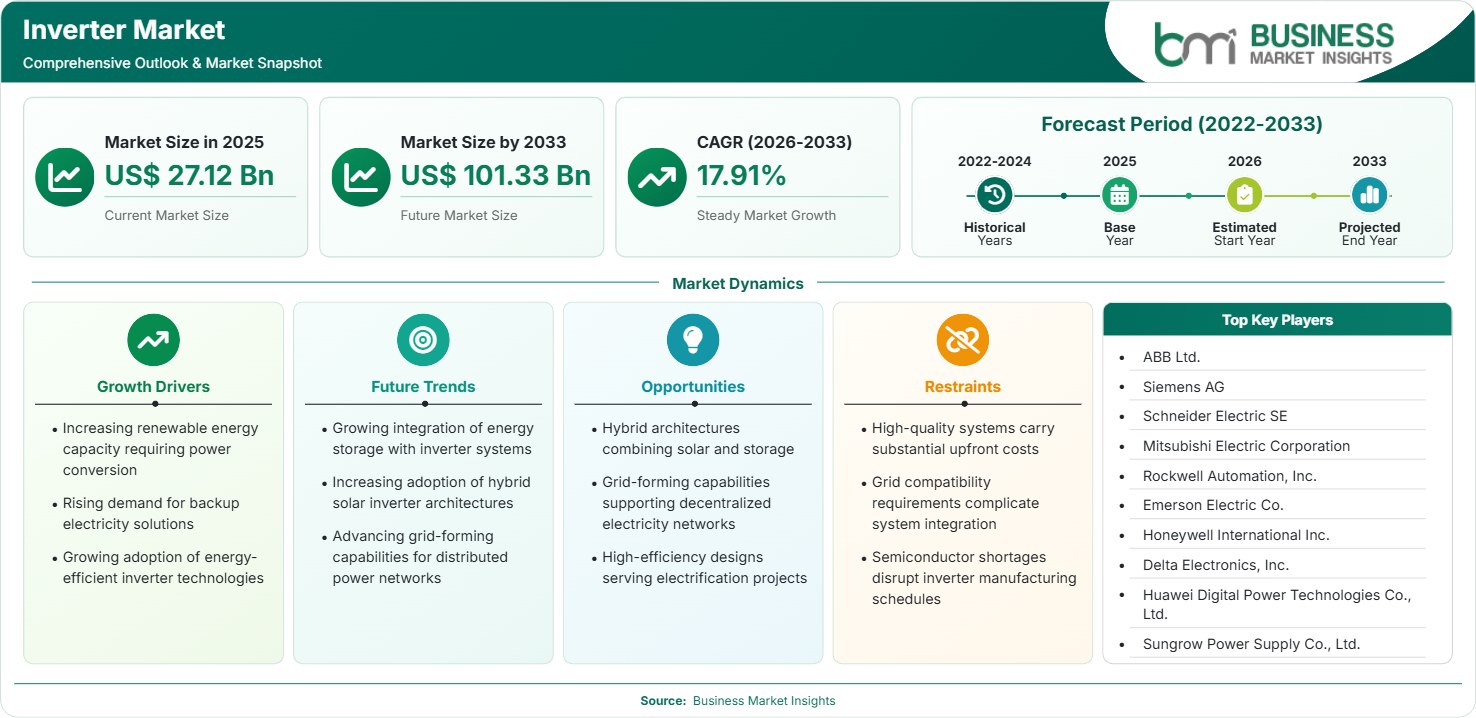
The Inverter Market size was valued at US$ 27.12 Billion in 2025 and is projected to reach US$ 101.33 Billion by 2033, growing at a CAGR of 17.91% during 2026–2033, driven by renewable energy integration, industrial automation upgrades, energy storage deployment, grid modernization investments, and increasing demand for reliable power conversion across commercial, industrial, and utility-scale applications.

Report Coverage
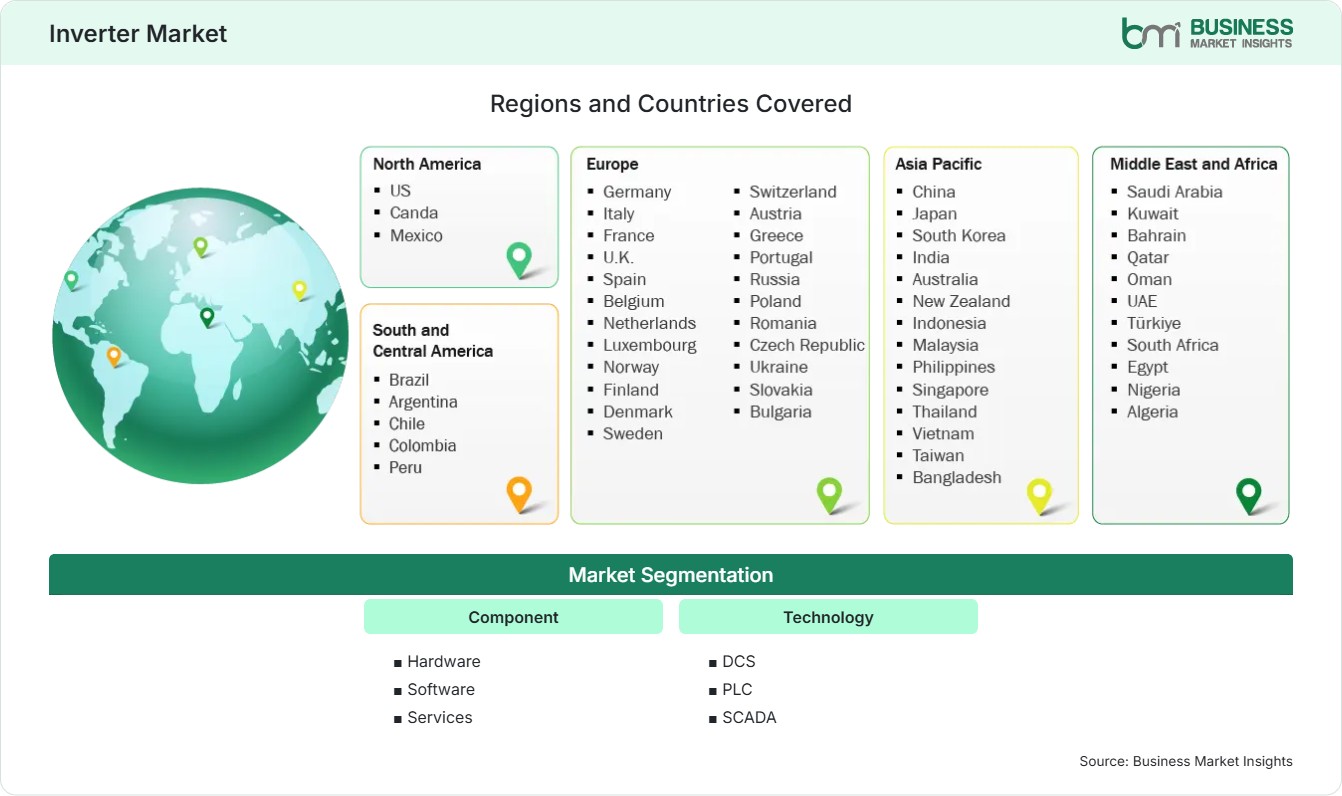
  • Component: Hardware, Software, Services
  • Technology: DCS, PLC, SCADA
US$ 27.12 Bn Market size in 2025
US$ 101.33 Bn Market Size by 2033
17.91% CAGR, 2026 - 2033
2026-2033 Forecast Period

AI Overview

Inverter Market Summary

  • North America Region: North America holds a market share of 32%–35% in 2025, growing at a CAGR of 16%–18% during 2026–2033. Key drivers include utility-scale solar deployment, energy storage growth, EV charging infrastructure expansion, grid resilience programs, industrial electrification investments, digital monitoring adoption, distributed energy resource integration, and supportive federal incentives across major economies. US market benefits from utility modernization and storage-linked installations, advancing at approximately 16.5%–18.5% CAGR.
  • Fastest Growing Region: Asia Pacific accounts for a 29%–32% share in 2025 and expands at a CAGR of 19%–21% through 2033. Growth stems from manufacturing expansion, renewable installations, urban electrification, microgrid investments, and infrastructure modernization across China, India, Southeast Asia, Australia, and regional industrial corridors.
  • Leading Segment: Hardware represents a 58%–62% share in 2025 and advances at a CAGR of 16%–18%. Growth is supported by increasing deployment of power electronics, industrial drives, renewable generation systems, energy storage projects, and replacement demand for higher-efficiency conversion equipment.
  • High Growth Segment: SCADA accounts for a 22%–26% share in 2025 and expands at a CAGR of 19%–22%. Adoption rises through remote asset monitoring, predictive maintenance capabilities, digital grid management, industrial automation modernization, cloud integration, and cybersecurity-enhanced operational systems.
  • Key Market Opportunity: Rapid coupling of battery energy storage and renewable power systems creates demand for advanced grid-forming architectures, intelligent monitoring tools, efficiency optimization solutions, and flexible power management platforms globally.
  • Major Market Players: ABB Ltd., Siemens AG, Schneider Electric SE, Mitsubishi Electric Corporation, Rockwell Automation, Inc., Emerson Electric Co., Honeywell International Inc., Delta Electronics, Inc., Huawei Digital Power Technologies Co., Ltd., Sungrow Power Supply Co., Ltd.
Strategic Insights

Inverter Market: Strategic Insights

Inverter Market Strategic Framework
FREE PDF
Request your free sample
Request free sample
Stakeholder View

Key Takeaways

  • Supply chains are becoming increasingly localized, with manufacturers establishing regional production bases to mitigate semiconductor availability risks and logistics disruptions.
  • Energy storage-linked installations present the highest revenue upside, particularly where solar generation, backup power requirements, and grid services converge.
  • Product innovation is shifting toward AI-enabled monitoring, grid-forming capabilities, higher conversion efficiencies, and predictive maintenance functionality.
  • Asia Pacific offers the strongest long-term opportunity due to industrialization, power infrastructure investments, and renewable deployment targets.
  • Strategic partnerships, acquisitions, and software integration investments are increasing as vendors seek differentiated offerings beyond hardware sales alone.
  • Recurring revenue from digital services, monitoring platforms, and lifecycle maintenance contracts is becoming an important profitability driver.
Geographic Outlook

Inverter Market Regional Highlights

North America Inverter Market

North America accounted for approximately 32%–35% Inverter Market share in 2025 and is forecast to grow at 16%–18% CAGR through 2033. Utility-scale renewable projects, energy storage investments, and grid resilience initiatives remain primary growth catalysts. The region benefits from advanced industrial infrastructure, strong technology adoption, and supportive incentive structures. Increasing electrification across transportation and commercial sectors supports product demand, while modernization of aging grid assets continues to generate opportunities for high-efficiency systems and intelligent monitoring solutions.

  • Utility-scale solar plus storage projects are creating sustained demand for advanced power conversion architectures.
  • Data center expansion increases requirements for reliable power management and backup systems.
  • Industrial modernization programs accelerate adoption of digitally connected equipment.
  • Government incentives support domestic manufacturing and clean energy infrastructure deployment.

US Inverter Market

The United States represents roughly 72%–76% of North American share and advances at 16.5%–18.5% CAGR. Growth is supported by large-scale renewable installations, battery storage deployment, grid enhancement projects, and industrial automation investments. Federal incentives continue encouraging adoption of efficient power technologies, while commercial users increasingly prioritize energy reliability and operational resilience.

  • Energy storage development is strengthening demand for grid-forming capabilities.
  • Utility operators emphasize resilience and distributed energy integration.
  • Manufacturing investments enhance domestic production capabilities.
  • Digital monitoring solutions gain traction across industrial facilities.

Europe Inverter Market

Europe held a 24%–27% share in 2025 and is projected to grow at 15%–17% CAGR. Decarbonization strategies, energy security priorities, and renewable integration initiatives underpin regional demand. Germany remains the leading market, while Spain and Poland exhibit stronger growth rates exceeding regional averages. Electrification policies and industrial efficiency targets continue supporting deployment across commercial and utility applications.

  • Renewable integration targets stimulate large-scale deployment activity.
  • Germany leads regional demand through advanced industrial and renewable ecosystems.
  • Spain demonstrates strong project pipeline growth supported by solar investments.
  • Digital energy management adoption continues accelerating across facilities.
  • Grid modernization remains a strategic priority among utilities.

Asia Pacific Inverter Market

The Asia Pacific region accounts for 29%–32%, with the fastest-growing segment at 19%–21% CAGR. The presence of robust manufacturing capabilities, renewable energy installations, and infrastructure development in urban areas drives market growth. China remains the leading contributor in the region, while India contributes significantly due to growth in electricity demand and renewable energy production. Regional industrialization continues to strengthen long-term demand fundamentals.

  • China leads deployment volumes across renewable and industrial applications.
  • India benefits from ambitious solar and infrastructure development programs.
  • Southeast Asia is emerging as a major investment destination.
  • Manufacturing expansion supports regional supply-chain advantages.
  • Smart grid implementation drives digital solution adoption.

Rest of World Inverter Market

Rest of World holds 10%–13% market share in 2025 and grows at 17%–19% CAGR. The Middle East will be aided by large-scale renewable and grid projects, while South and Central America will get a boost from distributed generation technology. Brazil is the dominant Latin American country, while Saudi Arabia has great growth prospects due to energy diversification programs.

  • Brazil leads regional deployment supported by distributed solar adoption.
  • Saudi Arabia accelerates renewable infrastructure investments.
  • Mining and industrial sectors create additional application opportunities.
  • Microgrid deployment supports remote power requirements.
  • Grid reliability concerns encourage modernization and technology upgrades.
Global Market Geography
FREE PDF
Request your free sample
Request free sample
Segment Analysis

Inverter Market Segmentation

Component

Component-based solutions make up the largest segment in the Inverter Market, accounting for 58%–62% of the market in 2025 and growing at a 16%–18% CAGR. These solutions benefit from renewable energy projects, automation, and smart grid infrastructure development. The sources of value creation move toward ecosystem-based solutions.

  • Hardware: Core power conversion equipment remains central to renewable generation, storage systems, industrial drives, and backup power infrastructure, supported by ongoing efficiency improvements and broader deployment across sectors.
  • Software: Analytics, diagnostics, asset monitoring, and predictive maintenance tools are increasingly embedded into solutions, helping operators optimize performance, reduce downtime, and improve lifecycle economics.
  • Services: Installation, maintenance, commissioning, technical support, and performance optimization services are gaining importance as customers seek long-term reliability and operational efficiency.

Technology

Technology-driven applications continue to change fast thanks to digitalization and automation in industries. There is demand for smart surveillance and operational visibility. The Inverter Market trends involve platforms that can improve efficiency, reliability, and remote manageability, as well as enhance productivity across industries.

  • DCS: Distributed control systems support complex process operations requiring high reliability, centralized visibility, and real-time operational management across industrial environments.
  • PLC: Programmable logic controllers remain widely adopted due to flexibility, scalability, process control capabilities, and suitability for manufacturing automation applications.
  • SCADA: Advanced supervisory control solutions enable remote monitoring, predictive analytics, asset performance management, and operational optimization across utilities and industrial facilities.
Market Forces

Inverter Market Dynamics

Key Market Drivers

Expansion of Renewable Energy Capacity Worldwide

According to the International Energy Agency, additions to renewable capacity continue to hit all-time highs, with solar PV the main source. Growth in renewable energy production calls for efficient conversion equipment capable of handling varying loads. This driver boosts the Inverter Market growth across utility-scale, commercial, and distributed environments. The installation of more solar power storage systems also increases the need for advanced design features to ensure stability and reliability. Inverter producers have responded to this challenge by developing highly efficient, low-cost-to-operate devices.

Growth of Battery Energy Storage Installations

The development of energy storage solutions continues to accelerate as the need for greater system efficiency and stability grows. Modern energy storage solutions require advanced power conversion techniques to deliver optimal performance. Such a combination of energy storage and renewable generation enables more effective use of intelligent solutions. In the developing energy market, technology developers are paying more attention to grid-forming capabilities and performance-optimization software. Growing investment in microgrids and backup power applications further strengthens demand across commercial, industrial, and utility sectors.

Industrial Automation and Digital Transformation

Manufacturers are continually investing in automation, predictive maintenance, and interconnectivity. Modern conversion systems that incorporate monitoring solutions will increase process efficiency and reliability. Energy optimization and process visibility have become priorities in industrial plants; therefore, favorable conditions have emerged for implementing these technologies. In addition, digital transformation projects drive demand for software solutions that can collect, analyze, and act on operational data in real time. These developments reinforce long-term deployment opportunities across manufacturing, utilities, data centers, and critical infrastructure applications.

Key Market Opportunities

Grid-Forming Technologies for Modern Power Networks

This shift towards power systems dominated by renewables offers an opportunity to develop solutions that improve resilience and stability. It becomes possible to develop technologies that will allow power resources to perform more sophisticated grid management functions and provide new ways to earn for the providers. The analysis of the Inverter Market Forecasts reveals growing investment in resilient solutions amid the rising share of renewables. Companies that can offer comprehensive hardware-software solutions will be able to use customers' changing needs to their advantage. Emerging markets also offer opportunities as grid modernization programs advance rapidly.

Expansion of Distributed Energy Resources

The use of distributed generation, community energy systems, and localized energy storage solutions is growing rapidly worldwide. This necessitates the provision of flexible, smart power conversion systems capable of handling bidirectional power flow. Providers of systems with scalable architectures and comprehensive management tools will certainly have an edge over their competition. Urban electrification and commercial resilience programs also bolster the rationale behind investing in distributed energy. The long-term opportunities extend well beyond equipment sales to include software subscriptions, monitoring services, and lifecycle support contracts.

AI-Enabled Energy Management Platforms

AI is increasingly becoming a part of asset management and optimization technologies. The ability of AI to forecast, detect faults, and perform predictive maintenance will enable operators to improve asset efficiency while reducing costs. Those vendors who can combine their hardware knowledge with digital skills will find their way in competitive markets. The growing need for transparency in operations and data-driven decision-making will drive adoption across various industries, utilities, and commercial buildings.

Market Restraints and Challenges

High Initial Investment and Integration Complexity

Factor: The deployment of sophisticated solutions is frequently associated with considerable investment in capital, technical knowledge, and system integration into the current infrastructure. Impact: Companies may be reluctant to adopt, even though there could be positive long-term results. Especially small businesses find it hard to absorb both the investment and risk involved in integration. Problems with integrating legacy systems and large-scale commissioning processes may increase project costs and extend timeframes. Even though technology prices keep falling, limited investment opportunities become a serious concern in various end-user industries.

Supply Chain and Semiconductor Availability Risks

Factor: The production of power electronics needs semiconductors, specialized materials, and global supply chains. Impact: The risks can lead to higher costs and longer shipping times, causing project delays. Geopolitical risks and logistics will remain important concerns in the industry. There is an increasing trend towards local sourcing and inventory diversification to gain resilience. Nevertheless, prolonged material shortages or cost fluctuations may affect profitability and rollouts, especially during peak-demand seasons.

Company Analysis

Competitive Landscape

The competitive environment is characterized by technology innovation, portfolio expansion, and digital integration initiatives. This Inverter Market analysis indicates growing competition between established industrial automation providers and specialized energy technology firms.

Company Name

Overview

Products and Services relevant to this market

ABB Ltd.

Global electrification and automation leader serving industrial and utility customers worldwide.

Power conversion systems, automation platforms, monitoring software, industrial energy management solutions.

Siemens AG

Major industrial technology provider with extensive automation and digitalization capabilities.

Industrial control systems, grid technologies, power electronics, digital platforms.

Schneider Electric SE

Energy management and automation specialist with strong sustainability focus.

Power conversion equipment, EcoStruxure software, grid and energy solutions.

Mitsubishi Electric Corporation

Diversified industrial technology company serving manufacturing and infrastructure sectors.

Industrial automation, power electronics, control systems, monitoring technologies.

Rockwell Automation, Inc.

Leading automation company focused on digital industrial transformation.

PLC, SCADA, control platforms, industrial software and services.

Emerson Electric Co.

Industrial automation and process management provider.

Control systems, monitoring software, automation technologies, lifecycle services.

Honeywell International Inc.

Global technology company serving industrial and infrastructure markets.

Process automation, control solutions, digital performance tools.

Delta Electronics, Inc.

Power electronics specialist with strong renewable energy presence.

Solar inverters, energy storage solutions, monitoring platforms.

Huawei Digital Power Technologies Co., Ltd.

Major provider of smart PV and energy management technologies.

Smart string inverters, energy storage integration, AI-powered platforms.

Sungrow Power Supply Co., Ltd.

Renewable energy technology specialist with global footprint.

Utility-scale inverters, energy storage systems, digital monitoring solutions.

Trust & Transparency

Research Methodology

The market analysis combines proprietary research with secondary data from government agencies, company disclosures, regulatory filings, industry databases and expert interviews. Market estimates are validated through data triangulation, cross-market benchmarking and analyst review.

View Full Research Methodology

Questions Answered

Frequently Asked Questions

What does an Inverter Market Report typically evaluate?

It assesses market size, competitive positioning, technological developments, regional opportunities, investment trends, segmentation performance, and future demand drivers.

How does energy storage influence demand patterns?

Battery systems require advanced power conversion and control technologies, increasing demand for intelligent solutions capable of supporting flexible grid interaction.

Why is software becoming more important in power conversion ecosystems?

Software enables predictive maintenance, performance optimization, asset monitoring, and remote management, creating operational and economic benefits beyond hardware functionality.

Which region offers the strongest long-term growth prospects?

Asia Pacific presents the strongest outlook due to large-scale renewable deployment, manufacturing expansion, infrastructure investment, and rising electricity demand.

What is the primary factor accelerating adoption across industries?

Renewable energy deployment combined with energy storage expansion remains the dominant growth catalyst, supported by grid modernization and industrial electrification investments.

Access the Full Inverter Market Report

Get segment-level forecasts, regional estimates, competitive benchmarking, company profiles and downloadable Excel datasets.

Access the full Inverter Market Report
350 pages PDF & Excel | 2026-09-10
Similar Research

Related Market Reports