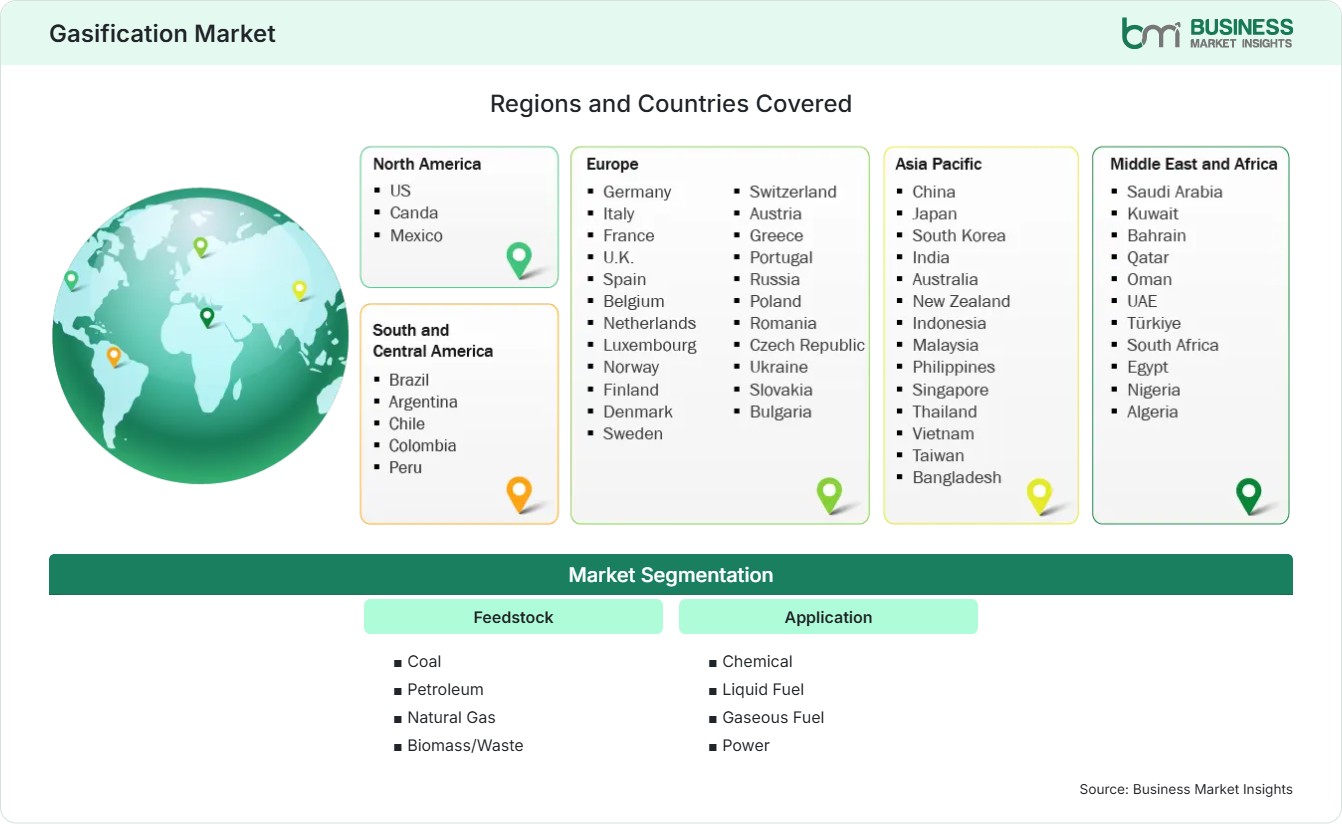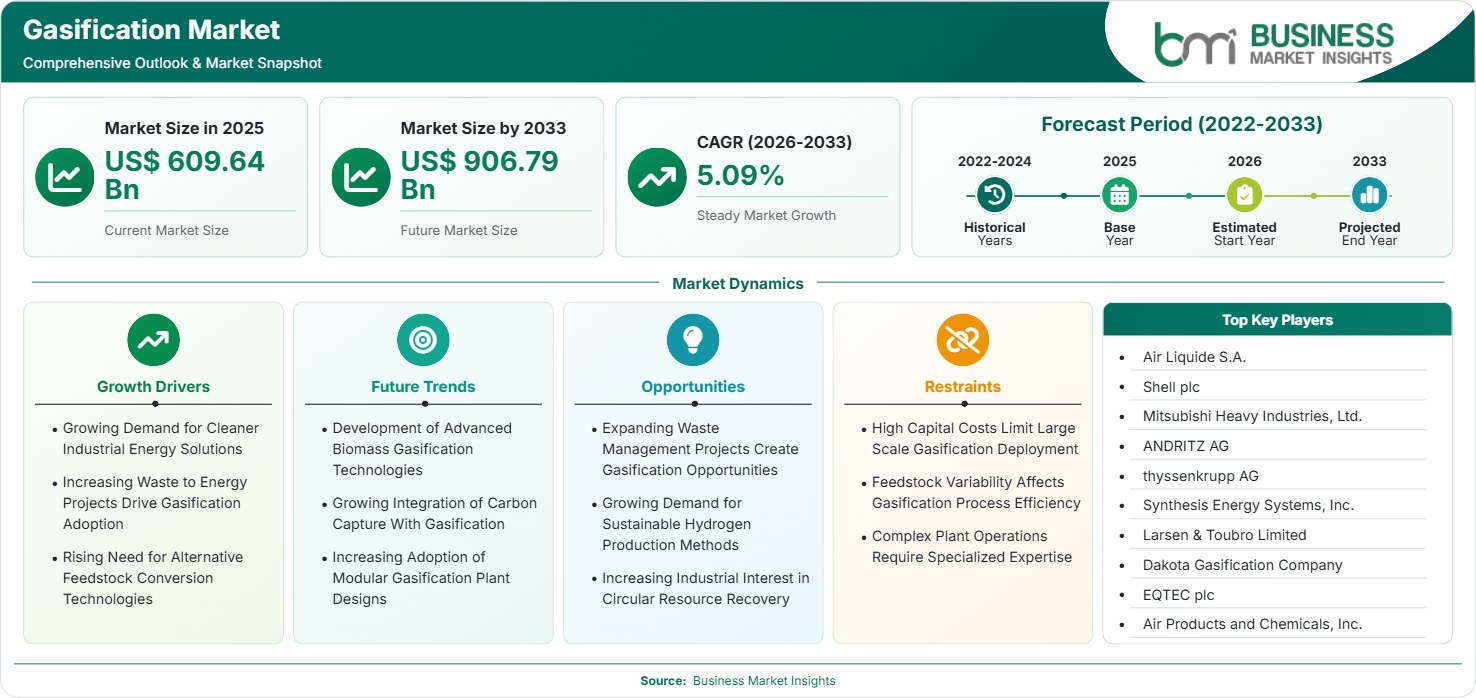
Gasification Market Regional Highlights
North America Gasification Market
North America accounted for an estimated 20%–23% share in 2025 and is projected to grow at a 4.2%–4.7% CAGR through 2033. The region benefits from established energy infrastructure, industrial gas demand, resource availability, and technology expertise. The Gasification Market share is supported by opportunities involving waste conversion, hydrogen, chemicals, and synthetic fuels.
- The US remains the principal regional market, with opportunities spanning hydrogen, industrial gases, chemicals, waste conversion, and resource-based syngas production supported by established energy infrastructure.
- Waste and biomass projects can gain traction where developers combine feedstock management with energy or fuel production, improving utilization of difficult-to-process materials while addressing disposal requirements.
- Industrial integration provides a commercial advantage because existing utilities, pipelines, storage facilities, and downstream processing infrastructure can reduce requirements for entirely new supporting assets.
- Carbon management integration can improve the investment case for selected projects by creating pathways toward lower-emission products while preserving syngas-based industrial applications.
US Gasification Market
The US represents approximately 16%–19% of global share in 2025 and is expected to expand at a 4.3%–4.8% CAGR through 2033. Domestic feedstock availability and established energy infrastructure support project development. The Gasification Market growth outlook is shaped by industrial decarbonization, hydrogen production, chemical manufacturing, waste conversion, and energy security considerations.
- Domestic resource availability supports projects using coal, natural gas, biomass, and waste, allowing developers to select feedstocks according to regional economics and downstream product requirements.
- Hydrogen and industrial gas applications create opportunities for gasification projects that integrate syngas processing, separation technologies, carbon management, and established industrial distribution networks.
- Chemical and fuel conversion can provide higher-value outlets for syngas than conventional electricity generation, particularly where long-term product offtake agreements support project financing.
Europe Gasification Market
Europe held an estimated 15%–18% share in 2025 and is projected to grow at a 4.5%–5.1% CAGR through 2033. Germany, the UK, France, and the Netherlands represent important markets, while Nordic and selected Eastern European economies offer additional opportunities. Germany is expected to grow at 4.6%–5.1% CAGR, while the UK can achieve 5.0%–5.6% CAGR as waste and low-carbon fuel projects develop.
- Germany benefits from its industrial base and engineering capabilities, creating opportunities for integrated syngas systems serving chemicals, fuels, hydrogen, and industrial energy requirements.
- The UK offers opportunities for waste and biomass conversion projects where gasification can support resource recovery, fuel production, and lower-carbon energy pathways.
- France and the Netherlands provide potential for integrated projects connected with chemicals, industrial gases, waste processing, and existing energy infrastructure.
- European project development increasingly emphasizes emissions performance, feedstock sustainability, carbon management, and compatibility with broader industrial decarbonization strategies.
Asia Pacific Gasification Market
Asia Pacific represented approximately 43%–47% share in 2025 and is projected to expand at a 5.8%–6.4% CAGR through 2033. China, India, Japan, South Korea, and Southeast Asian economies contribute to regional demand. China remains the leading market, while India and Southeast Asia provide strong growth opportunities as industrial capacity expands and governments pursue greater domestic energy and feedstock utilization.
- China provides the largest regional opportunity because of extensive industrial infrastructure, coal availability, chemical manufacturing capacity, and established expertise in large-scale syngas production.
- India offers growing potential through expanding industrial production, domestic coal resources, chemical manufacturing, and efforts to improve utilization of available energy and carbon feedstocks.
- Japan and South Korea provide opportunities for advanced systems emphasizing high efficiency, waste conversion, hydrogen, synthetic fuels, and integration with sophisticated industrial infrastructure.
- Southeast Asia presents longer-term potential as industrialization, biomass availability, waste generation, and energy diversification requirements create demand for flexible conversion technologies.
Rest of World Gasification Market
Rest of World accounted for approximately 15%–19% share in 2025 and is expected to grow at a 4.4%–5.0% CAGR through 2033. South America offers opportunities linked to biomass, waste, chemicals, and industrial fuels, with Brazil representing a leading market. Middle Eastern and African countries provide potential through industrial diversification, gas resources, waste management, and hydrogen projects.
South and Central America can benefit from abundant biomass resources and expanding industrial applications for syngas. Brazil provides the strongest regional opportunity because of its agricultural and biomass base.
- Brazil provides a strong biomass-based opportunity, particularly where agricultural residues can be integrated with chemical production, fuels, energy generation, or renewable gas pathways.
- Middle Eastern markets can leverage existing energy infrastructure and industrial capabilities to evaluate gasification for hydrogen, chemicals, synthetic fuels, and resource diversification.
- African markets offer potential for decentralized waste and biomass conversion, although project development depends heavily on infrastructure availability, financing, feedstock logistics, and technical expertise.
- Countries with reliable industrial offtake and concentrated feedstock resources are likely to provide stronger near-term investment conditions than fragmented markets with limited downstream infrastructure.