
Biomass Gasification Market Outlook: Size, Share, Trends, Growth Analysis, Competitive Landscape & Forecast, 2026–2033

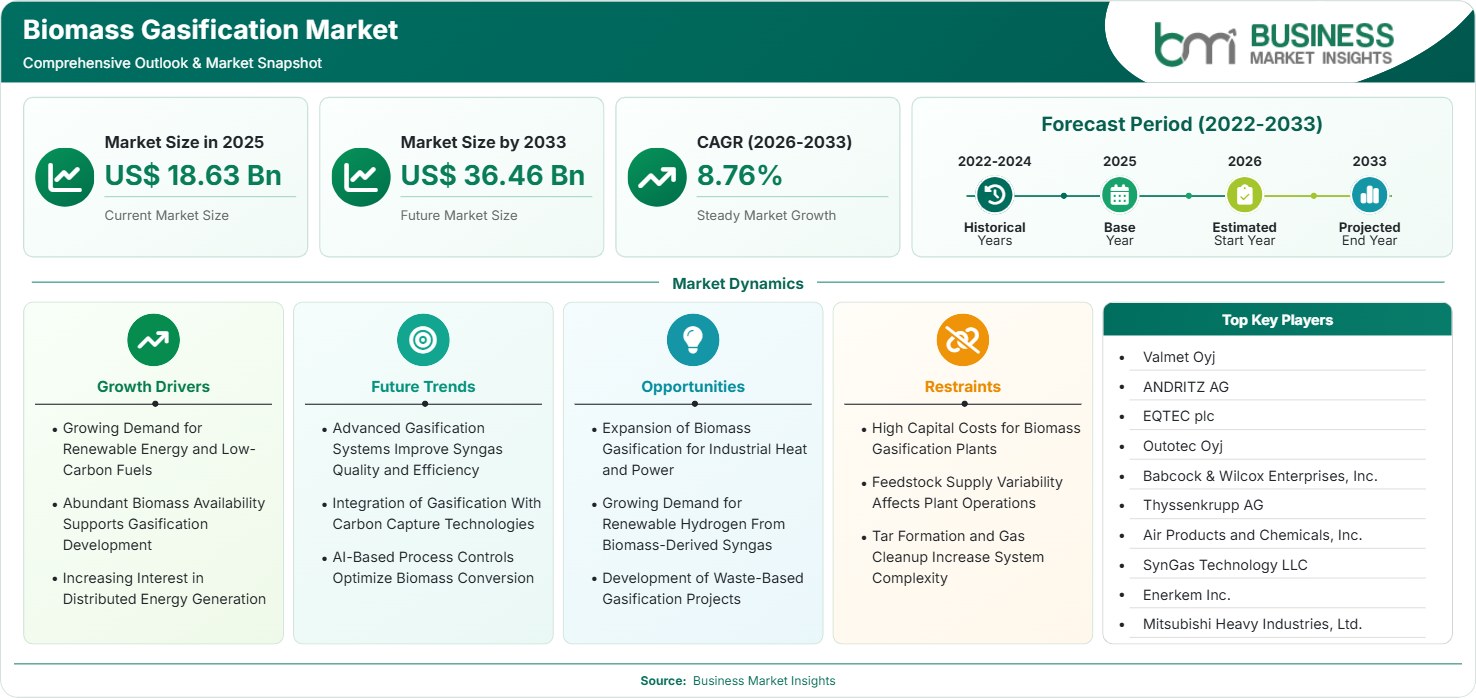
The Biomass Gasification Market size was valued at US$ 18.63 Billion in 2025 and is projected to reach US$ 36.46 Billion by 2033, growing at a CAGR of 8.76% during 2026–2033, driven by renewable energy demand, biomass availability, industrial decarbonization, and renewable fuel development.

Report Coverage
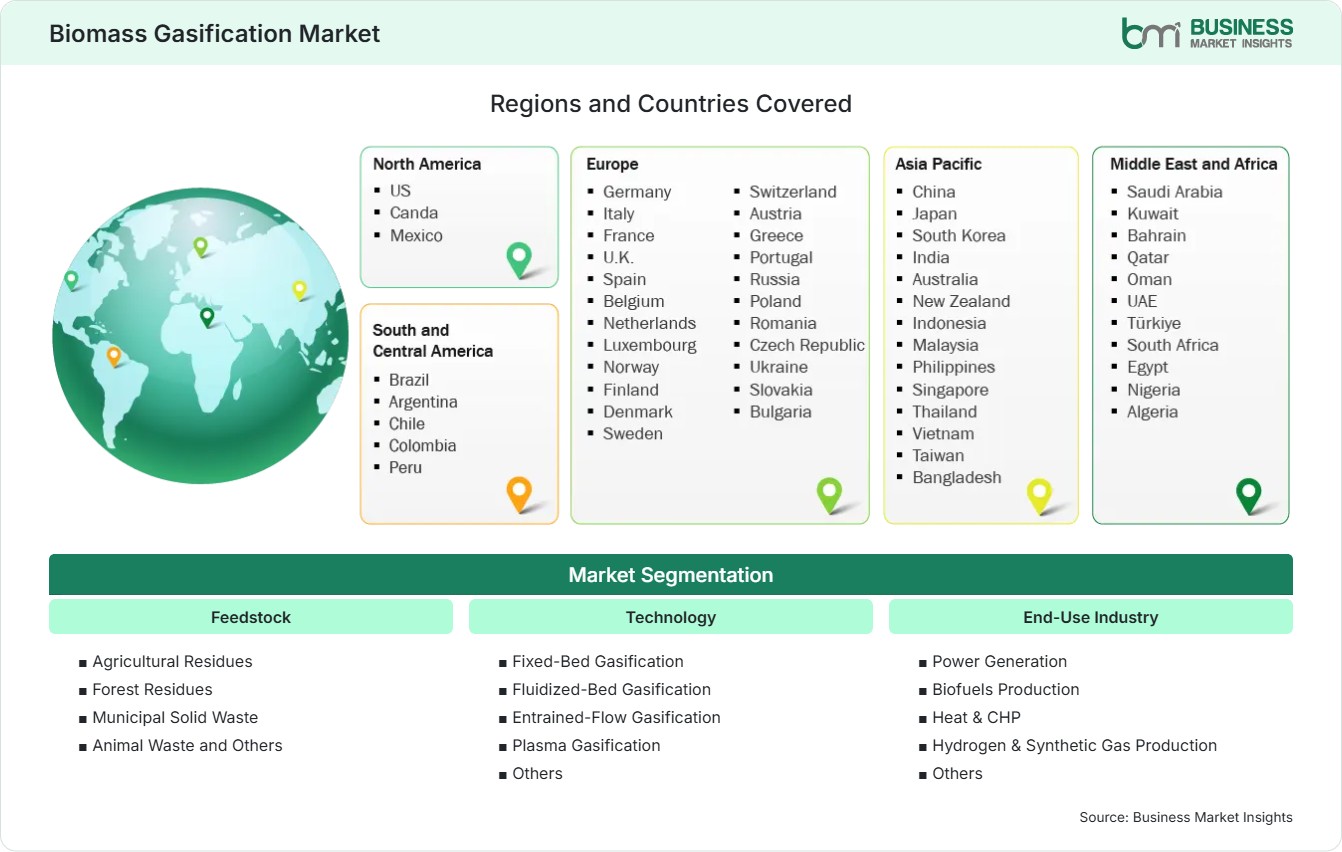
  • Feedstock: Agricultural Residues, Forest Residues, Municipal Solid Waste , Animal Waste and Others
  • Technology: Fixed-Bed Gasification, Fluidized-Bed Gasification, Entrained-Flow Gasification, Plasma Gasification, Others
  • End-Use Industry: Power Generation, Biofuels Production, Heat & CHP, Hydrogen & Synthetic Gas Production, Others
US$ 18.63 Bn Market size in 2025
US$ 36.46 Bn Market Size by 2033
8.76% CAGR, 2026 - 2033
2026-2033 Forecast Period

01 AI Overview

Biomass Gasification Market Summary

  • North America Region: North America holds a 25%–29% share in 2025 and grows at a 7.8%–9.1% CAGR during 2026–2033, supported by renewable power development, waste conversion, industrial heat demand, and interest in low-carbon fuels. The US accounts for 72%–76% of regional demand, distributed generation, industrial decarbonization, waste utilization, and renewable fuel development, with a 7.9%–9.2% CAGR during 2026–2033.
  • Fastest Growing Region: Asia Pacific holds a 34%–38% Biomass Gasification Market share in 2025 and grows at a 9.5%–10.8% CAGR during 2026–2033, supported by industrialization, expanding renewable energy systems, agricultural residue availability, waste management requirements, decentralized generation, and growing demand for cleaner industrial fuels.
  • Leading Segment: Power Generation holds a 35%–39% share in 2025 and grows at a 7.7%–8.8% CAGR during 2026–2033, supported by distributed generation, renewable electricity demand, biomass availability, energy diversification, and replacement of fossil-based generation in selected applications.
  • High Growth Segment: Hydrogen & Synthetic Gas Production holds a 9%–12% share in 2025 and grows at a 10.8%–12.5% CAGR during 2026–2033, supported by renewable hydrogen demand, syngas utilization, low-carbon fuels, carbon management, and industrial decarbonization.
  • Key Market Opportunity: Biomass-derived syngas creates opportunities across renewable hydrogen, industrial heat, synthetic fuels, waste conversion, distributed power, and integrated energy systems where local feedstock availability improves project economics.
  • Major Market Players: Valmet Oyj, ANDRITZ AG, EQTEC plc, Outotec Oyj, Babcock & Wilcox Enterprises, Inc., thyssenkrupp AG, Air Products and Chemicals, Inc., SynGas Technology LLC, Enerkem Inc., Mitsubishi Heavy Industries, Ltd.
02 Strategic Insights

Biomass Gasification Market: Strategic Insights

Biomass Gasification Market Strategic Framework
FREE PDF
Request your free sample
Request free sample
03 Stakeholder View

Key Takeaways

  • Feedstock availability is becoming a central project-selection factor because transportation distance, moisture content, seasonal variation, contamination, and competing biomass uses directly influence operating economics and plant reliability.
  • Power generation remains the largest application, while hydrogen, synthetic gas, industrial heat, and combined heat and power provide broader opportunities for higher-value syngas utilization.
  • Technology selection is moving toward systems capable of handling variable feedstocks while maintaining stable gas quality, reliable operation, effective tar management, and efficient downstream gas cleaning.
  • Asia Pacific provides the strongest expansion opportunity as agricultural residues, industrial energy demand, waste-management requirements, and decentralized power needs develop together.
  • Investment is increasingly directed toward integrated projects combining feedstock preparation, gasification, gas cleaning, heat recovery, power generation, fuel synthesis, or hydrogen production rather than standalone gasification equipment.
  • Competitive differentiation will increasingly depend on lifecycle service, plant availability, feedstock flexibility, automation, emissions control, project financing support, and the ability to integrate gasification with existing industrial energy systems.
04 Geographic Outlook

Biomass Gasification Market Regional Highlights

North America Biomass Gasification Market

North America Biomass Gasification Market holds a 25%–29% share in 2025 and grows at a 7.8%–9.1% CAGR through 2033. The US represents 72%–76% of regional demand and expands at a 7.9%–9.2% CAGR, supported by renewable energy development, industrial heat requirements, waste conversion, and distributed generation. Canada contributes through forestry residues and renewable energy applications.

  • The US provides the region’s broadest application base, with demand linked to renewable power, industrial energy requirements, waste utilization, and development of lower-carbon fuel pathways.
  • Canada benefits from substantial forestry resources and established biomass handling capabilities, supporting opportunities for gasification systems designed around woody residues and industrial energy applications.
  • Industrial users are evaluating biomass-derived syngas as an alternative energy source where local feedstock availability and existing thermal infrastructure can support economically viable conversion systems.
  • Project developers increasingly emphasize feedstock contracts, plant flexibility, gas cleanup, emissions performance, and long-term offtake arrangements when assessing commercial feasibility.

US Biomass Gasification Market

The US Biomass Gasification Market represents 72%–76% of North American demand in 2025 and grows at a 7.9%–9.2% CAGR through 2033. Demand is supported by renewable energy objectives, biomass availability, industrial heat requirements, waste conversion, and distributed energy development. Agricultural residues, forestry resources, and selected waste streams provide multiple feedstock options.

  • Renewable power and distributed generation applications support adoption where biomass resources can provide controllable energy output alongside other renewable sources.
  • Industrial facilities can use gasification to convert available biomass residues into process heat, electricity, or usable syngas, improving resource utilization within integrated energy systems.
  • Feedstock logistics remain important because transportation costs, moisture levels, contamination, and seasonal availability can materially influence project economics and operating stability.

Europe Biomass Gasification Market

Europe Biomass Gasification Market holds a 20%–24% share in 2025 and grows at a 7.4%–8.6% CAGR through 2033. Germany, the United Kingdom, Sweden, Finland, France, and the Netherlands are leading markets, while Poland and Denmark offer additional opportunities. European adoption is supported by renewable energy integration, industrial decarbonization, waste utilization, and demand for renewable fuels.

  • Germany and the United Kingdom provide strong opportunities for advanced biomass conversion because industrial decarbonization and renewable energy integration are increasing interest in alternative thermal energy sources.
  • Sweden and Finland benefit from established forestry industries and biomass supply chains, creating favorable conditions for woody residue utilization and integrated heat and power applications.
  • France and the Netherlands offer opportunities in waste conversion, industrial heat, and renewable fuel systems where gasification can be integrated with broader resource recovery infrastructure.
  • European projects increasingly prioritize emissions control, feedstock sustainability, plant efficiency, and integration with existing district heating or industrial energy networks.

Asia Pacific Biomass Gasification Market

Asia Pacific holds a 34%–38% share in 2025 and grows at a 9.5%–10.8% CAGR through 2033. China, India, Japan, and South Korea are leading markets, while Southeast Asia provides strong growth potential. Agricultural residues, industrial energy demand, expanding electricity requirements, and waste-management needs support regional adoption.

  • China benefits from extensive agricultural and industrial activity, creating feedstock availability and demand for decentralized energy, industrial heat, and waste-to-energy technologies.
  • India provides strong opportunities because agricultural residues are widely available while industrialization and distributed energy requirements continue increasing across manufacturing regions.
  • Japan and South Korea focus more strongly on efficient biomass utilization, energy security, industrial applications, and technologies compatible with established energy infrastructure.
  • Southeast Asian markets provide emerging opportunities where agricultural processing residues, palm-related biomass, forestry resources, and industrial heat demand can support localized gasification projects.

Rest of World Biomass Gasification Market

Rest of World holds a 10%–14% share in 2025 and grows at a 7.6%–9.0% CAGR through 2033. South and Central America are led by Brazil, Argentina, Chile, and Mexico, supported by agricultural residues, forestry resources, industrial processing, and renewable power requirements. Brazil provides the broadest regional opportunity because of its large agricultural and biomass resource base. Mexico also offers opportunities through industrial energy applications and distributed generation.

The Middle East and Africa provide additional potential through waste conversion, industrial heat, renewable power, and resource diversification. Saudi Arabia, the UAE, South Africa, and selected North African markets are leading opportunities, while adoption remains dependent on feedstock economics, infrastructure, financing, and project-scale requirements.

  • Brazil offers a broad feedstock base and industrial application potential, supporting gasification for power, heat, and higher-value energy products.
  • Mexico and Argentina provide opportunities around agricultural residues, industrial heat requirements, and decentralized energy systems, particularly where local biomass resources can reduce fuel logistics costs.
  • South Africa provides opportunities through industrial energy demand, agricultural residues, and waste management, although project economics remain sensitive to financing and feedstock availability.
  • Gulf and North African markets can use gasification within diversified energy systems where waste conversion and industrial decarbonization objectives create demand for alternative energy technologies.
Global Market Geography
FREE PDF
Request your free sample
Request free sample
05 Segment Analysis

Biomass Gasification Market Segmentation

Feedstock

Agricultural Residues hold a 31%–35% share in 2025 and grow at a 8.5%–9.4% CAGR through 2033. Feedstock selection determines gasifier performance, syngas quality, logistics costs, and plant availability. Agricultural and forest residues provide established biomass sources, while MSW and animal waste create additional conversion opportunities.

  • Agricultural Residues: Crop residues provide accessible biomass for decentralized energy and industrial applications, with adoption influenced by seasonal availability, moisture, collection systems, and competing agricultural uses.
  • Forest Residues: Forestry residues offer relatively consistent woody feedstock for larger systems, supporting power, heat, and industrial applications where established collection and transportation networks exist.
  • Municipal Solid Waste (MSW): MSW provides a waste-conversion route for selected combustible fractions, with demand influenced by waste composition, preprocessing, emissions control, and local disposal requirements.
  • Animal Waste: Animal waste can support gasification where drying, handling, and feedstock preparation systems are available, creating opportunities for agricultural facilities seeking additional energy recovery.

Technology

Fluidized-Bed Gasification holds a 36%–40% share in 2025 and grows at a 8.8%–9.7% CAGR through 2033. Technology selection depends on feedstock characteristics, plant capacity, syngas requirements, and operating conditions. Fluidized-bed systems provide strong feedstock flexibility, while fixed-bed technologies remain suitable for smaller applications.

  • Fixed-Bed Gasification: Fixed-bed systems suit smaller and relatively uniform feedstocks, offering straightforward operation for decentralized energy applications where consistent fuel preparation is achievable.
  • Fluidized-Bed Gasification: Fluidized-bed systems provide strong mixing and heat transfer, supporting larger capacities and broader feedstock flexibility for power, heat, and industrial energy applications.
  • Entrained-Flow Gasification: Entrained-flow systems operate at high temperatures and can produce syngas suitable for demanding downstream applications requiring extensive feedstock conversion and gas treatment.
  • Plasma Gasification: Plasma systems use very high-temperature conversion and are suited to specialized waste and residue applications where advanced treatment and syngas recovery justify higher system complexity.

End-Use Industry

Power Generation holds a 35%–39% share in 2025 and grows at a 7.7%–8.8% CAGR through 2033. Power remains the principal application because gasification converts solid biomass into combustible syngas that can support controlled electricity generation. Biofuels, heat and CHP, and hydrogen and synthetic gas production broaden demand. The Biomass Gasification Market trends increasingly favor integrated systems that maximize energy recovery across multiple output streams.

  • Power Generation: Gasification supports electricity production from biomass through syngas utilization, with adoption influenced by feedstock availability, generation efficiency, grid requirements, and plant economics.
  • Biofuels Production: Biomass-derived syngas can serve as an intermediate for renewable fuel production, creating opportunities where downstream synthesis infrastructure and sustainable feedstock supply are available.
  • Heat & CHP: Combined heat and power systems improve biomass utilization by producing useful thermal energy alongside electricity, supporting industrial facilities and district energy applications.
  • Hydrogen & Synthetic Gas Production: Gasification-derived syngas provides a pathway toward hydrogen and synthetic gas production, with commercial potential linked to gas cleanup, conversion efficiency, and downstream processing.
06 Market Forces

Biomass Gasification Market Dynamics

Key Market Drivers

Growing Demand for Renewable Energy and Low-Carbon Fuels

The transition toward lower-carbon energy systems is increasing interest in technologies that convert renewable biomass into electricity, heat, and fuel intermediates. Gasification provides greater flexibility than direct combustion because syngas can be directed toward different downstream uses depending on project requirements. The Biomass Gasification Market growth is therefore linked to demand for renewable energy alongside industrial efforts to reduce fossil fuel consumption. Gasification can also complement variable renewable generation by providing controllable energy output where sustainable feedstock is available.

Abundant Biomass Availability Supports Gasification Development

Availability of agricultural residues, forestry residues, certain parts of municipal waste, and animal-based feedstocks provides advantages to the process of biomass gasification. Availability of local feedstocks will enhance economic feasibility due to lower reliance on imported conventional fuels, especially when the residues do not have other high value applications. Consequently, technology vendors are now coming up with technologies that are more tolerant to variability in feedstock. The Biomass Gasification Market trend becoming increasingly favoring such projects.

Increasing Interest in Distributed Energy Generation

The demand for distributed energy generation will create opportunities for systems that produce energy through gasification of biomass near the fuel source and end user. Decentralized energy production can decrease reliance on transmission and turn low-quality waste materials into electricity or heat. Gasification will be especially applicable in cases where there is a need for controlled thermal energy for an industrial plant and availability of appropriate biomass. Smaller and modular systems can also serve applications where centralized infrastructure is unavailable or economically inefficient.

Key Market Opportunities

Expansion of Biomass Gasification for Industrial Heat and Power

Facilities in the industrial sector are looking for fuel alternatives other than fossil fuels for process heat, steam, and power generation, providing a great chance for biomass gasification. The syngas produced can be utilized in energy systems wherein there is a constant need for heat generation and when biomass residuals are readily available in the vicinity. Combined heat and power (CHP) can help optimize the energy efficiency of the system since both electricity and heat can be produced. Gasification can offer better fuel flexibility than that of conventional fuel-based systems.

Growing Demand for Renewable Hydrogen from Biomass-Derived Syngas

Hydrogen production represents an emerging higher-value application for biomass gasification because syngas can be processed into hydrogen after gas cleaning and conditioning. Gasification can also support broader renewable fuel systems where hydrogen is combined with other synthesis pathways to produce transport or industrial fuels. Developers are increasingly considering integrated configurations that combine feedstock preparation, gasification, gas cleanup, hydrogen separation, and carbon management. The Biomass Gasification Market Forecasts increasingly favor diversified output models where syngas can serve power, heat, hydrogen, or synthetic fuel applications.

Development of Waste-Based Gasification Projects

Gasification from waste provides opportunity for integration of energy recovery with waste management goals. Specific municipal and industrial wastes, with appropriate pre-treatment to strip non-burnable materials, become fuel sources suitable for gasification processes. Such gasification reduces dependency on traditional methods of disposal while at the same time converting the carbon component into syngas. The commercial feasibility of such gasification depends on various factors including the nature of the waste and its preprocessing.

Market Restraints and Challenges

High Capital Costs for Biomass Gasification Plants

Factor: Gasification facilities require specialized reactors, feedstock preparation, gas cleaning, heat recovery, emissions-control systems, controls, and downstream conversion equipment. Impact: High initial investment can limit adoption among smaller developers and make financing more difficult in markets with uncertain energy offtake. Capital requirements increase further when projects include hydrogen production, synthetic fuels, advanced gas purification, or carbon management. Equipment integration also requires engineering expertise and project-development time, increasing pre-operating expenditure.

Feedstock Supply Variability Affects Plant Operations

Factor: The biomass feedstock sources have varying levels of moisture, ash, size of particles, chemical composition, availability, and seasonal conditions. Impact: These factors may lower the efficiency of the gasifier and affect syngas quality, and make the process more costly due to the need for preprocessing, and introduce operational challenges. Seasonal fluctuations will apply especially to agricultural waste, whereas municipal waste may be constantly changing.

07 Company Analysis

Competitive Landscape

The competitive structure is influenced by gasifier design, feedstock flexibility, plant integration, gas-cleaning capabilities, automation, engineering expertise, project execution, and lifecycle services. The Biomass Gasification Market analysis also shows increasing importance of suppliers capable of integrating gasification with power generation, industrial heat, CHP, waste conversion, hydrogen, and synthetic gas production.

Company Name

Overview

Products and Services relevant to this market

Valmet Oyj

Energy and process technology supplier with extensive capabilities across biomass conversion, automation, and energy systems.

Biomass gasification systems, fluidized-bed technologies, fuel handling, automation, heat recovery, and lifecycle services.

ANDRITZ AG

Industrial technology provider with established biomass energy and gasification capabilities for industrial and utility applications.

Biomass gasifiers, fluidized-bed systems, fuel handling, gas treatment, energy systems, and plant services.

EQTEC plc

Gasification technology company focused on converting biomass and waste feedstocks into usable syngas and energy.

Advanced gasification technology, syngas production systems, plant integration, engineering, and technology licensing.

Outotec Oyj

Process technology company with expertise in thermal processing and energy-related industrial technologies.

Gasification-related process systems, thermal technologies, process integration, and engineering solutions for industrial applications.

Babcock & Wilcox Enterprises, Inc.

Energy technology supplier providing thermal conversion and waste-to-energy solutions for industrial and utility markets.

Biomass and waste conversion systems, gasification technologies, emissions control, boilers, and energy recovery systems.

thyssenkrupp AG

Industrial engineering group providing process technologies and integrated systems for energy and chemical applications.

Gasification technologies, process engineering, syngas systems, plant integration, and downstream chemical processing solutions.

Air Products and Chemicals, Inc.

Industrial gases and technology supplier with capabilities relevant to syngas conditioning and energy conversion systems.

Industrial gases, gas processing, syngas-related technologies, hydrogen solutions, and process integration services.

SynGas Technology LLC

Specialized gasification technology company focused on converting solid feedstocks into useful synthesis gas.

Gasification systems, syngas generation, biomass conversion technologies, engineering, and project support.

Enerkem Inc.

Renewable fuels technology company developing thermochemical conversion systems for waste and renewable feedstocks.

Waste gasification, syngas conversion, renewable fuels, methanol-related technologies, and integrated processing systems.

Mitsubishi Heavy Industries, Ltd.

Diversified engineering company with technologies spanning energy, environmental systems, thermal conversion, and gasification.

Biomass and waste conversion systems, gasification, energy systems, environmental technologies, and plant engineering.

10 Trust & Transparency

Research Methodology

The market analysis combines proprietary research with secondary data from government agencies, company disclosures, regulatory filings, industry databases and expert interviews. Market estimates are validated through data triangulation, cross-market benchmarking and analyst review.

View Full Research Methodology

11 Questions Answered

Frequently Asked Questions

Which application offers the strongest long-term opportunity in Biomass Gasification Market report?

Hydrogen and synthetic gas production provide an important long-term opportunity because gasification can convert biomass into syngas suitable for downstream fuel and chemical pathways, subject to feedstock sustainability and project economics.

What determines the economic feasibility of a gasification project?

Feedstock cost and availability, plant utilization, technology efficiency, capital requirements, gas-cleaning needs, energy offtake, financing conditions, and environmental compliance are the main commercial considerations.

How does gasification differ from direct biomass combustion?

Gasification converts biomass under controlled oxygen conditions to produce syngas, which can then be used for power, heat, hydrogen, or fuel production. Combustion directly oxidizes biomass to generate heat.

Which technology is most suitable for large biomass gasification facilities?

Fluidized-bed gasification is generally suited to larger and more flexible installations because it provides effective mixing and heat transfer while accommodating a broader range of biomass feedstocks.

What feedstocks are most suitable for biomass gasification?

Agricultural residues, forest residues, selected municipal solid waste streams, and animal waste can be suitable when their moisture, ash, particle size, and chemical characteristics match the selected gasification technology and preprocessing system.

Access the Full Biomass Gasification Market Report

Get segment-level forecasts, regional estimates, competitive benchmarking, company profiles and downloadable Excel datasets.

Access the full Biomass Gasification Market Report
350 pages PDF & Excel | 2026-08-19