
Solid Biomass Feedstock Market Outlook: Size, Share, Trends, Growth Analysis, Competitive Landscape & Forecast, 2026-2033

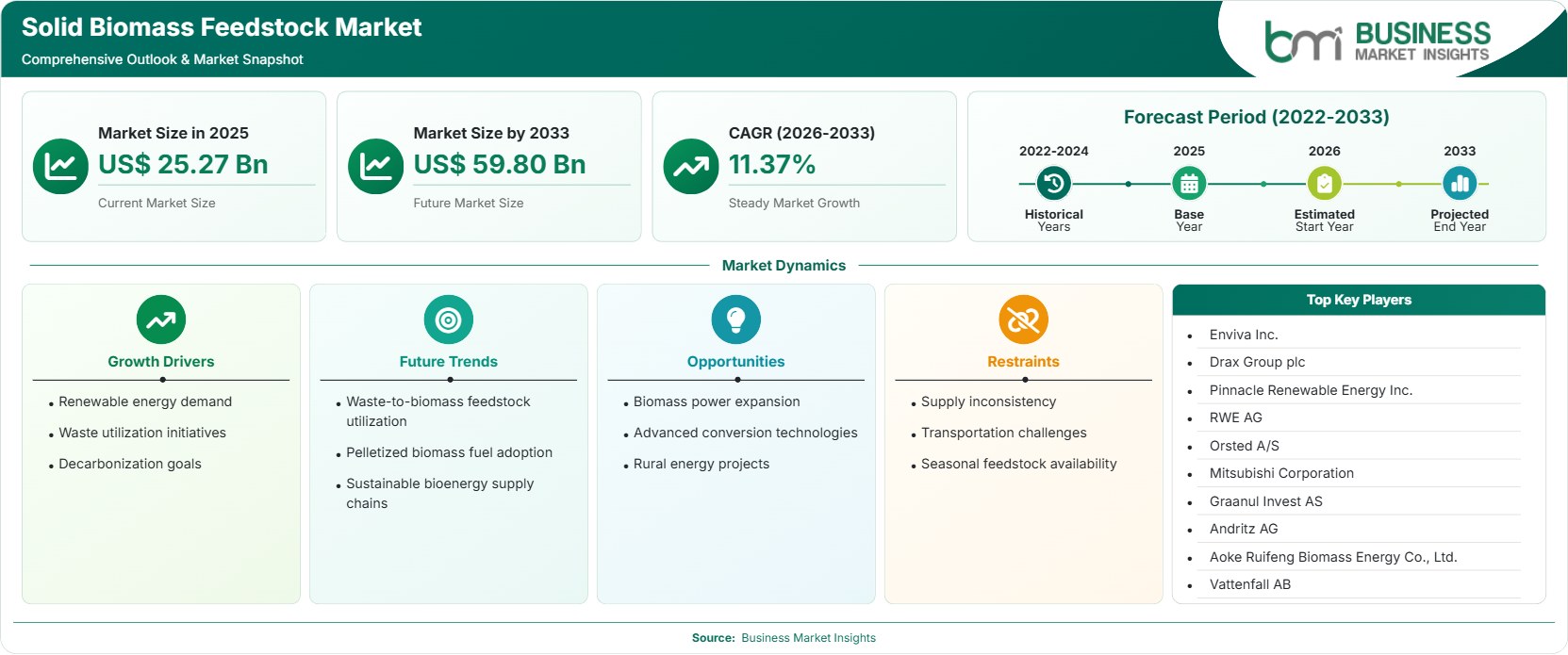
The Solid Biomass Feedstock Market size was valued at US$ 25.27 billion in 2025 and is projected to reach US$ 59.80 billion by 2033, growing at a CAGR of 11.37% during 2026–2033. Rising renewable energy adoption, waste utilization programs, decarbonization commitments, biomass power expansion, and investments in advanced conversion technologies are driving market opportunities.

Report Coverage
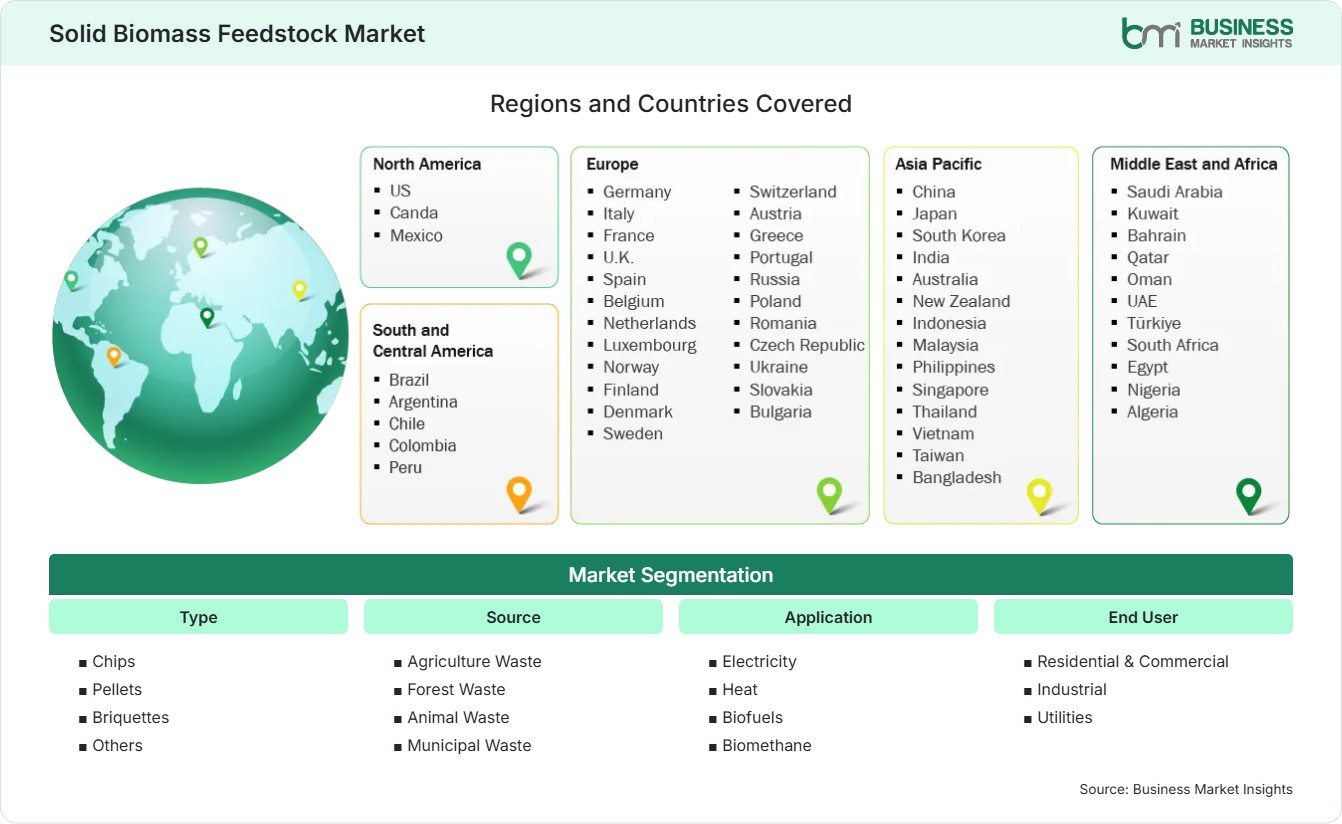
  • Type: Chips, Pellets, Briquettes, Others
  • Source: Agriculture Waste, Forest Waste, Animal Waste, Municipal Waste
  • Application: Electricity, Heat, Biofuels, Biomethane
  • End User: Residential & Commercial, Industrial, Utilities
US$ 25.27 Bn Market size in 2025
US$ 59.80 Bn Market Size by 2033
11.37% CAGR, 2026 - 2033
2026-2033 Forecast Period

AI Overview

Solid Biomass Feedstock Market Summary

North America Region: North America holds approximately 31%–34% market share in 2025 and is projected to expand at a CAGR of 10.8%–11.3% during 2026–2033. The region benefits from established biomass supply chains, renewable energy incentives, forest resource availability, and increasing demand for low-carbon fuels. The United States remains the primary contributor due to expanding pellet production, utility biomass projects, and industrial decarbonization initiatives, with an estimated 10.9%–11.4% CAGR through 2033.

Fastest Growing Region: Asia Pacific accounts for approximately 34%–37% of the Solid Biomass Feedstock market share in 2025 and is expected to register a CAGR of 12.1%–12.6% during 2026–2033. Growth is supported by increasing renewable energy investments, agricultural residue utilization, rural electrification initiatives, industrial biomass adoption, and government programs promoting alternative energy sources across China, India, Japan, and Southeast Asia.

Leading Segment: Pellets represent approximately 45%–49% market share in 2025 and are forecast to grow at a CAGR of 11.5%–12.0% during 2026–2033. Strong adoption is supported by standardized quality, efficient transportation, compatibility with existing energy infrastructure, and rising demand from utility-scale biomass power plants.

High Growth Segment: Biomethane application represents approximately 10%–14% market share in 2025 and is projected to grow at a CAGR of 12.8%–13.3% during the Solid Biomass Feedstock market forecast period. Growth is driven by renewable gas initiatives, waste conversion technologies, natural gas replacement strategies, and increasing interest in circular energy systems.

Key Market Opportunity: Expansion of biomass power generation, advanced conversion technologies, rural energy projects, and integrated waste-to-energy systems is creating opportunities for feedstock suppliers, technology providers, and renewable energy developers.

Major Market Players: Enviva Inc., Drax Group plc, Pinnacle Renewable Energy Inc., RWE AG, Ørsted A/S, Mitsubishi Corporation, Graanul Invest AS, Andritz AG, Aoke Ruifeng Biomass Energy Co., Ltd., and Vattenfall AB.

Strategic Insights

Solid Biomass Feedstock Market: Strategic Insights

Solid Biomass Feedstock Market Strategic Framework
FREE PDF
Request your free sample
Request free sample
Stakeholder View

Key Takeaways

  • The market value chain is expanding through collaboration among biomass producers and logistics providers focused on sustainable feedstock availability.
  • Wood pellets remain a major growth opportunity due to their standardized characteristics and increasing use in biomass-fired generation facilities.
  • Advanced conversion technologies are transforming biomass utilization by enabling higher-value outputs including renewable fuels, biomethane, and low-carbon industrial energy solutions.
  • Asia Pacific presents strong investment potential due to agricultural waste availability and increasing government support for biomass utilization.
  • Strategic partnerships, supply agreements, and renewable energy investments are shaping competitive strategies as companies seek reliable biomass sourcing and long-term market positions.
  • Integration of digital supply chain management and improved processing technologies is becoming important for maintaining feedstock quality.
Geographic Outlook

Solid Biomass Feedstock Market Regional Highlights

North America Solid Biomass Feedstock Market

North America accounted for approximately 31%–34% of the global market in 2025 and is projected to expand at a CAGR of 10.8%–11.3% through 2033. The Solid Biomass Feedstock Market share in the region is supported by abundant forestry resources, established pellet production infrastructure, renewable energy incentives, and increasing industrial decarbonization efforts. The United States leads regional adoption due to strong biomass export capacity, utility-scale biomass projects, and growing demand for low-carbon energy alternatives.

  • Forest residue availability and established wood processing industries are supporting consistent biomass pellet production across the United States and Canada.
  • Renewable energy policies are encouraging utilities and industries to integrate biomass-based fuels into existing energy generation systems.
  • Export-oriented pellet manufacturers are expanding production capacity to serve international markets seeking renewable alternatives for coal-based power generation.
  • Industrial users are adopting biomass feedstock solutions to reduce carbon emissions and meet sustainability objectives across manufacturing operations.
  • Advanced processing technologies are improving feedstock quality, storage efficiency, and supply chain reliability for regional biomass producers.

US Solid Biomass Feedstock Market

The United States represented approximately 27%–30% of global revenue in 2025 and is expected to grow at a CAGR of 10.9%–11.4% during 2026–2033. Increasing focus on emissions reduction and sustainable fuel alternatives continues supporting biomass feedstock adoption.

  • Utility companies are increasing biomass fuel utilization as part of strategies to reduce dependence on conventional fossil fuel sources.
  • Domestic pellet producers are expanding capacity to supply both domestic renewable energy projects and international biomass markets.
  • Agricultural residue utilization initiatives are creating additional feedstock opportunities beyond traditional forestry-based biomass sources.
  • Government incentives supporting renewable energy development are encouraging investments in biomass processing and supply infrastructure.

Europe Solid Biomass Feedstock Market

Europe held approximately 28%–31% of the Solid Biomass Feedstock market share in 2025 and is forecast to grow at a CAGR of 10.5%–11.0% through 2033. Regional demand is supported by renewable energy policies, carbon reduction targets, biomass heating adoption, and established bioenergy infrastructure. The United Kingdom, Germany, and Sweden represent major markets, while Finland and Denmark demonstrate strong growth due to forestry resources and advanced biomass utilization programs.

  • European energy transition strategies are increasing demand for sustainable biomass fuels across power generation and heating applications.
  • Countries with strong forestry sectors are developing integrated biomass supply chains to support renewable energy production.

Asia Pacific Solid Biomass Feedstock Market

Asia Pacific accounted for approximately 34%–37% of the global Solid Biomass Feedstock market share in 2025 and is expected to achieve the fastest growth with a CAGR of 12.1%–12.6% during 2026–2033. The region benefits from large agricultural residue availability, expanding renewable energy investments, industrial growth, and government-supported waste utilization programs. China represents the largest market, while India, Japan, and Southeast Asian countries demonstrate strong growth potential through biomass power and rural energy initiatives.

  • Agricultural waste availability is creating opportunities for biomass conversion projects across major farming economies in the region.
  • China is expanding biomass power capacity through renewable energy policies and waste utilization initiatives.
  • India is developing biomass energy projects focused on agricultural residue management and rural energy access.

Rest of World Solid Biomass Feedstock Market

The Rest of World region accounted for approximately 8%–11% of the Solid Biomass Feedstock market share in 2025 and is projected to expand at a CAGR of 10.7%–11.2% through 2033. South America, the Middle East, and Africa are developing biomass opportunities through agricultural waste utilization, renewable energy investments, and rural electrification programs. Brazil, South Africa, and Middle Eastern countries are exploring biomass solutions to diversify energy sources and support sustainability goals.

South America benefits from agricultural residues and forestry resources, while Africa is developing biomass projects to improve energy access. Middle Eastern markets are exploring biomass integration alongside broader renewable energy strategies and waste management initiatives.

  • Brazil represents a key regional market due to agricultural production, sugarcane residues, and expanding renewable energy development.
  • African countries are increasing biomass adoption through rural energy projects and waste management initiatives.
  • Middle Eastern economies are exploring biomass solutions for industrial applications and renewable energy diversification.
Global Market Geography
FREE PDF
Request your free sample
Request free sample
Segment Analysis

Solid Biomass Feedstock Market Segmentation

Type

The Type segment includes chips, pellets, briquettes, and other processed biomass formats used across energy and industrial applications. The segment accounted for approximately 100% of market revenue in 2025 and is projected to expand at a CAGR of 11.2%–11.7% during 2026–2033. Increasing demand for renewable fuels, efficient transportation formats, and standardized biomass products is supporting adoption across utilities, industrial facilities, and commercial energy users.

  • Chips: Biomass chips are widely used in heating systems and power generation due to availability, cost efficiency, and compatibility with large-scale biomass combustion facilities.
  • Pellets: Pellets represent a major biomass format due to standardized quality, high energy density, efficient transportation, and increasing utilization in utility-scale renewable energy generation projects.
  • Briquettes: Briquettes are gaining adoption in residential, commercial, and industrial heating applications due to compact structure, easy handling, and suitability as fossil fuel alternatives.
  • Others: Other biomass formats include specialized processed materials developed for specific applications requiring customized energy characteristics, handling properties, and conversion efficiency.

Source

The Source segment includes information on the use of agricultural, forestry, animal, and municipal waste to generate solid biomass. In 2025, the Source category accounted for about 100% of the total revenues earned by the global Solid Biomass Feedstock market, and its growth rate is predicted to be 11.3%-11.8 % through 2033. Increasing focus on waste utilization, circular economy initiatives, and sustainable energy generation is expanding feedstock availability.

  • Agricultural Waste: Agricultural waste is a rich source of biomass from agricultural residues, which can be used in projects involving renewable energy and waste management.
  • Forest Waste: Forest waste continues to be the major source, thanks to existing forestry practices and the widespread application of the waste as pellets and biomass fuel.
  • Animal Waste: Animal waste is increasingly used through biomass systems, which aid waste management and renewable energy production.
  • Municipal Waste: Municipal waste sources are available for waste-to-energy projects, improved recycling systems, and energy management.

Application

The Application Segment comprises applications of biomass in electricity generation, heat generation, biofuel production, and biomethane production using solid biomass as the feedstock. This segment accounted for approximately 100% of total market revenues in 2025 and is expected to grow at a CAGR of 11.5%- 12.0% from 2026 to 2033. The increasing demand for renewable energy and decarbonization programs is encouraging greater use of biomass utilization.

  • Electricity: power plant systems remain important applications owing to utility use, renewable energy goals, grid needs, and the replacement of fossil fuels.
  • Heat: There are increasing applications of biomass in heat production owing to low-carbon heating goals and increased energy efficiency.
  • Biofuels: The use of biomass for biofuel production is becoming increasingly popular owing to transport decarbonization goals, renewable fuel policies, and demand for sustainable alternatives.
  • Biomethane: Biomethane applications are growing, driven by advanced conversion technologies that transform biomass resources into renewable gas for energy and fuel use.

End User

The End User segment includes residential and commercial users, industrial facilities, and utilities adopting biomass feedstock for energy generation and heating requirements. The segment accounted for approximately 100% of market revenue in 2025 and is expected to grow at a CAGR of 11.4%–11.9% through 2033.

  • Residential & Commercial: Residential and commercial users are adopting biomass heating solutions due to renewable energy incentives, fuel cost considerations, and demand for sustainable heating alternatives.
  • Industrial: Industrial users utilize biomass feedstock for process heating, combined heat and power systems, and emissions reduction strategies across manufacturing operations.
  • Utilities: Utilities represent a leading end-user segment due to large-scale biomass power generation projects, renewable energy commitments, and integration with existing energy infrastructure.
Market Forces

Solid Biomass Feedstock Market Dynamics

Key Market Drivers

Rising renewable energy demand supporting biomass adoption

With the growing global interest in energy diversification towards renewables, there is an increase in the use of biomass feedstocks as industries and governments seek replacements for fossil fuels. The expansion of renewable energy capacity is evident across various countries as they work to cut emissions and enhance energy security. The Solid Biomass Feedstock Market growth is driven by rising consumption of sustainable fuels, biomass-fired electricity generation, and renewable heating technologies. Utilities are increasingly incorporating biomass into energy portfolios because it can provide dispatchable power compared with intermittent renewable sources.

Growing waste utilization initiatives improving feedstock availability

Waste management programs are creating new opportunities for biomass feedstock production by converting agricultural residues, forestry waste, municipal waste, and organic materials into renewable energy resources. There is a growing tendency to use circular economy concepts to minimize landfilling and improve resource efficiency. The application of biomass conversion technologies allows better exploitation of untapped waste resources and the creation of renewable energy sources. In particular, agricultural economies can benefit greatly from harvesting agricultural residues. The connection between waste management and renewable energy production is widening the scope for feedstocks.

Increasing decarbonization goals driving biomass integration

Decarbonization pledges worldwide have pushed industries and utilities toward lower-carbon energy sources, thereby increasing the need for sustainable biomass. Biomass is being utilized by businesses to reduce carbon emissions from electricity production, for industrial heating, and even as fuel. Solid Biomass Feedstock Market Trends show an increasing preference for biomass solutions that supplement renewable energy sources and support energy transition initiatives. Companies that consume large amounts of thermal energy have started considering biomass as an alternative energy source. Policies supporting efforts to reduce carbon footprints, adopt renewable energy, and use resources sustainably will help fuel growth in the future market. Sustainable biomass sourcing is increasingly important for environmental purposes.

Key Market Opportunities

Expansion of biomass power generation projects

The increase in biomass power production offers significant opportunities for feedstock suppliers, technology companies, and power firms. Power companies are setting up biomass power facilities to help them diversify their energy portfolio, ensure the availability of a dependable power source, and reduce greenhouse gas emissions. In addition, existing power plants are considering co-firing technologies to switch to renewable energy sources without incurring the costs of constructing new power plants. The opportunities are particularly high in areas with ample agricultural and forest land. Businesses that can establish dependable supply chains, processing facilities, and sustainable sourcing models, they can benefit from increasing demand. Expansion of biomass power projects is expected to create long-term requirements for pellets, chips, briquettes, and other solid biomass products.

Development of advanced biomass conversion technologies

Advancements in biomass conversion technologies are creating opportunities to increase resource efficiency and develop higher-value energy products. The technologies of gasification, pyrolysis, and biochemical conversion have been developed to make the production of renewable energy and fuel from biomass more feasible. Such technological development will enable the efficient use of various types of feedstock and increase conversion efficiency. Investments in research will facilitate the commercialization of advanced biomass facilities capable of utilizing agricultural residue, municipal solid waste, and other raw materials. Digital monitoring, efficient processing, and better supply chains will improve the economics of the projects. Technology providers that offer scalable biomass conversion solutions will benefit from investment in renewables.

Growth of rural energy development projects

Rural energy is opening up avenues for the adoption of biomass feedstock using local agricultural and forestry materials. Developing countries are implementing decentralized renewable energy systems to increase power generation capacity, boost local economies, and reduce dependence on foreign fuels. These biomass projects can help to generate power as well as create new sources of income for farmers through the use of residues. It reduces costs associated with waste transport, thereby promoting economic growth in the region. There is increased government support for renewable energy projects that will boost infrastructure and energy provision in rural areas. Expansion of community-scale biomass systems is expected to create opportunities for feedstock producers, technology providers, and project developers.

Market Restraints and Challenges

Supply inconsistency affecting feedstock reliability

Factor: Biomass availability depends on seasonal agricultural cycles, forestry activities, weather conditions, geographic distribution, and collection efficiency. Impact: Supply fluctuations can create challenges for biomass producers and energy operators by affecting feedstock availability, pricing stability, and continuous plant operations. Seasonal variations may require additional storage infrastructure and inventory management strategies to maintain reliable supply throughout the year. Inconsistent quality and moisture content can also influence conversion efficiency and operational performance. Companies must develop diversified sourcing networks, improved storage systems, and long-term supplier agreements to minimize supply risks. These challenges can increase operational complexity and affect project economics, particularly for large-scale biomass power facilities requiring consistent feedstock volumes.

Transportation challenges increasing logistics complexity

Factor: Solid biomass materials often have lower energy density compared with fossil fuels, requiring efficient logistics networks, storage facilities, and transportation planning. Impact: Transportation limitations can increase supply chain costs and reduce the economic feasibility of biomass projects located far from feedstock sources. Long-distance movement of bulky materials such as chips and agricultural residues requires optimized logistics strategies to maintain competitiveness. Infrastructure limitations in rural regions may further restrict access to biomass resources and delay project development. Companies are addressing these challenges through localized processing facilities, pelletization technologies, and improved supply chain management systems. However, transportation requirements remain a significant consideration for biomass producers seeking to expand operations across geographically dispersed markets.

Company Analysis

Competitive Landscape

Competitors in the industry include biomass producers, renewable energy companies, wood-based suppliers, technology firms, and integrated energy companies, all focusing on producing sustainable feedstock, optimizing supply chain management, and advancing renewable energy. The Solid Biomass Feedstock Market analysis shows increasing consolidation in the market, driven by production capacity, long-term supply contracts, sustainable procurement practices, and biomass conversion technologies.

Company Name

Overview

Products and Services relevant to this market

Enviva Inc.

Biomass producer specializing in sustainable wood pellets for renewable energy applications.

Industrial wood pellets, biomass supply solutions, sustainable sourcing, and renewable fuel services.

Drax Group plc

Renewable energy company operating biomass power generation and supply chain activities.

Biomass pellets, renewable power generation, carbon reduction solutions, and sustainable biomass sourcing.

Pinnacle Renewable Energy Inc.

Biomass pellet producer supporting renewable energy markets globally.

Wood pellets, biomass fuel production, supply chain management, and renewable energy feedstock solutions.

RWE AG

European energy company investing in renewable energy and sustainable power generation.

Biomass power generation, renewable fuels, energy transition solutions, and biomass sourcing services.

Ørsted A/S

Renewable energy company focused on sustainable energy production and decarbonization.

Biomass-based power generation, sustainable fuels, renewable energy projects, and energy transition services.

Mitsubishi Corporation

Diversified global company investing in energy, resources, and renewable technologies.

Biomass supply investments, renewable energy projects, fuel trading, and sustainable energy solutions.

Graanul Invest AS

European biomass company specializing in wood pellet production and renewable fuels.

Wood pellets, biomass fuels, sustainable forestry products, and renewable energy feedstock.

Andritz AG

Technology provider delivering equipment for biomass processing and energy conversion.

Biomass boilers, processing systems, combustion technology, and renewable energy equipment.

Aoke Ruifeng Biomass Energy Co., Ltd.

Chinese biomass energy company involved in renewable fuel production and utilization.

Biomass pellets, agricultural residue processing, renewable energy systems, and biomass solutions.

Vattenfall AB

European energy company developing renewable energy and sustainable power solutions.

Biomass energy generation, renewable power services, energy transition solutions, and sustainable fuel applications.

Industry Activity

Recent Developments

June 2026

Weng Yat Resources Sdn Bhd signed an MoU with Japan-based Daya Synergy Borneo Co Ltd to develop a biomass supply platform for the Japanese market, targeting more than RM60 million in annual revenue once full-scale exports begin. The agreement includes an initial trial shipment of 10,000 metric tonnes of wood pellets in 2026, with commercial shipments expected to commence in January 2027.

June 2026

Jenike & Johanson was granted a patent for its Jen-Zero technology, an engineered solution designed to reliably feed low-density biomass and municipal solid waste feedstocks into high-pressure reactors. The patented diverging pressurization geometry eliminates the need for pelletizing or costly pre-processing, with systems capable of handling up to 1,000 tons per day of biomass or MSW.

May 2026

PT PLN Energi Primer Indonesia (PLN EPI) signed an MoU with PT Sorbu Agro Energi to develop sorghum-based biomass for co-firing in coal-fired power plants. The partnership involves 10,000 hectares of land in Gorontalo, with PLN EPI acting as the biomass offtaker while Sorbu Agro Energi manages cultivation, supporting Indonesia's net-zero emissions targets.

January 2026

Drax Group plc launched its Biomass Tracker, a new digital tool that provides greater visibility into the journey our woody biomass takes through the company’s global supply chain.

Trust & Transparency

Research Methodology

The market analysis combines proprietary research with secondary data from government agencies, company disclosures, regulatory filings, industry databases and expert interviews. Market estimates are validated through data triangulation, cross-market benchmarking and analyst review.

View Full Research Methodology

Questions Answered

Frequently Asked Questions

What challenges affect biomass feedstock adoption?

Supply inconsistency, transportation complexity, storage requirements, seasonal availability, and feedstock quality variations can create operational challenges for biomass producers and energy operators.

What applications are creating future opportunities?

Biomethane, biofuels, biomass power generation, and advanced conversion technologies are creating opportunities by enabling higher-value utilization of agricultural waste, forestry residues, and organic resources.

How does biomass support energy transition goals?

Biomass supports energy transition by providing renewable fuel alternatives, reducing dependence on fossil fuels, utilizing waste resources, and enabling lower-carbon electricity, heating, and fuel production.

Which biomass type has strong market adoption?

Pellets have strong adoption due to standardized quality, high energy density, efficient transportation characteristics, and compatibility with existing biomass power generation infrastructure.

What factors are driving the Solid Biomass Feedstock Market?

The market is driven by renewable energy demand, waste utilization initiatives, decarbonization targets, biomass power expansion, and increasing adoption of sustainable fuels across utilities, industries, and commercial applications.

Access the Full Solid Biomass Feedstock Market Report

Get segment-level forecasts, regional estimates, competitive benchmarking, company profiles and downloadable Excel datasets.

Access the full Solid Biomass Feedstock Market Report
350 pages PDF & Excel | 2026-08-03
Similar Research

Related Market Reports