
Solid Oxide Fuel Cell Market Outlook: Size, Share, Trends, Growth Analysis, Competitive Landscape & Forecast, 2026-2033

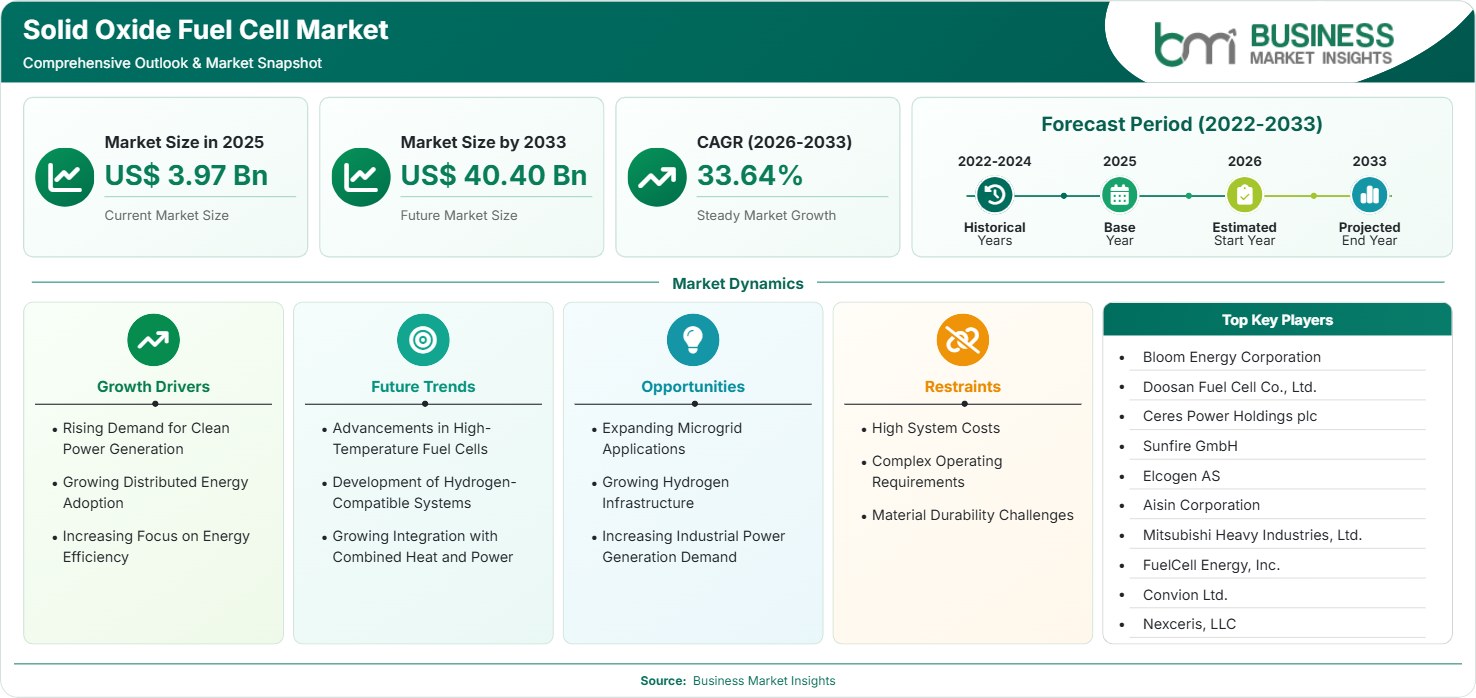
The Solid Oxide Fuel Cell Market size was valued at US$ 3.97 Billion in 2025 and is projected to reach US$ 40.40 Billion by 2033, growing at a CAGR of 33.64% during 2026–2033. Increasing demand for clean power generation, expansion of distributed energy systems, rising data center electricity requirements, and growing hydrogen infrastructure are creating strong opportunities for solid oxide fuel cell technologies across stationary, transport, and portable applications.

Report Coverage
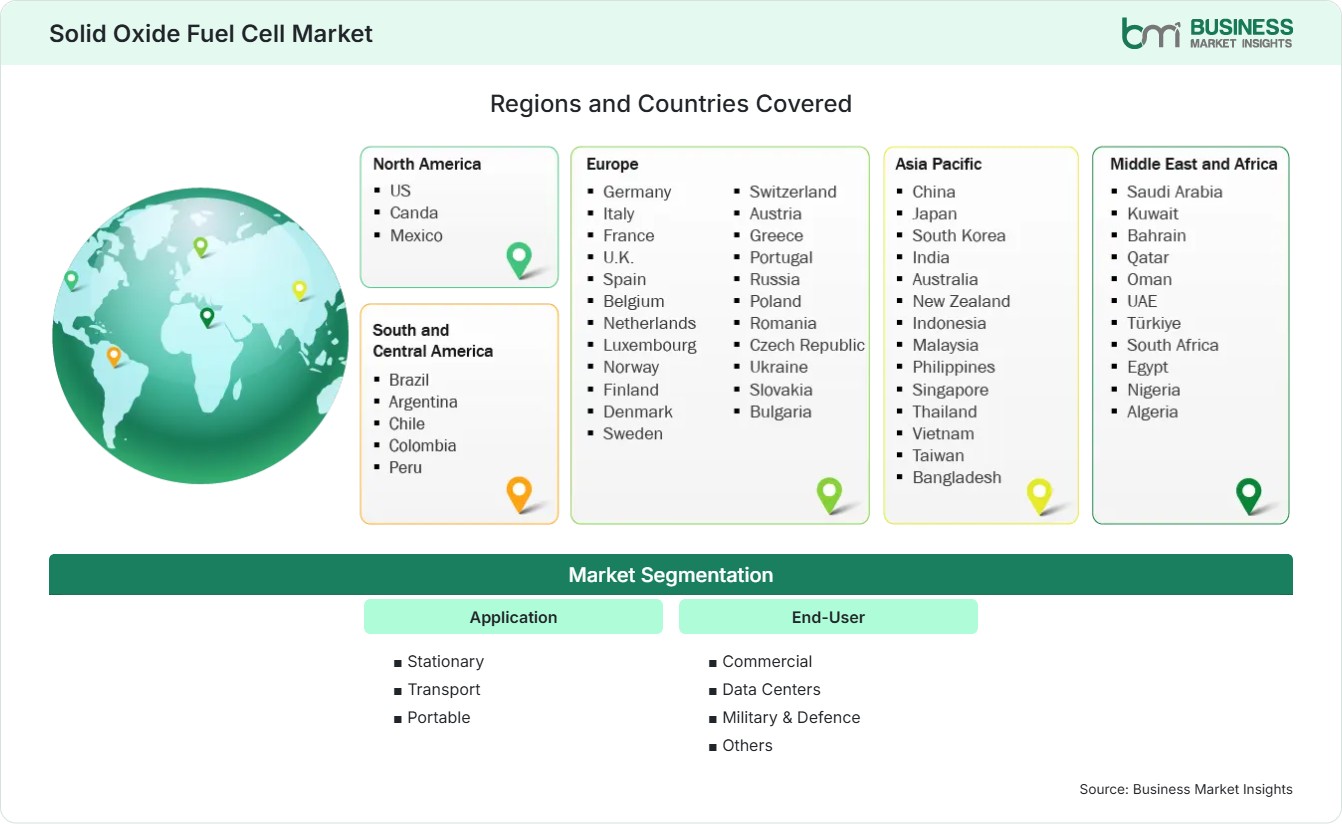
  • Application: Stationary, Transport, Portable
  • End-User: Commercial, Data Centers, Military & Defence, Others
US$ 3.97 Bn Market size in 2025
US$ 40.40 Bn Market Size by 2033
33.64% CAGR, 2026 - 2033
2026-2033 Forecast Period

AI Overview

Solid Oxide Fuel Cell Market Summary

  • North America Region: North America holds 32%–36% market share in 2025, growing at a 31%–34% CAGR during 2026–2033. Strong distributed power adoption, increasing data center requirements, industrial energy demand, grid capacity limitations, and investments in resilient energy infrastructure continue supporting deployment opportunities. The U.S. represents the regional leader with strong commercial and industrial adoption and is projected to record a CAGR of 30%–33% through 2033.
  • Fastest Growing Region: Asia Pacific accounts for 31%–35% market share in 2025 while advancing at a 35%–38% CAGR during 2026–2033. Increasing industrialization, energy security priorities, hydrogen development, domestic fuel-cell manufacturing, distributed generation requirements, and government-supported clean energy programs create favorable investment opportunities for solid oxide fuel cell technologies.
  • Leading Segment: Stationary applications hold 72%–76% market share in 2025 and are expected to expand at a 32%–35% CAGR during 2026–2033. Commercial facilities, industrial sites, data centers, and critical infrastructure increasingly require reliable onsite electricity while manufacturers improve system efficiency, modularity, fuel flexibility, and operating performance.
  • High Growth Segment: Data Centers account for 20%–24% market share in 2025 while registering a 38%–41% CAGR during 2026–2033. Increasing digitalization, artificial intelligence workloads, continuous electricity requirements, grid capacity limitations, and demand for reliable onsite power create strong long-term deployment opportunities for solid oxide systems.
  • Key Market Opportunity: Expanding microgrid applications, hydrogen infrastructure, industrial power generation, and data center deployment create opportunities for manufacturers to develop modular systems that combine reliable electricity generation, energy efficiency, fuel flexibility, and long-term operational support.
  • Major Market Players: Bloom Energy Corporation, Doosan Fuel Cell Co., Ltd., Ceres Power Holdings plc, Sunfire GmbH, Elcogen AS, Aisin Corporation, Mitsubishi Heavy Industries, Ltd., FuelCell Energy, Inc., Convion Oy, and Nexceris, LLC.
Strategic Insights

Solid Oxide Fuel Cell Market: Strategic Insights

Solid Oxide Fuel Cell Market Strategic Framework
FREE PDF
Request your free sample
Request free sample
Stakeholder View

Key Takeaways

  • Fuel-cell companies are now developing technology platforms that integrate all these technologies, including cells, stacks, power system, control systems, thermal management and maintenance services to enhance the system performance and gain a competitive advantage along the value chain.
  • The most significant investment opportunity lies in stationary applications since commercial establishments, industries, data centers, and critical infrastructure need electricity and efficient power generation systems.
  • Advancements in ceramic materials, stack design, thermal management systems, fuel flexibility and systems controls are helping to develop more efficient and durable solid oxide fuel cell platforms.
  • Asia Pacific presents the strongest long-term expansion opportunity because industrial development, distributed energy requirements, hydrogen strategies, domestic manufacturing capabilities, and energy security priorities are supporting solid oxide technology adoption.
  • Partnerships between fuel-cell companies, industrial companies, energy providers, technology companies, and infrastructure players are helping the commercialization process through technology integration, manufacturing abilities, and new applications.
Geographic Outlook

Solid Oxide Fuel Cell Market Regional Highlights

North America Solid Oxide Fuel Cell Market

North America accounted for 32%–36% of the market share in 2025 and is projected to expand at a 31%–34% CAGR during 2026–2033. The region benefits from advanced energy infrastructure, strong technology development, increasing distributed generation, expanding data centers, and industrial demand for reliable electricity. The Solid Oxide Fuel Cell Market share remains highest in North America because commercial users increasingly require resilient onsite generation while technology providers improve efficiency, modularity, fuel flexibility, and system integration capabilities.

  • Increasing data center development creates opportunities for onsite solid oxide generation because continuous electricity availability and reliable power capacity are becoming important requirements for digital infrastructure expansion.
  • Commercial and industrial facilities increasingly evaluate distributed power systems to reduce dependence on centralized electricity networks and improve operational resilience across facilities with critical electricity requirements.
  • Energy technology companies are strengthening manufacturing capabilities and technology partnerships to improve system performance, simplify installation, and increase deployment opportunities across commercial and industrial applications.
  • Increasing interest in hydrogen-ready power systems creates additional opportunities for solid oxide technologies as customers seek flexible pathways toward cleaner energy sources and improved long-term energy security.

US Solid Oxide Fuel Cell Market

The United States represented 78%–82% of North American revenue in 2025 and is anticipated to register a 30%–33% CAGR through 2033. Strong commercial infrastructure, expanding data center requirements, industrial electricity demand, energy resilience priorities, and advanced fuel-cell technology development position the country as the leading center for solid oxide deployment. The U.S. market continues benefiting from increasing investments in distributed power systems and clean energy technologies.

  • Data center operators increasingly evaluate onsite generation technologies to support growing electricity requirements while reducing dependence on constrained grid capacity and improving power reliability.
  • Commercial and industrial customers are adopting distributed energy strategies to improve resilience, manage electricity requirements, and support broader sustainability objectives across energy-intensive operations.
  • Technology developers continue improving stack durability, system efficiency, fuel flexibility, and modular deployment capabilities, creating opportunities for broader commercialization across stationary electricity applications.

Europe Solid Oxide Fuel Cell Market

Europe captured 24%–28% Solid Oxide Fuel Cell Market share during 2025 and is expected to grow at a 32%–35% CAGR through 2033. Industrial decarbonization, hydrogen development, energy security, distributed generation, and increasing focus on energy efficiency support regional adoption. Germany leads regional development because of its industrial base and clean energy technology capabilities, while Italy and the United Kingdom provide strong growth opportunities through industrial applications, distributed power requirements, and hydrogen-related technology development.

  • Germany remains a leading market because industrial users increasingly seek efficient power generation technologies that can support energy security, decarbonization, and distributed electricity requirements.
  • The United Kingdom provides opportunities through increasing attention toward energy resilience, hydrogen technologies, distributed generation, and clean energy infrastructure across commercial and industrial applications.
  • Italy benefits from industrial electricity requirements and established energy technology capabilities, supporting wider opportunities for stationary solid oxide systems and integrated energy applications.
  • European investment in hydrogen infrastructure and clean energy technologies creates favorable conditions for fuel-cell manufacturers developing systems capable of supporting flexible future energy pathways.

Asia Pacific Solid Oxide Fuel Cell Market

Asia Pacific accounted for 31%–35% of the market in 2025 and is forecast to expand at the highest CAGR of 35%–38% between 2026 and 2033. Rapid industrial development, increasing electricity demand, energy security priorities, hydrogen strategies, and expanding domestic fuel-cell manufacturing capabilities support regional growth. Japan and South Korea remain important markets, while China and India provide strong long-term expansion opportunities because of industrial development and increasing demand for efficient distributed electricity generation.

  • Japan strengthens solid oxide technology development through advanced manufacturing capabilities, established energy technology expertise, and increasing interest in efficient distributed generation systems.
  • South Korea continues supporting fuel-cell technology development through domestic manufacturing capabilities, hydrogen strategies, and increasing requirements for reliable and efficient electricity generation.
  • China provides substantial long-term potential because industrial development and increasing electricity requirements create opportunities for distributed generation technologies across commercial and industrial facilities.
  • India offers emerging opportunities as industrialization, infrastructure development, energy security requirements, and increasing investment in clean energy technologies support demand for efficient onsite electricity generation.

Rest of World Solid Oxide Fuel Cell Market

The Rest of the World represented 8%–12% Solid Oxide Fuel Cell Market share in 2025 and is projected to grow at a 29%–32% CAGR through 2033. Increasing investment in distributed electricity generation, industrial development, energy security, and clean energy infrastructure supports market expansion across South and Central America and the Middle East and Africa. Brazil and Chile provide opportunities in Latin America, while Saudi Arabia and the United Arab Emirates support increasing opportunities in the Middle East.

  • Brazil provides opportunities for distributed generation across industrial facilities and commercial infrastructure where reliable electricity and energy efficiency are important operational requirements.
  • Chile offers long-term opportunities through increasing development of hydrogen infrastructure, renewable energy resources, and clean energy technologies supporting future distributed power applications.
  • Saudi Arabia is developing energy and industrial infrastructure that can create opportunities for efficient distributed generation and hydrogen-linked fuel-cell applications.
  • The United Arab Emirates supports technology adoption through expanding energy diversification strategies, industrial development, and increasing interest in efficient and reliable clean power systems.
Global Market Geography
FREE PDF
Request your free sample
Request free sample
Segment Analysis

Solid Oxide Fuel Cell Market Segmentation

Application

The Application segment continues expanding as customers increasingly evaluate solid oxide technologies for reliable and efficient electricity generation across different operating environments. Stationary applications accounted for 72%–76% of the market in 2025 and are projected to grow at a 32%–35% CAGR during 2026–2033. The Solid Oxide Fuel Cell Market scope continues expanding through distributed generation, industrial power requirements, microgrid development, and increasing demand for dependable onsite electricity.

  • Stationary: Stationary systems support commercial buildings, industrial facilities, data centers, microgrids, and critical infrastructure requiring reliable electricity, efficient operation, fuel flexibility, and continuous power availability.
  • Transport: Transport applications provide opportunities for solid oxide systems in specialized mobility environments where fuel flexibility, efficient energy conversion, longer operating endurance, and reduced emissions support technology adoption.
  • Portable: Portable systems address specialized power requirements across remote operations, emergency applications, defense environments, and temporary infrastructure where reliable electricity and reduced conventional fuel dependence are important.

End-User

The End-User segment reflects increasing demand for dependable and efficient electricity across commercial, data center, military and defence, and other specialized applications. Data Centers represented 20%–24% market share in 2025 and are projected to expand at a 38%–41% CAGR during 2026–2033. Solid Oxide Fuel Cell Market trends are increasingly influenced by continuous electricity requirements, distributed generation, energy resilience, and growing demand for scalable onsite power systems.

  • Commercial: Commercial facilities increasingly evaluate onsite generation to improve power reliability, manage energy requirements, support sustainability objectives, and reduce exposure to centralized electricity limitations.
  • Data Centers: Data centers require continuous and scalable electricity to support expanding digital infrastructure, creating strong opportunities for onsite solid oxide generation across new and expanding facilities.
  • Military & Defence: Military and defence applications prioritize reliable electricity, operational resilience, energy independence, reduced logistical requirements, and flexible power generation for specialized and remote operating environments.
Market Forces

Solid Oxide Fuel Cell Market Dynamics

Key Market Drivers

Rising Demand for Clean Power Generation

Increasing electricity requirements and growing emphasis on cleaner energy generation are encouraging commercial, industrial, and infrastructure users to evaluate solid oxide fuel cell technologies. Such systems are capable of generating electricity continuously and facilitate distributed power initiatives as well as energy efficiency. It has become more important to find options that help decrease reliance on central electricity generation and fulfill environmental objectives. Flexibility in fuels also adds value to the adoption potential of such systems as they can be designed in accordance with the type of fuels used and energy plans of the future. The Solid Oxide Fuel Cell Market growth depends on the necessity to generate electricity reliably and with less harmful emissions.

Growing Distributed Energy Adoption

The increasing adoption of distributed energy systems is creating favorable conditions for solid oxide fuel cell deployment across commercial and industrial facilities. Customers increasingly prefer electricity generation closer to consumption points because localized power systems can improve resilience and reduce exposure to centralized grid limitations. Solid oxide systems can operate continuously and can be integrated with other distributed energy technologies to create flexible local power networks. Growing demand for microgrids, onsite power, and energy resilience is strengthening Solid Oxide Fuel Cell Market growth across multiple end-user categories.

Increasing Focus on Energy Efficiency

Energy efficiency is becoming an important consideration as commercial and industrial customers seek to manage increasing electricity requirements and improve operating economics. Solid oxide fuel cells convert fuel into electricity through an electrochemical process, creating opportunities for efficient power generation without conventional combustion-based electricity production. The ability to integrate electricity generation with heat utilization can further improve system value in facilities with suitable thermal requirements. These improvements strengthen Solid Oxide Fuel Cell Market trends by making the technology increasingly suitable for facilities seeking dependable power and better energy utilization. Increasing focus on efficiency will continue supporting market growth across commercial, industrial, and infrastructure applications.

Key Market Opportunities

Expanding Microgrid Applications

The expansion of microgrids provides an important opportunity for solid oxide fuel cell manufacturers because local energy systems require reliable generation capable of operating continuously alongside other power resources. Solid Oxide Fuel Cell Market Forecast a stable electricity source within commercial, industrial, institutional, and critical infrastructure microgrids. Increasing interest in energy resilience is encouraging customers to evaluate integrated power architectures rather than depending entirely on centralized electricity networks. Expanding microgrid applications therefore provide opportunities for suppliers to increase system deployment while developing engineering, installation, monitoring, maintenance, and long-term service capabilities.

Growing Hydrogen Infrastructure

Growing hydrogen infrastructure creates opportunities for solid oxide fuel cell technologies because hydrogen can support future low-emission electricity generation pathways. As hydrogen production, storage, transportation, and distribution systems develop, fuel-cell manufacturers can position their systems for greater fuel flexibility and future energy transition requirements. Solid oxide technology also connects with broader hydrogen technology development through electrolysis and integrated energy systems. Increasing hydrogen infrastructure can therefore support new commercial relationships between fuel-cell manufacturers, energy companies, industrial users, infrastructure developers, and technology providers while broadening the long-term addressable market.

Increasing Industrial Power Generation Demand

Industrial facilities represent an important opportunity because manufacturing and processing operations require dependable electricity to maintain continuous production. Power interruptions can affect productivity, equipment operation, and overall operating efficiency, increasing the value of reliable onsite generation. Solid oxide systems can support industrial customers seeking efficient electricity generation while providing opportunities for integrated heat utilization. Increasing industrialization across developing and established economies is expanding the number of facilities requiring dependable power infrastructure.

Market Restraints and Challenges

High System Costs

Factor: Solid oxide fuel cell systems require specialized ceramic materials, stack components, thermal-management systems, power electronics, controls, and balance-of-plant equipment, resulting in relatively high initial investment requirements. Manufacturing processes also require advanced production capabilities and quality control to maintain consistent system performance. Impact: High system costs can lengthen investment recovery periods and limit adoption among customers that prioritize low initial capital expenditure. Smaller commercial facilities may face greater difficulty justifying deployment when conventional electricity generation alternatives require lower upfront investment. Lower system costs will remain important for expanding adoption beyond large commercial, industrial, infrastructure, and specialized customers.

Complex Operating Requirements

Factor: Solid oxide fuel cells operate under demanding thermal and electrochemical conditions, requiring careful management of temperature, materials, fuel supply, system controls, and component durability. High operating temperatures can create additional engineering requirements and make system design more complex than conventional low-temperature fuel-cell technologies. Impact: Complex operating requirements can increase installation, maintenance, monitoring, and service needs while limiting adoption in applications requiring rapid cycling or frequent operating changes. Reducing operational complexity will help improve customer confidence and expand the range of commercial and industrial applications suitable for solid oxide fuel-cell deployment.

Company Analysis

Competitive Landscape

The market remains competitive, with established energy companies, fuel-cell specialists, industrial manufacturers, materials developers, and technology providers focusing on improving system efficiency, durability, scalability, and commercial deployment. Continuous investment in stack development, system integration, manufacturing capabilities, and strategic partnerships strengthens competitive positioning while supporting long-term Solid Oxide Fuel Cell Market analysis across stationary, transport, portable, and specialized energy applications.

Company Name

Overview

Products and Services Relevant to this Market

Bloom Energy Corporation

Energy technology company focused on solid oxide power generation and distributed electricity solutions for commercial and industrial users.

Solid oxide fuel-cell systems, distributed power generation, energy solutions, microgrid applications, and related support services.

Doosan Fuel Cell Co., Ltd.

South Korean fuel-cell company developing and supplying fuel-cell technologies for stationary power generation applications.

Fuel-cell power systems, solid oxide technology, distributed generation solutions, system integration, and maintenance services.

Ceres Power Holdings plc

Technology company developing solid oxide fuel-cell technology and working with industry partners to support commercialization.

SteelCell technology, solid oxide stacks, technology licensing, engineering support, and system development solutions.

Sunfire GmbH

German energy technology company focused on electrochemical systems supporting clean electricity and hydrogen applications.

Solid oxide electrolysis technology, hydrogen systems, electrolyzer solutions, stacks, and integrated energy technology.

Elcogen AS

Solid oxide technology developer providing cells, stacks, and modules for energy generation and hydrogen-related applications.

SOFC cells, stacks, modules, SOEC technology, engineering support, and integrated solid oxide solutions.

Aisin Corporation

Japanese industrial company with experience in energy systems and distributed power generation technologies.

Distributed fuel-cell systems, energy solutions, power-generation technologies, and related energy management capabilities.

Mitsubishi Heavy Industries, Ltd.

Diversified engineering company developing advanced energy technologies and solid oxide fuel-cell systems.

SOFC systems, distributed generation, hybrid energy systems, power generation, and hydrogen-related energy technologies.

FuelCell Energy, Inc.

Energy technology company providing distributed power generation and fuel-cell-based energy solutions.

Fuel-cell systems, distributed generation, microgrids, hydrogen technologies, power solutions, and service support.

Convion Oy

European solid oxide technology company developing systems for efficient electricity generation and hydrogen applications.

SOFC systems, solid oxide electrolysis, distributed power generation, hydrogen systems, and energy solutions.

Nexceris, LLC

Technology company specializing in materials, components, testing, and engineering solutions supporting solid oxide technologies.

Fuel-cell materials, components, testing capabilities, coatings, engineering services, and solid oxide technology development support.

Trust & Transparency

Research Methodology

The market analysis combines proprietary research with secondary data from government agencies, company disclosures, regulatory filings, industry databases and expert interviews. Market estimates are validated through data triangulation, cross-market benchmarking and analyst review.

View Full Research Methodology

Questions Answered

Frequently Asked Questions

Where can investors find detailed market insights?

The comprehensive Solid Oxide Fuel Cell Market Report provides detailed analysis of market trends, competitive landscape, segmentation, regional outlook, technology development, growth opportunities, restraints, and future industry prospects.

Which end-user segment has the strongest growth potential?

Data centers represent a high-growth opportunity because expanding digital infrastructure requires scalable and reliable electricity. Increasing demand for onsite power and energy resilience supports greater adoption of solid oxide systems within this segment.

Which application segment generates the highest revenue?

Stationary applications represent the leading segment because commercial facilities, industrial operations, data centers, microgrids, and critical infrastructure increasingly require continuous electricity, reliable onsite generation, and efficient energy utilization.

Which region dominates the Solid Oxide Fuel Cell Market?

North America remains a leading regional market because of strong distributed energy adoption, commercial and industrial electricity requirements, advanced technology capabilities, data center development, and increasing demand for reliable onsite power generation.

What is driving demand for solid oxide fuel cells?

Increasing electricity requirements, demand for reliable distributed generation, growing focus on energy efficiency, industrial power requirements, data center expansion, and development of cleaner energy systems are supporting wider adoption of solid oxide fuel-cell technologies.

Access the Full Solid Oxide Fuel Cell Market Report

Get segment-level forecasts, regional estimates, competitive benchmarking, company profiles and downloadable Excel datasets.

Access the full Solid Oxide Fuel Cell Market Report
350 pages PDF & Excel | 2026-08-19
Similar Research

Related Market Reports