
Heterojunction Solar Cell Market Outlook: Size, Share, Trends, Growth Analysis, Competitive Landscape & Forecast, 2026-2033

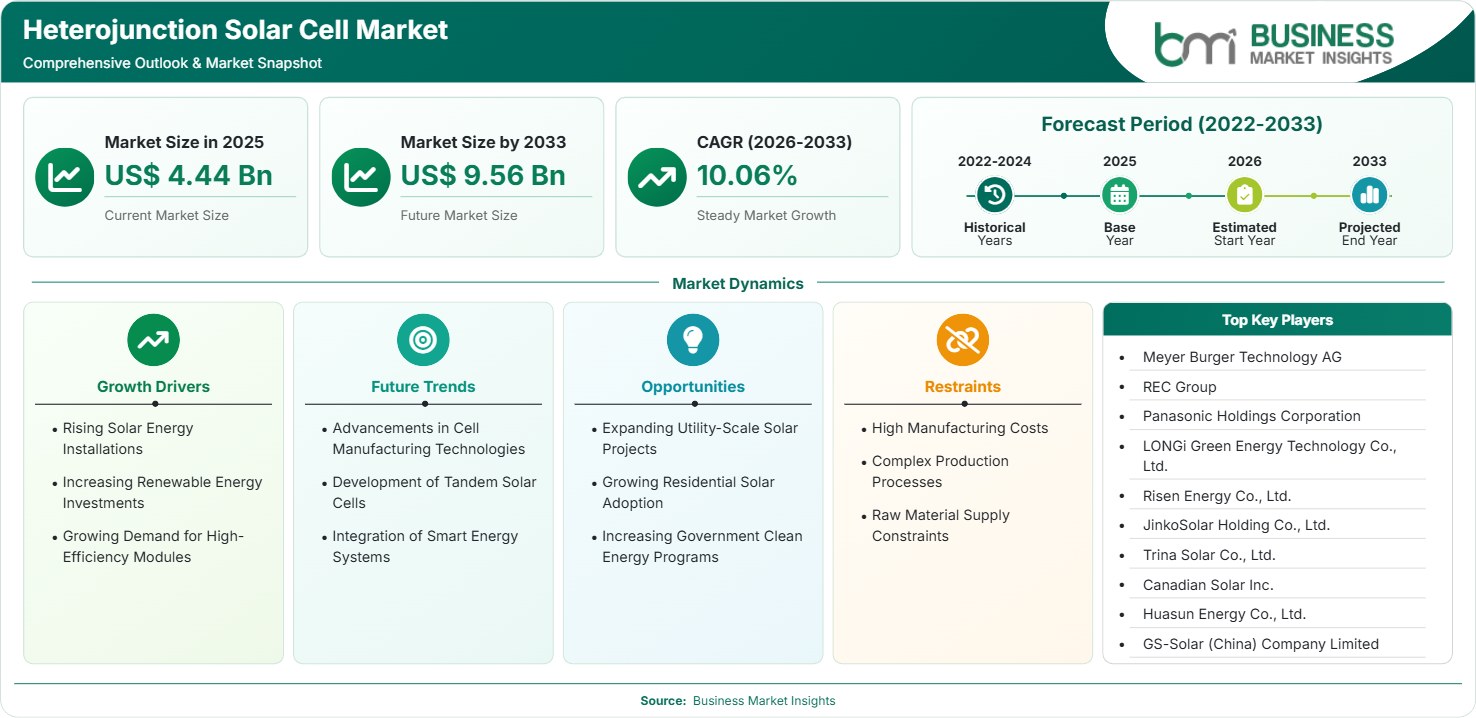
The Heterojunction Solar Cell Market size was valued at US$ 4.44 Billion in 2025 and is projected to reach US$ 9.56 Billion by 2033, growing at a CAGR of 10.06% during 2026–2033, driven by rising solar installations, efficiency improvements, renewable investments, and demand for advanced photovoltaic technologies.

Report Coverage
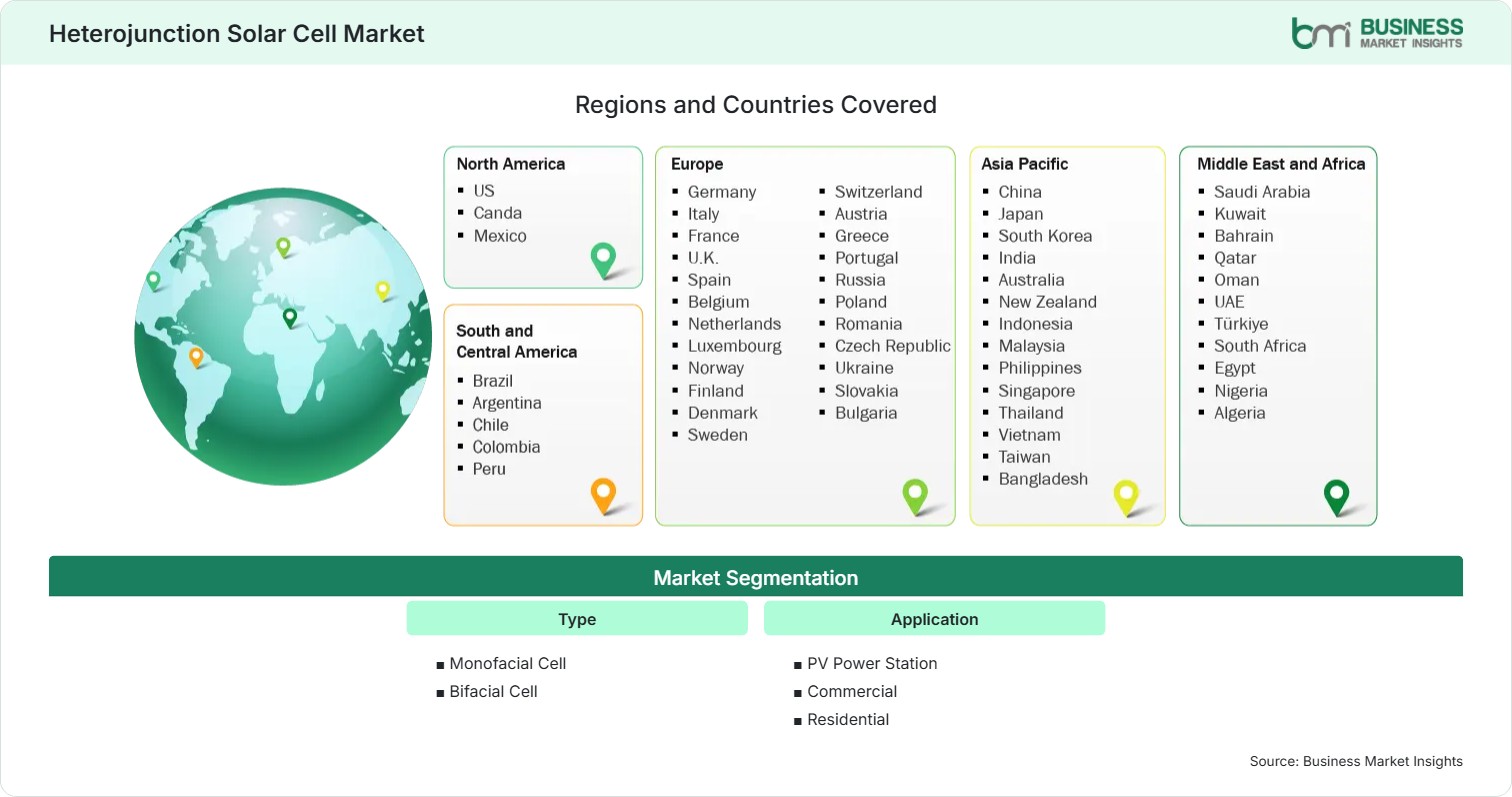
  • Type: Monofacial Cell, Bifacial Cell
  • Application: PV Power Station, Commercial, Residential
US$ 4.44 Bn Market size in 2025
US$ 9.56 Bn Market Size by 2033
10.06% CAGR, 2026 - 2033
2026-2033 Forecast Period

AI Overview

Heterojunction Solar Cell Market Summary

  • North America Region: North America holds a 20%–24% share in 2025, growing at a CAGR of 9%–11% during 2026–2033, supported by clean energy policies, utility solar expansion, technology modernization, and demand for high-efficiency modules. The US market analysis indicates strong adoption through domestic solar manufacturing incentives, with a CAGR of 9.5%–11%.
  • Fastest Growing Region: Asia Pacific accounts for a 45%–49% share in 2025, expanding at a CAGR of 11%–13% during 2026–2033, driven by large-scale solar capacity additions, manufacturing investments, government renewable programs, and increasing photovoltaic technology adoption.
  • Leading Segment: Bifacial Cell technology represents a 55%–60% share in 2025, growing at a CAGR of 11%–13% during 2026–2033, supported by higher energy yield, improved module performance, advanced manufacturing capabilities, and utility-scale solar deployment.
  • High Growth Segment: Residential applications capture a 18%–22% share in 2025, growing at a CAGR of 12%–14% during 2026–2033, supported by distributed energy adoption, declining balance-of-system costs, rooftop solar incentives, and consumer preference for efficient modules.
  • Key Market Opportunity: Expansion of high-efficiency photovoltaic manufacturing, integration with next-generation solar systems, and increasing demand for low-carbon electricity generation create opportunities for technology providers, module manufacturers, and clean energy investors.
  • Major Market Players: Meyer Burger Technology AG, REC Group, Panasonic Holdings Corporation, LONGi Green Energy Technology Co., Ltd., Risen Energy Co., Ltd., JinkoSolar Holding Co., Ltd., Trina Solar Co., Ltd., Canadian Solar Inc., Huasun Energy Co., Ltd., and GS-Solar (China) Company Limited.
Strategic Insights

Heterojunction Solar Cell Market: Strategic Insights

Heterojunction Solar Cell Market Strategic Framework
FREE PDF
Request your free sample
Request free sample
Stakeholder View

Key Takeaways

  • The value chain is becoming increasingly integrated as wafer suppliers, cell manufacturers, module producers, and technology providers collaborate to improve efficiency, production scalability, and cost competitiveness across advanced photovoltaic manufacturing ecosystems.
  • Utility-scale solar projects represent a major opportunity area as developers seek higher energy output from limited land availability. Bifacial configurations and high-efficiency modules are gaining attention for improving project economics.
  • Technological advancement is centered on improved silicon wafer quality, advanced surface passivation, thinner material usage, and manufacturing automation that can enhance performance while reducing production complexity.
  • Asia Pacific presents a strong investment case due to established photovoltaic manufacturing infrastructure, expanding renewable energy capacity, and increasing government support for domestic clean energy supply chains.
  • Industry consolidation and strategic partnerships are influencing competitive positioning as companies invest in production expansion, technology development, and international market penetration strategies.
  • Solar module manufacturers are increasingly prioritizing sustainable production methods, recycling initiatives, and lower-carbon manufacturing processes to align with evolving environmental standards and investor expectations.
Geographic Outlook

Heterojunction Solar Cell Market Regional Highlights

North America Heterojunction Solar Cell Market

North America maintains a 20%–24% share in 2025 and is projected to expand at a CAGR of 9%–11% during 2026–2033. The region benefits from solar manufacturing incentives, increasing utility deployment, and demand for premium photovoltaic technologies. The Heterojunction Solar Cell Market share reflects growing interest from developers seeking higher module efficiency and improved lifecycle performance. The United States leads regional adoption through manufacturing investments, while Canada supports renewable expansion through clean energy initiatives.

  • The United States is increasing domestic solar manufacturing capacity through policy support, encouraging adoption of advanced photovoltaic technologies and improving supply chain resilience for high-efficiency modules.
  • Utility-scale solar developers are adopting efficient module designs to maximize electricity generation from available land resources and improve project returns under changing energy market conditions.
  • Commercial solar installations are supporting technology adoption as businesses prioritize renewable electricity procurement and improved energy performance from advanced photovoltaic systems.
  • Research partnerships between manufacturers and technology institutions are accelerating improvements in cell efficiency, production methods, and next-generation solar module designs.

US Heterojunction Solar Cell Market

The US market represents a 16%–19% share in 2025 and is expected to grow at a CAGR of 9.5%–11% during 2026–2033. Strong policy support, domestic manufacturing initiatives, and rising renewable electricity demand are improving adoption prospects. The Heterojunction Solar Cell Market growth in the country is supported by utility projects, commercial installations, and increasing interest in efficient modules capable of delivering higher output across varied climatic conditions.

  • Federal incentives supporting domestic photovoltaic manufacturing are encouraging companies to establish advanced production facilities and strengthen local supply chains.
  • Utility solar developers are evaluating high-efficiency modules to optimize land utilization and improve electricity generation from large-scale installations.
  • Residential solar adoption is increasing as consumers seek improved energy output from limited rooftop spaces and advanced module technologies.
  • Technology providers are investing in manufacturing improvements to reduce costs and improve competitiveness against conventional photovoltaic solutions.

Europe Heterojunction Solar Cell Market

Europe accounts for a 22%–26% share in 2025, expanding at a CAGR of 10%–12% through 2033. The region benefits from ambitious renewable energy targets, carbon reduction strategies, and demand for efficient solar technologies. Germany, France, and Italy remain important markets, while emerging adoption is supported across Central European countries. The Heterojunction Solar Cell Market trends are influenced by energy security priorities and increasing investment in sustainable electricity infrastructure.

  • Germany is supporting advanced photovoltaic adoption through renewable energy expansion programs and industrial initiatives focused on clean technology manufacturing.
  • France is increasing solar deployment through utility and commercial projects requiring efficient modules with improved energy generation capability.
  • Italy’s distributed solar market is creating demand for high-performance modules suitable for residential and commercial rooftop installations.
  • European manufacturers are emphasizing sustainable production methods, recycling, and supply chain transparency to meet environmental expectations.
  • Research organizations are supporting photovoltaic innovation through efficiency improvement programs and collaboration with technology developers.

Asia Pacific Heterojunction Solar Cell Market

Asia Pacific dominates with a 45%–49% share in 2025 and records a CAGR of 11%–13% during 2026–2033. The region benefits from extensive solar manufacturing infrastructure, large renewable capacity additions, and government-led clean energy programs. China, Japan, India, and South Korea represent key contributors. The Heterojunction Solar Cell Market share is strengthened by expanding production capacity, technological innovation, and increasing demand for high-efficiency photovoltaic modules.

  • China remains the largest manufacturing hub due to established photovoltaic supply chains, large-scale production capacity, and continuous technology investment.
  • India is accelerating solar deployment through renewable energy targets and increasing demand for domestic photovoltaic manufacturing capabilities.
  • Japan continues adopting advanced modules for residential and commercial applications requiring efficient electricity generation.
  • South Korea supports photovoltaic innovation through technology-focused companies developing advanced solar manufacturing solutions.
  • Regional manufacturers are expanding production facilities to meet global demand for premium efficiency solar products.
Global Market Geography
FREE PDF
Request your free sample
Request free sample
Segment Analysis

Heterojunction Solar Cell Market Segmentation

Type

Type segmentation highlights the increasing preference for advanced photovoltaic architectures that deliver improved efficiency, lower degradation rates, and enhanced energy output. The segment holds a 100% share base in 2025, with growth supported by rising solar investments and technology upgrades. The Heterojunction Solar Cell Market scope is expanding as manufacturers develop differentiated cell structures for utility, commercial, and residential applications. The segment is expected to maintain a CAGR of 10.06% during 2026–2033 due to efficiency-focused solar deployment strategies.

  • Monofacial Cell: Monofacial cells remain widely adopted due to established manufacturing processes, compatibility with conventional module designs, and suitability for applications where direct sunlight exposure remains the primary energy source.
  • Bifacial Cell: Bifacial cells are gaining adoption through improved energy generation potential, rear-side light utilization, and suitability for utility-scale installations requiring enhanced performance and optimized land utilization.

Application

Application segmentation reflects expanding deployment across different solar installation categories as efficiency requirements influence technology selection. The segment structure demonstrates increasing adoption across utility, commercial, and residential projects. The Heterojunction Solar Cell Market trends indicate stronger demand from projects requiring higher power output, improved durability, and better space utilization. Application growth is supported by renewable energy targets, declining solar system costs, and increasing preference for advanced photovoltaic technologies. The segment is projected to expand at a CAGR of 10.06% between 2026–2033.

  • PV Power Station: PV power stations represent a major application area due to large-scale solar deployment, demand for higher energy yields, and increasing investments in efficient photovoltaic generation systems.
  • Commercial: Commercial applications are adopting advanced modules to reduce electricity costs, improve sustainability performance, and maximize energy generation from limited installation areas.
  • Residential: Residential adoption is increasing as homeowners seek efficient rooftop solar solutions, improved electricity savings, and reliable renewable energy systems supported by favorable incentive programs.
Market Forces

Heterojunction Solar Cell Market Dynamics

Key Market Drivers

Rising Solar Energy Installations

Increasing solar capacity additions worldwide are strengthening demand for high-efficiency photovoltaic technologies. According to the International Energy Agency, solar photovoltaic capacity additions have become a leading contributor to renewable electricity expansion. The rising number of installations in the utility scale and distributed energy projects will drive the growth of the Heterojunction Solar Cell as there will be more demand for enhanced module efficiencies along with higher energy production levels. The Heterojunction Solar Cell Market trends are being seen in terms of their adoption by developers who look at them as better than the traditional ones.

Increasing Renewable Energy Investments

The increasing trend of capital investments in clean energy infrastructure is driving the development of photovoltaics in key economies. The role of government policies, corporate renewable energy purchases, and energy transition plans is enhancing investment inflows in solar technologies. The industry will benefit from worldwide efforts to decrease carbon emissions and promote renewable energy production. Growing financial support for cutting-edge manufacturing facilities facilitates commercialization and industrialization of the technology. Investor attention to sustainable energy resources creates favorable conditions for the companies that develop efficient photovoltaic systems.

Growing Demand for High-Efficiency Modules

The demand for high-efficiency solar cells is rising since the need for high energy output from limited areas for installation is increasing. High-efficiency solar technologies have certain efficiency benefits that can lead to economic gains, especially in commercial and utility scale applications. Solar cell manufacturers are working on the design of their solar cells along with the materials and fabrication methods used in order to boost their efficiency. The growing tendency towards premium solar products is driving the Heterojunction Solar Cell Market trend.

Key Market Opportunities

Expanding Utility-Scale Solar Projects

Expansion of utility-scale solar projects creates opportunities for advanced photovoltaic technologies capable of delivering higher electricity generation and improved land efficiency. Large solar developers are increasingly evaluating high-performance modules to optimize project returns and reduce operational limitations. Heterojunction Solar Cell Market Forecast shows rising chances from big renewable energy projects, especially in areas with high clean energy aspirations. Investments into utility-scale systems, grid development, and auctions for renewable energy are driving the need for more efficient module technologies. Companies that have manufacturing facilities to scale up the production will benefit from the rising pipelines and solar capacity addition strategy.

Growing Residential Solar Adoption

Expansion of residential solar energy is giving rise to efficient modules that can be used in space-constrained rooftops. The increase in electricity costs, need for energy independence, and incentive programs by governments are motivating consumers to use renewable energy. High-efficiency PV technology will help consumers to produce more energy using less space in their installation. Firms that develop modules which are efficient and affordable can take advantage of opportunities in distributed generation industry.

Increasing Government Clean Energy Programs

Clean energy initiatives by the government are setting the stage for the widespread adoption of advanced photovoltaic technologies. Renewable energy goals set by the government, incentives in manufacturing, and sustainability legislation are promoting investments in the Heterojunction Solar Cell Market supply chain within the country. Public funding programs are assisting in accelerating research, increasing manufacturing, and commercialization. Nations that are concerned about energy security will focus on increasing their renewable power generation capability, which can be an opportunity for manufacturers and technologists.

Market Restraints and Challenges

High Manufacturing Costs

Factor: Advanced material requirements, specialized production equipment, and complex manufacturing processes increase production expenses for heterojunction modules. Impact: High manufacturing costs may result in reduced competitiveness in terms of pricing as compared to traditional solar power systems. The manufacturers need to work on improving efficiency of production, logistics, and economies of scale in order to minimize any cost-based barriers. While efficiency gains give competitive advantages, high initial costs continue to be an issue in adopting the technology.

Complex Production Processes

Factor: Heterojunction manufacturing requires precise fabrication processes, advanced surface treatment, and specialized equipment compared with traditional solar cell production. Impact: Technical complexity can create operational challenges, increase capital requirements, and slow production expansion for new market participants. Maintaining consistent quality and achieving high production yields require advanced manufacturing expertise and skilled technical resources. Industry players are investing in process innovation, automation, and research partnerships to overcome manufacturing limitations. Improvements in production technology will be essential for achieving broader commercialization and competitive positioning.

Company Analysis

Competitive Landscape

The Heterojunction Solar Cell Market analysis highlights a competitive environment shaped by technology innovation, manufacturing expansion, efficiency improvements, and strategic investments among leading photovoltaic companies. Market participants are focusing on production scalability, module performance enhancement, and global supply chain development to strengthen their positions.

Company Name

Overview

Products and Services relevant to this market

Meyer Burger Technology AG

Swiss solar technology company specializing in advanced photovoltaic manufacturing solutions and high-efficiency solar technologies.

Provides heterojunction cell technology, solar modules, production equipment, and advanced photovoltaic manufacturing solutions.

REC Group

Renewable energy company focused on premium solar modules and sustainable photovoltaic solutions for global markets.

Offers high-performance solar panels, advanced module technologies, and efficient photovoltaic products for multiple applications.

Panasonic Holdings Corporation

Global technology company with experience in energy solutions and advanced solar technology development.

Provides photovoltaic modules and energy solutions supporting efficient renewable power generation applications.

LONGi Green Energy Technology Co., Ltd.

Major solar manufacturer focused on photovoltaic innovation, large-scale production, and high-efficiency solar technologies.

Develops advanced solar cells, modules, and integrated photovoltaic solutions for global deployment.

Risen Energy Co., Ltd.

Renewable energy manufacturer specializing in solar products, technology development, and international photovoltaic projects.

Supplies solar modules, advanced cell technologies, and renewable energy solutions across multiple markets.

JinkoSolar Holding Co., Ltd.

Leading photovoltaic company focused on high-efficiency solar products and global manufacturing capabilities.

Provides solar cells, modules, and advanced photovoltaic technologies for utility and distributed projects.

Trina Solar Co., Ltd.

Solar technology company engaged in photovoltaic research, manufacturing, and renewable energy solutions.

Offers solar modules, smart energy solutions, and high-efficiency photovoltaic products.

Canadian Solar Inc.

Global solar energy company providing photovoltaic manufacturing and clean energy project development services.

Supplies solar modules, energy systems, and solar project development solutions worldwide.

Huasun Energy Co., Ltd.

Specialist solar company focused on heterojunction technology development and high-efficiency photovoltaic manufacturing.

Produces heterojunction solar cells, modules, and advanced solar energy solutions.

GS-Solar (China) Company Limited

Solar technology enterprise focused on advanced photovoltaic cell manufacturing and efficiency improvements.

Develops heterojunction photovoltaic cells and manufacturing technologies for solar applications.

Trust & Transparency

Research Methodology

The market analysis combines proprietary research with secondary data from government agencies, company disclosures, regulatory filings, industry databases and expert interviews. Market estimates are validated through data triangulation, cross-market benchmarking and analyst review.

View Full Research Methodology

Questions Answered

Frequently Asked Questions

What information does the Heterojunction Solar Cell Market Report provide?

The report provides insights into market size, growth factors, technology segmentation, competitive developments, regional trends, and strategic opportunities influencing the photovoltaic industry through 2033.

What applications are expected to drive future demand?

Utility-scale solar projects, commercial installations, and residential rooftop systems are expected to drive demand. Utility projects benefit from higher energy yields, while commercial and residential users gain advantages from efficient modules in space-constrained environments.

How does this technology support renewable energy goals?

Heterojunction technology supports renewable energy expansion by improving solar power generation efficiency and enabling greater electricity output from available land and rooftop spaces. This helps countries accelerate clean energy deployment and reduce dependence on conventional energy sources.

What role does manufacturing innovation play in this sector?

Manufacturing innovation helps reduce production costs, improve cell quality, and increase scalability. Automation, advanced material processing, and improved production techniques are enabling companies to enhance efficiency while addressing challenges associated with complex photovoltaic manufacturing.

What factors are increasing adoption of heterojunction photovoltaic technologies?

The adoption is increasing due to higher conversion efficiency, improved temperature performance, lower degradation rates, and demand for optimized electricity generation from limited installation areas. Advanced module performance is encouraging developers and consumers to consider premium solar technologies.

Access the Full Heterojunction Solar Cell Market Report

Get segment-level forecasts, regional estimates, competitive benchmarking, company profiles and downloadable Excel datasets.

Access the full Heterojunction Solar Cell Market Report
350 pages PDF & Excel | 2026-08-07