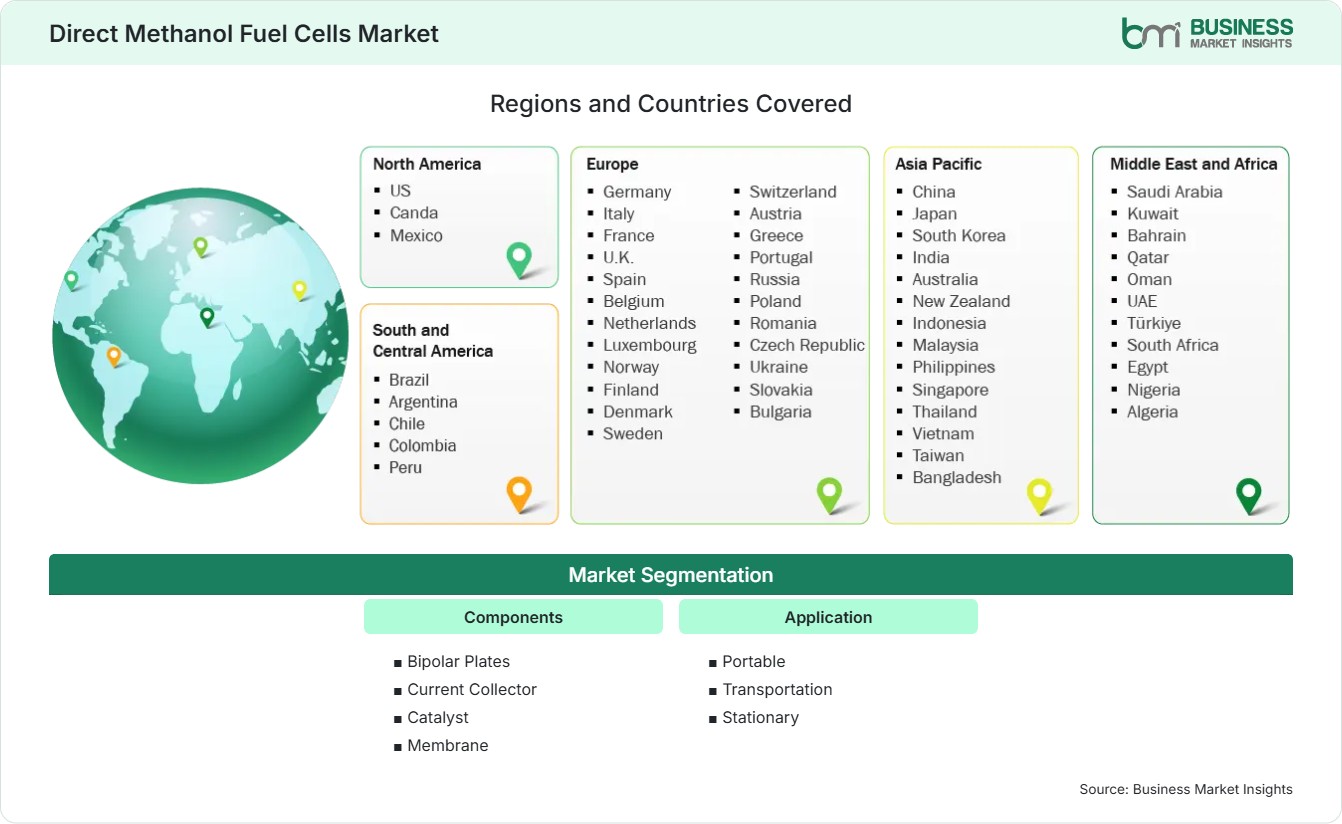
Direct Methanol Fuel Cells Market Regional Highlights
North America Direct Methanol Fuel Cells Market
North America holds a 34%–38% share in 2025 and is projected to register a 17.20%–18.60% CAGR during 2026–2033. The region benefits from specialized demand for portable power, defense equipment, remote communications, and backup systems. U.S. procurement requirements support application-focused development, while Canada contributes through clean-energy research and remote-power use cases. Regional Direct Methanol Fuel Cells Market share reflects established technical capabilities and specialized fuel-cell expertise.
- Defense and field operations favor compact power systems capable of operating independently from fixed electrical infrastructure, creating demand for fuel-cell configurations that provide sustained energy without frequent battery replacement.
- Remote telecommunications and monitoring equipment provide an application pathway where long-duration operation can reduce maintenance visits, particularly for installations located away from dependable grid connections.
- The United States remains the principal regional demand center, supported by specialized portable-power requirements, technology development, and application-specific fuel-cell integration.
- Canada provides opportunities in remote and distributed power applications, particularly where equipment requires dependable operation under conditions that make conventional charging infrastructure inconvenient.
US Direct Methanol Fuel Cells Market
The U.S. accounts for approximately 27%–31% of global demand in 2025 and is positioned for a 17.50%–18.80% CAGR during 2026–2033. Military, emergency-response, communications, monitoring, and field applications create purchasing environments where runtime and portability can outweigh acquisition cost. Direct Methanol Fuel Cells Market development is supported by system integrators, component suppliers, and application developers. Procurement decisions increasingly emphasize reliability, operating duration, compact packaging, and simplified fuel replenishment.
- Defense applications can support premium fuel-cell configurations because extended field operation reduces dependence on electrical charging infrastructure and improves logistical flexibility for equipment deployed away from fixed facilities.
- Portable communications and monitoring equipment represent another opportunity, particularly when systems require extended autonomous operation while maintaining compact dimensions and manageable fuel logistics.
- Specialized backup-power systems can provide an alternative to conventional battery banks where repeated charging cycles or replacement schedules create operational inconvenience for remote equipment operators.
Europe Direct Methanol Fuel Cells Market
Europe represents a 24%–28% share in 2025 and is expected to achieve a 16.60%–18.20% CAGR during 2026–2033. Germany and the United Kingdom remain important technology and application markets, while France and the Nordic countries provide additional opportunities through distributed-energy and clean-technology initiatives. Germany is positioned toward the upper end of the regional growth range at 17.40%–19.00%, supported by industrial engineering capabilities. Europe combines fuel-cell expertise with demand for efficient decentralized energy technologies, supporting gradual application diversification.
- Germany benefits from engineering capabilities spanning fuel-cell components, system integration, industrial electronics, and specialized energy equipment, creating a favorable environment for technology commercialization.
- The United Kingdom offers opportunities across portable power, communications, and specialized energy systems where low-emission operation and autonomous runtime provide differentiated value.
- Nordic markets can support remote and distributed applications because challenging operating environments increase the value of reliable, compact power systems with manageable refueling requirements.
- France provides an application base for specialized stationary and portable systems, particularly where energy resilience and lower-emission technologies influence equipment selection.
Asia Pacific Direct Methanol Fuel Cells Market
Asia Pacific holds a 22%–27% share in 2025 and records the fastest regional trajectory at 19.20%–21.10% CAGR during 2026–2033. Japan, South Korea, China, and selected Southeast Asian economies contribute through electronics manufacturing, fuel-cell engineering, and distributed-power applications. Japan remains a major technology center, while China provides manufacturing-scale opportunities. Direct Methanol Fuel Cells Market share is supported by dense electronics ecosystems and demand for compact energy solutions.
- Japan provides a strong technology environment for compact fuel-cell development, supported by established expertise in electronics, energy systems, materials engineering, and precision manufacturing.
- China offers significant manufacturing potential because extensive electronics and component supply chains can support localized production, system assembly, and application-specific commercialization.
- South Korea provides opportunities through advanced electronics and energy-technology capabilities, particularly for compact systems serving specialized power requirements and equipment requiring high operating reliability.
- Southeast Asian markets can develop demand for distributed and remote applications where grid limitations, equipment mobility, or operating conditions create value for autonomous generation.
Rest of World Direct Methanol Fuel Cells Market
Rest of World accounts for approximately 12%–16% of global demand in 2025, with a projected 15.80%–18.00% CAGR during 2026–2033. South and Central America offer opportunities through remote communications, distributed power, and off-grid equipment. Brazil and Mexico provide the strongest regional commercial bases, while Chile can support specialized remote-energy applications. Local fuel availability, servicing capabilities, and system durability will influence deployment rates across remote installations and specialized commercial environments.
- Brazil can support remote and distributed applications where autonomous equipment operation reduces dependence on charging infrastructure and provides greater flexibility for geographically dispersed installations.
- Mexico benefits from industrial and communications applications where portable or backup power can address operating requirements across facilities and remote equipment locations.
- The United Arab Emirates provides opportunities for specialized energy systems serving communications, monitoring, and resilient infrastructure where compact power technologies can complement conventional generation.
- South Africa can support remote equipment applications where dependable autonomous power is valuable and maintenance access creates an incentive for longer operating intervals.