
Direct Air Capture Market Outlook: Size, Share, Trends, Growth Analysis, Competitive Landscape & Forecast, 2026-2033

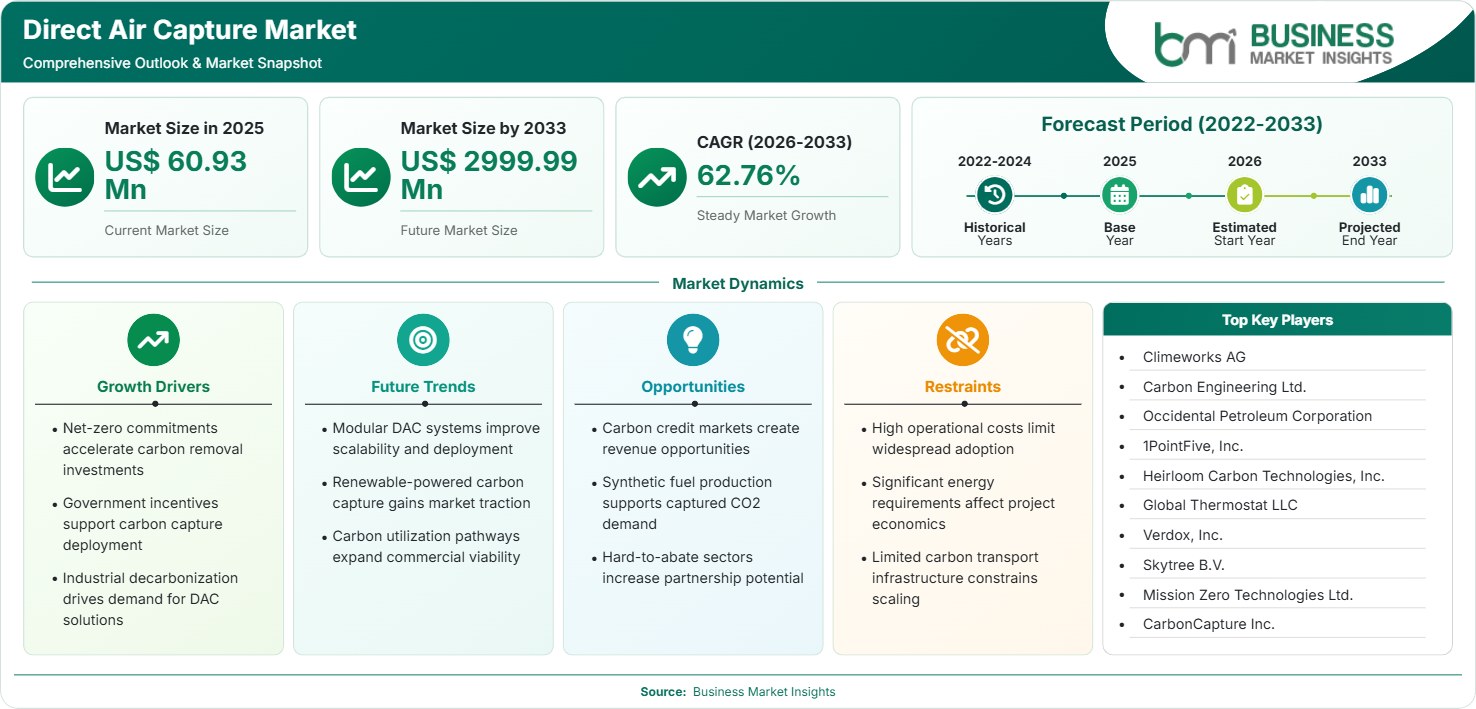
The Direct Air Capture Market size was valued at US$ 60.93 Million in 2025 and is projected to reach US$ 2999.99 Million by 2033, growing at a CAGR of 62.76% during 2026–2033, driven by carbon removal mandates, corporate net-zero commitments, carbon credit demand, government incentives, and expanding DAC project pipelines, creating new commercialization opportunities.

Report Coverage
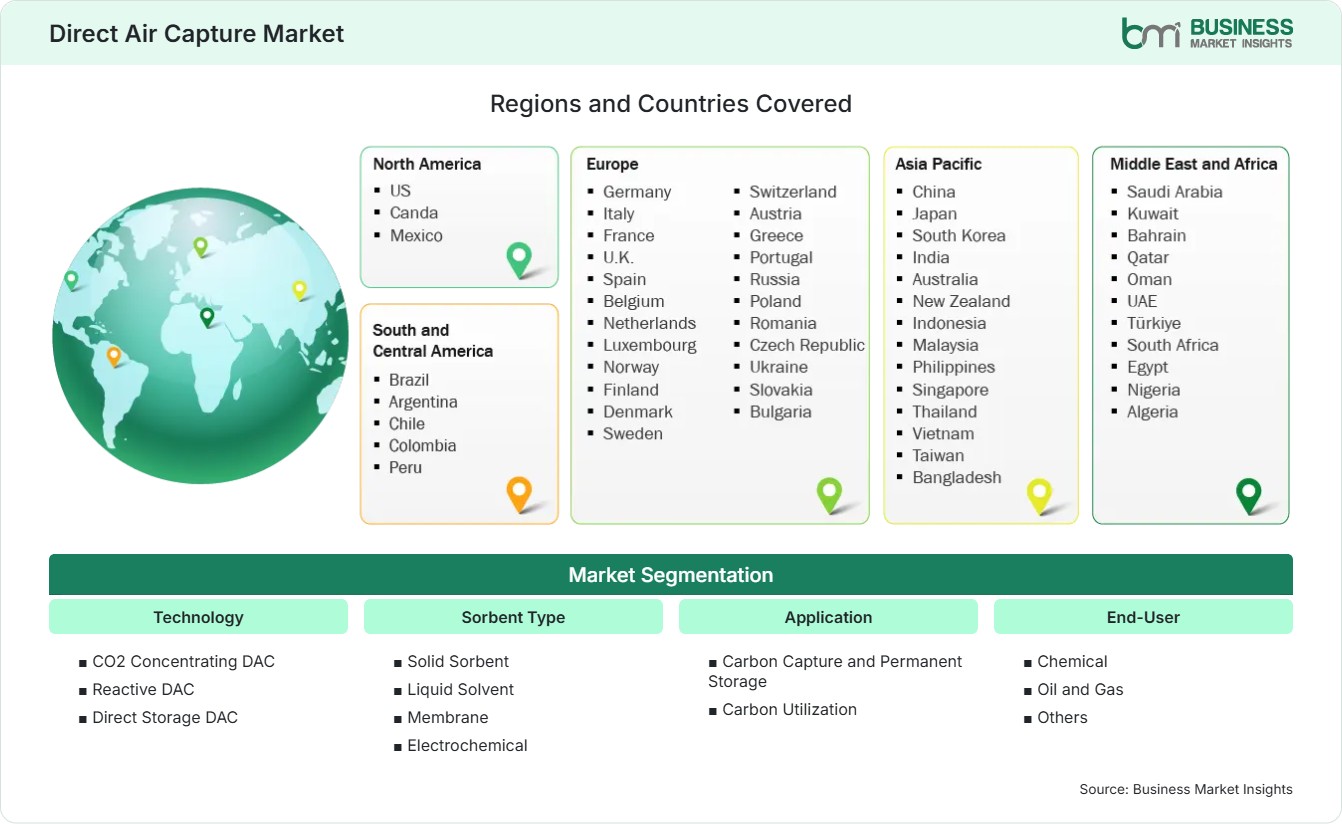
  • Technology: CO2 Concentrating DAC, Reactive DAC, Direct Storage DAC
  • Sorbent Type: Solid Sorbent, Liquid Solvent, Membrane, Electrochemical
  • Application: Carbon Capture and Permanent Storage, Carbon Utilization
  • End-User: Chemical, Oil and Gas, Others
US$ 60.93 Mn Market size in 2025
US$ 2999.99 Mn Market Size by 2033
62.76% CAGR, 2026 - 2033
2026-2033 Forecast Period

AI Overview

Direct Air Capture Market Summary

  • North America Region: North America holds a Direct Air Capture Market share of 42%–46% in 2025, growing with a CAGR of 60%–64% during 2026–2033. Key drivers include federal carbon removal incentives, large-scale DAC hub funding, and corporate procurement agreements. Opportunities emerge through permanent geological storage and industrial decarbonization projects across the region. US market maintains leadership through large commercial deployments and policy support, advancing at a CAGR of 61%–65%.
  • Fastest Growing Region: Asia Pacific holds market share of 18%–22% in 2025, growing with a CAGR of 66%–70% during 2026–2033. Expanding climate targets, renewable integration, and industrial emission mitigation programs support growth. Opportunities arise from emerging carbon markets, technology localization, and public-private partnerships.
  • Leading Segment: Carbon Capture and Permanent Storage holds a Direct Air Capture Market share of 68%–72% in 2025 and grows at a CAGR of 61%–65% during 2026–2033. Long-duration carbon removal requirements, compliance mechanisms, and durable storage verification frameworks create robust commercial demand and investment momentum.
  • High Growth Segment: Electrochemical holds market share of 8%–12% in 2025 and expands at a CAGR of 68%–72% during 2026–2033. Technology improvements, lower energy requirements, modular deployment potential, and increasing venture capital funding accelerate adoption across pilot and commercial projects.
  • Key Market Opportunity: Large-scale integration of carbon removal certificates into voluntary and compliance carbon markets enables recurring revenue streams, supports project financing, strengthens buyer confidence, and accelerates commercialization of advanced atmospheric carbon removal systems.
  • Major Market Players: Climeworks AG, Carbon Engineering Ltd., Occidental Petroleum Corporation, 1PointFive, Inc., Heirloom Carbon Technologies, Inc., Global Thermostat LLC, Verdox, Inc., Skytree B.V., Mission Zero Technologies Ltd., CarbonCapture Inc.
Strategic Insights

Direct Air Capture Market: Strategic Insights

Direct Air Capture Market Strategic Framework
FREE PDF
Request your free sample
Request free sample
Stakeholder View

Key Takeaways

  • The ecosystem increasingly depends on collaboration among DAC technology providers, renewable energy suppliers, carbon transport operators, geological storage partners, certification bodies, and carbon credit buyers, creating an integrated value chain.
  • Carbon capture and permanent storage applications present the strongest long-term commercial opportunity because buyers increasingly prioritize measurable, durable, and independently verified carbon removal outcomes over short-duration offsets.
  • Innovation is moving beyond traditional solvent-based designs toward electrochemical systems, advanced solid sorbents, heat recovery integration, digital monitoring platforms, and modular deployment approaches that improve operating economics.
  • Asia Pacific is emerging as a compelling investment destination as industrial decarbonization requirements, clean-energy investments, and government climate roadmaps create conditions for future commercial-scale deployments.
  • Investment activity increasingly features strategic partnerships, licensing agreements, infrastructure funding arrangements, and acquisitions involving energy majors seeking exposure to engineered carbon removal solutions.
  • Long-term offtake agreements from technology companies, airlines, and industrial corporations are becoming central mechanisms for reducing project risk and supporting commercial financing.
Geographic Outlook

Direct Air Capture Market Regional Highlights

North America Direct Air Capture Market

North America was expected to contribute 42%–46% of global demand in 2025 and grow at a 60%–64% CAGR through 2033. North America has the advantage of having large geological storage capabilities, federal government incentives, and carbon capture procurement initiatives. Existing large deployment pipelines in both the US and Canada will help develop infrastructure. Direct Air Capture Market share has been highest in this region owing to favorable policies, business alliances related to carbon management expertise, and commercial partnerships spanning capture, transportation, storage, and carbon credit monetization.

  • U.S. Department of Energy funding initiatives are supporting multiple DAC hub developments, accelerating commercialization and attracting infrastructure investors focused on permanent carbon removal solutions.
  • Energy companies increasingly collaborate with technology developers to integrate capture systems and geological sequestration capabilities within scalable commercial projects.
  • Long-term carbon removal purchasing agreements from technology and aviation sectors strengthen demand visibility and financing confidence.
  • Advanced monitoring, reporting, and verification systems enhance transparency and support premium carbon credit pricing.
  • Industrial decarbonization commitments continue expanding regional project pipelines and infrastructure investment requirements.

US Direct Air Capture Market

The United States accounted for 78%-82% of North American market revenues in 2025 and grew at a CAGR of 61%-65% from 2023 to 2033. Key projects being implemented in Texas, Louisiana, and California have boosted commercialization. The presence of abundant storage options, supportive policies, and corporate climate commitment creates an enabling environment for DAC technology adoption. Large-scale plant construction helps in technology validation and enhances its adoption potential. Participants in the Direct Air Capture Market continue to form partnerships across the energy, technology, and industrial segments.

  • Commercial-scale capture projects are creating operational benchmarks for future facilities and supporting supply chain maturation.
  • Carbon removal procurement from enterprise buyers contributes to stronger revenue certainty and project financing access.
  • State-level climate initiatives complement federal incentives, improving deployment economics across multiple regions.
  • Engineering expertise developed through carbon management projects enhances execution efficiency for large facilities.

Europe Direct Air Capture Market

The Europe region accounted for around 26%-30% of the market share in 2025 and is estimated to grow at a CAGR of 58%-62% until 2033. Factors driving the growth of the regional market include high climate objectives, the presence of carbon trading systems, and a well-established research environment. Switzerland takes the lead in commercial innovation initiatives, whereas Iceland holds significance owing to the availability of renewable energy and carbon mineralization techniques. Germany represents one of the fastest-growing national markets, supported by industrial decarbonization investments and climate technology funding programs designed to accelerate negative-emissions deployment.

  • Carbon removal certification initiatives improve buyer confidence and support market standardization.
  • Renewable energy availability enhances lifecycle emissions performance for operational projects.
  • Switzerland remains a leading innovation center with strong technology commercialisation capabilities.
  • Germany demonstrates rapid development potential with industrial climate investments and research funding.
  • Cross-border collaborations strengthen infrastructure development and knowledge transfer across the region.

Asia Pacific Direct Air Capture Market

Asia Pacific region accounts for 18%–22% of global revenue in 2025 and is the fastest-growing regional market, with a CAGR of 66%–70% through 2033. The growth drivers include reductions in industrial emissions, the adoption of renewable energy sources, and carbon neutrality initiatives. Japan remains the pioneer in near-term commercialization efforts through technology and climate innovation initiatives. India is a rapidly growing market owing to growing investments in clean energy solutions and carbon management technologies.

  • Governments increasingly evaluate engineered carbon removal technologies within broader net-zero roadmaps.
  • Renewable energy expansion improves opportunities for lower-emission DAC operations across major economies.
  • Japan maintains leadership through technology collaborations, demonstration projects, and commercialization initiatives.
  • India benefits from growing climate investment flows and expanding sustainability commitments.
  • Industrial sectors seek innovative approaches to address residual emissions that remain difficult to eliminate.

Rest of World Direct Air Capture Market

Rest of World represented approximately 8%–12% of global revenue in 2025 and is projected to expand at a CAGR of 63%–67% through 2033. South and Central America are exploring carbon management opportunities linked to sustainability initiatives and natural resource advantages.

The Middle East and Africa are beginning to adopt carbon removal as part of their energy transition. In the Middle East, the United Arab Emirates is a major investor, whereas Saudi Arabia is a promising country with great growth potential through climate technology programs and industrial decarbonization initiatives.

  • Energy diversification programs create opportunities for carbon management technology deployment.
  • The United Arab Emirates is emerging as a regional leader in climate infrastructure investments.
  • Saudi Arabia demonstrates high growth potential through large-scale sustainability initiatives.
  • Carbon credit market development supports commercial feasibility for regional projects.
  • Industrial emissions management requirements continue encouraging evaluation of engineered removal technologies.
Global Market Geography
FREE PDF
Request your free sample
Request free sample
Segment Analysis

Direct Air Capture Market Segmentation

Technology

The technology played a critical role in the development of the industry, with CO2 Concentrating DAC capturing the highest market share of 40%–44% in 2025, while the segment is growing at 60%–64%. The scope of the Direct Air Capture Market is broadening as players focus on efficiency, scalability, and lower-energy methods. Research into better capture techniques is ongoing.

  • CO2 Concentrating DAC: Utilizes concentration processes to improve capture efficiency and enable scalable deployment. Growing demand for permanent carbon removal and enhanced process optimization supports broader adoption across commercial projects.
  • Reactive DAC: Employs chemical reactions for atmospheric carbon capture. Continuous material innovation, efficiency improvements, and integration with renewable energy systems strengthen future deployment potential.
  • Direct Storage DAC: Integrates capture and sequestration pathways to streamline operations. Demand is rising among organizations seeking measurable and durable carbon removal with lower logistical complexity.

Sorbent Type

The use of sorbent technologies remains important for ensuring performance. In 2025, the Solid Sorbent segment accounted for about 38% to 42%, and it is expected to have a CAGR of 62% to 66%. Innovation in materials, efficiency in regeneration, and deployment capabilities are among the factors that will influence competition while supporting cost optimization efforts across commercial facilities.

  • Solid Sorbent: Favored for modular facility designs and operational flexibility. Continued material advancements enhance capture efficiency while supporting lower energy consumption and improved scalability.
  • Liquid Solvent: Widely used in large industrial installations requiring established capture mechanisms. Process familiarity and engineering maturity encourage adoption in commercial-scale projects.
  • Membrane: Emerging technology focused on selective carbon dioxide separation. Compact design potential and ongoing research investments support future commercialization opportunities.
  • Electrochemical: Gaining attention due to reduced thermal energy requirements and modular configuration advantages. Strong innovation activity and investment interest support rapid development.

Application

Carbon Capture and Permanent Storage leads with a market share of 68%-72% in 2025 and is forecast to grow at a CAGR of 61%-65%. Trends in the Direct Air Capture Market are increasingly oriented towards long-term carbon removal results backed by stringent measurement systems. The growing demand for robust carbon credits is driving market growth across sectors.

  • Carbon Capture and Permanent Storage: Delivers long-duration removal outcomes through geological sequestration or mineralization pathways. Increasing buyer preference for durable carbon removal continues supporting demand expansion.
  • Carbon Utilization: Captured carbon dioxide is used in fuels, materials, and industrial processes. Innovation and circular economy initiatives encourage broader utilization opportunities.

End-User

The chemicals segment held about a 34%–38% market share in 2025 and is expected to grow at a CAGR of 59%–63%. Rising focus on reducing emissions across the lifecycle, the use of sustainable feedstocks, and commitments to climate change drive its uptake. There is constant cross-industry collaboration that creates opportunities to utilize carbon dioxide in industry.

  • Chemical: Companies increasingly integrate carbon management strategies to reduce emissions intensity and support sustainability objectives while developing lower-carbon products.
  • Oil and Gas: Energy firms deploy atmospheric carbon removal solutions alongside sequestration capabilities to support net-zero commitments and diversify climate technology portfolios.
Market Forces

Direct Air Capture Market Dynamics

Key Market Drivers

Expansion of Corporate Net-Zero Procurement Programs

Large multinational companies are buying certified carbon dioxide removal credits to offset residual emissions that cannot be mitigated through greater efficiency. IT companies, banks, and airlines are committing to multi-year contracts that provide financial stability for project developers. Companies are learning how to differentiate between durable carbon dioxide removal and avoided carbon offsets, hence driving premium demand for these credits in the marketplace. There is growing emphasis on engineered removals in the decarbonization approaches adopted by professional associations and climate plans. The direct air capture market growth has resulted from these purchase agreements, which facilitate financing, facility development, and technology scaling.

Government Incentives Supporting Commercial Deployment

Support from the public sector continues to be one of the key drivers behind growth. The use of tax benefits, grants, power purchase agreements, infrastructural investments, and carbon management programs decreases deployment risks. In the US, the emergence of large financial assistance programs for DAC facilities helps accelerate commercialization efforts and attract private investment. Climate change-related policies in Europe also foster the development of reliable carbon removal capacities. Increasing congruence between countries' climate objectives and the need for engineered carbon removal will enhance future policy support.

Need for Negative Emissions in Climate Pathways

Increasingly, international organizations’ climate models now consider carbon dioxide removal (CDR) as a complementary technology alongside emissions reduction. Sectors that have proven difficult to abate, such as aviation, maritime, chemical, and industrial processes, continue to emit residual emissions. CDR from the atmosphere is one possible avenue for dealing with such emissions. Direct Air Capture Market trends indicate that energy transition approaches might not be sufficient to meet long-term climate objectives. With deep decarbonization targets being pursued by governments and businesses, there is likely a need for carbon dioxide removal approaches.

Key Market Opportunities

Integration with Carbon Removal Credit Markets

Growth opportunities abound in voluntary and emerging carbon compliance markets. Purchasers have an increasing demand for credits with clear removal, a measurement and verification process, and a clear removal process. Efforts toward standardization are enhancing credit quality and enabling institutions to participate in the market. According to Direct Air Capture Market Forecasts, increasing demand for high-quality carbon removal instruments can be an important source of income for project developers. Innovation in finance, insurance, and contracts is likely to increase market liquidity. This helps improve project bankability and attract investors interested in climate infrastructure with a regular income stream.

Deployment in Industrial Clusters

Locations for upcoming project facilities are very promising when they have good access to energy, the carbon transport network, a skilled workforce, and storage capabilities. The benefits of co-location include cost savings and simplified logistics. Carbon ecosystem integration enables operational effectiveness and better utilization opportunities. In view of the ever-increasing demands for industrial decarbonization, atmospheric carbon removal systems can serve as complementary measures. It is expected that such alliances among industry operators, carbon capture technology suppliers, storage companies, and renewable energy companies will prove more commercially viable and lower-risk.

Advancement of Modular and Low-Energy Technologies

Newer capture methodologies are characterized by low energy intensity, modularity, enhanced materials, and an easy manufacturing process. Electrochemical processes and enhanced sorbent technologies demonstrate the ability to reduce life-cycle costs and improve scalability. Investment through venture capital and strategic corporate investments remains ongoing. Small modular units can provide access for regions that lack industrial centers or infrastructure. Improved performance and cost reductions will expand applications to other customer categories that require flexible carbon management solutions. Differentiation and intellectual property rights constitute an extra edge for innovative players in the market.

Market Restraints and Challenges

High Capital and Operating Cost Requirements

Factor: Commercial facilities require substantial capital investment, advanced engineering expertise, significant energy inputs, and specialized infrastructure. Impact: Elevated project costs can limit near-term adoption and increase dependence on policy incentives, grants, and long-term carbon removal purchasing agreements. While scale economies are improving commercial viability, operators continue facing challenges related to financing large projects and achieving attractive returns. Cost competitiveness remains a critical consideration for buyers comparing carbon removal alternatives. Securing affordable renewable energy, optimizing operations, and increasing utilization rates are essential strategies for improving economic performance and accelerating broader deployment across international markets.

Infrastructure and Verification Complexity

Factor: Successful deployment requires coordination among capture facilities, carbon transportation systems, storage operators, verification organizations, and regulatory authorities. Impact: Delays in permitting, certification, and infrastructure development can slow project timelines and elevate commercial risk. Permanent storage projects must demonstrate environmental integrity and long-term monitoring capabilities. Variations in regulatory frameworks across regions further complicate expansion strategies. Developers frequently face challenges aligning technical requirements with evolving carbon market standards. Addressing these issues requires stronger ecosystem collaboration, standardized measurement methodologies, and sustained public-sector engagement to enable efficient scaling of atmospheric carbon removal capacity.

Company Analysis

Competitive Landscape

The Direct Air Capture Market analysis highlights a competitive environment characterized by technology innovation, project partnerships, commercial carbon removal agreements, and investments aimed at lowering capture costs and scaling deployments.

Company Name

Overview

Products and Services relevant to this market

Climeworks AG

Swiss pioneer specializing in commercial DAC deployment and carbon removal services with operational projects in Europe.

Direct air capture systems, permanent carbon removal services, carbon credit offerings, project development and monitoring solutions.

Carbon Engineering Ltd.

Technology innovator known for liquid-solution DAC processes and large-scale deployment approaches.

Liquid solvent DAC technology, engineering services, process licensing, carbon removal project support.

Occidental Petroleum Corporation

Energy major advancing atmospheric carbon removal through strategic investments and infrastructure capabilities.

Carbon management solutions, sequestration infrastructure, project development, carbon removal commercialization.

1PointFive, Inc.

Dedicated carbon management company developing large-scale DAC facilities and storage networks.

DAC plants, geologic sequestration services, carbon dioxide removal credits, carbon management solutions.

Heirloom Carbon Technologies, Inc.

Developer of mineralization-based atmospheric carbon removal systems focused on scalability.

Carbon removal technology, DAC facilities, permanent storage integration, removal credit generation.

Global Thermostat LLC

Carbon capture specialist focused on modular DAC solutions and industrial integration.

Direct air capture systems, carbon recovery solutions, climate technology services.

Verdox, Inc.

Climate technology company developing electrochemical carbon capture innovations.

Electrochemical capture systems, carbon separation technologies, engineering solutions.

Skytree B.V.

European company focused on compact carbon capture technologies and deployment flexibility.

Carbon capture equipment, modular DAC solutions, climate technology integration services.

Mission Zero Technologies Ltd.

UK-based innovator developing energy-efficient direct air capture platforms.

Electrochemical DAC systems, engineering optimization solutions, carbon removal technologies.

CarbonCapture Inc.

United States company developing modular DAC facilities emphasizing scalability and deployment speed.

Modular capture units, atmospheric carbon removal platforms, project deployment services.

Trust & Transparency

Research Methodology

The market analysis combines proprietary research with secondary data from government agencies, company disclosures, regulatory filings, industry databases and expert interviews. Market estimates are validated through data triangulation, cross-market benchmarking and analyst review.

View Full Research Methodology

Questions Answered

Frequently Asked Questions

What is the biggest challenge facing commercial deployment?

The primary challenge remains reducing capture costs while scaling infrastructure, verification systems, renewable energy integration, and long-term storage capabilities without compromising environmental integrity.

How does the Direct Air Capture Market Report help investors?

The Market Report provides insights on regional opportunities, technology developments, competitive positioning, investment trends, regulatory influences, and commercial adoption patterns supporting strategic decision-making.

Which industries are the most significant buyers of carbon removal services?

Technology companies, aviation operators, financial institutions, chemicals producers, and energy organizations are among the most active purchasers of long-duration carbon removal credits and services.

What distinguishes direct air capture from conventional carbon capture?

Direct air capture removes carbon dioxide directly from ambient air, while conventional systems generally capture emissions from industrial facilities before release into the atmosphere.

What factors are driving demand for atmospheric carbon removal solutions?

Carbon removal demand is rising due to net-zero commitments, regulatory pressures, demand for durable carbon credits, and growing recognition that residual emissions require permanent mitigation approaches beyond traditional emissions reduction measures.

Access the Full Direct Air Capture Market Report

Get segment-level forecasts, regional estimates, competitive benchmarking, company profiles and downloadable Excel datasets.

Access the full Direct Air Capture Market Report
350 pages PDF & Excel | 2026-08-28