
Zinc Air Battery Market Outlook: Size, Share, Trends, Growth Analysis, Competitive Landscape & Forecast, 2026-2033

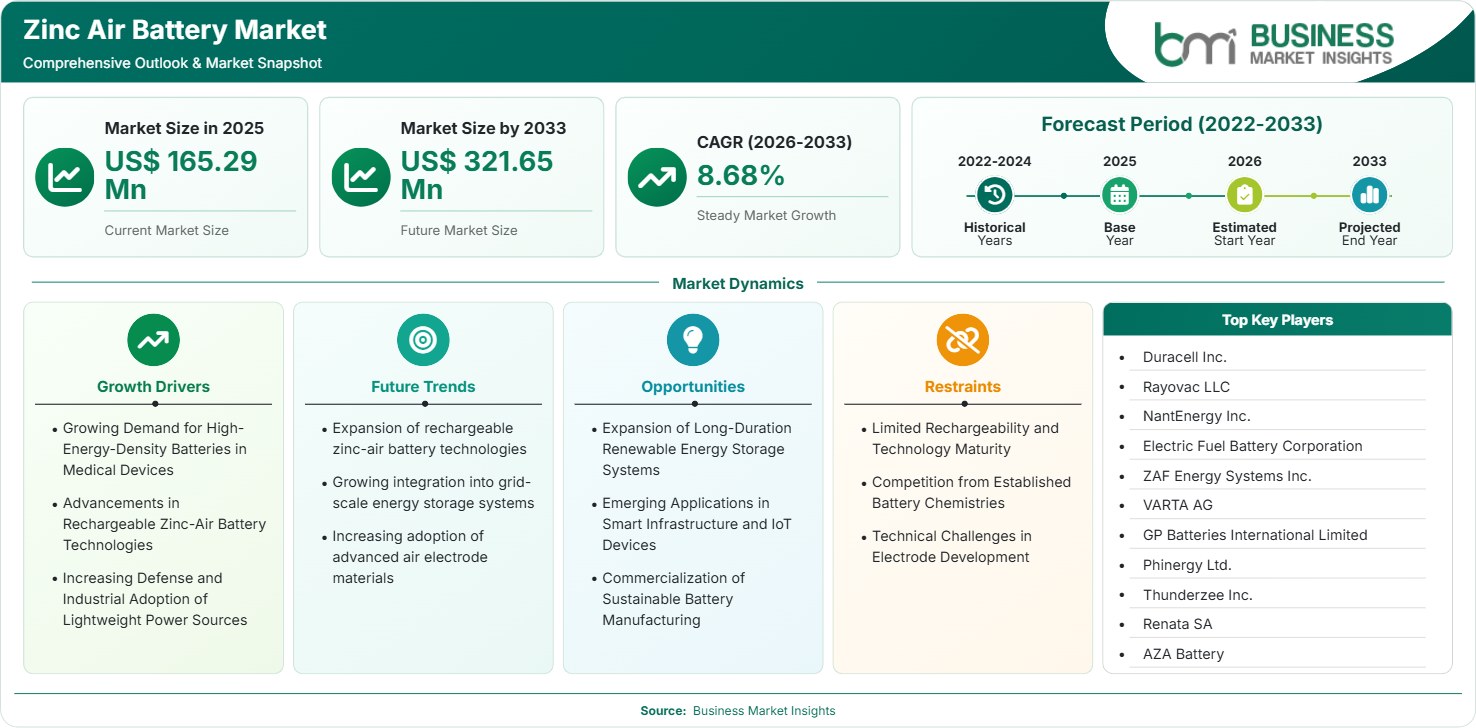
The Zinc Air Battery Market size was valued at US$ 165.29 Million in 2025 and is projected to reach US$ 321.65 Million by 2033, growing at a CAGR of 8.68% during 2026–2033. Rising adoption of compact energy storage technologies, expanding hearing aid demand, increasing military modernization programs, and advances in rechargeable zinc-air chemistry are creating strosng commercialization opportunities across consumer electronics, medical, and industrial applications.

Report Coverage
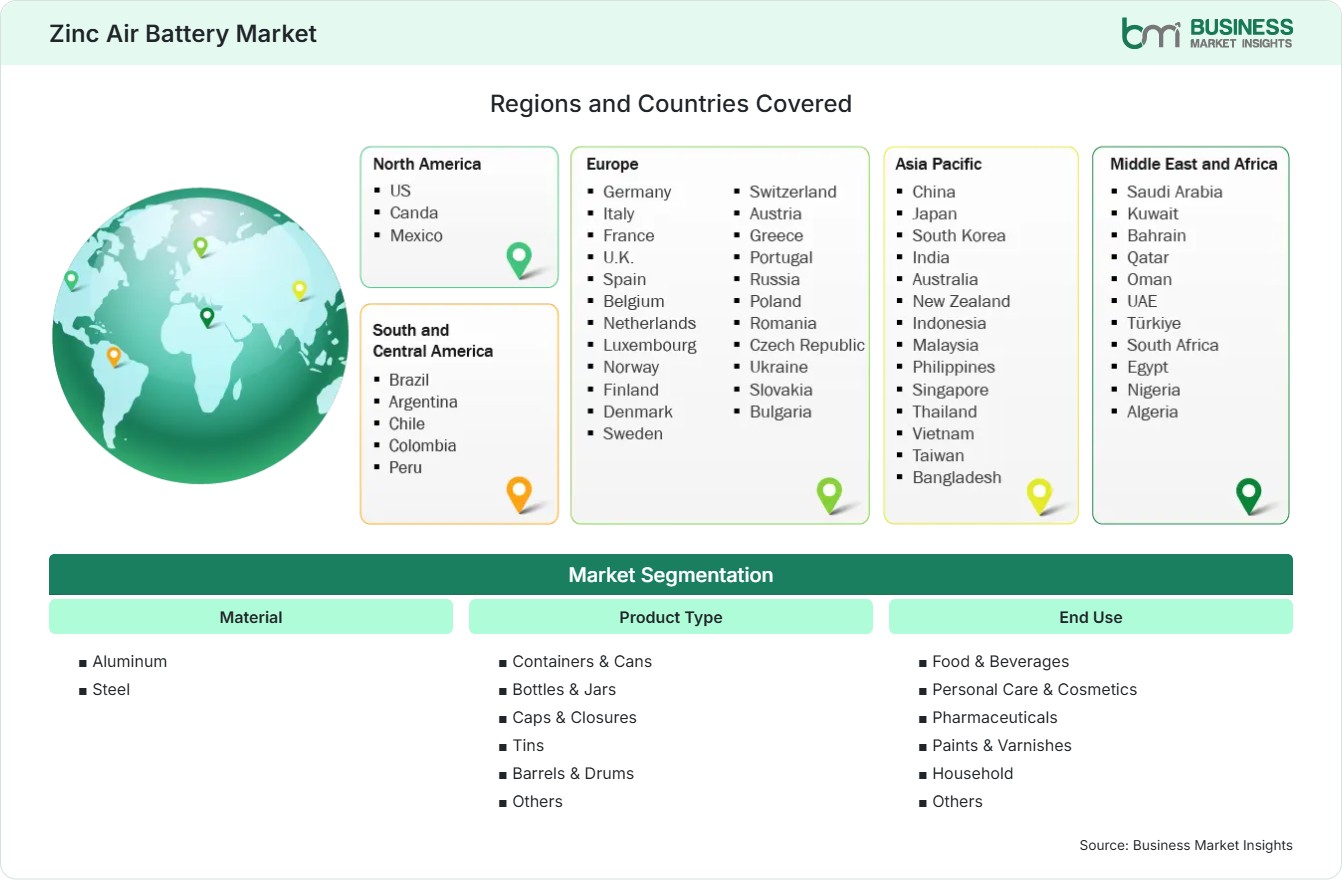
  • Material: Aluminum, Steel
  • Product Type: Containers & Cans, Bottles & Jars, Caps & Closures, Tins, Barrels & Drums, Others
  • End Use: Food & Beverages, Personal Care & Cosmetics, Pharmaceuticals, Paints & Varnishes, Household, Others
US$ 165.29 Mn Market size in 2025
US$ 321.65 Mn Market Size by 2033
8.68% CAGR, 2026 - 2033
2026-2033 Forecast Period

01 AI Overview

Zinc Air Battery Market Summary

  • North America Region: North America holds an estimated 34%–37% market share in 2025 and is projected to expand at a 7.8%–8.4% CAGR during 2026–2033. Growth is supported by advanced battery research, increasing medical device adoption, Défense modernization programs, and investments in sustainable energy storage technologies across industrial applications. The U.S. market benefits from strong R&D capabilities, established battery manufacturers, expanding healthcare demand, and government-backed innovation initiatives, supporting a projected CAGR of 8.0%–8.6% through 2033.
  • Fastest Growing Region: Asia Pacific accounts for approximately 26%–29% market share in 2025 and is expected to register the fastest CAGR of 9.5%–10.2% between 2026 and 2033. Rapid industrialization, healthcare expansion, battery manufacturing investments, and increasing demand for affordable energy storage continue accelerating regional adoption.
  • Leading Segment: Non-Rechargeable batteries represent 62%–66% of total market share in 2025 and are forecast to grow at a 7.9%–8.5% CAGR through 2033. Continued demand from hearing aids, medical electronics, stable voltage output requirements, and long shelf life remain the primary market expansion drivers.
  • High Growth Segment: Rechargeable batteries account for 34%–38% market share in 2025 while recording the fastest CAGR of 9.8%–10.5% during 2026–2033. Ongoing technological advancements, renewable energy storage applications, improved recharge efficiency, and sustainability initiatives continue creating attractive commercial opportunities.
  • Key Market Opportunity: Growing commercialization of rechargeable zinc-air technologies for grid storage, electric mobility support systems, and backup power applications offers manufacturers significant opportunities to develop high-energy-density, environmentally sustainable battery solutions across emerging economies.
  • Major Market Players: Duracell Inc., Rayovac LLC, NantEnergy Inc., Electric Fuel Battery Corporation, ZAF Energy Systems Inc., VARTA AG, GP Batteries International Limited, Phinergy Ltd., Thunderzee Inc., Renata SA, and AZA Battery.
02 Strategic Insights

Zinc Air Battery Market: Strategic Insights

Zinc Air Battery Market Strategic Framework
FREE PDF
Request your free sample
Request free sample
03 Stakeholder View

Key Takeaways

  • Supply chain resilience is becoming a key competitive factor as manufacturers integrate sourcing, electrode production, and battery assembly to improve efficiency, reduce disruptions, and strengthen cost competitiveness across medical, industrial, and defense applications.
  • Medical applications remain the primary revenue driver, with hearing aids leading demand due to replacement cycles, compact size, and reliable performance. Rechargeable zinc-air batteries are also creating opportunities in energy storage and portable electronics.
  • Technological innovation is advancing toward rechargeable zinc-air systems through improved catalysts, air electrodes, electrolytes, and cycle-life performance, enabling broader adoption beyond traditional battery applications.
  • Asia Pacific offers strong long-term growth potential, supported by expanding battery manufacturing, government initiatives, healthcare investments, and rising adoption of sustainable energy storage technologies.
  • Strategic partnerships and licensing agreements are accelerating zinc-air battery commercialization by improving scalability, reducing development timelines, and strengthening collaboration among technology developers, research institutions, and end-use industries.
  • Environmental sustainability is becoming a key market driver as zinc-air batteries offer material efficiency, lower environmental impact, and recyclability benefits, supporting adoption across industries pursuing carbon reduction goals.
04 Geographic Outlook

Zinc Air Battery Market Regional Highlights

North America Zinc Air Battery Market

North America accounted for an estimated 34%–37% of the global market share in 2025 and is projected to expand at a CAGR of 7.8%–8.4% during 2026–2033. The region benefits from strong research capabilities, established battery manufacturers, and widespread adoption of hearing aids and portable medical devices. Government funding for advanced energy storage technologies, increasing defense modernization programs, and investments in sustainable battery innovation continue to strengthen the Zinc Air Battery Market share across healthcare, industrial, and military applications.

  • The United States remains the largest regional contributor due to strong healthcare spending, continuous battery technology innovation, and growing deployment of portable electronic devices requiring reliable, lightweight power sources.
  • Defense agencies continue investing in compact, high-energy-density batteries for communication systems, surveillance equipment, and field operations, creating long-term demand for advanced zinc-air battery technologies.
  • Research collaborations among universities, battery developers, and government laboratories are accelerating commercialization of rechargeable zinc-air technologies while improving battery efficiency, durability, and operational reliability.
  • Sustainability initiatives promoting recyclable battery chemistries and environmentally responsible manufacturing practices encourage continued investment across battery production and next-generation energy storage applications.
  • Increasing demand for backup power solutions in industrial monitoring, smart infrastructure, and emergency response equipment further supports regional expansion throughout the forecast period.

US Zinc Air Battery Market

The United States represents the largest national market within North America, accounting for approximately 72%–76% of regional revenue in 2025 while advancing at a projected CAGR of 8.0%–8.6% through 2033. Rising adoption across hearing aids, military electronics, and specialized industrial equipment continues supporting long-term Zinc Air Battery Market growth within high-value application segments.

  • Federal research funding continues supporting advanced battery chemistry development, enabling manufacturers to improve rechargeable zinc-air performance and commercialization potential.
  • Medical device manufacturers increasingly adopt high-energy-density batteries to improve device reliability, operational efficiency, and patient convenience across healthcare applications.
  • Strategic Défense procurement programs encourage deployment of lightweight batteries capable of supporting extended operational missions and demanding environmental conditions.
  • Investments in domestic battery manufacturing strengthen supply chain resilience while reducing dependence on imported battery components and specialty materials.

Europe Zinc Air Battery Market

Europe captured approximately 27%–30% of global market share during 2025 and is forecast to register a CAGR of 8.2%–8.8% through 2033. Regional expansion is supported by ambitious sustainability targets, increasing investment in battery innovation, and strong demand for environmentally friendly energy storage technologies. Germany leads regional production, while the United Kingdom demonstrates one of the fastest growth trajectories through expanding clean-energy initiatives and advanced battery research programs in Zinc Air Battery Market.

  • Germany remains the leading regional market because of advanced manufacturing capabilities, strong industrial research infrastructure, and established battery technology companies.
  • The United Kingdom experiences robust expansion supported by university-led battery research, public funding initiatives, and increasing commercialization of innovative energy storage technologies.
  • European environmental regulations continue encouraging adoption of recyclable battery chemistries and sustainable manufacturing practices across multiple industries.
  • Medical technology companies increasingly integrate zinc-air batteries into portable healthcare devices requiring dependable performance, compact size, and extended operating life.
  • Collaborative research projects supported by European innovation programs accelerate development of next-generation rechargeable battery technologies.

Asia Pacific Zinc Air Battery Market

Asia Pacific accounted for approximately 26%–29% of the global market in 2025 and is projected to record the fastest CAGR of 9.5%–10.2% between 2026 and 2033. Expanding battery manufacturing capacity, increasing healthcare investments, favorable government policies, and rapid industrialization continue supporting strong regional demand in Zinc Air Battery Market. China leads overall production, while India records the fastest regional growth as investments in advanced battery technologies continue accelerating.

  • China maintains regional leadership through large-scale battery manufacturing, extensive electronics production, and continuous investment in advanced energy storage research.
  • India demonstrates rapid expansion driven by government manufacturing initiatives, healthcare modernization, and increasing investments in sustainable battery technologies.
  • Japan continues emphasizing high-performance battery innovation, supporting development of advanced rechargeable zinc-air technologies for commercial applications.
  • South Korea strengthens regional competitiveness through advanced materials research, precision manufacturing expertise, and strategic investments in battery development.
  • Rising medical device production and growing renewable energy deployment create additional commercial opportunities across Asia Pacific.

Rest of World Zinc Air Battery Market

Rest of World contributes approximately 8%–10% of global revenue during 2025 while advancing at a CAGR of 8.4%–9.0% through 2033. South & Central America continues expanding through healthcare infrastructure improvements and industrial modernization initiatives. Meanwhile, the Middle East & Africa experiences gradual adoption supported by investments in critical infrastructure, emergency power systems, and specialized industrial applications requiring dependable portable energy solutions in Zinc Air Battery Market.

  • Brazil leads South & Central America through expanding healthcare investments, improving industrial capabilities, and increasing demand for portable electronic power solutions.
  • Mexico benefits from growing electronics manufacturing activities and strengthening industrial supply chains supporting battery component production.
  • Saudi Arabia invests in advanced industrial infrastructure and energy diversification projects that encourage adoption of innovative battery technologies.
  • South Africa demonstrates increasing utilization across mining, industrial safety equipment, and specialized monitoring applications requiring dependable portable power.
  • Government initiatives supporting clean energy, industrial diversification, and infrastructure modernization continue creating long-term opportunities across emerging economies.
Global Market Geography
FREE PDF
Request your free sample
Request free sample
05 Segment Analysis

Zinc Air Battery Market Segmentation

Type

The Type segment accounted for the Non-Rechargeable batteries representing the dominant category. The segment held an estimated 62%–66% market share in 2025 and is projected to expand at a CAGR of 7.9%–8.5% during 2026–2033. Increasing product innovation, wider application coverage, and evolving battery chemistry continue to expand the Zinc Air Battery Market scope across medical, industrial, and energy storage applications.

  • Non-Rechargeable: Widely adopted for hearing aids and compact medical electronics because of high energy density, stable voltage output, extended shelf life, and reliable performance under continuous low-power operating conditions.
  • Rechargeable: Rapid technological progress in catalyst materials, electrolyte optimization, and air electrode design supports commercialization across renewable energy storage, industrial backup systems, defense equipment, and next-generation portable electronics.

Application

The Application segment reflects diversified adoption across healthcare, defense, industrial safety, and specialized electronic equipment. This segment recorded strong commercial demand in 2025, with Hearing Aids contributing the largest revenue share of approximately 48%–52%, while the overall application segment is expected to register a CAGR of 8.6%–9.1% during the forecast period. Continuous product innovation and evolving Zinc Air Battery Market trends are supporting broader deployment across multiple end-use industries.

  • Hearing Aids: The largest application segment benefits from continuous replacement demand, compact battery dimensions, dependable power delivery, long operating duration, and increasing global prevalence of age-related hearing impairment.
  • Military Devices: Defense organizations increasingly utilize zinc-air batteries in portable communication equipment, surveillance systems, navigation devices, and mission-critical electronics where lightweight construction and high energy density remain operational priorities.
  • Safety Lamps: Industrial safety lamps deployed across mining, oil & gas, underground construction, and emergency response operations increasingly incorporate zinc-air batteries because of dependable performance, extended operational duration, and minimal maintenance requirements.
06 Market Forces

Zinc Air Battery Market Dynamics

Key Market Drivers

Growing Demand for High-Energy-Density Batteries in Medical Devices

The expanding use of hearing aids and compact medical electronics remains one of the strongest growth drivers for the market. Zinc-air batteries provide high energy density, stable voltage, and extended operational life compared with many conventional primary battery technologies. According to the World Health Organization, more than 1.5 billion people worldwide experience some degree of hearing loss, with hundreds of millions requiring hearing rehabilitation services. As populations continue aging across developed and emerging economies, manufacturers are witnessing increasing demand for compact, dependable battery solutions. This sustained healthcare demand continues to support Zinc Air Battery Market growth, particularly across hearing aid manufacturers, portable diagnostic equipment, and other low-power medical devices requiring consistent performance and long service life.

Advancements in Rechargeable Zinc-Air Battery Technologies

Innovation in rechargeable zinc-air battery technology has completely changed the industry's commercial prospects. Research organizations and battery makers have been investing in developing better catalysts, electrolytes, and air electrodes, which were once a problem due to inefficient recharge processes and cycle life. The development of better battery technology has improved efficiency and reduced degradation over several recharge cycles. Increased investment from both research programs and battery makers has helped commercialize the technology in renewable energy storage and distributed power generation.

Increasing Defense and Industrial Adoption of Lightweight Power Sources

The defense industry and industrial firms are continually seeking lightweight, robust batteries that meet the needs of portable electronic equipment in harsh environmental conditions. Zinc-air batteries offer high energy density and long operating time, making them ideal for communication systems, surveillance devices, emergency lights, navigation equipment, and remote monitoring systems. The trend towards military modernization, prevalent in North America, Europe, and Asia, is also stimulating interest in modern portable energy solutions. Commercialization is further promoted by regulations governing industrial safety.

Key Market Opportunities

Expansion of Long-Duration Renewable Energy Storage Systems

The increasing production of electricity from renewable sources is leading to many opportunities for rechargeable zinc-air battery technology. The need for power companies for long-term economic storage to regulate production from intermittent sources such as solar and wind energy is on the rise. Zinc-air batteries have good sustainability features, are made using readily available materials, and may be cheaper than many other battery technologies. Favorable Zinc Air Battery Market Forecasts indicate increasing investment in pilot projects and commercial-scale installations as governments pursue decarbonization strategies and strengthen electricity infrastructure resilience over the coming decade.

Emerging Applications in Smart Infrastructure and IoT Devices

The rapid adoption of smart infrastructure, automation, and Internet of Things technology has created a need for smaller, maintenance-friendly power sources. The zinc-air battery is a reliable energy source for sensors, wireless monitoring devices, smart metering devices, environmental monitoring equipment, and remote industrial assets. Due to their longevity, zinc-air batteries require less maintenance in situations where battery replacement is costly or difficult. Increased investment in smart cities and digitalized industry has increased the business prospects of manufacturers producing zinc-air batteries.

Commercialization of Sustainable Battery Manufacturing

The environmental sustainability of battery products is becoming a major concern for governments as well as business buyers. Zinc-air batteries are made from readily available zinc ore and exhibit good recyclability properties, making them an ideal fit for circular economy and sustainable manufacturing concepts. Companies that have adopted clean production technologies, recycling-friendly products, and environmentally friendly supply chains are improving their market competitiveness. Corporate sustainability practices, strict environmental laws, and consumer interest in green technologies are driving investments in future manufacturing plants for zinc-air batteries.

Market Restraints and Challenges

Limited Rechargeability and Technology Maturity

Factor: Despite further advancements in the design of rechargeable zinc-air batteries, technological hurdles involving air electrode breakdown, electrolyte instability, and recharging inefficiency still pose major hindrances to their commercialization. Impact: Such performance issues limit reliability for intensive uses and hinder entry into industries where intensive recharging is needed. The manufacturers keep on researching on advanced catalysts and better designs to overcome such challenges, yet the timeline for commercialization takes longer compared to other advanced technologies like lithium-ion.

Competition from Established Battery Chemistries

Factor: Lithium-ion, nickel-metal hydride, and many other advanced batteries still hold prominent positions in the market due to well-developed production, logistics, and technological improvements. Impact: The high level of competition does not allow for a a flexible pricing policy and forces customers to switch to zinc-air batteries despite their environmental benefits. It is necessary for manufacturers to demonstrate improved lifecycle economics, performance, recharging capabilities, and sustainable production to achieve commercial success.

07 Company Analysis

Competitive Landscape

The competitive environment remains moderately consolidated, with global battery manufacturers and specialized technology developers investing in product innovation, rechargeable battery research, and application-specific solutions. Current Zinc Air Battery Market analysis indicates that companies are emphasizing strategic partnerships, R&D investments, and sustainable battery technologies to strengthen their positions across healthcare, industrial, and energy storage applications.

Company Name

Overview

Products and Services Relevant to this Market

Duracell Inc.

Global battery manufacturer recognized for premium consumer and specialty batteries, supported by extensive distribution channels and continuous investment in battery innovation.

Zinc-air hearing aid batteries, specialty button cells, portable power solutions, and battery technologies for medical and consumer electronic devices.

Rayovac LLC

Established battery manufacturer offering a wide portfolio of consumer and specialty batteries with a strong presence in hearing aid battery markets.

Zinc-air hearing aid batteries, specialty batteries, consumer batteries, portable power products, and battery accessories.

NantEnergy Inc.

Clean energy technology company developing advanced metal-air battery systems for industrial, telecom, and off-grid energy storage applications.

Rechargeable zinc-air battery systems, long-duration energy storage, microgrid solutions, and industrial backup power technologies.

Electric Fuel Battery Corporation

Specialized developer of metal-air battery technologies focusing on high-energy-density applications for transportation and defense sectors.

Zinc-air battery systems, military power solutions, transportation batteries, and advanced electrochemical energy technologies.

ZAF Energy Systems Inc.

U.S.-based battery technology company focused on developing advanced rechargeable zinc-air battery platforms for commercial applications.

Rechargeable zinc-air batteries, battery materials, energy storage technologies, and customized battery development services.

VARTA AG

European battery manufacturer serving healthcare, industrial, and consumer electronics markets through advanced battery technologies and innovation.

Zinc-air hearing aid batteries, button cells, medical batteries, rechargeable batteries, and energy storage solutions.

GP Batteries International Limited

International battery manufacturer supplying portable battery technologies across consumer, industrial, and healthcare industries worldwide.

Zinc-air batteries, alkaline batteries, rechargeable batteries, specialty batteries, and portable energy products.

Phinergy Ltd.

Technology company developing metal-air battery systems for long-duration energy storage and transportation applications.

Zinc-air battery technologies, aluminum-air systems, energy storage platforms, and clean energy solutions.

Thunderzee Inc.

Battery technology company focused on advanced zinc-air battery development for industrial and specialty applications.

Zinc-air batteries, portable energy systems, industrial battery technologies, and customized power solutions.

Renata SA

Swiss battery manufacturer specializing in precision miniature batteries serving healthcare and industrial electronic applications.

Zinc-air hearing aid batteries, miniature batteries, button cells, and specialty medical battery solutions.

AZA Battery

European manufacturer engaged in zinc-air battery production for niche industrial and healthcare applications.

Zinc-air batteries, specialty batteries, portable power products, and customized battery technologies.

10 Trust & Transparency

Research Methodology

The market analysis combines proprietary research with secondary data from government agencies, company disclosures, regulatory filings, industry databases and expert interviews. Market estimates are validated through data triangulation, cross-market benchmarking and analyst review.

View Full Research Methodology

11 Questions Answered

Frequently Asked Questions

How does the Zinc Air Battery Market Report benefit stakeholders?

The report helps manufacturers, investors, distributors, technology developers, and policymakers evaluate market opportunities, competitive positioning, emerging applications, regional developments, and long-term investment strategies.

What factors are supporting future market expansion?

Growing hearing aid adoption, increasing Défense modernization, continuous battery technology innovation, renewable energy storage requirements, and government support for sustainable battery technologies are expected to drive long-term market demand.

Which region dominates the Zinc Air Battery Market?

North America currently leads the global market owing to advanced battery research, established healthcare infrastructure, strong defense investments, and the presence of several leading battery technology companies.

Why are rechargeable zinc-air batteries gaining attention?

Rechargeable zinc-air batteries offer the potential for lower environmental impact, abundant raw material availability, high theoretical energy density, and cost-effective long-duration energy storage for renewable energy and industrial applications.

What are the primary applications of zinc-air batteries?

Zinc-air batteries are primarily used in hearing aids, military communication equipment, safety lamps, medical devices, industrial monitoring systems, and selected backup power applications because of their high energy density and dependable operating performance.

Access the Full Zinc Air Battery Market Report

Get segment-level forecasts, regional estimates, competitive benchmarking, company profiles and downloadable Excel datasets.

Access the full Zinc Air Battery Market Report
350 pages PDF & Excel | 2026-08-12