
Renewable Methanol Market Outlook: Size, Share, Trends, Growth Analysis, Competitive Landscape & Forecast, 2026-2033

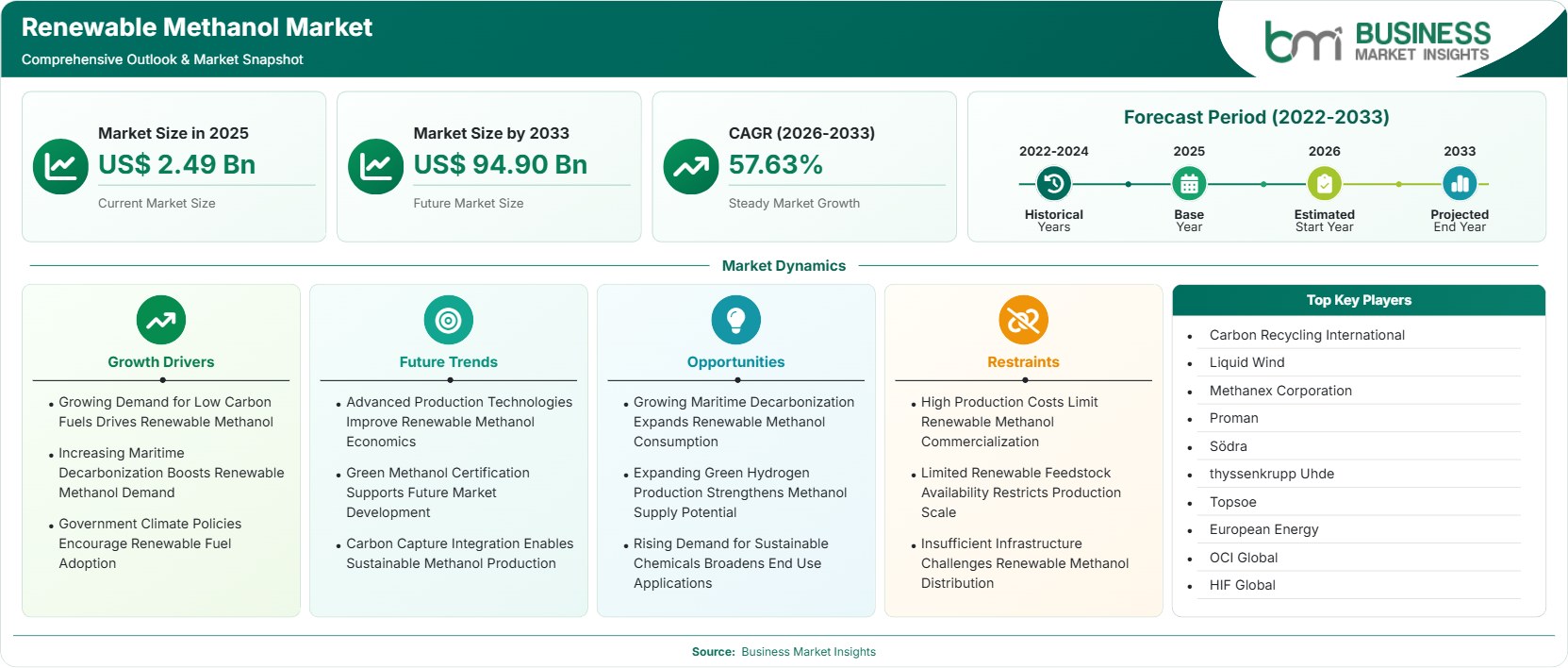
The Renewable Methanol Market size was valued at US$ 2.49 billion in 2025 and is projected to reach US$ 94.90 billion by 2033, growing at a CAGR of 57.63% during 2026–2033, driven by maritime decarbonization, renewable hydrogen expansion, climate policies, sustainable chemicals demand, and low-carbon fuel investments.

Report Coverage
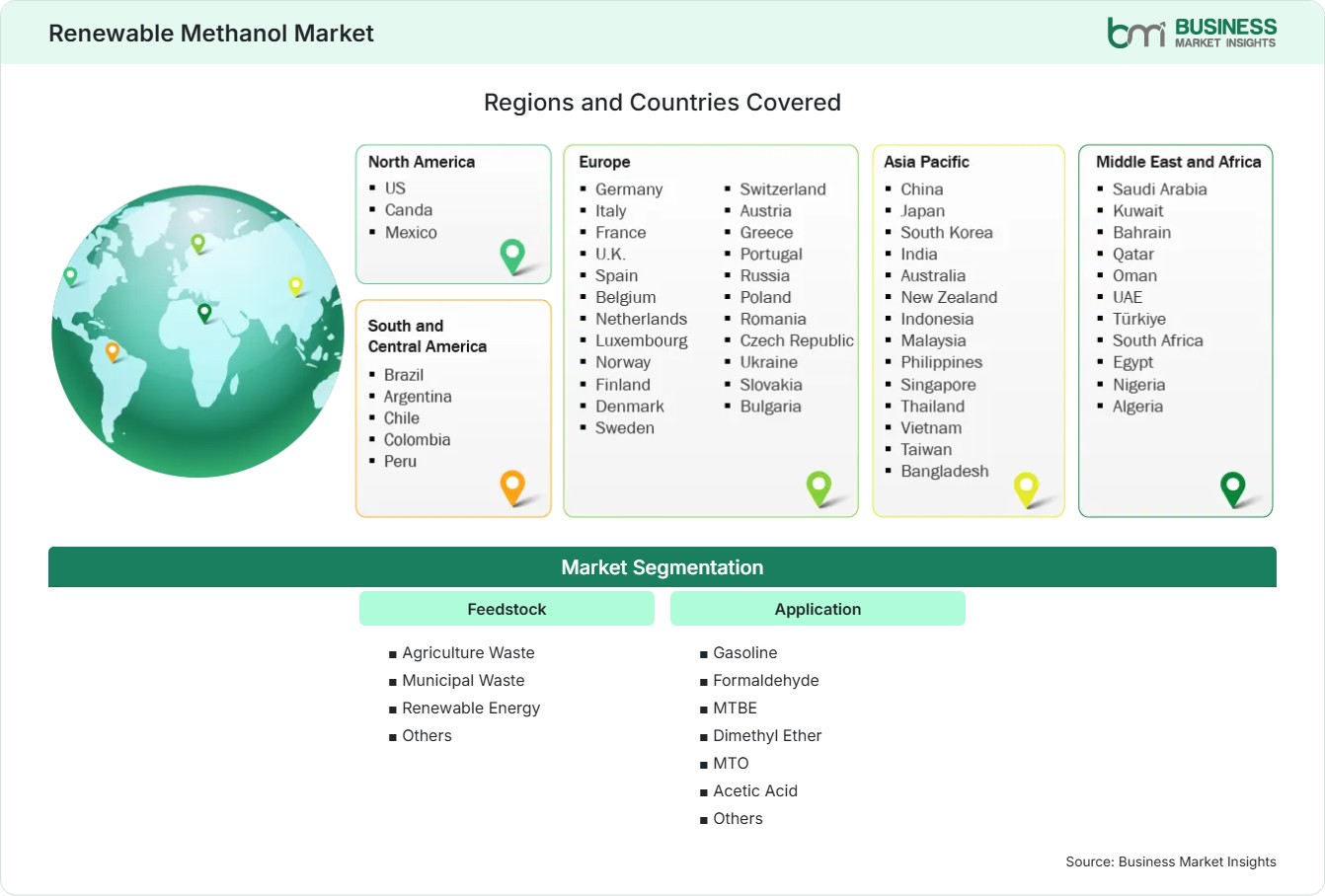
  • Feedstock: Agriculture Waste, Municipal Waste, Renewable Energy, Others
  • Application: Gasoline, Formaldehyde, MTBE, Dimethyl Ether, MTO, Acetic Acid, Others
US$ 2.49 Bn Market size in 2025
US$ 94.90 Bn Market Size by 2033
57.63% CAGR, 2026 - 2033
2026-2033 Forecast Period

01 AI Overview

Renewable Methanol Market Summary

  • North America Region: North America holds a 18%–23% share in 2025, growing at a 49%–54% CAGR through 2033, supported by clean hydrogen, carbon capture, renewable power, industrial decarbonization, maritime fuel demand, and expanding investment in integrated low-carbon fuel projects. The US market is advancing at a 48%–53% CAGR, supported by clean hydrogen incentives, carbon utilization, renewable electricity, industrial infrastructure, and emerging demand from shipping and sustainable chemical producers.
  • Fastest Growing Region: Asia Pacific accounts for a 27%–32% share in 2025 and is projected to expand at a 61%–66% CAGR, driven by renewable energy investments, chemical manufacturing, shipping activity, green hydrogen projects, carbon utilization, and accelerating industrial decarbonization across major economies.
  • Leading Segment: Renewable Energy represents a 42%–47% share in 2025 and is projected to grow at a 58%–63% CAGR, supported by renewable electricity, electrolyzer deployment, Power-to-X integration, captured CO₂ utilization, falling clean-energy costs, and demand for low-carbon fuels.
  • High Growth Segment: Dimethyl Ether represents an 8%–12% share in 2025 and is expected to grow at a 63%–68% CAGR, supported by cleaner fuel requirements, LPG substitution, decentralized energy applications, and expanding pathways for renewable methanol conversion.
  • Key Market Opportunity: Renewable methanol provides a flexible decarbonization molecule for shipping, chemicals, and synthetic fuels, allowing producers to monetize renewable electricity, sustainable biomass, biogenic carbon, captured CO₂, and waste-based feedstocks.
  • Major Market Players: Carbon Recycling International, Liquid Wind, Methanex Corporation, Proman, Södra, thyssenkrupp Uhde, Topsoe, European Energy, OCI Global, HIF Global
02 Strategic Insights

Renewable Methanol Market: Strategic Insights

Renewable Methanol Market Strategic Framework
FREE PDF
Request your free sample
Request free sample
03 Stakeholder View

Key Takeaways

  • The value chain is moving towards more integrated systems involving renewable energy, electrolysis, carbon capture, methanol production, storage, ports, and long-term offtake contracts. Those who have control over different stages can mitigate risk and enhance the economics of projects.
  • Maritime fuels are among the top near-term applications, while sustainable chemicals and synthetic fuels offer other options for demand. The liquid-handling properties of methanol make it feasible for transport via fuel networks.
  • Competition in technology is becoming centered on electrolyzer efficiency, catalysts, carbon sources, operational flexibility, and affordable hydrogen. Integrated systems can enhance economic performance through better management of energy and carbon input.
  • Investment in the Asia Pacific is promising due to industrial methanol use, chemical manufacturing, renewable energy investments, and shipping. Countries such as China, Japan, South Korea, and Australia have distinct mixes of demand and resource bases for methanol.
  • The competitive environment is being changed through strategic investments and consolidation. The acquisition of OCI Global's international methanol business by Methanex Corporation increased its competitive advantage in global methanol and low-carbon methanol markets.
04 Geographic Outlook

Renewable Methanol Market Regional Highlights

North America Renewable Methanol Market

North America holds an 18%–23% share in 2025 and is projected to expand at a 49%–54% CAGR during 2026–2033. The region benefits from renewable electricity, established methanol infrastructure, carbon capture expertise, and clean hydrogen investment. The United States represents the dominant market, while Canada offers renewable power and biomass advantages. Renewable Methanol Market share is supported by industrial demand and emerging marine applications.

  • US developers are integrating renewable hydrogen with captured or biogenic CO₂, creating pathways for lower-carbon methanol production serving marine fuels, chemicals, and synthetic fuel applications.
  • Canada offers potential for biomass-derived methanol because forestry residues and renewable electricity can support integrated production models near ports and industrial demand centers.
  • Gulf Coast infrastructure provides access to methanol terminals, chemical consumers, carbon management projects, and export logistics, allowing renewable facilities to connect with existing industrial networks.
  • Long-term maritime fuel procurement can create bankable demand for producers as shipping companies evaluate methanol-compatible vessels and lower-carbon fuel supply chains.

US Renewable Methanol Market

The US represents a 14%–18% share of North America's 2025 market and is projected to grow at a 48%–53% CAGR through 2033. Its position reflects renewable power development, clean hydrogen incentives, carbon capture capabilities, and established chemical infrastructure. Renewable Methanol Market opportunities are expanding as developers connect low-carbon hydrogen projects with captured carbon and long-term fuel or chemical offtake agreements.

  • Federal clean hydrogen and carbon management incentives can improve project economics where renewable electricity, carbon capture, and methanol synthesis are colocated to reduce transportation costs.
  • Gulf Coast industrial clusters provide access to methanol terminals, chemical customers, ports, and export infrastructure, supporting larger projects with diversified downstream demand.
  • Emerging marine fuel corridors can increase demand as vessel operators evaluate methanol-compatible propulsion and seek fuels capable of reducing lifecycle greenhouse gas emissions.

Europe Renewable Methanol Market

Europe accounts for a 30%–35% share in 2025 and is forecast to expand at a 53%–58% CAGR during 2026–2033. Denmark and Germany lead project development, while Sweden, Finland, the Netherlands, and Spain offer additional opportunities. Denmark is projected to grow at 55%–60%, while Germany could reach 54%–59% CAGR as renewable power, hydrogen infrastructure, and maritime demand converge. Renewable Methanol Market development benefits from strong decarbonization policies and established industrial clusters.

  • Denmark is emerging as a Power-to-X hub because renewable electricity, biogenic CO₂, electrolyzers, and maritime offtake can be integrated within a connected industrial ecosystem.
  • Germany offers potential for renewable methanol deployment because its industrial base requires lower-carbon chemical feedstocks while renewable energy expansion supports Power-to-X integration.
  • Finland and Sweden combine forest residues, renewable electricity, port infrastructure, and industrial expertise, creating favorable conditions for biomass-based and e-methanol projects.
  • The Netherlands provides access to major ports and chemical clusters, supporting methanol storage, distribution, imports, and potential domestic production.

Asia Pacific Renewable Methanol Market

Asia Pacific represents a 27%–32% share in 2025 and is projected to register a 61%–66% CAGR during 2026–2033, making it the fastest-growing regional market. China leads regional deployment potential, while Japan and South Korea offer strong maritime and chemical demand. Australia benefits from renewable electricity and export opportunities. China is estimated to grow at 63%–68%, while Australia could reach 62%–67% CAGR as renewable hydrogen and e-fuel projects expand.

  • China combines large chemical manufacturing capacity, renewable energy investment, and industrial decarbonization priorities, creating opportunities for projects integrating carbon capture and renewable hydrogen.
  • Japan's shipping industry and industrial consumers provide potential demand for imported renewable methanol, while domestic companies can participate through long-term offtake agreements.
  • South Korea's shipbuilding capabilities and maritime companies create a strong ecosystem for methanol-fueled vessels, supporting demand across Asian shipping routes.
  • Australia has abundant renewable energy resources and access to Asian markets, creating opportunities for export-oriented projects converting renewable electricity and hydrogen into transportable methanol.

Rest of World Renewable Methanol Market

South and Central America account for a 10%–14% share in 2025 and are projected to grow at a 55%–60% CAGR, supported by renewable electricity, biomass resources, and export potential. Brazil leads regional opportunities, while Chile offers renewable hydrogen potential. The Middle East and Africa represent a 7%–11% share and are expected to expand at a 51%–56% CAGR, supported by solar resources, industrial decarbonization, and export projects.

Brazil and Chile can combine renewable power with agricultural residues and port access, while Saudi Arabia and the UAE offer large-scale renewable energy and industrial infrastructure. Competitiveness will depend on carbon sourcing, water availability, export logistics, and international offtake.

  • Brazil offers agricultural residues, bioenergy expertise, and renewable electricity resources, enabling pathways combining biomass and renewable hydrogen for domestic and export-oriented production.
  • Chile's solar and wind resources create potential for Power-to-X projects producing renewable methanol for maritime customers and international markets.
  • Saudi Arabia and the UAE can leverage renewable energy projects, industrial zones, ports, and international shipping connections to develop export-focused renewable methanol hubs.
  • South Africa offers biomass and renewable energy potential but requires infrastructure investment and reliable financing to develop production at commercially relevant scale.
Global Market Geography
FREE PDF
Request your free sample
Request free sample
05 Segment Analysis

Renewable Methanol Market Segmentation

Feedstock

Feedstock accounted for the full market structure across specified categories in 2025, with Renewable Energy representing a 42%–47% share and a 58%–63% CAGR during 2026–2033. The segment benefits from Power-to-X integration, declining renewable electricity costs, electrolyzer deployment, and increasing demand for lower-carbon fuels and chemical feedstocks.

  • Agriculture Waste: Agricultural residues provide biogenic carbon for methanol pathways, enabling producers to convert underutilized biomass into fuels and chemicals while supporting rural value creation.
  • Municipal Waste: Municipal waste provides an alternative carbon source for waste-to-methanol facilities, reducing landfill dependence while enabling production near population centers and industrial demand hubs.
  • Renewable Energy: Renewable electricity enables green hydrogen production through electrolysis, which combines with captured or biogenic CO₂ to produce e-methanol for shipping, chemicals, and synthetic fuels.
  • Others: Other feedstocks include forestry residues, biogenic CO₂, industrial carbon streams, and recovered carbon sources, supporting diversified production where conventional biomass availability is constrained.

Application

Application demand spans gasoline, formaldehyde, MTBE, dimethyl ether, MTO, and acetic acid, with Dimethyl Ether representing the high-growth segment at an estimated 8%–12% share and 63%–68% CAGR during 2026–2033. Renewable Methanol Market scope is expanding as low-carbon methanol moves beyond marine fuel applications into chemical intermediates and synthetic fuels.

  • Gasoline: Methanol can support gasoline blending and synthetic gasoline pathways, creating opportunities where renewable carbon and hydrogen are available for lower-carbon fuel production.
  • Formaldehyde: Formaldehyde production remains an important methanol-consuming application, with renewable methanol offering chemical manufacturers a pathway to reduce lifecycle emissions.
  • MTBE: MTBE provides an established outlet for methanol derivatives, although regional fuel regulations and environmental restrictions influence demand patterns.
  • Dimethyl Ether: Dimethyl ether offers growth potential as a cleaner fuel and LPG alternative, while renewable methanol provides a flexible intermediate for production.
  • MTO: Methanol-to-olefins technology creates a pathway from renewable methanol to petrochemical building blocks, potentially lowering carbon intensity in plastics and chemical production.
  • Acetic Acid: Acetic acid producers can use renewable methanol as a lower-carbon feedstock, enabling chemical manufacturers to reduce embedded emissions and meet sustainability requirements.
06 Market Forces

Renewable Methanol Market Dynamics

Key Market Drivers

Growing Demand for Low Carbon Fuels Drives Renewable Methanol

There is a growing demand for low-carbon liquid fuels, which is a structural force driven by the need of the shipping industry, the chemicals industry, and synthetic fuels manufacturers to use alternatives to fossil-based raw materials. The Renewable Methanol Market growth is driven by methanol's established status as a liquid and its compatibility with existing storage and transport infrastructure. The International Maritime Organization's framework for a net-zero world is putting more pressure on ship owners to consider lower-carbon fuels throughout their lifecycle.

Increasing Maritime Decarbonization Boosts Renewable Methanol Demand

Maritime decarbonization is creating a significant demand avenue, as maritime carriers can operate dual-fuel ships and establish low-carbon fuel value chains. With stricter emissions regulations, there is increased focus on fuels that minimize carbon intensity without requiring entirely new logistical chains. Kassø plant started e-methanol production in 2025, with maritime consumers being one of the key drivers behind the plant. This forms a business ecosystem comprising fuel producers, maritime owners/operators, ports, storage providers, certifying organizations, and tech firms.

Government Climate Policies Encourage Renewable Fuel Adoption

Climate regulations are increasing the uptake of renewable fuels by raising carbon emissions reduction targets in the transport and industrial sectors. Lifecycle carbon accounting, renewable fuels standards, and policies differentiating low-carbon molecules versus fossil-based methanol are key factors shaping the Renewable Methanol Market trends. Regulation of maritime transport in Europe is highly influential, as it helps develop a system to lower the greenhouse gas intensity of ships. In the US, there is potential to benefit from incentives related to clean hydrogen and carbon management, which will help to enhance project economics.

Key Market Opportunities

Growing Maritime Decarbonization Expands Renewable Methanol Consumption

An opportunity exists in the maritime industry because renewable methanol provides a viable fuel source for vessels designed for methanol. Shipowners are planning ahead for future fuel procurement to comply with emissions regulations and advance their decarbonization plans. Value can be captured from producers through proximity to shipping ports, offtake contracts, and integration with bunker storage. Opportunities exist in certification, carbon accounting, terminal development, logistics, and digital fuel tracking. As adoption increases, producers with access to renewable electricity and carbon may develop a strategic advantage near major shipping lanes.

Expanding Green Hydrogen Production Strengthens Methanol Supply Potential

The scaling up of green hydrogen production will lead to the development of a larger supply base for e-methanol, given hydrogen's role as a key ingredient in Power-to-X processes. Asset efficiency can be increased by integrating electrolyzers with renewables and carbon capture technologies. Methanol enables the transport of hydrogen as a liquid, and hence, logistics may be easier than directly exporting hydrogen in certain cases. Consequently, renewable methanol market forecasts are increasingly tied to the growth of renewable electricity, electrolyzers, and carbon capture technology.

Rising Demand for Sustainable Chemicals Broadens End Use Applications

Chemical producers also offer another avenue, in which low-carbon methanol can help reduce carbon intensity in existing end-use applications through limited modifications to the chemical conversion process itself. Low-carbon formaldehyde, acetic acid, olefins, and other chemicals produced from methanol have demand not just in the transport industry but also in other sectors. Purchasing departments increasingly analyze the emissions associated with each component of their supply chain, enabling the creation of premiums for low-carbon feedstocks. Manufacturers can also diversify their revenue sources by serving both marine fuel buyers and chemical producers. Facilities near chemical hubs can save on logistics costs and increase carbon use efficiency.

Market Restraints and Challenges

High Production Costs Limit Renewable Methanol Commercialization

Factor: Renewable methanol production generally requires higher-cost renewable electricity, electrolyzers, carbon capture, and specialized synthesis infrastructure than conventional methanol production. Impact: This cost differential can affect final decision-making in cases where long-term contracts or policies that incentivize do not leave enough room for premium pricing. A commercial project has to take into consideration the availability of renewable energy, the use of electrolyzers, the source of carbon, financing costs, and the size of the plant at the same time. Small projects may have higher per-unit costs because capital investment is spread more thinly relative to the small production volume.

Limited Renewable Feedstock Availability Restricts Production Scale

Factor: Renewable methanol pathways depend on sustainable biomass, biogenic CO₂, renewable electricity, or captured carbon, and each source faces geographic, technical, or sustainability constraints. Impact: The lack of availability of the right raw materials can limit plant capacity, increase transport needs, and intensify competition among producers of renewable fuels and chemicals. Biomass plants need to consider collection costs, competing uses, land-use sustainability, and supply availability, while e-methanol plants require sufficient renewable energy and appropriate carbon sources. The carbon capture system might be concentrated in certain industrial sites.

07 Company Analysis

Competitive Landscape

The Renewable Methanol Market analysis indicates competition among renewable fuel developers, methanol producers, technology licensors, engineering companies, forestry specialists, and Power-to-X developers. Competitive positioning increasingly depends on renewable electricity access, sustainable carbon sourcing, technology efficiency, project financing, certification, and long-term customer contracts.

Company Name

Overview

Products and Services relevant to this market

Carbon Recycling International

Carbon recycling company focused on converting captured carbon into renewable methanol and supporting low-carbon fuel production.

Renewable methanol technology, CO₂ utilization, carbon recycling systems, and methanol production solutions.

Liquid Wind

Swedish e-methanol project developer focused on integrated renewable electricity, hydrogen, and captured biogenic CO₂ systems.

E-methanol project development, Power-to-X integration, renewable hydrogen, and carbon capture integration.

Methanex Corporation

Global methanol producer with extensive production, marketing, distribution, and emerging low-carbon methanol capabilities.

Methanol production, global marketing, distribution, logistics, and low-carbon methanol solutions.

Proman

Global methanol and chemical producer developing lower-carbon pathways and sustainable methanol applications.

Methanol production, low-carbon fuels, bio-methanol development, chemicals, and sustainable fuel solutions.

Södra

Swedish forest industry group with renewable biomass resources and expertise relevant to bio-based products and fuels.

Forestry residues, bio-based products, renewable carbon feedstocks, and biomass-derived applications.

thyssenkrupp Uhde

Engineering and technology company providing process technology for large-scale green methanol and Power-to-X facilities.

Green methanol technology, engineering, FEED, process design, and plant integration.

Topsoe

Technology provider specializing in catalysts and process technologies for renewable fuels and chemicals.

Methanol synthesis catalysts, Power-to-X technology, electrolyzer solutions, and process optimization.

European Energy

Renewable energy and Power-to-X developer operating integrated renewable electricity and e-methanol projects.

E-methanol production, renewable energy, electrolyzers, CO₂ utilization, and Power-to-X projects.

OCI Global

International industrial company with methanol and low-carbon fuel capabilities across global energy and chemical markets.

Methanol, low-carbon methanol, fuel distribution, and sustainable chemical feedstocks.

HIF Global

E-fuels developer producing synthetic fuels using renewable hydrogen and captured carbon.

E-methanol, synthetic fuels, renewable hydrogen, captured CO₂ utilization, and Power-to-X development.

10 Trust & Transparency

Research Methodology

The market analysis combines proprietary research with secondary data from government agencies, company disclosures, regulatory filings, industry databases and expert interviews. Market estimates are validated through data triangulation, cross-market benchmarking and analyst review.

View Full Research Methodology

11 Questions Answered

Frequently Asked Questions

What does the Renewable Methanol Market Report cover?

The report covers market size, segmentation, regional analysis, competitive landscape, growth drivers, opportunities, restraints, trends, technology developments, and strategic factors influencing industry expansion.

Why is renewable hydrogen important for renewable methanol production?

Renewable hydrogen supplies the hydrogen component required for e-methanol synthesis. When combined with captured or biogenic CO₂, it enables Power-to-X production that converts renewable electricity into a transportable liquid fuel and chemical feedstock.

How is maritime decarbonization influencing renewable methanol demand?

Maritime decarbonization is encouraging shipping companies to adopt methanol-capable vessels and secure lower-carbon fuel supplies. This is creating demand for production facilities, bunkering infrastructure, storage, certification, and long-term fuel contracts.

Which region is expected to experience the fastest Renewable Methanol Market expansion?

Asia Pacific is positioned as the fastest-growing region, supported by renewable energy investments, chemical manufacturing, shipping activity, green hydrogen projects, and industrial decarbonization initiatives across major economies.

What factors are supporting market growth?

Growing demand for low-carbon fuels, maritime decarbonization, renewable hydrogen expansion, climate policies, sustainable chemical procurement, and investment in Power-to-X infrastructure are supporting market development.

Access the Full Renewable Methanol Market Report

Get segment-level forecasts, regional estimates, competitive benchmarking, company profiles and downloadable Excel datasets.

Access the full Renewable Methanol Market Report
350 pages PDF & Excel | 2026-08-06