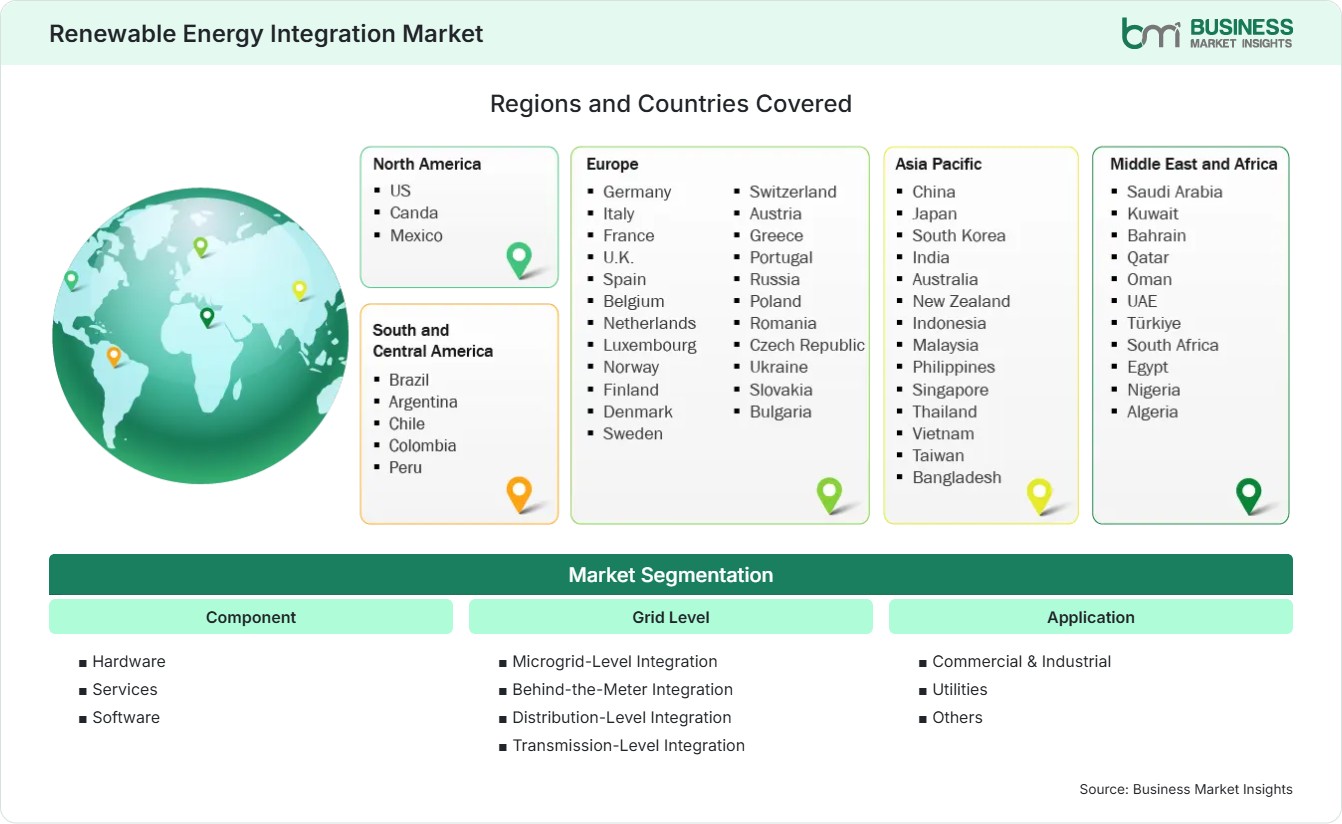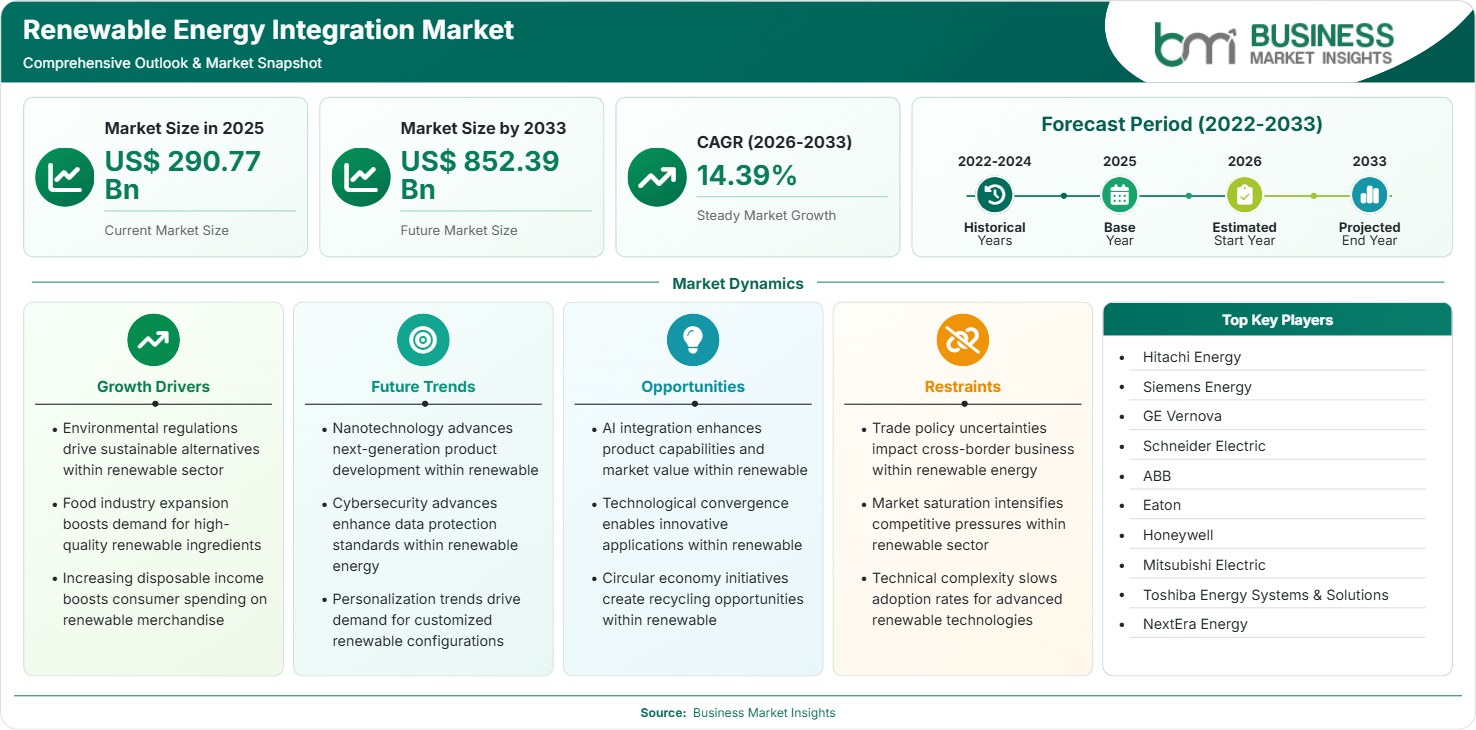
Renewable Energy Integration Market Regional Highlights
North America Renewable Energy Integration Market
North America accounted for 30%–33% of the global Renewable Energy Integration Market in 2025 and is projected to expand at a 13.2%–14.0% CAGR during 2026–2033. The region benefits from strong renewable energy investments, grid modernization programs, energy storage deployment, and increasing integration of distributed energy resources. Utilities are upgrading transmission and distribution infrastructure to manage rising solar and wind penetration. The U.S. remains the dominant contributor due to clean energy policies, large-scale renewable projects, and advanced digital grid initiatives supporting reliable electricity management and decarbonization objectives.
- Increasing renewable capacity additions across the U.S. and Canada are driving demand for advanced grid management technologies, battery storage integration, and flexible power infrastructure solutions.
- Utility companies are investing in smart grid modernization to improve grid stability, manage intermittent renewable generation, and enhance real-time monitoring capabilities.
- Expansion of utility-scale solar and wind projects is increasing the requirement for advanced inverters, energy management systems, and transmission-level integration technologies.
- Federal clean energy initiatives and emission reduction targets are encouraging investments in renewable integration technologies, storage solutions, and decentralized energy management platforms.
- Growing adoption of microgrids across commercial facilities, industrial sites, and critical infrastructure is strengthening demand for resilient renewable energy integration solutions.
US Renewable Energy Integration Market
The United States represents the largest contributor within North America, accounting for 82%–86% of regional Renewable Energy Integration Market share in 2025 and expanding at a 13.5%–14.3% CAGR through 2033. Growth is supported by increasing renewable electricity generation, utility-scale energy storage projects, grid resilience initiatives, and investments in advanced energy management platforms. Federal and state-level renewable energy programs are accelerating deployment of solar, wind, battery storage, and smart grid technologies across residential, commercial, and industrial applications.
- Rising solar and wind installations are increasing pressure on utilities to adopt advanced grid balancing technologies and flexible energy management solutions.
- Energy storage deployment is expanding rapidly as utilities seek solutions to manage renewable intermittency and improve electricity reliability during peak demand periods.
- Industrial and commercial facilities are adopting microgrid technologies to enhance energy resilience and integrate distributed renewable energy resources.
- Digital grid platforms and artificial intelligence-based analytics are improving operational decision-making, predictive maintenance, and renewable power forecasting capabilities.
Europe Renewable Energy Integration Market
Europe captured 25%–28% of the global Renewable Energy Integration Market in 2025 and is expected to grow at a 13.8%–14.6% CAGR during 2026–2033. The region is supported by aggressive renewable energy targets, grid decarbonization strategies, and investments in energy storage infrastructure. Germany leads regional adoption due to extensive renewable deployment and grid modernization programs, while the United Kingdom demonstrates strong growth momentum with a 14.5%–15.2% CAGR driven by offshore wind expansion, smart grid initiatives, and clean energy transition policies.
- European Union renewable energy targets continue encouraging investments in transmission upgrades, distribution automation, and renewable integration technologies.
- Germany maintains regional leadership through strong renewable electricity generation, advanced industrial infrastructure, and extensive investments in grid flexibility solutions.
- The United Kingdom is accelerating renewable integration through offshore wind projects, energy storage deployment, and modernization of electricity networks.
- Increasing adoption of digital energy management platforms enables utilities to optimize renewable generation, improve grid visibility, and enhance operational efficiency.
- European utilities are increasingly deploying battery energy storage systems to balance renewable power fluctuations and maintain grid reliability.
Asia Pacific Renewable Energy Integration Market
Asia Pacific represented 37%–40% of the global Renewable Energy Integration Market in 2025 and is projected to register the fastest growth at a 15.2%–16.0% CAGR between 2026 and 2033. Rapid renewable energy expansion, rising electricity demand, smart grid investments, and government-supported clean energy initiatives are accelerating regional adoption. China dominates the regional market due to large-scale renewable installations and grid development programs, while India is experiencing rapid expansion with a 15.6%–16.4% CAGR supported by solar growth, energy transition initiatives, and infrastructure modernization.
- China remains the leading regional market through extensive solar and wind capacity additions, advanced transmission networks, and large-scale renewable integration projects.
- India is expanding renewable integration capabilities through ambitious solar deployment programs, battery storage investments, and modernization of electricity distribution networks.
- Japan and South Korea are advancing smart grid technologies, renewable energy management platforms, and energy storage systems to improve grid flexibility.
- Southeast Asian countries are increasing renewable investments as governments focus on energy security, sustainable development, and reduced dependence on conventional power sources.
- Growing industrialization and urbanization across Asia Pacific are creating demand for reliable renewable power management solutions and decentralized energy systems.
Rest of World Renewable Energy Integration Market
The Rest of World region accounted for 7%–10% of the global Renewable Energy Integration Market in 2025 and is forecast to expand at a 13.5%–14.3% CAGR during the forecast period. South and Central America are increasing renewable investments through solar, wind, and hydroelectric projects, while the Middle East and Africa are accelerating clean energy adoption through diversification strategies and large-scale renewable developments. Expanding electricity access programs and grid modernization initiatives are creating opportunities for renewable integration technologies across emerging economies.
- Brazil leads South and Central America through expanding renewable generation capacity, grid improvement programs, and investments in energy storage solutions.
- Chile and other Latin American economies are increasing renewable deployment through solar and wind projects requiring advanced integration and grid management technologies.
- Middle Eastern countries are investing in large-scale solar projects, smart grids, and energy storage systems to support sustainable energy diversification.
- African nations are adopting renewable integration solutions to improve electricity access, strengthen grid reliability, and support decentralized energy systems.
- International partnerships and infrastructure investments are accelerating deployment of renewable energy technologies across developing markets with growing power requirements.