
Alternative Fuels Market Outlook: Size, Share, Trends, Growth Analysis, Competitive Landscape & Forecast, 2026-2033

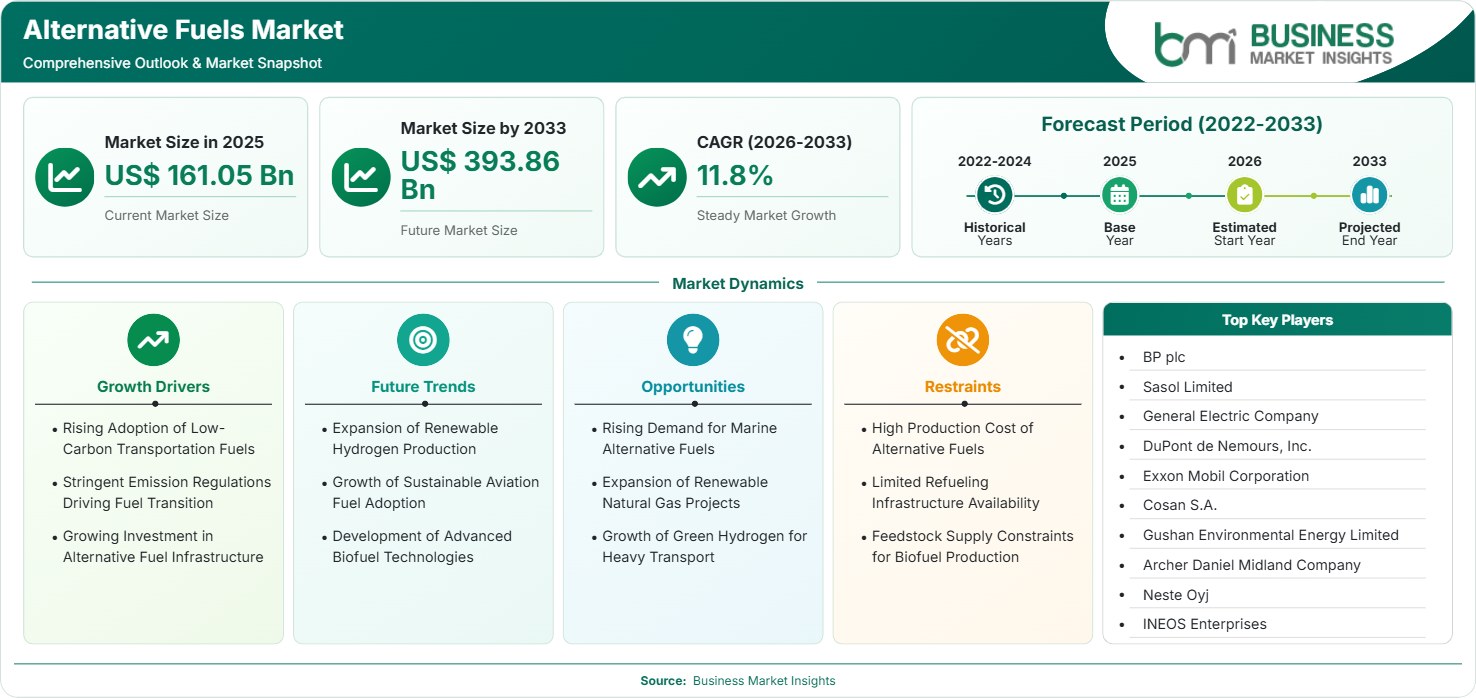
The Alternative Fuels Market size was valued at US$ 161.05 Billion in 2025 and is projected to reach US$ 393.86 Billion by 2033, growing at a CAGR of 11.8% during 2026–2033. Growth is driven by increasing efforts to reduce greenhouse gas emissions, rising adoption of sustainable transportation fuels, expanding investments in renewable energy infrastructure, growing demand for low-carbon fuel alternatives, and supportive government policies promoting energy diversification.

Report Coverage
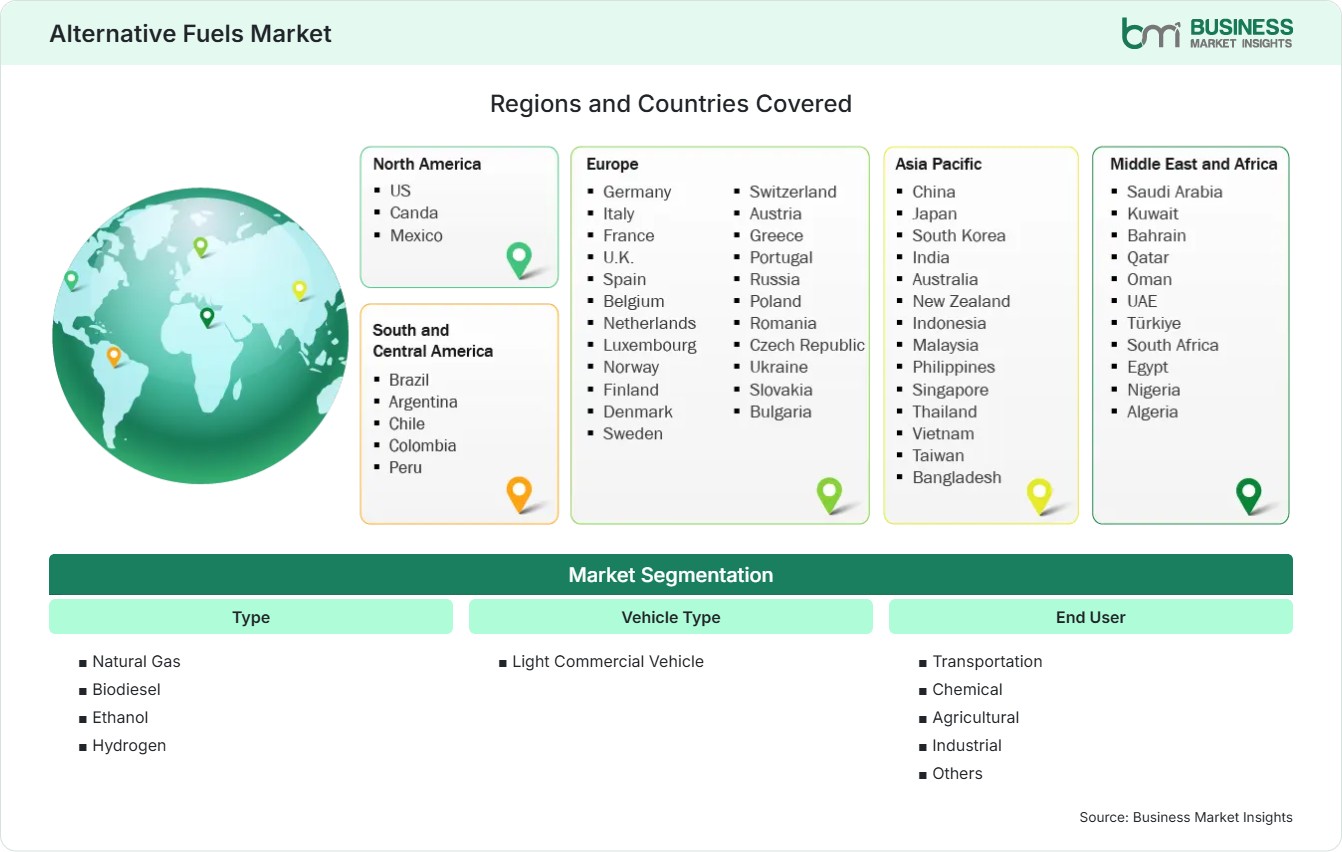
  • Type: Natural Gas, Biodiesel, Ethanol, Hydrogen
  • Vehicle Type: Light Commercial Vehicle
  • End User: Transportation, Chemical, Agricultural, Industrial, Others
US$ 161.05 Bn Market size in 2025
US$ 393.86 Bn Market Size by 2033
11.8% CAGR, 2026 - 2033
2026-2033 Forecast Period

01 AI Overview

Alternative Fuels Market Summary

  • North America Region: North America holds a market share of 30%–33% in 2025, growing at a CAGR of 11.0%–11.6% during 2026–2033. Demand is supported by expanding biofuel production, increasing natural gas vehicle adoption, and investments in clean energy infrastructure. The U.S. remains the dominant market, advancing at a CAGR of 11.2%–11.8%.
  • Fastest Growing Region: Asia Pacific accounts for 34%–37% of revenue in 2025 and is projected to register a CAGR of 12.6%–13.3% through 2033. Rising industrialization, growing energy consumption, and government initiatives supporting cleaner fuel adoption continue to support market development.
  • Leading Segment: Natural Gas holds a market share of 42%–46% in 2025 and is expected to grow at a CAGR of 11.3%–11.9%. Demand is driven by lower emissions compared with conventional fuels and growing adoption in transportation and industrial applications.
  • High Growth Segment: Hydrogen accounts for 16%–20% of market revenue in 2025 and is projected to register a CAGR of 14.0%–14.8% during the forecast period. Increasing investments in hydrogen infrastructure and low-carbon energy systems continue supporting expansion.
  • Key Market Opportunity: Growing investments in hydrogen ecosystems, renewable fuel production, and low-emission transportation networks are creating significant opportunities for fuel producers and technology providers.
  • Major Market Players: BP plc, Sasol Limited, General Electric Company, DuPont de Nemours, Inc., Exxon Mobil Corporation, Cosan S.A., Gushan Environmental Energy Limited, Archer Daniel Midland Company, Neste Oyj, and INEOS Enterprises.
02 Strategic Insights

Alternative Fuels Market: Strategic Insights

alternative-fuels-market-market-strategic-framework
FREE PDF
Request your free sample
Request free sample
03 Stakeholder View

Key Takeaways

  • The market ecosystem includes fuel producers, feedstock suppliers, transportation companies, industrial users, energy infrastructure providers, technology developers, and government agencies supporting clean energy initiatives.
  • Natural gas remains the leading fuel category due to its relatively lower emissions profile, established distribution infrastructure, and widespread use across transportation and industrial sectors.
  • Hydrogen presents one of the most attractive long-term opportunities as investments accelerate in fuel production, storage, fueling infrastructure, and low-carbon energy systems worldwide.
  • Asia Pacific continues to provide the strongest growth potential owing to expanding industrial activity, increasing energy demand, supportive regulatory frameworks, and ongoing investments in cleaner fuel technologies.
  • Transportation remains the dominant end-use sector, although industrial, agricultural, and chemical applications are increasingly contributing to overall market expansion and diversification.
  • Product innovation is increasingly focused on advanced biofuels, renewable hydrogen, emission reduction technologies, and sustainable fuel production processes capable of supporting global decarbonization objectives while improving energy resilience.
  • Alternative fuels market trend includes rapid expansion of renewable fuels, increasing hydrogen infrastructure development, growing adoption of advanced biofuels, and rising investments in low-carbon fuel production to support global decarbonization and energy transition goals.
04 Geographic Outlook

Alternative Fuels Market Regional Highlights

North America Alternative Fuels Market

North America accounted for 30%–33% of global revenue in 2025 and is projected to expand at a CAGR of 11.0%–11.6% through 2033. Growth is supported by increasing investments in renewable fuels, strong natural gas infrastructure, and expanding adoption of lower-emission transportation solutions. The Alternative Fuels Market share in the region continues benefiting from government incentives, corporate sustainability initiatives, and advancements in clean fuel technologies.

  • Transportation companies across North America are increasingly adopting alternative fuels to reduce emissions, improve fuel efficiency, and lower long-term operating costs.
  • Expanding renewable diesel and biodiesel production capacity in the United States and Canada continues supporting market growth across commercial transportation and industrial sectors.
  • Industrial and fleet operators are integrating cleaner fuel alternatives to meet corporate sustainability targets and comply with evolving environmental regulations.
  • Investments in hydrogen production facilities, distribution networks, and fueling infrastructure are increasing steadily across key transportation corridors.
  • Strong federal and state/provincial regulatory support, including emissions reduction programs and clean fuel incentives, continues encouraging fuel diversification strategies throughout North America.
  • Growing adoption of low-carbon fuels in freight, public transit, aviation, and marine transportation is further strengthening long-term market expansion.

US Alternative Fuels Market

The United States represented 25%–28% of global revenue in 2025 and is anticipated to register a CAGR of 11.2%–11.8% during the forecast period. Demand is driven by expanding renewable fuel production, increasing alternative fuel vehicle adoption, and growing investments in hydrogen and biofuel infrastructure. Continued policy support and private-sector investment support Alternative Fuels Market growth.

  • U.S. renewable fuel producers continue expanding production capacity to meet growing demand for low-carbon transportation and industrial fuels.
  • Natural gas remains widely utilized across transportation, power generation, and industrial sectors due to its cost efficiency and relatively lower emissions.
  • Hydrogen production, storage, and fueling infrastructure projects are attracting significant public and private investment across the United States.
  • Corporate sustainability commitments and federal clean energy initiatives are accelerating the adoption of lower-carbon fuel solutions.
  • Increasing production of renewable diesel, sustainable aviation fuel (SAF), and biodiesel is strengthening the country's alternative fuels ecosystem.
  • Supportive government incentives, emissions reduction policies, and advancements in clean fuel technologies continue driving growth in the U.S. market.

Europe Alternative Fuels Market

Europe held 27%–30% of global revenue in 2025 and is projected to grow at a CAGR of 11.4%–12.0% through 2033. The alternative fuels market forecast suggests that carbon reduction targets, renewable energy initiatives, and transport decarbonization programs continue supporting market expansion. Germany remains the leading market with a CAGR of 11.5%–12.1%, while the Netherlands is the fastest-growing country, expanding at a CAGR of 12.1%–12.7%.

  • Renewable fuel adoption continues increasing across transportation and industrial segments.
  • Hydrogen infrastructure development remains a major area of investment.
  • Germany maintains leadership through strong industrial demand and energy transition policies.
  • The Netherlands is witnessing accelerated growth due to renewable fuel production and logistics investments.
  • Decarbonization strategies continue supporting long-term fuel diversification.

Asia Pacific Alternative Fuels Market

Asia Pacific accounted for 34%–37% of global revenue in 2025 and is expected to remain the fastest-growing region, registering a CAGR of 12.6%–13.3% through 2033. Rising energy demand, increasing industrialization, and government support for cleaner fuels continue driving market growth. China remains the largest regional market with a CAGR of 12.4%–13.1%, while India records the highest growth at 13.1%–13.8%.

  • Rapid economic growth continues to increase demand for diversified energy sources.
  • China benefits from large-scale investments in hydrogen, ethanol, and natural gas infrastructure.
  • India is witnessing growing adoption of biofuels and alternative transportation fuels.
  • Industrial decarbonization programs continue supporting fuel consumption growth.
  • Energy security initiatives are encouraging wider adoption of renewable fuel solutions.

Rest of World Alternative Fuels Market

The Rest of World region accounted for 8%–11% of global revenue in 2025 and is expected to register a CAGR of 11.1%–11.7% through 2033. Market growth is supported by increasing fuel diversification efforts, expanding renewable energy investments, and rising demand for cleaner industrial fuels. Demand remains particularly strong in transportation and industrial applications.

Brazil is the leading market in South & Central America and is forecast to grow at a CAGR of 11.4%–12.0%. In the Middle East & Africa, Saudi Arabia is expected to be the fastest-growing country with a CAGR of 11.6%–12.2%.

  • Brazil continues benefiting from its established biofuel industry and ethanol production capacity.
  • Saudi Arabia is increasing investments in hydrogen and low-carbon fuel initiatives.
  • Industrial modernization programs continue supporting alternative fuel adoption.
  • Governments are increasingly promoting sustainable fuel utilization across key sectors.
  • Energy transition initiatives are creating long-term growth opportunities across emerging economies.
global-market-geography
FREE PDF
Request your free sample
Request free sample
05 Segment Analysis

Alternative Fuels Market Segmentation

Type

Fuel type continues to play a crucial role in shaping market demand as industries and transportation operators increasingly transition toward lower-carbon energy sources. Natural Gas leads the segment with 42%–46% share in 2025 and is projected to grow at a CAGR of 11.3%–11.9% through 2033. The Alternative Fuels Market scope continues expanding as governments and businesses prioritize fuel diversification and emission reduction strategies across transportation, industrial, and commercial applications.

  • Natural Gas: Dominates demand due to established infrastructure, lower emissions compared to conventional fuels, and widespread use across transportation and industrial operations.
  • Biodiesel: Benefits from increasing renewable fuel mandates and growing utilization within commercial vehicle fleets.
  • Ethanol: Continues witnessing strong adoption through fuel blending programs and renewable transportation fuel initiatives.
  • Hydrogen: Emerges as the fastest-growing category due to increasing investments in green hydrogen production and clean mobility solutions.

Vehicle Type

Vehicle adoption continues influencing demand patterns across fuel categories. Commercial transportation fleets remain key consumers of alternative fuels as operators focus on emissions reduction and long-term fuel cost optimization.

  • Light Commercial Vehicle: Represents a significant application category due to increasing fleet electrification, last-mile delivery expansion, and growing adoption of natural gas, biodiesel, ethanol, and hydrogen-based fuel solutions among logistics and transportation operators.
  • Heavy Commercial Vehicle: Experiences strong growth owing to increasing decarbonization efforts in freight transportation, rising adoption of compressed natural gas (CNG), liquefied natural gas (LNG), biodiesel, renewable diesel, and hydrogen fuel technologies. Fleet operators are increasingly investing in alternative fuel-powered trucks and heavy-duty transportation solutions to comply with emission regulations, reduce operating costs, and achieve sustainability targets.

End User

End-user demand continues diversifying as alternative fuels expand beyond transportation into industrial and commercial sectors. Growing sustainability commitments are supporting increased adoption across multiple industries.

  • Transportation: Remains the dominant end-use sector driven by regulatory pressure, fleet decarbonization programs, and fuel diversification initiatives.
  • Chemical: Utilizes alternative fuels as feedstocks and energy sources to improve sustainability performance.
  • Agricultural: Benefits from biofuel adoption and growing demand for lower-emission farming operations.
  • Industrial: Increasingly adopts cleaner fuels to meet environmental targets and improve energy efficiency.
  • Others: Includes power generation, commercial operations, and specialized energy applications.
06 Market Forces

Alternative Fuels Market Dynamics

Key Market Drivers

Rising Adoption of Low-Carbon Transportation Fuels

Transportation is still among the biggest contributors to greenhouse gases, leading to increasing efforts being made towards the development of fuel alternatives that emit lower amounts of carbon. Organizations such as fleet operations, logistics firms, and transportation companies are increasingly shifting their focus towards the use of natural gas, biodiesel, ethanol, and hydrogen-based fuel alternatives. Alternative fuel technology helps organizations in meeting their sustainability targets as well as in complying with changing environmental laws and regulations. There has been increased investment in sustainable transportation technology around the globe.

Stringent Emission Regulations Driving Fuel Transition

Governments worldwide are implementing increasingly stringent emission regulations aimed at reducing greenhouse gas emissions and improving air quality. These regulations are encouraging industries and transportation operators to shift away from traditional fossil fuels toward cleaner energy alternatives. Compliance requirements are accelerating investments in renewable fuels, hydrogen technologies, and advanced biofuel production capabilities. Regulatory support, combined with carbon reduction commitments from large organizations, continues creating favorable conditions for alternative fuel adoption. The ongoing policy-driven transition toward cleaner energy sources is expected to strengthen long-term alternative fuels market expansion.

Growing Investment in Alternative Fuel Infrastructure

Significant investments are being directed toward production facilities, storage systems, transportation networks, and refueling infrastructure supporting alternative fuels. Governments, energy companies, and private investors are increasingly financing projects designed to improve fuel availability and commercial viability. Infrastructure development plays a critical role in enabling broader adoption across transportation and industrial sectors. Expanding distribution networks and technological improvements are reducing accessibility barriers while increasing consumer confidence. Continued infrastructure investments remain essential to supporting large-scale market growth throughout the forecast period.

Key Market Opportunities

Rising Demand for Marine Alternative Fuels

There is an increasing need for the maritime industry to look for more environmentally friendly fuels due to the increasing efforts by global shipping firms in reducing their environmental footprint through complying with changing environmental requirements. Some of the emerging types of fuels that can be considered include biofuels, liquefied natural gas, renewable fuels, and hydrogen-powered fuels. Many opportunities will be presented within the marine alternative fuels market due to the need for shipping companies to have more sustainable strategies and meet changing environmental requirements.

Expansion of Renewable Natural Gas Projects

Renewable natural gas projects have gained traction because organizations are looking for alternative sources of energy that can help them become more sustainable. Renewable natural gas is derived from various organic waste sources, including farm byproducts, landfills, and wastewater treatment plants. Renewable natural gas projects provide both benefits to the environment and take advantage of the pre-existing natural gas infrastructure. The government and utility companies are actively encouraging the growth of such projects through incentives and renewable energy programs. Increasing awareness about the concept of circular economy and waste-to-energy systems is also driving growth.

Growth of Green Hydrogen for Heavy Transport

Green hydrogen is emerging as one of the most promising solutions for decarbonizing heavy transportation applications where conventional electrification may be challenging. Industries including trucking, rail, shipping, and heavy industrial transport are exploring hydrogen-powered solutions to meet emission reduction targets. Significant investments are being directed toward hydrogen production facilities, storage technologies, and refueling infrastructure. Technological advancements are gradually improving production efficiency and supporting commercialization efforts. As governments and private stakeholders continue prioritizing hydrogen ecosystems, green hydrogen is expected to create substantial long-term opportunities across the alternative fuels value chain.

Market Restraints and Challenges

High Production Cost of Alternative Fuels

Factor: Many alternative fuels require specialized production processes, advanced technologies, dedicated feedstocks, and substantial infrastructure investments that increase overall production costs compared with conventional fuels.

Impact: Elevated production expenses can affect competitiveness and slow adoption in cost-sensitive industries. Market participants often require supportive policies, incentives, and technological improvements to improve economic viability. Cost-related challenges may delay large-scale commercialization and influence investment decisions across certain regions and applications.

Limited Refueling Infrastructure Availability

Factor: The availability of refueling and distribution infrastructure for alternative fuels remains limited in many regions, particularly for hydrogen and specialized renewable fuel categories.

Impact: Insufficient infrastructure can reduce consumer confidence, restrict vehicle adoption, and limit accessibility for industrial users. Organizations may face operational constraints when fuel availability is inconsistent or geographically limited. Addressing infrastructure gaps will remain critical for supporting widespread market adoption and long-term industry growth.

07 Company Analysis

Competitive Landscape

The market remains competitive with the presence of global energy companies, renewable fuel producers, industrial technology providers, and biofuel manufacturers. Companies are focusing on renewable fuel production, hydrogen development, sustainable feedstocks, carbon reduction initiatives, and fuel infrastructure expansion. Growing investments in decarbonization strategies continue shaping Alternative Fuels Market analysis and competitive strategies across the global energy value chain.

Company Name

Overview

Products and Services Relevant to this Market

BP plc

Global energy company investing in low-carbon and alternative fuel solutions.

Biofuels, hydrogen projects, renewable energy solutions, alternative fuels.

Sasol Limited

Integrated energy and chemicals company with synthetic and alternative fuel capabilities.

Alternative fuels, synthetic fuels, energy solutions, fuel technologies.

General Electric Company

Industrial technology provider supporting energy transition initiatives.

Energy infrastructure, hydrogen technologies, industrial energy solutions.

DuPont de Nemours, Inc.

Science and technology company serving energy and industrial markets.

Fuel processing materials, biofuel solutions, industrial technologies.

Exxon Mobil Corporation

Global energy producer investing in lower-emission fuel technologies.

Biofuels, hydrogen initiatives, alternative fuel development projects.

Cosan S.A.

Major bioenergy company with strong ethanol production capabilities.

Ethanol, renewable fuel solutions, bioenergy products.

Gushan Environmental Energy Limited

Renewable energy company focused on biodiesel and environmental solutions.

Biodiesel production, renewable fuel products, energy solutions.

Archer Daniel Midland Company

Agricultural processing company and major biofuel producer.

Ethanol, renewable fuels, bio-based energy solutions.

Neste Oyj

Global producer of renewable fuels and sustainable energy products.

Renewable diesel, sustainable aviation fuel, renewable fuel technologies.

INEOS Enterprises

Industrial manufacturing and energy-related business operator.

Alternative fuel initiatives, industrial energy solutions, fuel technologies.

08 Industry Activity

Recent Developments

July 2026

The U.S. Department of Energy announced its intent to launch the ASPECT funding opportunity, supporting innovative alternative feedstocks and chemical technologies to strengthen domestic manufacturing and expand resilient U.S. chemical supply chains.

May 2026

Volvo Trucks launched an all-new 13-liter combustion engine platform supporting renewable diesel, gas, and future hydrogen fuels, delivering improved fuel efficiency, lower emissions, and enhanced performance for heavy-duty trucks.

May 2026

Neste Oyj expanded its renewable fuel production initiatives by increasing capacity and advancing sustainable feedstock utilization to meet rising global demand for lower-carbon transportation fuels, supporting industrial decarbonization goals and strengthening its position in the renewable energy market.

February 2026

BP plc increased investments in hydrogen and renewable fuel infrastructure, focusing on production, distribution, and integrated energy projects to accelerate the energy transition, reduce carbon emissions, and support growing demand from transportation and industrial sectors.

10 Trust & Transparency

Research Methodology

The market analysis combines proprietary research with secondary data from government agencies, company disclosures, regulatory filings, industry databases and expert interviews. Market estimates are validated through data triangulation, cross-market benchmarking and analyst review.

View Full Research Methodology

11 Questions Answered

Frequently Asked Questions

What challenge has the greatest long-term impact on the industry?

High production costs remain a major challenge because advanced fuel production technologies, infrastructure requirements, and feedstock expenses can affect large-scale adoption and commercialization.

How is hydrogen influencing market growth?

Hydrogen is gaining significant attention as a low-carbon fuel solution for transportation and industrial applications, supported by increasing investments in production and infrastructure development.

Why is Asia Pacific the fastest-growing region?

The region benefits from rising energy demand, expanding industrialization, growing investments in alternative fuels, and supportive government initiatives promoting cleaner energy adoption.

Which fuel type segment leads the market?

Natural Gas leads the market due to its established infrastructure, lower emission profile compared with conventional fuels, and widespread adoption across transportation and industrial sectors.

What is driving growth in the alternative fuels market report?

Rising adoption of low-carbon transportation fuels, stringent emission regulations, growing investment in alternative fuel infrastructure, and increasing sustainability initiatives are the primary growth drivers.

Access the Full Alternative Fuels Market Report

Get segment-level forecasts, regional estimates, competitive benchmarking, company profiles and downloadable Excel datasets.

Access the full Alternative Fuels Market Report
350 pages PDF & Excel | 2026-07-31