Biomass Fuel (Wood Pellets & PKS) Market Regional Highlights
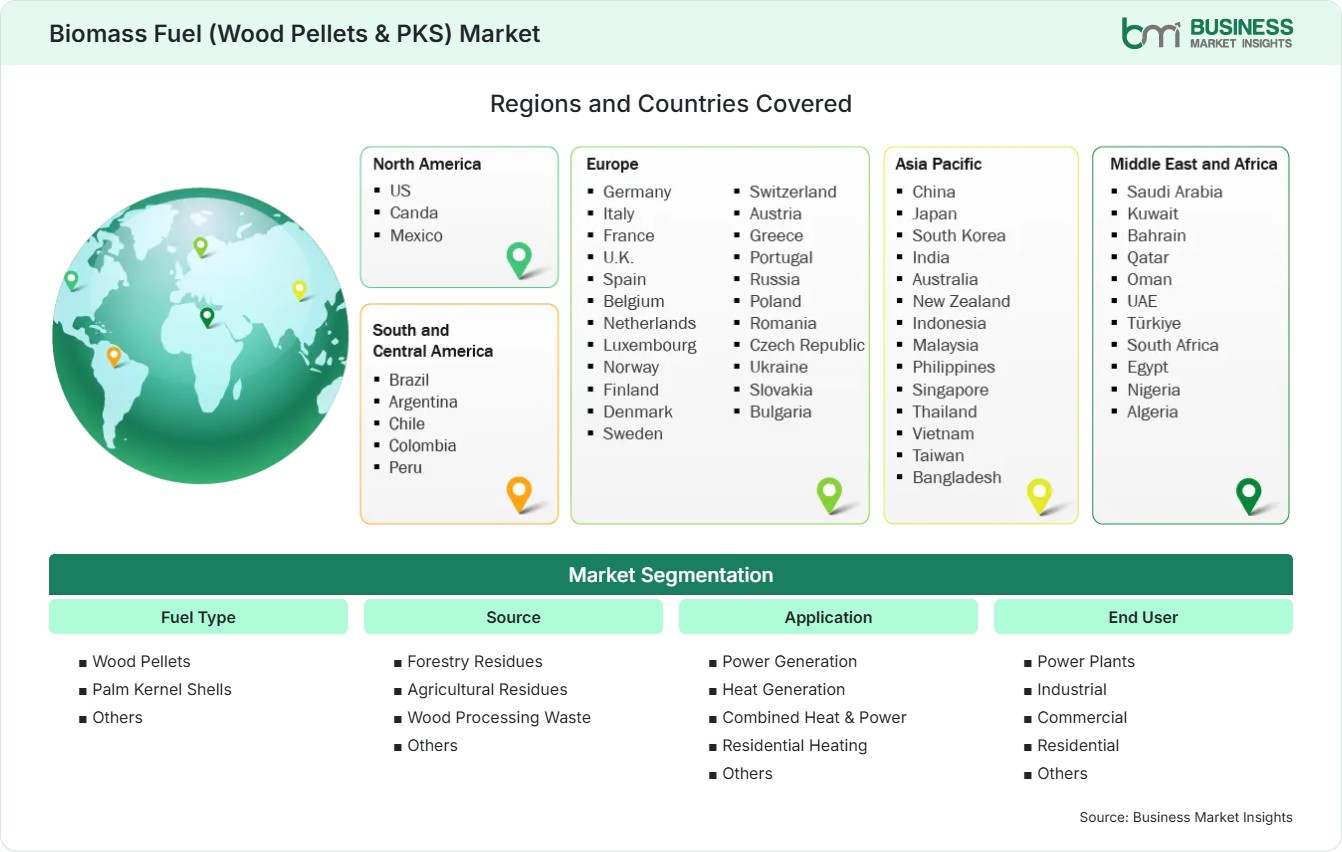
North America Biomass Fuel (Wood Pellets & PKS) Market
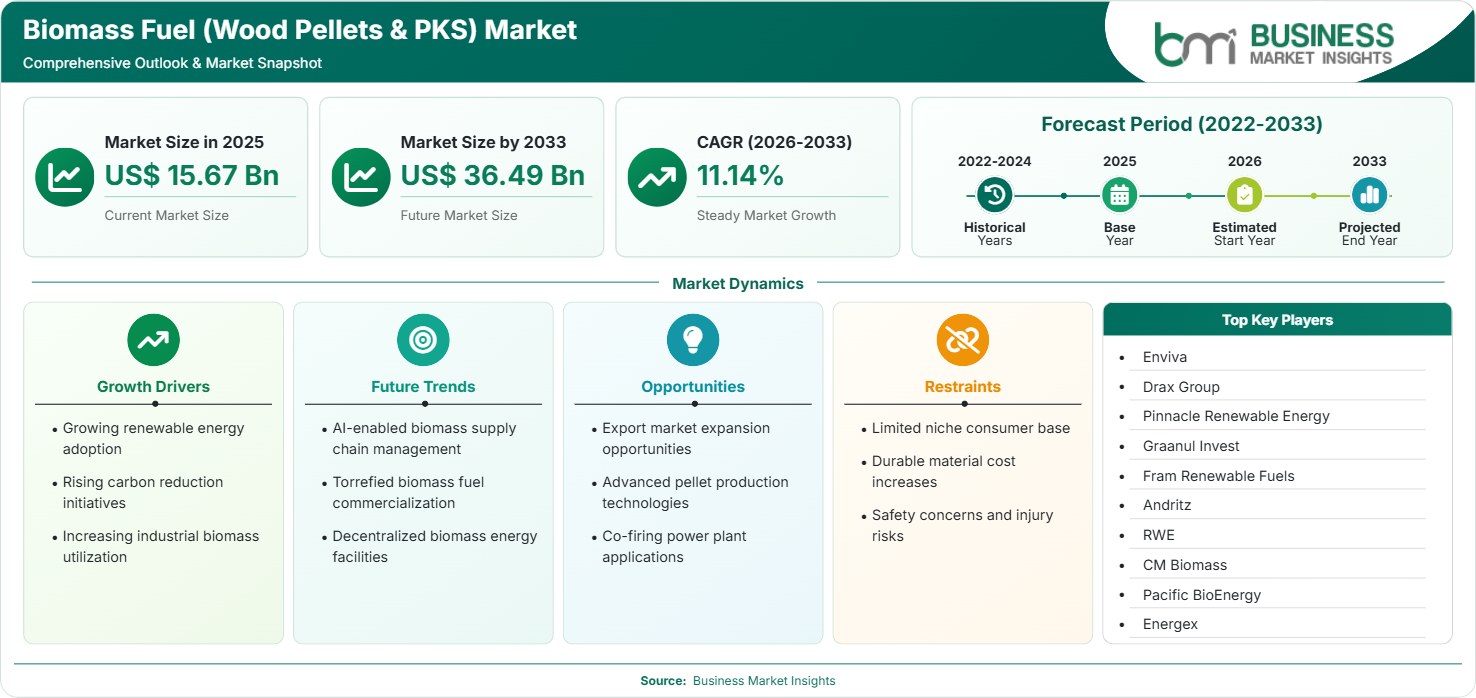
North America accounted for approximately 34%–37% of global revenue in 2025 and is projected to register a 10.5%–11.2% CAGR through 2033. The region continues to be one of the leading producers and exporters in the world due to availability of forest resources, pellet manufacturing facilities and rising international demand. The Biomass Fuel (Wood Pellets & PKS) Market share depends on growing export capability, sustainability of forests and rising renewable energy infrastructure investments in the United States and Canada.
- The United States leads regional production through extensive pellet manufacturing facilities supplying domestic utilities and international markets, particularly Europe and Asia.
- Canada continues expanding biomass production by utilizing sustainable forestry residues and increasing exports supported by modern port infrastructure and government-backed renewable energy initiatives.
- Growing investments in carbon-neutral energy projects continue strengthening demand for certified biomass fuels throughout North America.
US Biomass Fuel (Wood Pellets & PKS) Market
The United States represented approximately 26%–29% of global market revenue in 2025 and is expected to grow at a 10.7%–11.4% CAGR during the forecast period. Increasing investments in pellet manufacturing facilities, sustainable forestry management, and export-oriented production continue supporting industry expansion. The Biomass Fuel (Wood Pellets & PKS) Market growth is reinforced by rising renewable energy investments, growing industrial biomass utilization, and expanding long-term supply agreements with international utilities.
- Export demand from European utilities remains a major contributor to pellet production expansion across the southeastern United States.
- Government support for renewable energy and sustainable forestry continues strengthening domestic biomass production capacity.
- Industrial biomass utilization is increasing as manufacturers seek lower-carbon alternatives to conventional fossil fuels.
Europe Biomass Fuel (Wood Pellets & PKS) Market
Europe accounted for 32%–35% of global revenue in 2025 and is anticipated to expand at a 10.8%–11.5% CAGR during 2026–2033. The region remains one of the largest biomass fuel consumers owing to ambitious decarbonization policies, renewable heating programs, and increasing biomass co-firing in power generation. Germany leads regional consumption, while the United Kingdom demonstrates the fastest adoption through large-scale biomass power generation projects.
- Germany remains the largest biomass-consuming country, supported by industrial heating applications and renewable energy policies.
- The United Kingdom continues expanding biomass-fired electricity generation through large utility-scale conversion projects.
- Nordic countries maintain strong demand supported by district heating systems and sustainable forestry practices.
Asia Pacific Biomass Fuel (Wood Pellets & PKS) Market
Asia Pacific represented approximately 24%–27% of global market revenue in 2025 and is forecast to register the highest CAGR of 12.6%–13.3% through 2033. Strong industrialization, expanding renewable electricity generation, and increasing biomass co-firing projects continue supporting regional growth. Japan leads regional imports, while India demonstrates the fastest growth owing to expanding biomass utilization and renewable energy investments.
- Japan remains one of the world's largest importers of industrial wood pellets supporting renewable electricity generation.
- India is rapidly increasing biomass utilization through renewable energy programs and industrial decarbonization initiatives.
- South Korea continues expanding biomass co-firing projects to reduce dependence on conventional coal-fired electricity generation.
Rest of World Biomass Fuel (Wood Pellets & PKS) Market
The Rest of World region accounted for approximately 6%–9% of global revenue in 2025 and is expected to grow at a 11.1%–11.8% CAGR during the forecast period. South America and the Middle East & Africa are gradually increasing biomass utilization through renewable electricity projects and industrial heating applications. Brazil, Saudi Arabia, and South Africa remain important emerging markets with increasing investment in sustainable energy infrastructure.
- Brazil continues expanding biomass energy production through agricultural residues and forestry-based renewable fuel initiatives.
- Saudi Arabia is investing in renewable energy diversification, creating opportunities for biomass fuel adoption in industrial applications.
- South Africa is increasing biomass utilization to improve energy security and diversify electricity generation sources.