Wood Pellets Market Regional Highlights
North America Wood Pellets Market
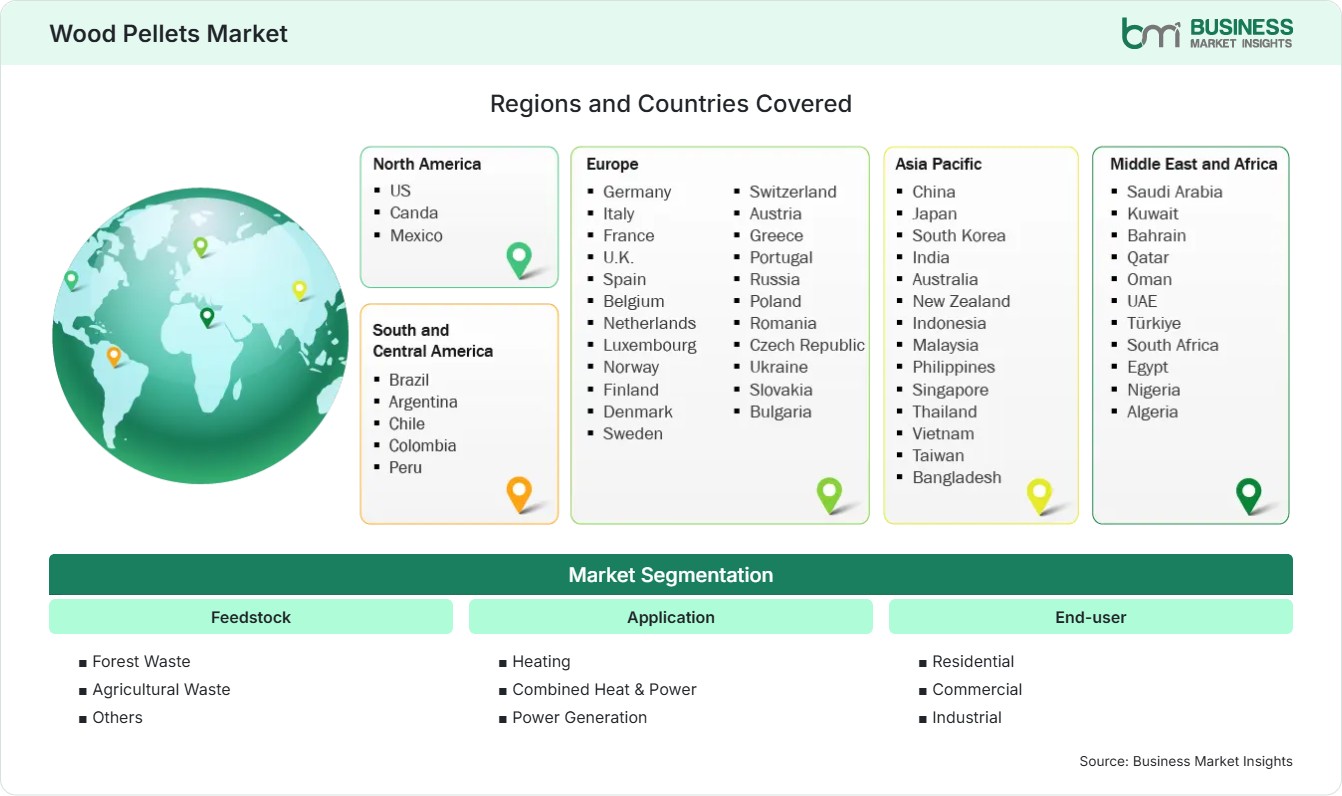
North America held a 28%–32% of global wood pellets market share in 2025 and is projected to expand at a 6.2%–6.8% CAGR during 2026–2033. The region is characterized by availability of forest resources, well developed pellet plants, export facilities, and need for heat at home. The USA retains its supremacy as a producer and consumer, whereas Canada expands its influence through western pellets and exports to Europe.
- The United States remains the regional production leader, supported by southeastern forestry resources, established deep-water terminals, domestic heating demand, and utility-scale biomass supply agreements.
- Canada offers growth potential through abundant forestry residues and proximity to Pacific and Atlantic export routes, although winter logistics and rail availability influence delivered pellet economics.
- Regional producers increasingly invest in certification, feedstock traceability, and digital monitoring as European and Asian buyers raise sustainability documentation requirements.
- Industrial consumption remains important, with EIA data showing wood and wood waste accounted for 68% of US wood-energy consumption in 2025, primarily reflecting industrial applications.
US Wood Pellets Market
The US Wood Pellets Market represented 21%–25% of global demand in 2025 and is estimated to grow at a 6.0%–6.6% CAGR through 2033. The country combines extensive southeastern timber resources with established pellet manufacturing and export infrastructure. Residential heating remains concentrated in colder regions, while industrial and power applications support larger-volume consumption. Producers are increasingly optimizing plant locations around sawmill residues, rail access, inland waterways, and ports.
- The Southeast remains the principal production corridor because of timber availability, established forestry industries, and access to Atlantic and Gulf Coast export terminals.
- Residential pellet heating remains concentrated in colder northern states, while industrial biomass demand supports larger year-round volumes and provides more stable offtake opportunities.
- US producers benefit from established export logistics, but international competitiveness remains exposed to ocean freight, currency movements, and changing European sustainability requirements.
- The EIA reported that industrial users accounted for approximately 68% of US wood and wood-waste energy consumption in 2025, reinforcing industrial demand's importance.
Europe Wood Pellets Market
Europe wood pellets market accounted for a 32%–36% share in 2025 and is projected to grow at a 5.8%–6.5% CAGR through 2033. Germany, Italy, Denmark, the United Kingdom, and the Netherlands remain important consumption centers, while the United Kingdom and Denmark maintain strong utility-scale biomass demand. Germany and Italy lead residential heating applications. Poland is a high-growth country at an estimated 7.0%–8.0% CAGR, supported by heating modernization and biomass substitution.
- Germany leads residential pellet heating demand, supported by established heating infrastructure, appliance adoption, and consumer familiarity with automated pellet boilers.
- Italy remains a major residential market, where pellet stoves and boilers support decentralized heating demand across households and commercial properties.
- The United Kingdom and Denmark maintain strong industrial and utility biomass demand, although sustainability scrutiny increasingly influences procurement decisions and long-term policy support.
- Poland represents a high-growth market, with tightening quality requirements and modernization of residential heating systems creating opportunities for certified pellet suppliers.
Asia Pacific Wood Pellets Market
Asia Pacific wood pellets market held an 18%–22% share in 2025 and is forecast to achieve an 8.0%–9.0% CAGR through 2033, making it the fastest-growing regional market. Japan and South Korea lead demand through utility-scale biomass procurement, while Vietnam, Indonesia, Malaysia, and Thailand offer production opportunities. Japan is projected to grow at 8.5%–9.5% CAGR, supported by long-term renewable power strategies.
- Japan leads regional demand for imported pellets, supported by biomass power projects, long-term procurement arrangements, and decarbonization strategies requiring dependable renewable fuel supplies.
- South Korea remains a significant buyer, although policy changes and sustainability scrutiny are influencing the structure of biomass procurement and the attractiveness of imported feedstocks.
- Vietnam and Indonesia offer production potential because forestry and agricultural residues can support pellet manufacturing, although certification and sustainable sourcing remain critical.
- Japan's high-growth outlook is supported by expanding biomass generation and long-term fuel requirements, creating opportunities for suppliers with secure international logistics.
Rest of World Wood Pellets Market
South and Central America represented approximately 7%–10% of 2025 global demand, with Brazil and Chile providing the strongest production opportunities through forestry resources and established industrial wood sectors. Brazil is projected to grow at 7.0%–8.0% CAGR as domestic biomass use expands. The region can also supply international markets, although export infrastructure remains uneven.
- Brazil benefits from large-scale forestry plantations and established wood-processing industries, creating favorable conditions for pellet production and domestic industrial biomass applications.
- Chile offers export potential through forestry residues and established port infrastructure, although domestic demand remains smaller than major North American and European markets.
- Turkey leads regional residential and industrial pellet adoption, supported by heating needs and expanding interest in renewable solid fuels.
- South Africa represents a high-growth opportunity where agricultural residues, industrial heat demand, and energy diversification could support pelletization investments.
- Middle Eastern adoption remains selective, with opportunities concentrated in district heating, industrial boilers, and renewable energy projects where alternative biomass feedstocks are economically accessible.