
Vegan Cosmetics Market Outlook: Size, Share, Trends, Growth Analysis, Competitive Landscape & Forecast, 2026-2033

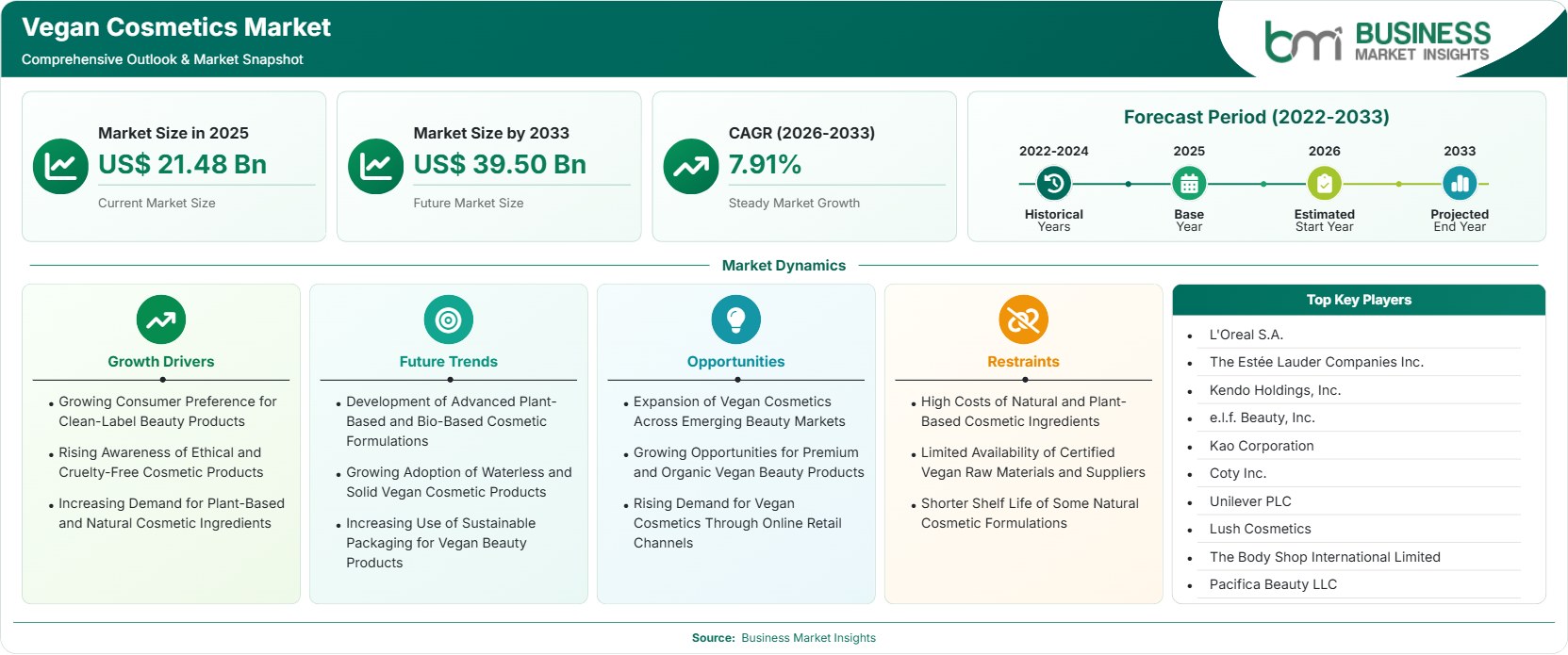
The Vegan Cosmetics Market size was valued at US$ 21.48 Billion in 2025 and is projected to reach US$ 39.50 Billion by 2033, growing at a CAGR of 7.91% during 2026–2033, driven by clean-label beauty preferences, ethical consumption, plant-based ingredients, premium product innovation, emerging-market expansion, and rapid e-commerce adoption.

Report Coverage
  • Type: Skin Care, Hair Care, Makeup, Others
  • Gender: Male, Female
  • Distribution Channel: E-commerce, Hypermarkets/Supermarkets, Departmental Stores, Specialty Stores, Others
US$ 21.48 Bn Market size in 2025
US$ 39.50 Bn Market Size by 2033
7.91% CAGR, 2026 - 2033
2026-2033 Forecast Period

AI Overview

Vegan Cosmetics Market Summary

  • North America Region: North America held a 29%–33% share in 2025 and is projected to grow at a 7.2%–8.2% CAGR during 2026–2033, supported by strong consumer awareness of cruelty-free products, clean-label formulations, premium beauty spending, ingredient transparency, and expanding digital beauty retail. The US market is projected to grow at a 7.3%–8.3% CAGR, supported by ethical consumption, influencer-led discovery, premium skincare, and direct-to-consumer brands.
  • Fastest Growing Region: Asia Pacific represented a 23%–27% share in 2025 and is projected to expand at a 9.0%–10.5% CAGR through 2033, driven by rising disposable incomes, beauty-conscious younger consumers, social-commerce penetration, expanding premium skincare demand, and growing awareness of plant-based formulations.
  • Leading Segment: Skin Care represented a 42%–46% share in 2025 and is projected to grow at a 8.0%–9.0% CAGR through 2033, supported by increasing ingredient awareness, daily skincare routines, demand for natural formulations, premiumization, and broad product innovation across facial and body care.
  • High Growth Segment: E-commerce represented a 25%–29% share in 2025 and is projected to grow at a 10.0%–11.5% CAGR through 2033, driven by digital discovery, social commerce, direct-to-consumer brands, broader product availability, subscription models, and personalized online recommendations.
  • Key Market Opportunity: Online-first distribution, premium plant-based formulations, emerging beauty markets, transparent ingredient sourcing, and certified vegan positioning create opportunities for brands combining ethical credentials with measurable product performance.
  • Major Market Players: L'Oréal S.A., The Estée Lauder Companies Inc., Kendo Holdings, Inc., e.l.f. Beauty, Inc., Kao Corporation, Coty Inc., Unilever PLC, Lush Cosmetics, The Body Shop International Limited, and Pacifica Beauty LLC.
Strategic Insights

Vegan Cosmetics Market: Strategic Insights

Vegan Cosmetics Market Strategic Framework
FREE PDF
Request your free sample
Request free sample
Stakeholder View

Key Takeaways

  • The value chain increasingly connects plant-based ingredient suppliers, specialty formulators, certification organizations, contract manufacturers, packaging providers, beauty brands, retailers, and digital marketplaces, making supply transparency strategically important.
  • Skin care remains the strongest product opportunity because consumers increasingly build multi-step routines and seek plant-derived alternatives for moisturizers, cleansers, serums, masks, and body-care products.
  • Product innovation is shifting toward biotechnology-derived ingredients, plant-based actives, waterless formulations, microbiome-focused products, multifunctional cosmetics, and packaging solutions that reinforce sustainability positioning.
  • Asia Pacific offers the strongest regional expansion opportunity as younger consumers, rising incomes, social commerce, and beauty-conscious populations accelerate adoption of premium and ethically positioned cosmetics.
  • Competitive activity is increasingly centered on portfolio expansion, strategic acquisitions, celebrity and influencer partnerships, digital-first launches, and collaborations designed to reach younger consumers and strengthen brand differentiation.
  • Brands that combine credible vegan certification, transparent sourcing, clinically supported performance, premium sensory experiences, and convenient digital purchasing can achieve stronger consumer trust and defend pricing power.
Geographic Outlook

Vegan Cosmetics Market Regional Highlights

North America Vegan Cosmetics Market

North America accounted for a 29%–33% share in 2025 and North America vegan cosmetics market forecast to grow at a 7.2%–8.2% CAGR through 2033. The region benefits from high consumer awareness of clean beauty, cruelty-free products, ingredient transparency, and ethical sourcing. The US represents the dominant regional market, supported by strong premium beauty expenditure, direct-to-consumer brands, influencer marketing, and sophisticated e-commerce infrastructure. Canada also contributes through growing demand for natural and environmentally responsible beauty products.

  • Consumers increasingly scrutinize ingredient lists, certifications, sourcing practices, and animal-testing policies, encouraging brands to communicate product provenance and ethical credentials more transparently.
  • Direct-to-consumer beauty companies are expanding vegan product portfolios through social media, personalized recommendations, subscription models, and community-driven marketing strategies that strengthen consumer engagement.
  • Premium skincare continues gaining traction as consumers prioritize perceived efficacy, sophisticated formulations, and sustainable positioning alongside vegan and cruelty-free product attributes.

US Vegan Cosmetics Market

The US vegan cosmetics market represented approximately 88%–92% of North American demand in 2025 and is projected to grow at a 7.3%–8.3% CAGR through 2033. The market benefits from high beauty expenditure, strong digital retail penetration, influencer marketing, and widespread consumer awareness of clean-label and cruelty-free products.

  • Premium consumers are increasingly willing to pay for products combining vegan formulations, recognizable certifications, ingredient transparency, clinical claims, and sustainable packaging.
  • E-commerce provides smaller brands with national market access while enabling direct customer relationships, first-party data collection, subscription programs, and personalized product recommendations.
  • Established beauty companies are expanding vegan ranges to respond to changing consumer preferences and compete with digitally native brands specializing in ethical beauty positioning.

Europe Vegan Cosmetics Market

Europe vegan cosmetics market held a 27%–31% share in 2025 and is projected to grow at a 6.8%–7.8% CAGR through 2033. Germany, the United Kingdom, France, Italy, and Spain represent leading markets, while the United Kingdom is projected to grow at a 7.5%–8.5% CAGR.. Regulatory scrutiny of cosmetic claims also encourages greater emphasis on substantiated product positioning.

  • Germany represents a leading market due to strong consumer interest in natural cosmetics, sustainability, ingredient transparency, and environmentally responsible product development.
  • The United Kingdom benefits from established ethical beauty communities, specialty retailers, premium skincare demand, and strong online purchasing behavior across younger consumer groups.
  • France and Italy provide opportunities through established cosmetics industries, premium beauty consumption, product innovation, and increasing interest in plant-based formulations.
  • European consumers increasingly expect brands to demonstrate credible sustainability practices, encouraging greater transparency around sourcing, manufacturing, packaging, and product claims.

Asia Pacific Vegan Cosmetics Market

Asia Pacific represented a 23%–27% global vegan cosmetics market share in 2025 and is projected to achieve a 9.0%–10.5% CAGR through 2033, making it the fastest-growing region. China, Japan, South Korea, India, and Australia represent major markets, while India is projected to grow at a 10.0%–11.5% CAGR. Rising incomes, expanding beauty routines, social commerce, younger consumers, and growing interest in natural ingredients are supporting market expansion.

  • China represents a major opportunity as digitally engaged consumers increasingly discover beauty products through social commerce, livestreaming, influencers, and online marketplaces.
  • India offers strong growth potential due to expanding disposable incomes, increasing beauty awareness, e-commerce penetration, and rising consumer interest in natural and ethical personal care.
  • South Korea and Japan benefit from sophisticated skincare cultures, advanced formulation capabilities, and strong consumer interest in ingredient-focused products and innovative beauty concepts.
  • Australia provides opportunities through high consumer awareness of natural ingredients, sustainability, ethical sourcing, and premium beauty products distributed through specialty and online channels.

Rest of World Vegan Cosmetics Market

South and Central America vegan cosmetics market accounted for a 9%–11% share in 2025 and is projected to grow at a 7.5%–9.0% CAGR through 2033. Brazil and Mexico represent leading markets, supported by strong beauty cultures, expanding middle-class populations, natural ingredient availability, and growing e-commerce penetration. The Middle East and Africa represented a 7%–9% share in 2025 and is projected to grow at a 7.0%–8.5% CAGR through 2033.

  • Brazil provides strong opportunities because of its established cosmetics industry, large consumer base, rich botanical resources, and increasing interest in natural and sustainable beauty products.
  • Mexico is benefiting from expanding modern retail, e-commerce adoption, premium beauty consumption, and growing awareness of clean-label and cruelty-free cosmetic positioning.
  • The UAE and Saudi Arabia offer attractive premium beauty opportunities as affluent consumers increasingly seek sophisticated formulations, international brands, and products aligned with ethical consumption preferences.
  • South Africa represents a developing opportunity supported by natural beauty trends, expanding online retail, specialty stores, and consumer interest in plant-derived cosmetic ingredients.
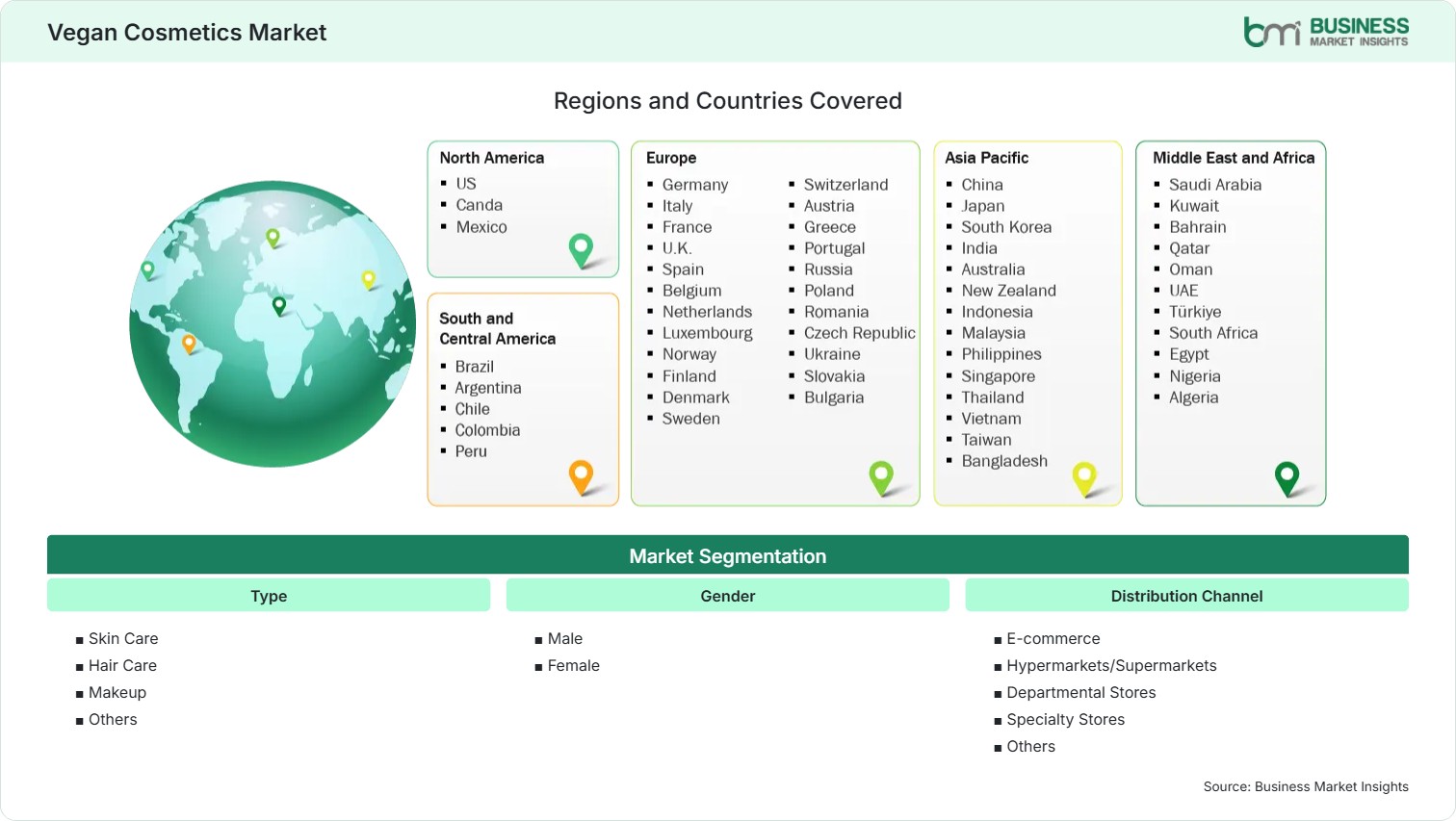
Global Market Geography
FREE PDF
Request your free sample
Request free sample
Segment Analysis

Vegan Cosmetics Market Segmentation

Type

Skin Care represented a 42%–46% share in 2025 and is projected to grow at a 8.0%–9.0% CAGR during 2026–2033. Consumers increasingly prioritize ingredient transparency, daily skincare routines, natural actives, and preventive beauty.

  • Skin Care: Vegan skincare benefits from daily routine adoption, ingredient-conscious consumers, plant-derived actives, premium formulations, and growing demand for moisturizers, cleansers, serums, masks, and body-care products.
  • Hair Care: Vegan hair care is expanding through shampoos, conditioners, treatments, and styling products formulated with botanical ingredients, responding to demand for ethical, clean-label, and silicone-free alternatives.
  • Makeup: Vegan makeup adoption is supported by expanding shade ranges, improved formulation performance, influencer marketing, and consumer interest in cruelty-free products across complexion, eye, lip, and color cosmetics.

Gender

Female consumers represented a 68%–72% share in 2025 and are projected to drive a 7.5%–8.5% CAGR during 2026–2033. Male consumers represent an expanding opportunity as grooming, skincare awareness, ingredient transparency, and gender-neutral product positioning encourage broader adoption of vegan cosmetics.

  • Male: Male adoption is increasing as skincare and grooming routines become more mainstream, with vegan cleansers, moisturizers, hair products, and grooming formulations gaining greater visibility.
  • Female: Female consumers remain the dominant customer base due to broader product usage across skincare, makeup, hair care, and specialized beauty routines, supporting continued category expansion.

Distribution Channel

E-commerce represented a 25%–29% share in 2025 and is projected to grow at a 10.0%–11.5% CAGR during 2026–2033. Specialty stores remain important for product education, while supermarkets and department stores expand mainstream accessibility.

  • E-commerce: Online retail enables direct brand engagement, broad product discovery, influencer-led purchasing, subscription models, reviews, and access to niche vegan products unavailable through traditional retail.
  • Hypermarkets/Supermarkets: Large-format retailers expand mainstream accessibility by offering vegan cosmetics alongside conventional beauty products, supporting consumer trial through competitive pricing and convenient shopping.
  • Departmental Stores: Department stores provide premium brand visibility, product demonstrations, beauty consultations, and curated assortments that support higher-value vegan cosmetics and established international brands.
  • Specialty Stores: Specialty beauty stores attract ingredient-conscious consumers through expert guidance, curated vegan assortments, certification information, and differentiated natural and ethical beauty experiences.
Market Forces

Vegan Cosmetics Market Dynamics

Key Market Drivers

Growing Consumer Preference for Clean-Label Beauty Products

More consumers are looking at cosmetic ingredients, sourcing, formulas, and safety when buying beauty products. Beauty companies are simplifying the stories of their ingredients, focusing on natural ingredients, lowering specific synthetic ingredients, and making their packaging statements more transparent. This vegan cosmetics market trend holds especially true for younger consumers, who look up their beauty products through social media platforms, product reviews, creators, and websites before buying them. With consumers relating clean beauty to wellness lifestyles, vegan beauty products are becoming increasingly popular in skin care, hair care, and makeup.

Rising Awareness of Ethical and Cruelty-Free Cosmetic Products

Consumer awareness of animal welfare and ethical consumption is increasingly influencing purchasing decisions across all beauty categories, especially among younger and socially connected consumers. Increased demand for cruelty-free and vegan products is prompting beauty brands to adopt certifications, provide clear sourcing information, and implement ethical product development processes. Animal testing is now better recognized due to social media campaigns and activist organizations, which makes cruelty-free brands more noticeable to consumers. When ethical considerations begin to form part of wider consumer decisions, brands that have clearly articulated and credible claims will have a leg up on competitors.

Increasing Demand for Plant-Based and Natural Cosmetic Ingredients

There has been growing consumer interest in botanical extracts, natural actives, and plant oils as well as recognizable sources for these ingredients. Beauty brands are conducting more research into using natural plant sources and formulating products with natural ingredients alongside cosmetic science. The demand for plant-based products is also pushing ingredient suppliers to develop better extraction methods and improve the performance of these ingredients. Companies that can show both ingredient authenticity and efficacy can win the attention of consumers without giving the impression that natural/vegan products will reduce product performance.

Key Market Opportunities

Expansion of Vegan Cosmetics Across Emerging Beauty Markets

The emerging markets in the beauty industry are a great opportunity for companies due to increasing disposable income, urbanization, e-commerce adoption, and awareness of the global beauty trend. E-commerce provides an opportunity for both global and digital-only beauty companies to reach these markets without depending on the traditional physical distribution channels. Companies that partner locally, adjust their pricing, and provide certification details will earn the consumer’s trust and win the market.

Growing Opportunities for Premium and Organic Vegan Beauty Products

Premiumization provides an opportunity for brands that manufacture vegan cosmetics because such products are not only ethically justified but clinically proven effective, featuring innovative textures and delivery systems and excellent packaging. Modern consumers are increasingly expecting natural and plant-based products to match the performance of other products. It means that more attention will be paid to innovations in biotechnologically derived active ingredients, plant-derived active ingredients, microbiome-friendly products, and multifunctional products.

Rising Demand for Vegan Cosmetics Through Online Retail Channels

The digital commerce for cosmetics is helping vegan cosmetics gain more customers through comparison of ingredients, certifications, reviews, and company values before making a purchase. Digital native brands may utilize social media, influencer collaborations, live streaming, and personalized recommendations to target their audience more effectively. The subscription and replenishment models are especially suitable for regularly needed skin care and hair care products. Those companies that integrate storytelling with dependable logistics and information about the products have a chance to attract consumers looking for convenience and vegan cosmetics at the same time.

Market Restraints and Challenges

High Costs of Natural and Plant-Based Cosmetic Ingredients

Factor: Some natural or plant-based components will require specialized cultivation, extraction, purification, and processing techniques, and supply may be seasonally influenced by cultivation and harvesting practices. Impact: Increased input costs can lead to higher formula and product costs, affecting affordability for price-conscious consumers and placing margin pressure on brands. High-end vegan brands will have to bear some of those costs to remain competitive, whereas mass-market brands will find it harder to scale up plant-based formulas.

Limited Availability of Certified Vegan Raw Materials and Suppliers

Factor: The supply chain for certified vegan raw materials can be smaller than that of conventional materials, with a need for supplier validation, traceability, contamination control, and proof of certification. Impact: Availability constraints can result in a more complicated procurement process, delayed product development, and limited formulation options for companies needing to maintain consistency in their vegan status. For small companies, the task of sourcing sufficient certified ingredients can be even more difficult, especially during product expansion into other market.

Company Analysis

Competitive Landscape

The Vegan Cosmetics Market analysis reflects competition between multinational beauty companies, premium cosmetics groups, specialist vegan brands, and digitally native businesses. Market participants are differentiating through clean-label formulations, ethical certifications, ingredient transparency, product efficacy, influencer partnerships, and omnichannel distribution.

Company Name

Overview

Products and Services relevant to this market

L'Oréal S.A.

Global beauty company with extensive operations across skincare, hair care, makeup, and professional beauty categories.

Vegan and plant-based beauty formulations, skincare, makeup, hair care, research, product development, and global beauty distribution.

The Estée Lauder Companies Inc.

Global prestige beauty group with a broad portfolio spanning skincare, makeup, fragrance, and hair care.

Premium skincare, makeup, vegan-positioned formulations, product innovation, beauty research, and omnichannel distribution.

Kendo Holdings, Inc.

Beauty incubator and brand developer specializing in innovative cosmetics and prestige beauty concepts.

Makeup, skincare, brand development, product innovation, and specialized beauty portfolios with ethical and clean-positioned offerings.

e.l.f. Beauty, Inc.

Accessible beauty company focused on cosmetics, skincare, and digital-first consumer engagement across mass and prestige channels.

Makeup, skincare, vegan and cruelty-free beauty products, digital commerce, and affordable cosmetic innovation.

Kao Corporation

Japanese consumer products and cosmetics company with extensive beauty, personal care, and research capabilities.

Skincare, hair care, beauty products, formulation research, plant-derived ingredients, and sustainable product development.

Coty Inc.

Global beauty company operating across cosmetics, fragrance, and skincare with strong international brand distribution.

Color cosmetics, skincare, beauty innovation, product development, and distribution across mass and prestige channels.

Unilever PLC

Global consumer goods company with extensive personal care operations and growing sustainability-focused product portfolios.

Skincare, hair care, beauty products, plant-based formulations, ethical sourcing, and global consumer distribution.

Lush Cosmetics

Specialist beauty company known for handmade cosmetics and strong ethical positioning across personal care categories.

Vegan cosmetics, skincare, hair care, bath products, plant-based ingredients, ethical sourcing, and specialty retail.

The Body Shop International Limited

Beauty brand historically associated with ethical sourcing, natural ingredients, and cruelty-free beauty positioning.

Skincare, body care, hair care, cosmetics, natural ingredients, ethical sourcing, and specialty beauty retail.

Pacifica Beauty LLC

Beauty company focused on vegan and cruelty-free cosmetics and personal care products across accessible beauty categories.

Vegan makeup, skincare, hair care, fragrances, body care, cruelty-free formulations, and online retail.

Trust & Transparency

Research Methodology

The market analysis combines proprietary research with secondary data from government agencies, company disclosures, regulatory filings, industry databases and expert interviews. Market estimates are validated through data triangulation, cross-market benchmarking and analyst review.

View Full Research Methodology

Questions Answered

Frequently Asked Questions

How are established beauty companies responding to vegan beauty demand?

Established companies are expanding plant-based product ranges, investing in sustainable formulations, strengthening ingredient transparency, developing ethical product lines, and using digital channels to reach younger consumers.

What challenges affect vegan cosmetics manufacturers?

Manufacturers face higher costs for certain plant-based ingredients, limited certified supplier availability, sourcing complexity, formulation challenges, and the need to substantiate vegan and ethical product claims.

Why is e-commerce important for vegan beauty brands?

E-commerce enables consumers to compare certifications, ingredients, reviews, and brand values while giving niche and digitally native brands broader access to domestic and international customers.

Which product category offers the strongest opportunity in vegan cosmetics market report?

Skincare offers the strongest opportunity because consumers increasingly follow multi-step routines and seek plant-derived ingredients, premium formulations, natural actives, and products aligned with clean beauty preferences.

What is driving demand for vegan cosmetics?

Demand is being driven by clean-label preferences, ethical consumption, cruelty-free awareness, plant-based ingredient interest, and increasing consumer attention to ingredient transparency and sustainability.

Access the Full Vegan Cosmetics Market Report

Get segment-level forecasts, regional estimates, competitive benchmarking, company profiles and downloadable Excel datasets.

Access the full Vegan Cosmetics Market Report
350 pages PDF & Excel | 2026-08-06
Similar Research

Related Market Reports