
Upcycled Cosmetic Ingredients Market Outlook: Size, Share, Trends, Growth Analysis, Competitive Landscape & Forecast, 2026-2033

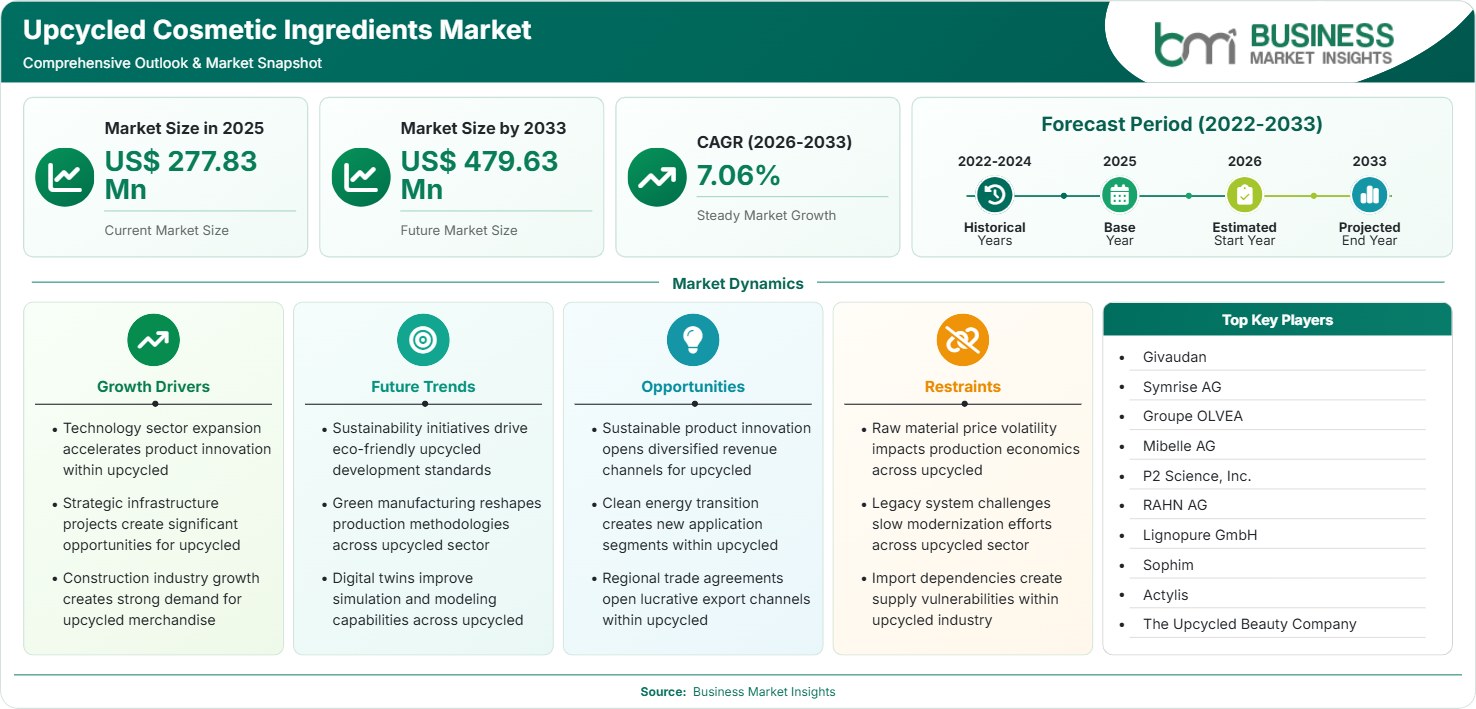
The Upcycled Cosmetic Ingredients Market size was valued at US$ 277.83 Million in 2025 and is projected to reach US$ 479.63 Million by 2033, growing at a CAGR of 7.06% during 2026–2033. Increasing consumer preference for sustainable beauty products, circular economy adoption, waste reduction initiatives, clean beauty innovation, and demand for traceable cosmetic formulations are driving market expansion.

Report Coverage
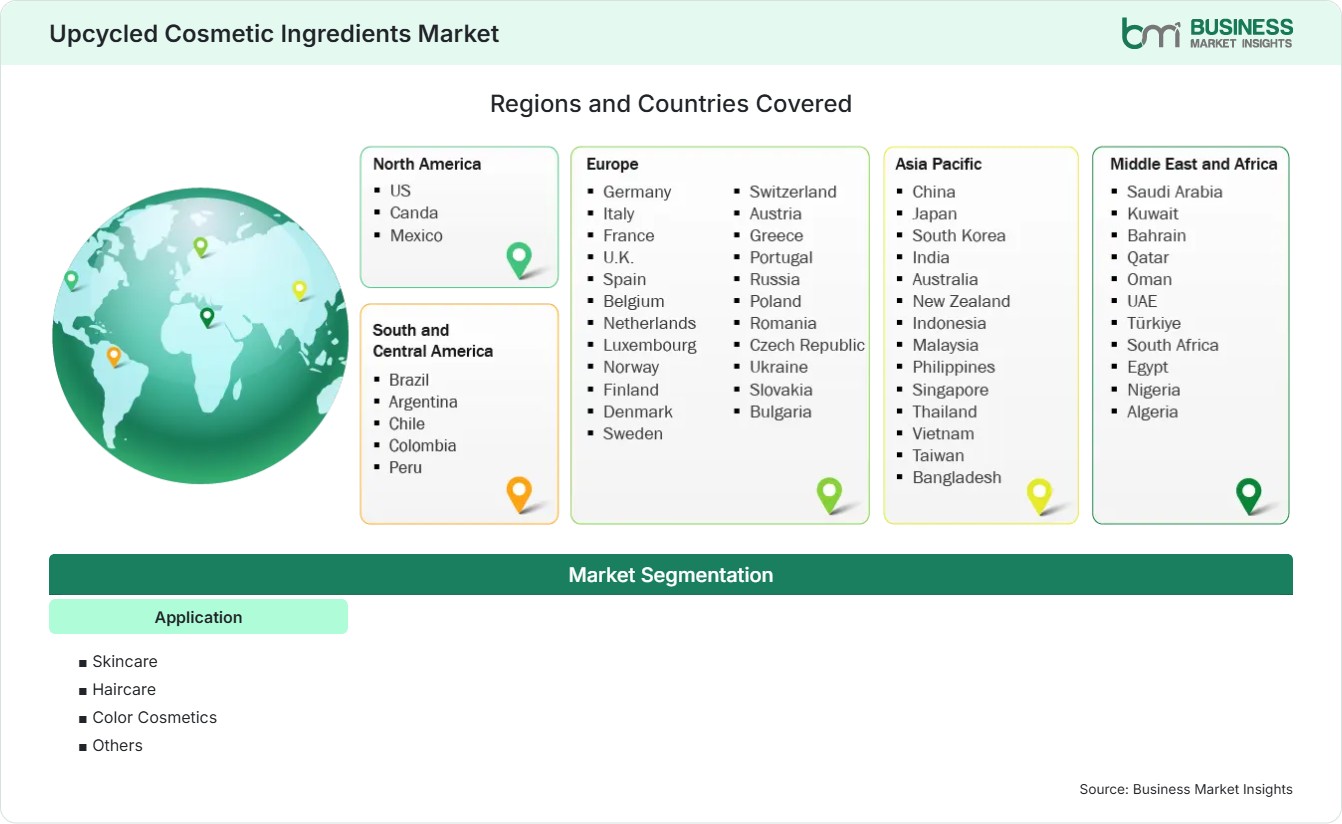
  • Application: Skincare, Haircare, Color Cosmetics, Others
US$ 277.83 Mn Market size in 2025
US$ 479.63 Mn Market Size by 2033
7.06% CAGR, 2026 - 2033
2026-2033 Forecast Period

01 AI Overview

Upcycled Cosmetic Ingredients Market Summary

  • North America Region: North America accounted for 30%–33% share in 2025 and is projected to grow at a CAGR of 7.2%–7.8% during 2026–2033. The region benefits from strong clean beauty demand, advanced cosmetic innovation, sustainability-focused brands, and increasing investment in bio-based ingredient development. The U.S. represents the largest regional contributor, supported by premium skincare adoption, sustainable product launches, and ingredient innovation, achieving a CAGR of 7.3%–7.9% during the forecast period.
  • Fastest Growing Region: Asia Pacific represented 27%–30% share in 2025 and is expected to expand at a CAGR of 7.8%–8.4%. Rising beauty consumption, expanding personal care industries, growing environmental awareness, and increasing adoption of sustainable formulations are accelerating regional opportunities.
  • Leading Segment: Skincare applications held 45%–48% share in 2025 and are expected to grow at a CAGR of 7.4%–8.0% due to strong demand for natural active ingredients, anti-aging formulations, and environmentally responsible beauty products.
  • High Growth Segment: Haircare applications are projected to register a CAGR of 7.6%–8.2% due to increasing demand for sustainable conditioning agents, plant-derived extracts, and innovative ingredient solutions.
  • Key Market Opportunity: Opportunities are emerging through advanced biotechnology, waste-derived active ingredients, sustainable sourcing partnerships, and increasing adoption of circular beauty models across global cosmetic brands.
  • Major Market Players: Givaudan, Symrise AG, Groupe OLVEA, Mibelle AG, P2 Science, Inc., RAHN AG, Lignopure GmbH, Sophim, Actylis, The Upcycled Beauty Company, and Cargill, Incorporated.
02 Strategic Insights

Upcycled Cosmetic Ingredients Market: Strategic Insights

Upcycled Cosmetic Ingredients Market Strategic Framework
FREE PDF
Request your free sample
Request free sample
03 Stakeholder View

Key Takeaways

  • The market ecosystem includes cosmetic brands, biotechnology companies, ingredient suppliers, agricultural processors, and sustainability-focused innovators developing circular ingredient solutions.
  • Skincare and haircare applications provide strong growth potential due to rising demand for natural actives, botanical extracts, and environmentally responsible formulations.
  •  Innovation is shifting toward advanced extraction methods, fermentation technologies, biotechnology platforms, and scalable production of waste-derived cosmetic ingredients.
  • Asia Pacific offers strong investment opportunities due to expanding beauty markets, increasing sustainability awareness, and growing demand for premium personal care products.
  • Strategic collaborations between ingredient manufacturers and cosmetic brands are increasing to accelerate development of sustainable formulations and strengthen supply chain transparency.
04 Geographic Outlook

Upcycled Cosmetic Ingredients Market Regional Highlights

North America Upcycled Cosmetic Ingredients Market

North America accounted for 30%–33% share in 2025 and is projected to grow at a CAGR of 7.2%–7.8% during 2026–2033. The region maintains a strong position due to rising clean beauty adoption, advanced cosmetic research capabilities, and increasing investment in sustainable ingredient development. The United States remains the leading market, supported by premium skincare brands, consumer preference for ethical products, and growing demand for transparent sourcing. The Upcycled Cosmetic Ingredients Market share is strengthening as manufacturers introduce innovative waste-derived ingredients.

  • Cosmetic brands are increasing partnerships with ingredient suppliers to develop sustainable formulations with improved traceability.
  • Consumer demand for environmentally responsible beauty products is encouraging adoption of recycled and upcycled active ingredients.
  • Biotechnology advancements are improving extraction efficiency and enabling commercial-scale production of sustainable cosmetic ingredients.
  • Premium skincare categories are supporting demand for innovative ingredients with functional and environmental benefits.

US Upcycled Cosmetic Ingredients Market

The United States represented 82%–86% of North American demand in 2025 and is expected to grow at a CAGR of 7.3%–7.9% through 2033. The Upcycled Cosmetic Ingredients Market benefits from strong clean beauty trends, established cosmetic innovation ecosystems, and increasing sustainability commitments from major personal care companies. Brands are adopting upcycled ingredients to improve environmental performance and meet consumer expectations for responsible product development. Growing investment in biotechnology-based cosmetic solutions is supporting market expansion.

  • Beauty companies are launching sustainable product lines using plant-based and waste-derived cosmetic ingredients.
  • Research organizations are developing innovative extraction technologies to improve ingredient functionality and scalability.
  • Retailers are increasing sustainability requirements, encouraging brands to adopt transparent ingredient sourcing practices.

Europe Upcycled Cosmetic Ingredients Market

Europe accounted for 28%–31% share in 2025 and is forecast to expand at a CAGR of 6.9%–7.5% during 2026–2033. The region is a major hub for sustainable cosmetics due to strong environmental regulations, circular economy initiatives, and consumer preference for ethical beauty products. France, Germany, Switzerland, and the United Kingdom are key markets supporting innovation. The Upcycled Cosmetic Ingredients Market growth is driven by established ingredient manufacturers and increasing demand for responsible formulations.

  • France leads sustainable beauty innovation through strong cosmetic research capabilities and premium product development.
  • Germany and Switzerland are advancing biotechnology-based ingredient solutions through specialized research and manufacturing expertise.
  • European regulations promoting sustainable production are encouraging companies to improve ingredient traceability.
  • Cosmetic manufacturers are adopting circular sourcing models to reduce waste and environmental impact.

Asia Pacific Upcycled Cosmetic Ingredients Market

Asia Pacific represented 27%–30% share in 2025 and is expected to register the fastest CAGR of 7.8%–8.4% during 2026–2033. Increasing beauty product consumption, expanding personal care industries, and rising environmental awareness are supporting market growth. China, Japan, South Korea, and India are major contributors due to strong cosmetic manufacturing bases and growing consumer interest in sustainable products. The Upcycled Cosmetic Ingredients Market trends indicate increasing adoption of innovative botanical and biotechnology-derived ingredients.

  • China is expanding sustainable beauty production through increasing investment in advanced cosmetic ingredient technologies.
  • South Korea is supporting innovation through clean beauty brands and advanced skincare formulation development.
  • India provides opportunities through agricultural waste availability and growing demand for sustainable personal care products.
  • Japan continues focusing on high-quality cosmetic ingredients with improved environmental performance.

Rest of World Upcycled Cosmetic Ingredients Market

The Rest of World region accounted for 8%–11% Upcycled Cosmetic Ingredients Market share in 2025 and is projected to grow at a CAGR of 6.5%–7.1% during 2026–2033. Latin America, the Middle East, and Africa are gradually adopting sustainable beauty practices due to rising cosmetic consumption and increasing awareness of environmental responsibility. Regional producers are exploring agricultural by-products and locally available resources for ingredient development. Growing partnerships with global cosmetic companies are creating new opportunities.

  • Brazil is developing sustainable cosmetic opportunities through biodiversity resources and natural ingredient innovation.
  • Middle Eastern markets are increasing demand for premium beauty products with sustainability-focused positioning.
  • African regions provide opportunities through agricultural waste utilization and renewable ingredient sourcing.
  • International cosmetic companies are expanding sustainable product availability across emerging markets.
  • Local ingredient producers are developing partnerships to improve manufacturing capabilities and market access.
Global Market Geography
FREE PDF
Request your free sample
Request free sample
05 Segment Analysis

Upcycled Cosmetic Ingredients Market Segmentation

Application

The Application segment includes Skincare, Haircare, Color Cosmetics, and Others, representing diverse opportunities for sustainable ingredient adoption across beauty and personal care categories. Skincare held the leading position with 45%–48% share in 2025 and is projected to grow at a CAGR of 7.4%–8.0% during 2026–2033. Increasing demand for natural actives, anti-aging formulations, and environmentally responsible beauty products is driving segment expansion. The Upcycled Cosmetic Ingredients Market forecasts continues growing as brands integrate waste-derived ingredients into premium formulations.

  • Skincare: Skincare represents the largest application area due to strong consumer demand for sustainable active ingredients, botanical extracts, antioxidants, and functional ingredients supporting clean beauty product development.
  • Haircare: Haircare adoption is increasing as brands incorporate upcycled oils, plant-derived compounds, and sustainable conditioning agents to create environmentally responsible shampoos, treatments, and styling products.
  • Color Cosmetics: Color cosmetics manufacturers are exploring upcycled pigments, natural additives, and sustainable formulation approaches to meet consumer expectations for ethical and environmentally conscious beauty products.
06 Market Forces

Upcycled Cosmetic Ingredients Market Dynamics

Key Market Drivers

Growing Consumer Preference for Sustainable Beauty Products

Consumers are increasingly prioritizing environmentally responsible personal care products, creating strong demand for ingredients developed through circular and sustainable processes. Beauty customers are seeking transparency regarding sourcing, production methods, and environmental impact. The Upcycled Cosmetic Ingredients Market growth is supported by rising awareness of waste reduction, ethical consumption, and clean beauty principles. Cosmetic brands are responding by incorporating ingredients derived from agricultural residues, food by-products, and renewable resources into product formulations. This shift is encouraging ingredient suppliers to develop innovative solutions that maintain performance while improving sustainability credentials. Premium skincare and personal care categories are particularly benefiting as consumers associate responsible sourcing with product quality and brand value.

Increasing Adoption of Circular Economy Practices

The transition toward circular economy models is encouraging cosmetic manufacturers to utilize previously discarded resources as valuable raw materials. Companies are developing extraction and processing technologies that convert waste streams into functional cosmetic ingredients with commercial applications. Food industry by-products, plant residues, and natural processing waste are becoming important sources for antioxidants, oils, active compounds, and specialty ingredients. This approach helps reduce waste while creating additional value from existing resources. Ingredient suppliers are collaborating with cosmetic brands to develop traceable and sustainable supply chains. Growing corporate sustainability commitments are further accelerating adoption of upcycled ingredients across skincare, haircare, and personal care product categories.

Advancements in Biotechnology and Ingredient Processing

Technological advancements in biotechnology, extraction methods, and fermentation processes are improving the quality and scalability of Upcycled Cosmetic Ingredients Market. Manufacturers are investing in advanced techniques to isolate valuable compounds from waste materials while maintaining product safety and effectiveness. These innovations are enabling the development of high-performance ingredients suitable for premium cosmetic formulations. Improved processing capabilities are also helping suppliers achieve consistent quality and meet regulatory requirements. As cosmetic companies seek differentiated products, biotechnology-driven solutions are becoming increasingly important. The integration of scientific research with sustainability objectives is creating new opportunities for ingredient manufacturers to deliver innovative solutions with environmental benefits.

Key Market Opportunities

Expansion of Premium Clean Beauty Formulations

The growth of premium clean beauty products is creating opportunities for suppliers of Upcycled Cosmetic Ingredients Market. Consumers are increasingly willing to purchase products positioned around sustainability, ethical sourcing, and natural ingredient benefits. Cosmetic brands are using innovative ingredients as differentiation tools to strengthen product positioning and build customer loyalty. Upcycled ingredients provide opportunities to develop unique formulations with environmental narratives while maintaining functional performance. Manufacturers capable of delivering scientifically validated, traceable, and scalable ingredients can capture increasing demand from premium skincare and personal care companies. This opportunity is especially significant as global beauty brands continue expanding sustainable product portfolios across multiple regions.

Increasing Partnerships Between Brands and Ingredient Suppliers

Collaborative partnerships between cosmetic companies and ingredient manufacturers are creating opportunities for faster innovation and commercialization of sustainable ingredients. Brands are working with suppliers to identify suitable waste streams, develop extraction processes, and create application-specific ingredients. These collaborations help improve supply chain transparency and support the development of differentiated beauty products. Ingredient companies with strong research capabilities and sustainable sourcing networks are positioned to benefit from increasing industry cooperation. Partnerships are also enabling smaller innovators to access global cosmetic markets through established distribution channels. As sustainability becomes a competitive factor, collaboration across the value chain will continue shaping market development.

Utilization of Agricultural and Food Processing By-products

The availability of agricultural residues and food processing by-products creates significant opportunities for upcycled ingredient development. Materials such as fruit peels, seeds, plant fibers, and botanical residues contain valuable compounds that can be transformed into cosmetic ingredients. Companies are exploring these resources to develop antioxidants, oils, extracts, and functional additives for beauty applications. Regions with strong agricultural production provide opportunities for localized sourcing and sustainable ingredient supply chains. This approach supports waste reduction while creating additional economic value for producers. Increasing interest in natural and traceable ingredients is expected to encourage further investment in technologies that enable efficient conversion of by-products into cosmetic solutions.

Market Restraints and Challenges

Limited Awareness and Consumer Understanding of Upcycled Ingredients

Factor: Many consumers remain unfamiliar with the concept of Upcycled Cosmetic Ingredients Market and their benefits compared with conventional alternatives.

Impact: A lack of awareness makes this process slow and difficult for brands to convey the importance of sustainable ingredients. Companies have to work on educating consumers about where these ingredients come from and the benefits they offer. Consumers’ perceptions of inferiority of products due to their quality or performance could affect purchase decisions. It is essential for cosmetic companies to adopt effective ways of communication backed by science. Despite growing interest in sustainability, further awareness efforts are needed for market acceptance of upcycled beauty solutions.

High Development Costs and Supply Chain Complexity

Factor: Developing upcycled ingredients requires specialized extraction technologies, quality control processes, and reliable sourcing networks.

Impact: Research, processing, and certification costs can be higher, which will lead to higher product development costs for the suppliers of ingredients. It is important for them to have consistent supply chains in place so that their raw material sources can guarantee them consistency and quality ingredients. The variability in raw materials from waste sources can cause problems in this regard. While technological improvements are reducing barriers, development complexity remains a challenge for companies seeking large-scale commercialization of Upcycled Cosmetic Ingredients Market.

07 Company Analysis

Competitive Landscape

The competitive environment is influenced by sustainable ingredient innovation, biotechnology capabilities, sourcing networks, and partnerships with cosmetic brands. The Upcycled Cosmetic Ingredients Market analysis highlights that companies are focusing on developing traceable, high-performance, and environmentally responsible ingredients derived from renewable and waste-based resources to support evolving beauty industry requirements.

Company Name

Overview

Products and Services Relevant to this Market

Givaudan

Swiss fragrance and beauty ingredient company focused on innovative and sustainable solutions.

Upcycled active ingredients, cosmetic formulations, natural extracts, fragrance solutions, and sustainable beauty ingredients.

Symrise AG

German company providing fragrances, flavors, and cosmetic ingredient solutions globally.

Cosmetic actives, botanical ingredients, functional ingredients, and sustainable personal care solutions.

Groupe OLVEA

French supplier specializing in natural oils and sustainable ingredient sourcing.

Upcycled oils, vegetable extracts, natural cosmetic ingredients, and sustainable sourcing solutions.

Mibelle AG

Swiss biotechnology-driven company developing active ingredients for personal care applications.

Cosmetic actives, plant-based ingredients, biotechnology solutions, and sustainable formulation support.

P2 Science, Inc.

U.S.-based biotechnology company creating sustainable specialty ingredients.

Bio-based cosmetic ingredients, renewable chemistry solutions, and sustainable personal care components.

RAHN AG

Swiss specialty ingredient provider serving cosmetics and personal care industries.

Active ingredients, botanical extracts, functional cosmetic ingredients, and formulation technologies.

Lignopure GmbH

German biotechnology company developing lignin-based sustainable ingredients.

Lignin-derived cosmetic ingredients, natural antioxidants, and renewable beauty ingredient solutions.

Sophim

French company specializing in sustainable natural cosmetic ingredients.

Olive-derived ingredients, natural emollients, botanical actives, and sustainable cosmetic solutions.

Actylis

U.S.-based global manufacturer of specialty ingredients for various industries.

Cosmetic ingredients, specialty chemicals, customized ingredient solutions, and sustainable materials.

The Upcycled Beauty Company

U.K.-based company focused on transforming waste materials into beauty ingredients.

Upcycled cosmetic ingredients, sustainable formulation concepts, and circular beauty solutions.

Cargill, Incorporated

Global company providing agricultural-based ingredient solutions.

Plant-based ingredients, natural extracts, specialty cosmetic components, and sustainable sourcing solutions.

10 Trust & Transparency

Research Methodology

The market analysis combines proprietary research with secondary data from government agencies, company disclosures, regulatory filings, industry databases and expert interviews. Market estimates are validated through data triangulation, cross-market benchmarking and analyst review.

View Full Research Methodology

11 Questions Answered

Frequently Asked Questions

What challenges are highlighted in the Upcycled Cosmetic Ingredients Market?

Challenges include limited consumer awareness, complex sourcing processes, higher development costs, ingredient standardization issues, and the need for reliable supply chains.

How does biotechnology support upcycled ingredient development?

Biotechnology enables efficient extraction, fermentation, and processing methods that improve ingredient quality, scalability, consistency, and suitability for advanced cosmetic formulations.

Which application segment dominates demand for Upcycled Cosmetic Ingredients Market?

Skincare represents the leading application due to strong consumer interest in sustainable active ingredients, natural formulations, and premium environmentally responsible beauty products.

Why are brands adopting upcycled ingredients in beauty products?

Brands are adopting these ingredients to reduce waste, improve sustainability performance, meet consumer expectations, and develop innovative formulations aligned with circular economy principles.

What are upcycled cosmetic ingredients?

Upcycled cosmetic ingredients are functional beauty ingredients created by converting previously unused or discarded materials into valuable components for skincare, haircare, and personal care formulations.

Access the Full Upcycled Cosmetic Ingredients Market Report

Get segment-level forecasts, regional estimates, competitive benchmarking, company profiles and downloadable Excel datasets.

Access the full Upcycled Cosmetic Ingredients Market Report
350 pages PDF & Excel | 2026-08-17