
Eyewear Market Outlook: Size, Share, Trends, Growth Analysis, Competitive Landscape & Forecast, 2022-2033

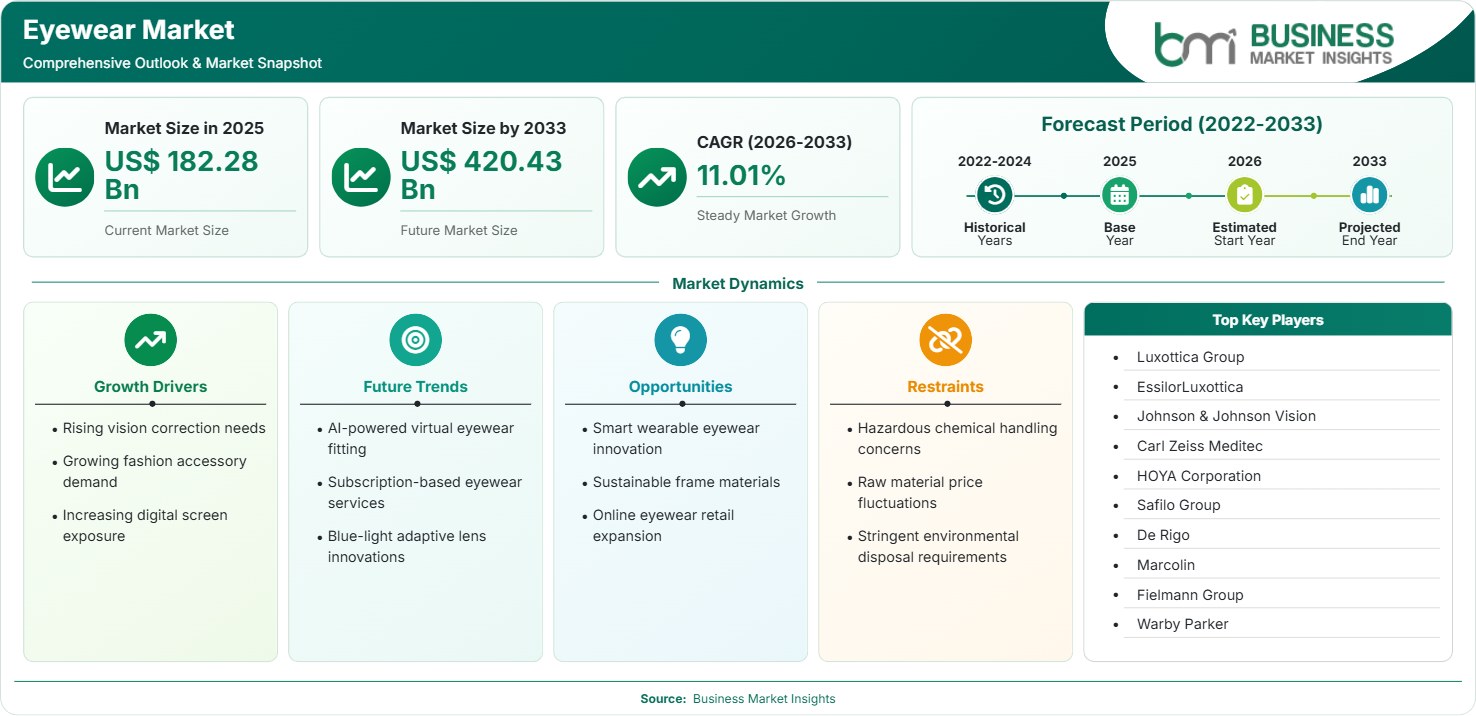
The Eyewear Market size was valued at US$ 182.28 billion in 2025 and is projected to reach US$ 420.43 billion by 2033, growing at a CAGR of 11.01% during 2026–2033. Rising vision correction needs, growing demand for fashion-oriented eyewear, and increasing digital screen exposure are driving market expansion, while smart eyewear innovation, sustainable materials, and online retail channels present strong future growth opportunities.

Report Coverage
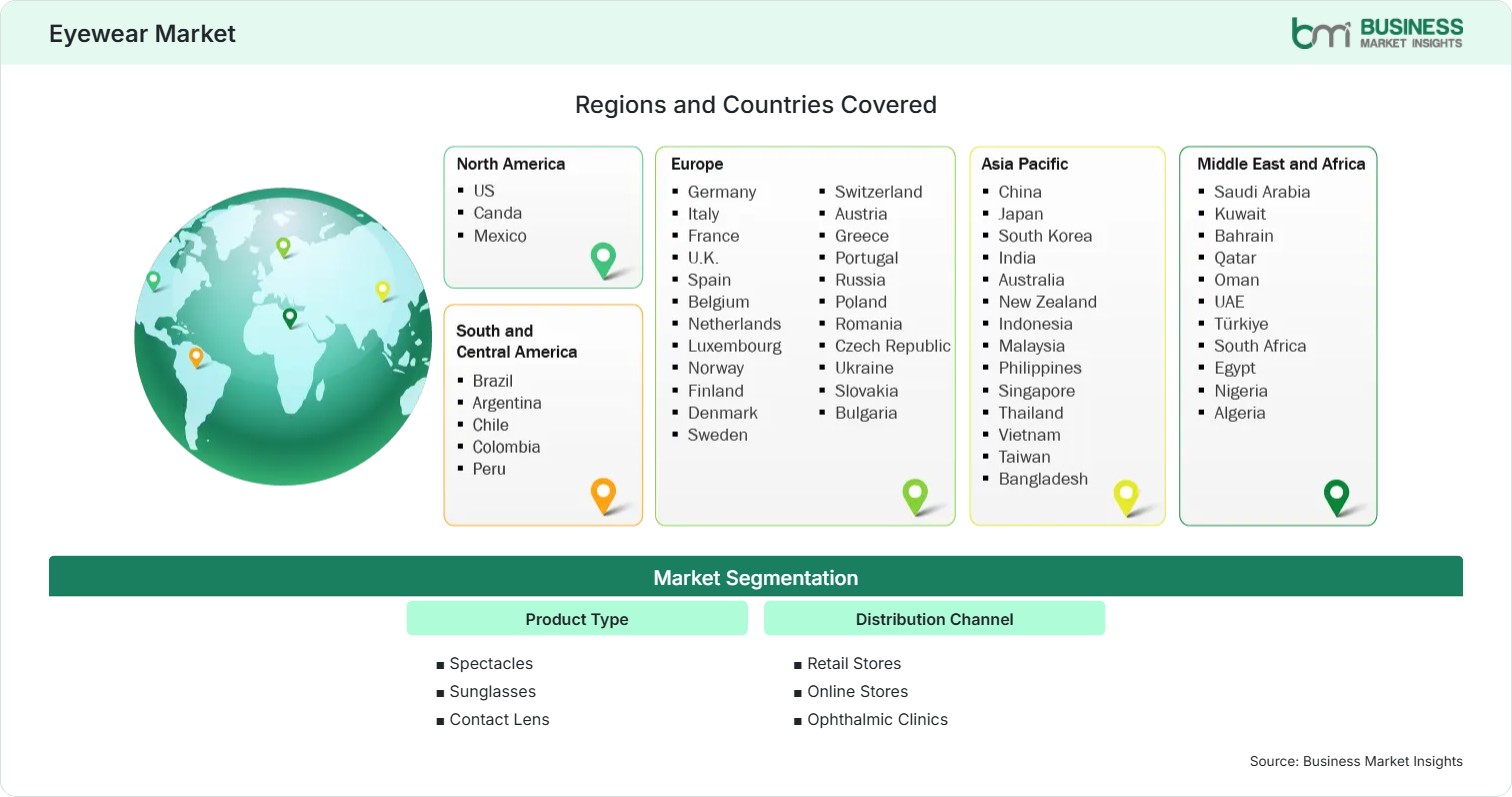
  • Product Type: Spectacles [Frames and Lens], Sunglasses [Plano and Prescription], Contact Lens [Toric, Multifocal, Sphere]
  • Distribution Channel: Retail Stores, Online Stores, Ophthalmic Clinics
US$ 182.28 Bn Market size in 2025
US$ 420.43 Bn Market Size by 2033
11.01% CAGR, 2026 - 2033
2026-2033 Forecast Period

01 AI Overview

Eyewear Market Summary

  • North America Region: North America holds 31%–34% market share in 2025 and is projected to expand at a CAGR of 10.5%–11.1% during 2026–2033. High consumer spending, widespread adoption of premium eyewear, and increasing demand for vision care products continue supporting regional leadership. The U.S. market is expected to register a CAGR of 10.7%–11.3% during the forecast period.
  • Fastest Growing Region: Asia Pacific accounts for 30%–33% of the market in 2025 and is forecast to grow at a CAGR of 11.8%–12.4% through 2033. Rising disposable incomes, expanding middle-class populations, increasing myopia prevalence, and rapid e-commerce growth continue accelerating regional demand.
  • Leading Segment: Spectacles represent 49%–52% of the market in 2025 and are projected to expand at a CAGR of 10.9%–11.5% during the forecast period. Increasing vision correction requirements and continuous frame innovations continue supporting segment leadership.
  • High Growth Segment: Online Stores account for 24%–27% market share in 2025 growing at a CAGR of 12.4% to 13.0% during 2025 to 2033 period. Digital retailing, virtual try-on features, and increasing consumer
  • Key Market Opportunity: The increased use of smart eyewear, environmentally friendly frame materials, AI-driven vision testing technology, and omnichannel selling is presenting significant opportunities for eyewear companies and sellers.
  • Major Market Players: EssilorLuxottica SA, Johnson & Johnson Vision Care, Inc., Carl Zeiss Meditec AG, HOYA Corporation, Safilo Group S.p.A., De Rigo Vision S.p.A., Marcolin S.p.A., Fielmann Group AG, Warby Parker Inc., and Luxottica Group S.p.A.
02 Strategic Insights

Eyewear Market: Strategic Insights

Eyewear Market Strategic Framework
FREE PDF
Request your free sample
Request free sample
03 Stakeholder View

Key Takeaways

  • The industry value chain is becoming increasingly integrated, connecting lens manufacturers, frame producers, optical retailers, ophthalmic clinics, e-commerce platforms, and technology providers to deliver personalized vision care and premium consumer experiences.
  • Online retail and digitally enabled vision care present the strongest long-term growth opportunity, supported by virtual try-on technologies, home vision testing solutions, and expanding direct-to-consumer business models across developed and emerging markets.
  • Innovation is shifting toward intelligent and sustainable eyewear, with manufacturers investing in smart glasses, blue-light filtering lenses, lightweight materials, recycled frame components, and AI-enabled optical technologies to strengthen product differentiation.
  • Asia Pacific represents the most attractive investment destination, driven by rising disposable incomes, increasing urbanization, expanding vision correction awareness, and growing adoption of premium eyewear products across large consumer populations.
  • Strategic acquisitions, licensing agreements, and brand collaborations continue reshaping competition. Leading companies are expanding premium brand portfolios, strengthening omnichannel retail networks, and investing in digital customer engagement to improve market reach.
  • Customization and digital manufacturing technologies are transforming product development, enabling personalized lens designs, advanced frame fitting, and faster production cycles while improving customer satisfaction and operational efficiency.
04 Geographic Outlook

Eyewear Market Regional Highlights

North America Eyewear Market

North America accounted for approximately 31%–34% Eyewear Market share in 2025 and is projected to register a CAGR of 10.5%–11.1% during 2026–2033. High awareness of vision care, premium product adoption, and advanced retail infrastructure continue supporting regional leadership. Increasing digital lifestyles and an aging population are significantly contributing to Eyewear Market growth across prescription and fashion eyewear categories.

  • Growing incidence of myopia, presbyopia, and digital eye strain continues increasing demand for prescription lenses, blue-light filtering eyewear, and premium optical products.
  • Consumers increasingly prefer premium branded eyewear featuring lightweight materials, advanced lens coatings, and personalized frame designs for improved comfort and aesthetics.
  • Omnichannel retail strategies combining physical optical stores with digital commerce continue improving customer convenience and product accessibility.
  • Continuous technological innovation in lens manufacturing and smart eyewear solutions supports higher-value product adoption across both healthcare and lifestyle segments.
  • Expanding insurance coverage and preventive eye care initiatives continue encouraging routine vision examinations and eyewear purchases.

US Eyewear Market

The United States represented approximately 26%–29% of the global market in 2025 and is projected to grow at a CAGR of 10.7%–11.3% during the forecast period. Increasing digital screen usage, rising demand for premium eyewear, and strong consumer spending continue supporting market expansion.

  • Optical retailers increasingly integrate AI-powered vision assessment tools and virtual try-on technologies to improve customer engagement and purchasing decisions.
  • Growing adoption of premium prescription sunglasses and blue-light filtering lenses continues expanding product demand across multiple consumer demographics.
  • Fashion collaborations between eyewear brands and luxury designers continue strengthening premium product sales and consumer brand loyalty.
  • Digital commerce platforms continue improving accessibility through home delivery, subscription models, and flexible product customization options.

Europe Eyewear Market

Europe accounted for approximately 28%–31% of the market in 2025 and is expected to register a CAGR of 10.8%–11.4% during 2026–2033. Strong optical retail networks, premium eyewear manufacturing capabilities, and increasing consumer awareness of eye health continue supporting regional growth.

  • Italy leads regional manufacturing expertise with a CAGR of 10.9%–11.5%, supported by premium eyewear production, luxury brands, and global exports.
  • Germany is projected to record the fastest regional growth with a CAGR of 11.2%–11.8%, driven by increasing demand for technologically advanced lenses and premium vision care products.
  • France and Spain continue witnessing growing demand for designer eyewear supported by fashion-conscious consumers and expanding retail networks.
  • Sustainable production initiatives encourage adoption of recycled materials and environmentally responsible manufacturing across European eyewear companies.
  • Digital eye care services and omnichannel retail strategies continue improving customer accessibility and market penetration.

Asia Pacific Eyewear Market

Asia Pacific accounted for approximately 30%–33% of the global market in 2025 and is projected to register the fastest CAGR of 11.8%–12.4% during 2026–2033. Increasing myopia prevalence, expanding middle-class populations, and rapid urbanization continue driving strong regional market growth.

  • China dominates regional demand with a CAGR of 11.9%–12.5%, supported by large consumer populations, expanding premium eyewear adoption, and strong domestic manufacturing capabilities.
  • India is expected to record the fastest regional growth with a CAGR of 12.3%–12.9%, driven by increasing awareness of vision correction, rising disposable incomes, and expanding organized optical retail.
  • Japan and South Korea continue investing in advanced lens technologies and premium eyewear innovations to address evolving consumer preferences.
  • Growing e-commerce penetration continues improving accessibility to prescription and fashion eyewear across emerging economies.
  • Rising awareness regarding preventive eye care continues supporting long-term demand for corrective vision products.

Rest of World Eyewear Market

The Rest of World region accounted for approximately 8%–10% of the global market in 2025 and is projected to expand at a CAGR of 11.0%–11.6% during the forecast period. Increasing urbanization, improving healthcare access, and expanding organized retail continue supporting market growth across South & Central America and the Middle East & Africa.

Growing investments in vision care infrastructure and expanding distribution networks continue improving access to affordable and premium eyewear products across developing economies.

  • Brazil leads regional demand with a CAGR of 11.1%–11.7%, supported by expanding optical retail, increasing consumer awareness, and rising disposable incomes.
  • The United Arab Emirates is projected to record the fastest regional growth with a CAGR of 11.4%–12.0%, driven by premium retail expansion, luxury eyewear demand, and growing healthcare investments.
  • Saudi Arabia continues strengthening optical healthcare services through expanding vision care clinics and organized retail development.
  • South Africa continues witnessing increasing adoption of affordable prescription eyewear supported by improving healthcare accessibility and rising consumer awareness.
Global Market Geography
FREE PDF
Request your free sample
Request free sample
05 Segment Analysis

Eyewear Market Segmentation

Product Type

The Product Type segment accounted for approximately 49%–52% of the market in 2025 and is projected to grow at a CAGR of 10.9%–11.5% during 2026–2033. Rising demand for prescription vision correction, premium fashion eyewear, and technologically advanced lenses continues driving segment expansion. The expanding Eyewear Market scope is encouraging manufacturers to develop lightweight frames, smart lenses, and sustainable materials that address both medical and lifestyle requirements.

  • Spectacles:
    • Frames: Frame innovation focuses on lightweight metals, bio-based plastics, premium acetate materials, and customizable designs that enhance comfort, durability, and fashion appeal for diverse consumer groups.
    • Lens: Advanced lenses featuring blue-light protection, photochromic technology, anti-reflective coatings, and high-index materials continue gaining adoption due to increasing digital device usage and vision correction requirements.
  • Sunglasses:
    • Plano: Plano sunglasses remain popular among fashion-conscious consumers seeking UV protection, premium styling, and sports-oriented performance across daily and outdoor applications.
    • Prescription: Prescription sunglasses are witnessing rising adoption as consumers increasingly demand integrated vision correction with UV protection and customized lens technologies.
  • Contact Lens:
    • Toric: Toric contact lenses are increasingly adopted for astigmatism correction owing to improved comfort, enhanced stability, and continuous innovations in soft lens materials.
    • Multifocal: Multifocal contact lenses support growing demand from aging populations requiring convenient correction for both near and distance vision without multiple eyewear products.
    • Sphere: Sphere contact lenses remain widely utilized for correcting myopia and hyperopia, supported by affordability, broad product availability, and technological improvements in daily disposable lenses.

Distribution Channel

The Distribution Channel segment represented approximately 45%–48% of the market in 2025 and is projected to register a CAGR of 11.3%–11.9% during the forecast period. Digital transformation, omnichannel retail strategies, and increasing consumer preference for convenient purchasing experiences continue reshaping global distribution. Emerging Eyewear Market trends increasingly favor integrated online and offline customer engagement.

  • Retail Stores: Retail stores continue dominating sales through personalized consultations, product fitting, eye examinations, and premium customer experiences supported by established optical retail networks.
  • Online Stores: Online platforms continue expanding rapidly through virtual try-on technologies, digital prescriptions, competitive pricing, home delivery, and AI-powered product recommendations.
  • Ophthalmic Clinics: Ophthalmic clinics remain essential distribution channels by combining professional eye examinations with prescription eyewear recommendations and integrated patient care services.
06 Market Forces

Eyewear Market Dynamics

Key Market Drivers

Rising vision correction needs

Increasing prevalence of myopia, hyperopia, astigmatism, and presbyopia is driving global demand for prescription eyewear. According to the World Health Organization, billions of people experience vision impairment requiring corrective solutions, while aging populations continue expanding the addressable market. These demographic trends significantly strengthen Eyewear Market growth, encouraging continuous innovation in lenses, frames, and personalized optical products.

Growing fashion accessory demand

Eyewear has evolved beyond vision correction into a premium lifestyle and fashion accessory. Consumers increasingly purchase multiple eyewear products for different occasions, supported by designer collaborations, luxury branding, and seasonal product launches. Premium materials, customized frame designs, and celebrity endorsements continue stimulating consumer demand across both prescription and non-prescription categories.

Increasing digital screen exposure

Growing use of smartphones, computers, tablets, and digital entertainment platforms has increased concerns regarding digital eye strain and blue-light exposure. Manufacturers continue introducing specialized blue-light filtering lenses, anti-glare coatings, and ergonomic optical technologies that improve visual comfort and reinforce long-term Eyewear Market trends.

Key Market Opportunities

Smart wearable eyewear innovation

Integration of augmented reality, artificial intelligence, voice assistance, health monitoring, and wireless connectivity is transforming smart eyewear into multifunctional wearable devices. Technology companies and traditional eyewear manufacturers are expanding strategic collaborations, creating significant Eyewear Market Forecasts for premium connected eyewear solutions across healthcare, enterprise, and consumer applications.

Sustainable frame materials

Growing environmental awareness encourages manufacturers to develop recycled plastics, bio-acetate, bamboo, recycled metals, and biodegradable frame materials. Sustainable product innovation supports premium brand positioning while meeting evolving consumer preferences for environmentally responsible eyewear products.

Online eyewear retail expansion

Digital commerce continues reshaping global eyewear distribution through AI-powered recommendations, virtual try-on platforms, online eye testing services, subscription models, and direct-to-consumer sales. These innovations improve customer accessibility while reducing distribution costs and expanding market penetration.

Market Restraints and Challenges

Counterfeit product competition

The primary Factor restricting market profitability is the increasing availability of counterfeit branded eyewear across physical and online sales channels. Impact: Counterfeit products reduce revenues for legitimate manufacturers, damage brand reputation, compromise product quality, and undermine consumer confidence in premium eyewear brands.

Price-sensitive consumer segments

The major Factor limiting premium product adoption is affordability across developing economies and cost-conscious consumer groups. Impact: High prices for branded frames, advanced lenses, and premium optical technologies encourage consumers to delay purchases or shift toward lower-cost alternatives, limiting revenue growth for premium manufacturers.

07 Company Analysis

Competitive Landscape

The competitive landscape is characterized by continuous investments in premium lens technologies, sustainable frame materials, digital retail platforms, and smart eyewear innovation. The Eyewear Market analysis highlights that leading companies are strengthening their global presence through acquisitions, brand partnerships, omnichannel expansion, and product portfolio diversification to address evolving consumer preferences and vision care needs.

Company Name

Overview

Products and Services Relevant to this Market

Luxottica Group S.p.A.

Global eyewear manufacturer and retailer with an extensive portfolio of premium brands and retail networks.

Eyeglass frames, sunglasses, prescription eyewear, retail services, licensed luxury eyewear brands.

EssilorLuxottica SA

Global leader in ophthalmic lenses, eyewear manufacturing, and vision care solutions.

Prescription lenses, frames, sunglasses, smart eyewear, vision care products, optical retail services.

Johnson & Johnson Vision Care, Inc.

Leading provider of vision care products specializing in contact lens technologies.

Contact lenses, disposable lenses, toric lenses, multifocal lenses, eye care solutions.

Carl Zeiss Meditec AG

Medical technology company offering advanced ophthalmic and optical solutions.

Precision lenses, ophthalmic diagnostics, optical equipment, vision correction technologies.

HOYA Corporation

Global manufacturer of optical products and advanced vision care technologies.

Prescription lenses, optical coatings, progressive lenses, specialty vision products.

Safilo Group S.p.A.

Italian eyewear company focused on premium and licensed eyewear collections.

Optical frames, sunglasses, sports eyewear, luxury eyewear collections.

De Rigo Vision S.p.A.

Designer and manufacturer of premium eyewear for global fashion brands.

Prescription frames, sunglasses, luxury eyewear, licensed fashion collections.

Marcolin S.p.A.

Eyewear manufacturer specializing in luxury and designer brand partnerships.

Premium optical frames, sunglasses, licensed luxury eyewear products.

Fielmann Group AG

European optical retailer providing comprehensive vision care solutions.

Prescription eyewear, eye examinations, contact lenses, optical retail services.

Warby Parker Inc.

Direct-to-consumer eyewear company integrating digital retail with vision care services.

Prescription glasses, sunglasses, contact lenses, virtual try-on, eye examination services.

08 Industry Activity

Recent Developments

June 2026

EssilorLuxottica S.A. and Meta Platforms, Inc. launched a new Meta Glasses collection under the Meta brand, expanding their AI-enabled smart eyewear portfolio with more affordable prescription and sunglass options to accelerate mainstream adoption.

March 2026

EssilorLuxottica S.A. and Meta Platforms, Inc. expanded their AI eyewear portfolio with new Ray-Ban Meta Optics prescription-first smart glasses, offering enhanced comfort, customization, and AI functionality for prescription eyewear users.

December 2025

Warby Parker Inc. and Google LLC announced a strategic partnership to develop AI-powered smart glasses, combining Warby Parker's eyewear expertise with Google's AI and Android XR technologies to launch next-generation connected eyewear.

July 2025

Meta acquired a minority stake (approximately 3%) in EssilorLuxottica, strengthening their long-term partnership to accelerate the development and commercialization of AI-powered smart eyewear globally.

10 Trust & Transparency

Research Methodology

The market analysis combines proprietary research with secondary data from government agencies, company disclosures, regulatory filings, industry databases and expert interviews. Market estimates are validated through data triangulation, cross-market benchmarking and analyst review.

View Full Research Methodology

11 Questions Answered

Frequently Asked Questions

Who are the leading companies operating in the Eyewear Market?

Major companies include Luxottica Group S.p.A., EssilorLuxottica SA, Johnson & Johnson Vision Care, Inc., Carl Zeiss Meditec AG, HOYA Corporation, Safilo Group S.p.A., De Rigo Vision S.p.A., Marcolin S.p.A., Fielmann Group AG, and Warby Parker Inc.

Which distribution channel is expected to grow the fastest?

Online stores are projected to witness the fastest growth due to expanding e-commerce adoption, virtual try-on technologies, digital eye testing solutions, and increasing consumer preference for convenient shopping experiences.

Which product segment holds the largest market share?

Spectacles remain the leading product category because of increasing prevalence of refractive vision disorders, continuous frame innovation, premium lens technologies, and sustained demand across all age groups.

Which region dominates the market?

North America holds the largest market share due to strong consumer purchasing power, widespread adoption of premium eyewear products, advanced healthcare infrastructure, and a well-established optical retail ecosystem.

What are the primary factors driving the market?

The Eyewear Market report highlights that the market is driven by increasing vision correction requirements, rising digital screen exposure, growing consumer preference for fashionable eyewear, technological advancements in lenses, and expanding access to vision care services worldwide.

Access the Full Eyewear Market Report

Get segment-level forecasts, regional estimates, competitive benchmarking, company profiles and downloadable Excel datasets.

Access the full Eyewear Market Report
350 pages PDF & Excel | 2026-07-27