
Underwear Market Outlook: Size, Share, Trends, Growth Analysis, Competitive Landscape & Forecast, 2022-2033

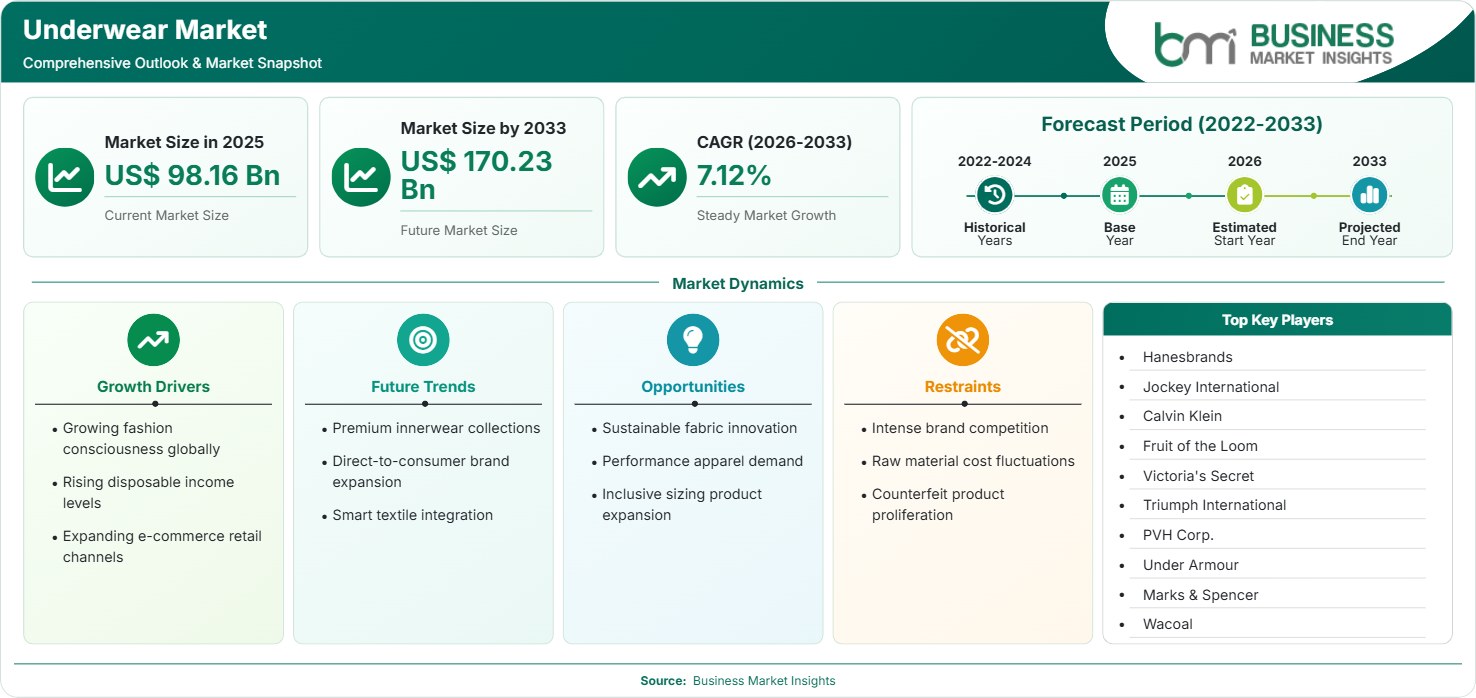
The Underwear Market size was valued at US$ 98.16 billion in 2025 and is projected to reach US$ 170.23 billion by 2033, growing at a CAGR of 7.12% during 2026–2033. Rising fashion consciousness, increasing disposable income, premiumization of intimate apparel, rapid expansion of e-commerce, sustainable fabric innovation, and growing demand for functional innerwear continue to strengthen long-term market opportunities.

Report Coverage
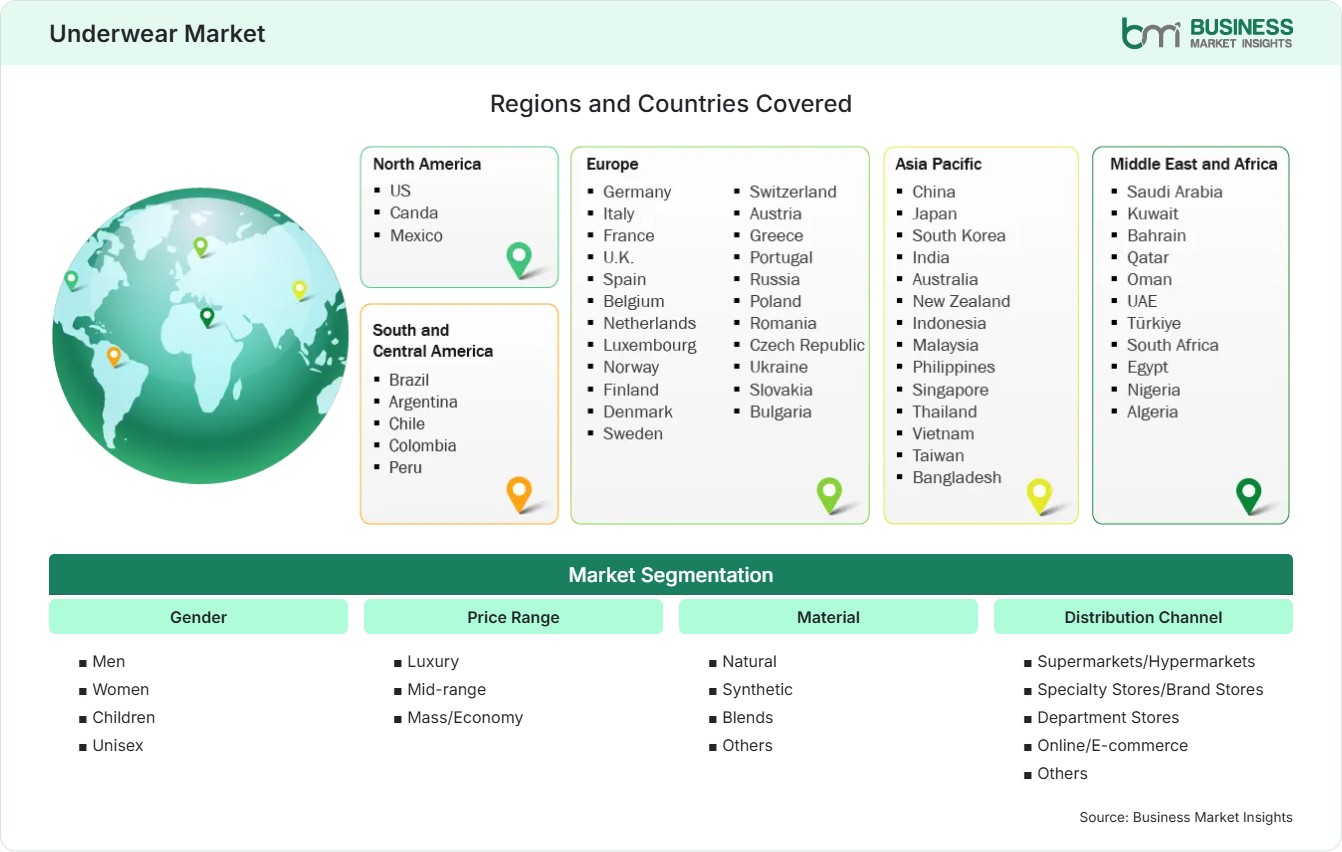
  • Gender: Men, Women, Children, Unisex
  • Price Range: Luxury, Mid-range, Mass/Economy
  • Material: Natural, Synthetic, Blends, Others
  • Distribution Channel: Supermarkets/Hypermarkets, Specialty Stores/Brand Stores, Department Stores, Online/E-commerce, Others
US$ 98.16 Bn Market size in 2025
US$ 170.23 Bn Market Size by 2033
7.12% CAGR, 2026 - 2033
2026-2033 Forecast Period

AI Overview

Underwear Market Summary

  • North America Region: North America holds an estimated 36%–38% market share in 2025 and is projected to expand at a 5.8%–6.4% CAGR during 2026–2033. Premium brand penetration, strong retail infrastructure, omnichannel strategies, and demand for performance underwear continue supporting revenue growth. The U.S. remains the largest regional contributor with an estimated 6.0%–6.5% CAGR, supported by innovation and digital retail expansion.
  • Fastest Growing Region: Asia Pacific accounts for approximately 28%–31% of global revenue in 2025 while advancing at a 8.5%–9.3% CAGR through 2033. Rising middle-class income, organized retail expansion, urbanization, digital commerce, and increasing premium apparel adoption continue accelerating regional demand.
  • Leading Segment: Women represent the leading segment with an estimated 48%–52% share in 2025 and is expected to register a 6.8%–7.4% CAGR. Continuous product innovation, demand for comfort-focused lingerie, inclusive sizing, and premium intimate apparel collections support segment leadership.
  • High Growth Segment: Online/E-commerce captures approximately 18%–22% of sales during 2025 while expanding at a 9.5%–10.2% CAGR. Direct-to-consumer strategies, personalized recommendations, convenient product comparison, subscription models, and digital marketing accelerate consumer adoption.
  • Key Market Opportunity: Sustainable materials, recycled fibers, biodegradable textiles, seamless knitting technologies, smart inventory management, and digital customization platforms create attractive investment opportunities while strengthening brand differentiation across premium and mass-market categories.
  • Major Market Players: Hanesbrands Inc., Jockey International, Inc., PVH Corp., Fruit of the Loom, Inc., Victoria's Secret & Co., Triumph International Holding AG, Under Armour, Inc., Marks and Spencer plc, Wacoal Holdings Corp., Calvin Klein.
Strategic Insights

Underwear Market: Strategic Insights

Underwear Market Strategic Framework
FREE PDF
Request your free sample
Request free sample
Stakeholder View

Key Takeaways

  • The value chain is increasingly integrating sustainable fiber suppliers, textile innovators, apparel manufacturers, digital retailers, and direct-to-consumer brands to improve efficiency, traceability, and product differentiation.
  • Women's premium lingerie, performance innerwear, sustainable collections, and online retail channels continue presenting the strongest medium-term revenue opportunities for manufacturers and investors.
  • Innovation is shifting toward seamless knitting, moisture-wicking fabrics, antimicrobial finishes, recycled fibers, AI-driven demand forecasting, and body-inclusive product development.
  • Asia Pacific presents the strongest investment opportunity owing to rising apparel consumption, expanding organized retail, increasing urbanization, and rapidly growing digital commerce ecosystems.
  • Strategic acquisitions, brand collaborations, manufacturing expansion, and supply chain diversification remain central competitive strategies among leading international apparel companies.
Geographic Outlook

Underwear Market Regional Highlights

North America Underwear Market

North America accounted for 20%–23% of the global Underwear Market in 2025 and is projected to expand at a 5.8%–6.3% CAGR during 2026–2033. Premium product demand, high replacement frequency, strong omnichannel retail networks, and consumer preference for branded innerwear continue supporting regional expansion. Product innovation in moisture-management fabrics, seamless construction, and sustainable materials further strengthens competitiveness. The Underwear Market share in North America is reinforced by widespread digital adoption, direct-to-consumer business models, and established brand loyalty across the United States and Canada.

  • The United States remains the primary revenue contributor, supported by premiumization, increasing demand for performance underwear, and widespread e-commerce adoption that enhances consumer accessibility across multiple price categories.
  • Sustainable fabric innovations, recycled fibers, and ethical sourcing initiatives are encouraging consumers to shift toward environmentally responsible products while supporting premium pricing strategies for leading manufacturers.
  • Omnichannel retail strategies combining physical stores, brand websites, and digital marketplaces improve customer engagement, inventory optimization, and personalized shopping experiences throughout the region.

US Underwear Market

The United States represented approximately 16%–18% of the global Underwear Market in 2025 and is expected to register a 6.0%–6.5% CAGR through 2033. Strong consumer purchasing power, premium brand penetration, and continuous innovation in performance fabrics support long-term expansion. Direct-to-consumer sales, subscription purchasing models, and digital personalization continue transforming purchasing behavior while strengthening profitability for established apparel brands. Consumer preference for sustainable and inclusive product offerings further supports category development.

  • High household spending on apparel and frequent replacement cycles sustain stable demand across premium, mid-range, and value product categories.
  • Digital commerce platforms increasingly influence purchasing decisions through personalized recommendations, flexible returns, and subscription-based replenishment programs.
  • Growing demand for inclusive sizing and adaptive underwear expands addressable consumer segments while improving customer loyalty.

Europe Underwear Market

Europe held approximately 22%–24% of global revenue in 2025 and is anticipated to expand at a 5.5%–6.1% CAGR during the forecast period. Demand remains supported by premium fashion consumption, sustainability initiatives, and increasing consumer preference for ethically sourced apparel. Germany, France, Italy, and the United Kingdom remain leading revenue contributors, while Eastern European countries demonstrate faster consumption growth supported by expanding retail infrastructure and rising disposable incomes.

  • Germany leads regional consumption through strong purchasing power, advanced retail infrastructure, and established premium apparel brands.
  • The United Kingdom records healthy growth through digital retail expansion, subscription commerce, and premium intimate apparel demand.
  • Sustainable manufacturing practices and recyclable textile adoption increasingly influence purchasing decisions across European consumers.

Asia Pacific Underwear Market

Asia Pacific represented 41%–49% of global market revenue in 2025, making it the largest regional Underwear Market while recording the fastest expansion at a 6.7%–7.4% CAGR during 2026–2033. China remains the leading national market, whereas India demonstrates the strongest long-term expansion due to urbanization, increasing disposable incomes, organized retail development, and rapid digital commerce penetration. Manufacturing capabilities across the region continue supporting global supply chains and export competitiveness.

  • China maintains regional leadership through its extensive manufacturing ecosystem, premium product adoption, and expanding domestic consumption.
  • India delivers the strongest growth momentum as branded underwear penetration increases across urban and semi-urban markets.
  • Rapid expansion of mobile commerce platforms significantly improves accessibility for domestic and international underwear brands.

Rest of World Underwear Market

The Rest of World region, comprising South & Central America and the Middle East & Africa, accounted for approximately 8%–11% of global revenue in 2025 and is projected to grow at a 6.1%–6.8% CAGR through 2033. Brazil remains the leading South American market, while the United Arab Emirates and Saudi Arabia demonstrate notable expansion in the Middle East through premium retail investments and increasing consumer spending.

  • Expanding organized retail, improving digital commerce infrastructure, and growing awareness regarding comfort-focused apparel continue supporting regional demand across both developing and emerging economies.
  • Brazil leads South & Central America through strong domestic apparel manufacturing and increasing consumer demand for branded products.
  • Mexico benefits from expanding retail networks and growing cross-border apparel trade with North America.
Global Market Geography
FREE PDF
Request your free sample
Request free sample
Segment Analysis

Underwear Market Segmentation

<

Gender

The gender segment remains the foundation of demand across global apparel categories, with Women accounting for an estimated 48%–52% market share in 2025 and advancing at a 6.8%–7.4% CAGR through 2033. Product innovation, comfort-focused designs, premium lingerie collections, and expanding inclusive sizing continue driving adoption. The Underwear Market scope continues to broaden as brands diversify portfolios to address evolving consumer preferences across all age groups and gender identities.

  • Men – Briefs: Traditional briefs remain widely preferred for daily comfort and athletic use, supported by breathable fabrics, ergonomic construction, and consistent replacement demand across mature and emerging consumer markets.
  • Men – Boxers: Boxers continue gaining popularity among younger consumers owing to relaxed fit, improved ventilation, fashionable prints, and premium cotton materials that enhance everyday comfort.
  • Men – Boxer-Briefs: Boxer-briefs combine flexibility, support, and performance, making them increasingly popular among active consumers seeking moisture management and superior fit across sports and casual applications.
  • Women – Panties: Panties represent the largest women's product category, supported by broad style availability, frequent replacement cycles, seamless construction, and increasing preference for sustainable materials and premium comfort.
  • Women – Bras: Continuous innovation in wireless designs, adaptive support technologies, and personalized sizing enhances consumer satisfaction while encouraging premium product purchases across diverse demographic groups.
  • Women – Lingerie: Lingerie demand benefits from premiumization, fashion influence, bridal collections, and expanding online retail platforms offering wider product assortments with improved size guidance.
  • Children: Children's underwear experiences stable demand driven by population growth, product safety standards, soft fabrics, and increasing parental preference for hypoallergenic and durable materials.
  • Unisex: Unisex products continue expanding through gender-inclusive collections emphasizing comfort, minimalist aesthetics, and versatile sizing suitable for broader consumer demographics.

Price Range

The Mid-range segment accounts for approximately 46%–50% of global revenue in 2025 and is projected to register a 6.9%–7.3% CAGR through 2033. Consumers increasingly seek products balancing affordability, durability, and premium comfort. Strong brand recognition, expanding retail availability, and continuous product upgrades sustain demand across developed and developing economies while supporting higher customer retention.

  • Luxury: Premium collections attract affluent consumers through superior craftsmanship, innovative fabrics, exclusive branding, and enhanced shopping experiences that reinforce customer loyalty and higher spending.
  • Mid-range: Mid-range products appeal to broad consumer groups by combining quality materials, competitive pricing, attractive designs, and reliable durability suitable for everyday use.
  • Mass/Economy: Mass-market offerings maintain strong sales through affordability, extensive retail distribution, bulk purchasing behavior, and increasing accessibility across developing markets.

Material

Natural materials dominate the material segment with an estimated 36%–40% of the Underwear Market share in 2025 and are expected to expand at a 6.5%–7.0% CAGR through 2033. Cotton, bamboo, and other natural fibres remain preferred for breathability, softness, and sustainability. Blended fabrics are also witnessing increased adoption because they combine comfort, durability, elasticity, and improved moisture management.

  • Natural: Cotton and bamboo fibers remain highly preferred because of superior comfort, breathability, skin compatibility, and increasing consumer interest in environmentally responsible textile materials.
  • Synthetic: Synthetic materials deliver enhanced durability, elasticity, quick-drying performance, and moisture management, making them suitable for sportswear and performance-focused underwear collections.
  • Blends: Blended fabrics combine natural softness with synthetic strength, offering improved durability, wrinkle resistance, flexibility, and enhanced long-term product performance.

Distribution Channel

Specialty Stores/Brand Stores accounted for approximately 38%–42% of revenue in 2025 and are projected to expand at a 6.3%–6.8% CAGR through 2033. Consumers continue valuing personalized fitting assistance, complete product assortments, and premium shopping experiences. Meanwhile, online retail remains the fastest-growing channel, supported by digital personalization, wider product selection, and convenient purchasing experiences.

  • Supermarkets/Hypermarkets: Large retail chains support volume sales through convenience, competitive pricing, and extensive availability of economy and mid-range underwear products.
  • Specialty Stores/Brand Stores: Brand-exclusive outlets strengthen customer engagement through professional fitting services, premium merchandising, complete collections, and personalized purchasing experiences.
  • Department Stores: Department stores continue attracting consumers through multi-brand product offerings, promotional campaigns, seasonal collections, and established customer loyalty programs.
  • Online/E-commerce: Online platforms benefit from digital convenience, product reviews, virtual sizing tools, subscription services, and rapid home delivery, supporting sustained long-term channel expansion. Top of Form

Bottom of Form

Market Forces

Underwear Market Dynamics

Key Market Drivers

Growing fashion consciousness globally

Increased awareness about fashion trends, growing disposable income, and personal comfort have been instrumental in transforming consumer behavior in global apparel markets. The desire among consumers for items that are visually appealing and functional is prompting manufacturers to produce unique lines that incorporate sustainability, seamlessness, and moisture management. The Underwear Market growth is further supported by expanding organized retail and digital commerce platforms, enabling brands to reach broader consumer segments.

Rising disposable income levels

Increasing household income, particularly across emerging economies, has significantly influenced consumer spending on premium apparel and branded innerwear. Asians, Latin Americans, and Middle Easterns, due to increased middle class population in those regions, are now more interested in buying quality, durable, and comfortable undergarments rather than cheap ones. Urbanization, good job opportunities, and increasing female participation in workforce also support the demand for fashionable intimate apparels.

Expanding e-commerce retail channels

The rapid growth of e-commerce has transformed underwear retail through greater product accessibility, personalized recommendations, virtual sizing tools, and convenient home delivery. The direct to consumer model allows businesses to build stronger relationships with their customers and minimize reliance on traditional retailers. Digital platforms can also help businesses develop exclusive product lines online, provide opportunities for subscription purchases, and use AI technology to manage their inventories. Social media marketing is still affecting younger consumers' buying decisions.

Key Market Opportunities

Sustainable fabric innovation

The increasing adoption of recycled polyester, organic cotton, bamboo fibers, biodegradable textiles, and low-impact dyeing technologies presents significant investment opportunities for manufacturers. Sustainability in manufacturing and consumers' demand for green products will force apparel firms to rethink their offerings. According to Underwear Market Forecasts, there is an expectation for increased commitment to circular textiles, sustainable supply chain practices, and sustainable packaging.

Performance apparel demand

Growing participation in fitness, sports, and outdoor activities continues driving demand for performance-focused underwear featuring moisture-wicking fabrics, odor-control technologies, stretch materials, and ergonomic construction. Customers are more demanding nowadays, looking for clothing that is comfortable for any activity while remaining durable and fashionable. Companies that put efforts into improving textile technology, using seamless knitting, and developing fabrics will benefit from higher demands of consumers. Collaboration with sportswear companies and research on technical clothing can bring additional profits for companies.

Inclusive sizing product expansion

Expanding inclusive sizing and adaptive product collections provides substantial growth opportunities as brands address increasingly diverse consumer needs. Development of products that include body positivity, inclusivity, maternity clothes, and unisex lines allows for targeting under-served customers. Technologies such as digital body scanning and artificial intelligence-powered sizing enhance the level of trust that results in less product returns. Those businesses that place emphasis on designing inclusive products, engaging consumers and providing personalized shopping experience can succeed in establishing consumer loyalty and achieving higher conversion rates.

Market Restraints and Challenges

Intense brand competition

Factor: Competitors are present among the many global brands, regional brands, and private label brands; therefore, there is stiff competition in both premium and value categories. There is constant rivalry among companies on price wars, innovation of products, advertisements, and growth in retail stores.

Impact: Competitive forces limit pricing options and create narrower profit margins, especially for small-scale producers who lack strong brand identity. Increasing customer demands for high-quality products at low prices along with their environmental concerns necessitate ongoing spending on product innovation, online marketing, and logistics operations, leading to rising operational expenses.

Raw material cost fluctuations

Factor: Volatility in prices of cotton, artificial fibers, energy, transport, and labor directly influences cost of production. Disruptions in geopolitics and effects of climate change on agriculture production also add to the element of uncertainty in pricing.

Impact: Higher costs of raw materials lead to lower profits for producers and might call for pricing changes that affect buyers’ choices. Firms become more diverse in their procurement methods, use recycling techniques, and improve production processes as means of reducing the pressure on costs; however, all this requires money.

Company Analysis

Competitive Landscape

The competitive environment is characterized by continuous product innovation, sustainability initiatives, omnichannel retail expansion, and strategic brand positioning. Underwear Market analysis indicates that major players are working on premium product range, performance fabric, digital selling, and logistics management in order to increase their presence across the globe. In addition, manufacturers are focusing on providing inclusive size, eco-friendly material, and direct-to-consumer business models.

Company Name

Overview

Products and Services relevant to this market

Hanesbrands Inc.

A leading global apparel manufacturer with a diversified portfolio of innerwear, activewear, and hosiery brands, supported by an extensive international distribution network.

Men's and women's underwear, bras, panties, shapewear, thermal wear, socks, performance innerwear, and sustainable apparel collections.

Jockey International, Inc.

Privately held apparel company recognized for comfort-focused innerwear and premium quality products with strong retail and e-commerce presence worldwide.

Briefs, boxers, boxer-briefs, bras, panties, loungewear, sleepwear, performance underwear, and children's innerwear.

Calvin Klein (PVH Corp.)

Global premium fashion brand operating under PVH Corp., known for innovative design, strong brand recognition, and premium intimate apparel collections.

Premium underwear, bras, lingerie, performance innerwear, loungewear, and fashion-focused intimate apparel for men and women.

Fruit of the Loom, Inc.

Global manufacturer with a strong presence in value-oriented apparel, offering affordable innerwear products across multiple international markets.

Briefs, boxers, undershirts, panties, sports bras, children's underwear, socks, and everyday essentials.

Victoria's Secret & Co.

International specialty retailer focused on premium lingerie, beauty products, and intimate apparel through physical stores and digital channels.

Bras, panties, lingerie, shapewear, sleepwear, intimate apparel, beauty products, and seasonal collections.

Triumph International Holding AG

Global intimate apparel company with extensive expertise in premium lingerie, shapewear, and comfort-focused product innovation across international markets.

Bras, panties, shapewear, lingerie, sports bras, premium intimate apparel, and bodywear collections.

PVH Corp.

Global apparel company managing internationally recognized fashion brands while expanding premium innerwear offerings through innovation and digital retail strategies.

Underwear, bras, premium basics, performance apparel, fashion essentials, and licensed intimate apparel products.

Under Armour, Inc.

Performance apparel company specializing in technically advanced sportswear with increasing focus on functional and moisture-management innerwear products.

Performance underwear, compression garments, athletic briefs, boxerjocks, sports apparel, and moisture-wicking base layers.

Marks and Spencer plc

Leading multinational retailer with a strong reputation for high-quality clothing, including extensive own-brand underwear and lingerie ranges.

Men's underwear, women's lingerie, bras, panties, shapewear, children's underwear, and sustainable cotton collections.

Wacoal Holdings Corp.

Japanese apparel manufacturer recognized globally for premium lingerie, innovative fit technologies, and extensive research-driven product development.

Premium bras, panties, lingerie, shapewear, maternity wear, sleepwear, and luxury intimate apparel solutions.

Industry Activity

Recent Developments

March 2026

Jockey International Inc. launched the limited-edition Jockey 1876 Collection as part of its 150th anniversary celebration, while expanding strategic partnerships to strengthen its global innerwear and underwear business.

December 2025

Gildan Activewear Inc. completed the acquisition of HanesBrands Inc., adding iconic underwear and innerwear brands including Hanes, Bali, Maidenform, Playtex, Wonderbra, Bonds, Berlei, Bras N Things, and Zorba to its portfolio, significantly expanding its global underwear business.

August 2025

HanesBrands Inc. and Gildan Activewear Inc. announced an agreement to combine their businesses, creating a global basic apparel leader. The transaction strengthens the companies' underwear and innerwear portfolios, expands vertically integrated manufacturing capabilities, and is expected to deliver approximately US$200 million in annual run-rate cost synergies within three years.

March 2025

HanesBrands Inc. launched Hanes Moves, its first cross-category athleisure collection, expanding beyond traditional underwear into performance-inspired innerwear and apparel designed for everyday comfort and active lifestyles.

Trust & Transparency

Research Methodology

The market analysis combines proprietary research with secondary data from government agencies, company disclosures, regulatory filings, industry databases and expert interviews. Market estimates are validated through data triangulation, cross-market benchmarking and analyst review.

View Full Research Methodology

Questions Answered

Frequently Asked Questions

What insights does the Underwear Market Report provide for businesses and investors?

The report provides insights into market size, growth trends, segmentation, regional performance, competitive strategies, and emerging opportunities. It helps businesses evaluate investment potential, identify high-growth categories, understand consumer behavior shifts, and develop strategies aligned with changing market dynamics.

What role does technology play in the evolution of underwear products?

Technology is improving product performance through innovations such as seamless knitting, advanced moisture-wicking fabrics, antimicrobial treatments, smart sizing solutions, and AI-supported inventory management. These advancements help manufacturers create products that deliver improved comfort, functionality, and personalized consumer experiences.

Which distribution channel is gaining the most importance for underwear sales?

Online and e-commerce channels are becoming increasingly important due to convenience, wider product availability, personalized recommendations, flexible returns, and direct-to-consumer strategies. Digital platforms enable brands to reach new customer segments while collecting consumer insights to improve product development and marketing strategies.

How are sustainability initiatives affecting underwear manufacturers?

Manufacturers are adopting organic cotton, recycled fibers, biodegradable materials, and responsible production methods to address environmental concerns. Sustainable product development helps brands improve differentiation, meet evolving consumer expectations, and comply with increasing global focus on responsible textile manufacturing and supply chain transparency.

What factors are influencing consumer purchasing decisions in the underwear industry?

Consumers increasingly prioritize comfort, fit, fabric quality, durability, sustainability, and brand reputation. Demand is shifting toward products featuring breathable materials, seamless construction, moisture management, inclusive sizing, and environmentally responsible manufacturing practices. Underwear Market Trends, such as Digital reviews and personalized shopping experiences, are also influencing purchase decisions.

Access the Full Underwear Market Report

Get segment-level forecasts, regional estimates, competitive benchmarking, company profiles and downloadable Excel datasets.

Access the full Underwear Market Report
350 pages PDF & Excel | 2026-07-31
Similar Research

Related Market Reports