
Shampoo Market Outlook: Size, Share, Trends, Growth Analysis, Competitive Landscape & Forecast, 2022-2033

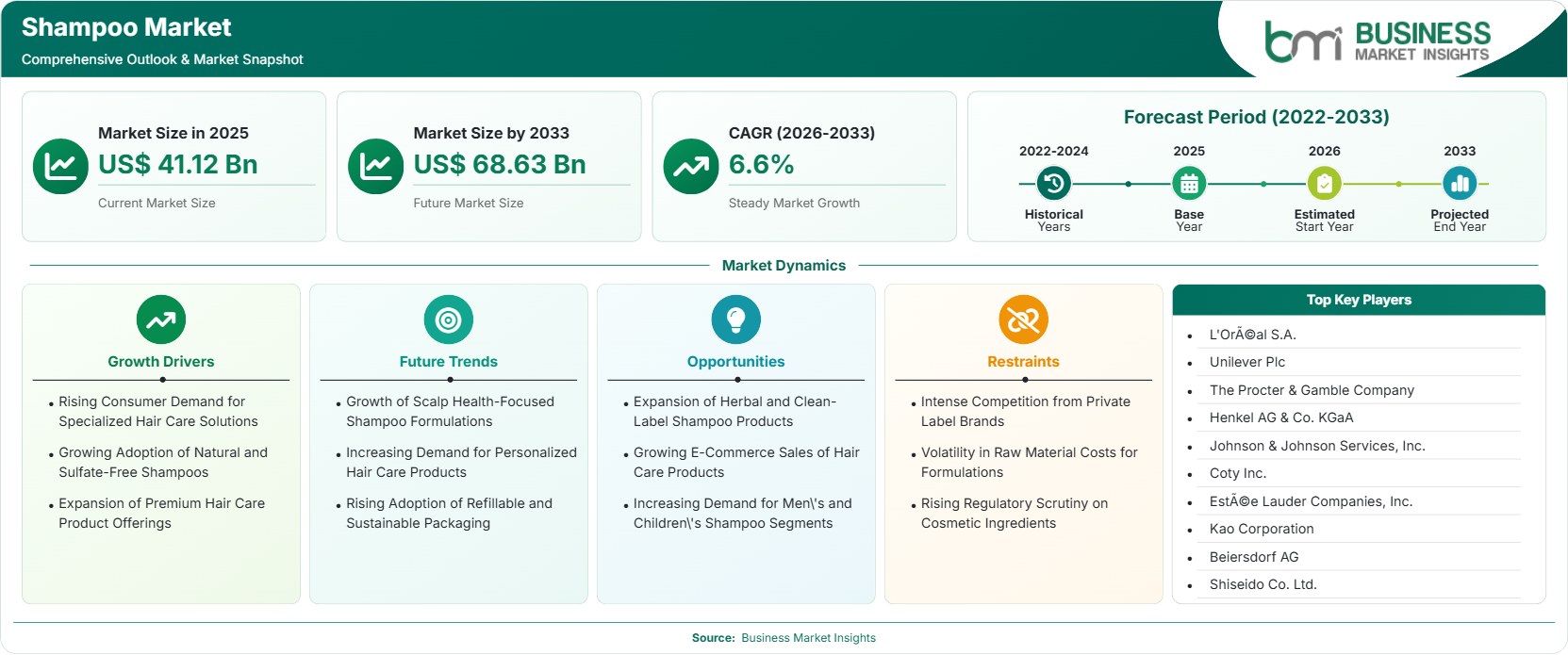
The Shampoo Market size was valued at US$ 41.12 Billion in 2025 and is projected to reach US$ 68.63 Billion by 2033, growing at a CAGR of 6.61% during 2026–2033. Rising consumer awareness regarding hair health, increasing demand for specialized hair care products, growing premiumization trends, and expanding e-commerce penetration are supporting market growth. Opportunities are emerging from natural ingredient-based shampoos, scalp-care formulations, and personalized hair care solutions.

Report Coverage
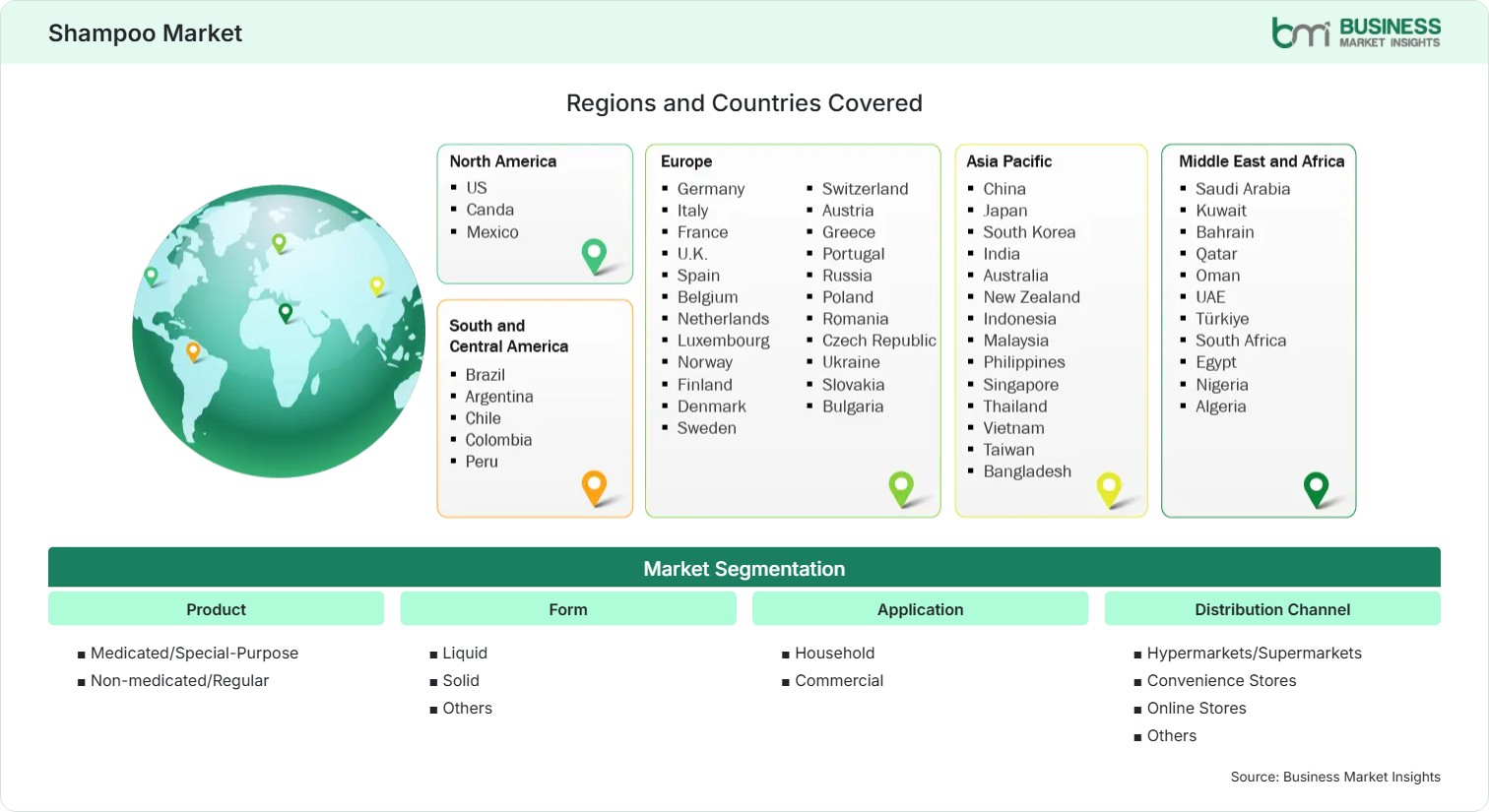
  • Product: Medicated/Special-Purpose, Non-medicated/Regular
  • Form: Liquid, Solid, Others
  • Application: Household, Commercial
  • Distribution Channel: Hypermarkets/Supermarkets, Convenience Stores, Online Stores, Others
  • Manufacturers: Private Label, Toll Manufacturing, Multinational
US$ 41.12 Bn Market size in 2025
US$ 68.63 Bn Market Size by 2033
6.6% CAGR, 2026 - 2033
2026-2033 Forecast Period

01 AI Overview

Shampoo Market Summary

  • North America Region: North America holds a shampoo market share of 29%–32% in 2025 and is projected to grow at a CAGR of 6.1%–7.1% during 2026–2033. Strong consumer spending on personal care products, premium hair care adoption, and increasing demand for specialized formulations continue supporting regional demand. The US market is projected to grow at a CAGR of 6.3%–7.3% through 2033.
  • Fastest Growing Region: Asia Pacific accounts for 31%–34% share in 2025 and is expected to grow at a CAGR of 7.2%–8.2% during the forecast period. Rising disposable incomes, expanding middle-class populations, and increasing awareness regarding hair care are driving regional growth.
  • Leading Segment: Non-medicated/Regular Shampoo represents 68%–71% share in 2025 and is projected to grow at a CAGR of 6.2%–7.2% through 2033. Daily usage patterns, broad consumer appeal, and continuous product innovation support segment leadership.
  • High Growth Segment: Medicated/Special-Purpose Shampoo holds 29%–32% share in 2025 and is projected to grow at a CAGR of 7.5%–8.5% during 2026–2033. Growing concerns related to dandruff, hair fall, scalp disorders, and hair repair treatments continue accelerating demand.
  • Key Market Opportunity: Rising demand for sulfate-free, organic, herbal, and scalp-health-focused shampoo products is creating significant opportunities for manufacturers and brand owners.
  • Major Market Players: L'Oréal S.A., Unilever Plc, The Procter & Gamble Company, Henkel AG & Co. KGaA, Johnson & Johnson Services, Inc., Coty Inc., Estée Lauder Companies, Inc., Kao Corporation, Beiersdorf AG, and Shiseido Co. Ltd.
02 Strategic Insights

Shampoo Market: Strategic Insights

Shampoo Market Strategic Framework
FREE PDF
Request your free sample
Request free sample
03 Stakeholder View

Key Takeaways

  • Non-medicated shampoos remain the largest segment due to widespread daily usage and broad consumer acceptance.
  • Medicated and special-purpose shampoos represent the fastest-growing product category driven by rising scalp and hair health concerns.
  • Asia Pacific continues to lead market expansion due to rising consumption of personal care products and growing middle-class populations.
  • Premium and natural ingredient-based formulations are becoming important differentiators across competitive product categories.
  • Online retail platforms are expanding market reach while influencing consumer purchase behavior through product visibility and convenience.
  • Manufacturers are increasingly focusing on sustainability, clean-label ingredients, and environmentally friendly packaging solutions.
  • The Shampoo Market trend indicates strong opportunities in scalp-care, anti-hair-fall, and hair-repair product categories.
  • Brand innovation and product customization remain critical strategies for attracting and retaining consumers.
04 Geographic Outlook

Shampoo Market Regional Highlights

North America Shampoo Market

North America accounted for a 29%–32% share in 2025 and is projected to expand at a CAGR of 6.1%–7.1% during 2026–2033. The region benefits from high consumer spending on personal care products, strong penetration of premium hair care brands, and increasing awareness regarding scalp health. The Shampoo Market share remains concentrated in the US due to established retail networks, high product innovation activity, and growing demand for specialized formulations.

  • Consumers are increasingly purchasing sulfate-free, paraben-free, and naturally derived products as awareness regarding ingredient safety continues to rise.
  • Premium hair care products focusing on hydration, repair, and scalp nourishment are gaining traction across both online and offline retail channels.
  • Strong salon and professional hair care industries are supporting demand for high-performance cleansing and treatment shampoos.
  • Manufacturers are introducing personalized and dermatologist-tested formulations targeting specific hair and scalp concerns.
  • E-commerce platforms continue influencing purchasing decisions through subscription services, influencer marketing, and product reviews.

US Shampoo Market

The US represented a 24%–27% share in 2025 and is estimated to grow at a CAGR of 6.3%–7.3% through 2033. High consumer awareness, strong brand penetration, and increasing adoption of premium hair care solutions support market expansion. The Shampoo Market growth in the US is driven by rising demand for scalp-care products, anti-hair-fall formulations, and clean-label personal care products.

  • Consumers are increasingly seeking multifunctional products that provide cleansing, conditioning, protection, and scalp treatment benefits.
  • Growing awareness regarding hair damage caused by environmental factors is stimulating demand for specialized repair-focused shampoos.
  • Premium and luxury brands continue expanding offerings through innovative ingredients and customized formulations.
  • Digital marketing and social media influence are significantly shaping consumer preferences and purchase decisions.

Europe Shampoo Market

Europe held a 25%–28% share in 2025 and is expected to grow at a CAGR of 5.8%–6.8% from 2026–2033. Germany, the UK, and France represent major markets due to high personal care expenditure, mature retail infrastructure, and growing demand for sustainable beauty products. Germany is estimated to expand at 6.2%–7.2% CAGR, supported by increasing preference for natural and organic formulations.

  • Consumers are increasingly favoring environmentally friendly products featuring recyclable packaging and plant-based ingredients.
  • Germany is witnessing growing demand for premium and dermatologically tested hair care products.
  • The UK shampoo market benefits from strong product innovation and expanding online beauty retail channels.
  • France remains an important market supported by premium beauty culture and demand for high-quality hair care products.
  • Sustainability initiatives and regulatory emphasis on ingredient transparency are reshaping product development strategies.

Asia Pacific Shampoo Market

Asia Pacific accounted for a 31%–34% share in 2025 and is projected to register a CAGR of 7.2%–8.2% during 2026–2033. China, India, Japan, and South Korea are leading markets due to rising disposable incomes, increasing urbanization, and growing awareness regarding personal grooming. China is expected to grow at 7.5%–8.5% CAGR, while India demonstrates strong growth potential with a CAGR of 7.8%–8.8% during the forecast period.

  • Rising middle-class populations are increasing spending on branded and premium hair care products.
  • China is witnessing strong demand for scalp-health-focused and herbal product categories.
  • India continues experiencing robust growth due to increasing awareness of personal care and expanding retail distribution networks.
  • Japan and South Korea are contributing through innovation in premium, functional, and beauty-oriented formulations.
  • Regional consumers are increasingly attracted to herbal, ayurvedic, and naturally derived ingredient-based products.

Rest of World Shampoo Market

Rest of World accounted for a 11%–14% share in 2025 and is expected to grow at a CAGR of 6.0%–7.0% through 2033. Latin America, the Middle East, and Africa are witnessing increasing demand for hair care products due to improving consumer purchasing power, urbanization, and growing awareness regarding personal grooming. Brazil, UAE, and Saudi Arabia represent important growth markets.

  • Brazil continues to be a major consumer of hair care products supported by strong beauty and personal care culture.
  • Middle Eastern consumers are increasingly purchasing premium and salon-inspired hair care solutions.
  • Saudi Arabia and UAE are experiencing growth through expanding retail channels and premium product availability.
  • African markets are gradually increasing consumption due to rising urban populations and expanding personal care awareness.
  • International brands are strengthening regional presence through localized products, strategic partnerships, and targeted marketing initiatives.
Global Market Geography
FREE PDF
Request your free sample
Request free sample
05 Segment Analysis

Shampoo Market Segmentation

Product

Product segmentation plays a critical role in defining consumer purchasing behavior as customers increasingly seek solutions tailored to specific hair and scalp concerns. Non-medicated/Regular Shampoo accounted for 68%–71% share in 2025 and is projected to grow at a CAGR of 6.2%–7.2% through 2033 due to widespread daily usage and broad product availability. Growing awareness regarding scalp health is also supporting demand for specialized formulations.

  • Non-medicated/Regular: This segment dominates the shampoo market due to its daily-use nature, affordability, and availability across mass-market and premium categories. Continuous innovation in moisturizing, nourishing, and strengthening formulations supports steady growth.
  • Medicated/Special-Purpose: The fastest-growing category, driven by increasing consumer concerns regarding dandruff, scalp sensitivity, hair fall, color protection, and hair repair. Dermatologist-recommended and clinically tested products continue gaining popularity globally.

Form

Consumer convenience, usage preferences, and sustainability considerations significantly influence form-based demand patterns. Liquid Shampoo represented 82%–85% share in 2025 and is expected to grow at a CAGR of 6.3%–7.3% through 2033 due to ease of application, product familiarity, and extensive product availability across retail channels.

  • Liquid: The leading segment owing to ease of use, broad product variety, and strong consumer preference across household and commercial applications.
  • Solid: Increasingly gaining traction among environmentally conscious consumers due to reduced packaging requirements, portability, and sustainability benefits.
  • Others: Includes powder and specialty formats designed for travel convenience, water conservation, and niche consumer requirements.

Application

Application-based demand is shaped by household consumption patterns, professional salon usage, and hospitality industry requirements. Household Application accounted for 88%–91% share in 2025 and is projected to expand at a CAGR of 6.4%–7.4% through 2033.

  • Household: The largest segment due to routine personal grooming practices and increasing consumer focus on hair health and maintenance.
  • Commercial: Demand is supported by salons, spas, hotels, wellness centers, and institutional facilities seeking premium and specialized hair care products.

Distribution Channel

Distribution channels continue evolving with the rapid growth of digital commerce and changing purchasing preferences. Hypermarkets/Supermarkets held 38%–41% share in 2025 and are projected to grow at a CAGR of 5.8%–6.8% through 2033 due to broad product assortment and strong consumer accessibility.

  • Hypermarkets/Supermarkets: Continue dominating sales through extensive product visibility, promotional activities, and convenient purchasing experiences.
  • Convenience Stores: Benefit from impulse purchases and strong accessibility, particularly in urban and semi-urban areas.
  • Online Stores: The fastest-growing channel, estimated to expand at a CAGR of 8.5%–9.5%, driven by e-commerce growth, subscription models, influencer marketing, and direct-to-consumer strategies.
  • Others: Includes pharmacies, specialty beauty stores, salon channels, and independent retail outlets.

Manufacturers

Manufacturer segmentation reflects diverse production and branding strategies adopted across the hair care industry. Multinational Manufacturers accounted for 56%–59% share in 2025 and are expected to grow at a CAGR of 6.5%–7.5% through 2033 due to strong brand recognition, extensive distribution networks, and continuous product innovation.

  • Multinational: Lead the market through global brand portfolios, significant R&D investments, premium product launches, and extensive marketing capabilities.
  • Private Label: Growing steadily as retailers expand affordable product offerings and improve product quality to compete with established brands.
  • Toll Manufacturing: Increasingly utilized by emerging brands and niche companies seeking flexible production capabilities and reduced capital requirements.
06 Market Forces

Shampoo Market Dynamics

Key Market Drivers

Rising Consumer Demand for Specialized Hair Care Solutions

Consumers are becoming increasingly aware of individual hair and scalp needs, resulting in growing demand for specialized shampoo products designed to address specific concerns. Products targeting dandruff control, hair fall reduction, scalp hydration, color protection, damage repair, and volumizing benefits are gaining significant traction across both developed and emerging markets. Manufacturers are expanding product portfolios with scientifically formulated solutions tailored to different hair textures, lifestyles, and environmental conditions. Social media influence, beauty awareness campaigns, and greater access to product information are encouraging consumers to seek targeted hair care solutions rather than generic cleansing products. This shift toward customized hair care continues to support sustained category expansion across multiple consumer segments.

Growing Adoption of Natural and Sulfate-Free Shampoos

The increasing preference for clean beauty and ingredient transparency is accelerating demand for natural, herbal, and sulfate-free shampoo formulations. Consumers are closely evaluating product labels and seeking alternatives that avoid harsh chemicals while incorporating plant-based ingredients and naturally derived extracts. Brands are responding by introducing products containing botanical oils, herbal extracts, proteins, and naturally sourced cleansing agents. The Shampoo Market growth is benefiting from this transition as consumers associate natural formulations with healthier hair and scalp outcomes. Growing awareness regarding environmental sustainability and wellness-oriented lifestyles is further strengthening demand for clean-label personal care products worldwide.

Expansion of Premium Hair Care Product Offerings

Premiumization continues to influence purchasing behavior across the global hair care industry. Consumers are increasingly willing to spend more on products offering advanced ingredients, salon-quality performance, specialized benefits, and enhanced user experiences. Premium shampoos featuring keratin treatments, nourishing oils, scalp therapies, and professional-grade formulations are witnessing strong demand across retail channels. Manufacturers are leveraging innovation, premium packaging, and scientific claims to differentiate products and strengthen brand value. Rising disposable incomes, growing beauty consciousness, and increasing focus on self-care routines are contributing to sustained growth in the premium shampoo segment across several regions.

Key Market Opportunities

Expansion of Herbal and Clean-Label Shampoo Products

The growing popularity of natural beauty products is creating substantial opportunities for manufacturers focused on herbal and clean-label formulations. Consumers are increasingly drawn to products containing ingredients such as aloe vera, tea tree oil, argan oil, coconut extracts, biotin, and botanical proteins. Demand is particularly strong among consumers seeking safer and environmentally responsible alternatives to conventional personal care products. The Shampoo Market Forecast indicates continued growth potential for brands capable of combining natural ingredients with proven performance benefits. Companies investing in transparent sourcing, sustainable production practices, and ingredient innovation are expected to benefit from expanding consumer interest in clean beauty solutions.

Growing E-Commerce Sales of Hair Care Products

E-commerce platforms are transforming the way consumers discover, compare, and purchase shampoo products. Online retail channels provide access to a broader range of brands, product information, customer reviews, and promotional offers. Direct-to-consumer models are enabling manufacturers to strengthen engagement with consumers while expanding market reach beyond traditional retail environments. Digital platforms also allow companies to introduce niche and premium product lines more efficiently. Increasing smartphone usage, digital payment adoption, and convenience-oriented shopping behavior are expected to continue driving online sales growth, creating attractive opportunities for both established brands and emerging market participants.

Increasing Demand for Men's and Children's Shampoo Segments

Specialized products designed for men and children represent a significant growth opportunity within the hair care industry. Men's grooming trends are encouraging greater demand for shampoos targeting concerns such as hair thinning, scalp health, and active lifestyles. Similarly, parents are increasingly seeking mild, dermatologically tested products formulated specifically for children's hair and scalp needs. Manufacturers are developing age-specific and gender-focused offerings that address unique consumer requirements while enhancing product differentiation. Expansion of these specialized segments is expected to create new revenue opportunities and strengthen long-term category development across global markets.

Market Restraints and Challenges

Intense Competition from Private Label Brands

Factor: Retailers are increasingly expanding private label personal care portfolios by offering competitively priced shampoo products across mass-market and premium categories. Many of these products feature similar ingredients, packaging quality, and performance claims as branded alternatives.

Impact: Growing private label penetration intensifies competition and places pressure on established brands to maintain market share and pricing power. Manufacturers must continuously invest in innovation, branding, marketing, and product differentiation to retain consumer loyalty. Increased competition can also affect margins and create challenges for premium product positioning within highly saturated retail environments.

Volatility in Raw Material Costs for Formulations

Factor: Shampoo production depends on a variety of raw materials including surfactants, conditioning agents, fragrances, preservatives, packaging materials, and botanical ingredients. Fluctuations in commodity prices, supply chain disruptions, and transportation costs can create pricing instability.

Impact: Rising input costs can reduce profitability and increase pressure on manufacturers to adjust product pricing. Cost volatility may also affect procurement strategies, product development activities, and long-term planning decisions. Companies increasingly focus on supply-chain diversification, ingredient optimization, and operational efficiencies to reduce exposure to raw material price fluctuations while maintaining product quality and performance.

07 Company Analysis

Competitive Landscape

The Shampoo Market analysis is characterized by intense competition among multinational personal care companies, beauty and cosmetics manufacturers, premium hair care brands, and private label producers. Companies are focusing on product innovation, natural ingredients, premium formulations, scalp-care solutions, and sustainable packaging strategies to strengthen their market positions. Consumers are increasingly seeking products that address specific hair concerns, prompting manufacturers to invest in specialized formulations, clean-label offerings, and personalized hair care solutions. Strategic marketing initiatives, e-commerce expansion, and portfolio diversification remain key competitive strategies across the industry.

Company Name

Overview

Products and Services Relevant to this Market

L'Oréal S.A.

Global beauty and personal care leader with extensive hair care portfolio.

Premium shampoos, scalp-care products, hair repair solutions, and professional hair care products.

Unilever Plc

Major consumer goods company with broad personal care offerings.

Daily-use shampoos, anti-dandruff formulations, and hair nourishment products.

The Procter & Gamble Company

Global consumer products manufacturer with leading hair care brands.

Regular shampoos, medicated shampoos, premium hair care, and scalp treatment solutions.

Henkel AG & Co. KGaA

Consumer and professional beauty products company.

Hair cleansing products, salon-grade formulations, and specialized hair treatment solutions.

Johnson & Johnson Services, Inc.

Global healthcare and consumer products company.

Children's shampoos, gentle cleansing formulations, and family-oriented hair care products.

Coty Inc.

Beauty and personal care company with premium brand portfolio.

Hair care products, premium formulations, and beauty-focused cleansing solutions.

Estée Lauder Companies, Inc.

Prestige beauty products manufacturer.

Luxury hair care products, premium shampoos, and specialized hair treatment formulations.

Kao Corporation

Global personal care company focused on innovation and quality.

Scalp-care shampoos, moisturizing products, and specialized hair cleansing solutions.

Beiersdorf AG

Personal care company with strong skincare and hair care presence.

Hair cleansing products, scalp-health formulations, and consumer care solutions.

Shiseido Co. Ltd.

Premium beauty company with extensive hair care expertise.

Professional hair care products, advanced formulations, and premium scalp treatment shampoos.


10 Trust & Transparency

Research Methodology

The market analysis combines proprietary research with secondary data from government agencies, company disclosures, regulatory filings, industry databases and expert interviews. Market estimates are validated through data triangulation, cross-market benchmarking and analyst review.

View Full Research Methodology

11 Questions Answered

Frequently Asked Questions

What opportunities exist for shampoo manufacturers?

Major opportunities include herbal and clean-label products, e-commerce expansion, men's grooming products, children's hair care solutions, scalp-health formulations, and premium personalized hair care offerings.

Why does Asia Pacific lead market growth?

Asia Pacific leads growth due to rising disposable incomes, increasing urbanization, expanding middle-class populations, growing awareness regarding personal grooming, and strong demand for herbal and natural hair care products.

Which segment is growing the fastest?

Medicated/Special-Purpose Shampoo is the fastest-growing segment due to increasing concerns related to dandruff, hair fall, scalp sensitivity, hair repair, and other targeted treatment needs.

Which product segment dominates the market?

Non-medicated/Regular Shampoo dominates the market due to its widespread daily usage, broad consumer appeal, affordability, and continuous innovation across mass-market and premium categories.

What is driving growth in the shampoo market report?

Growth is driven by increasing consumer awareness regarding hair health, rising demand for specialized hair care solutions, growing adoption of natural and sulfate-free formulations, and expanding premium product offerings.

Access the Full Shampoo Market Report

Get segment-level forecasts, regional estimates, competitive benchmarking, company profiles and downloadable Excel datasets.

Access the full Shampoo Market Report
350 pages PDF & Excel | 2026-08-03