
Toaster Market Outlook: Size, Share, Trends, Growth Analysis, Competitive Landscape & Forecast, 2026-2033

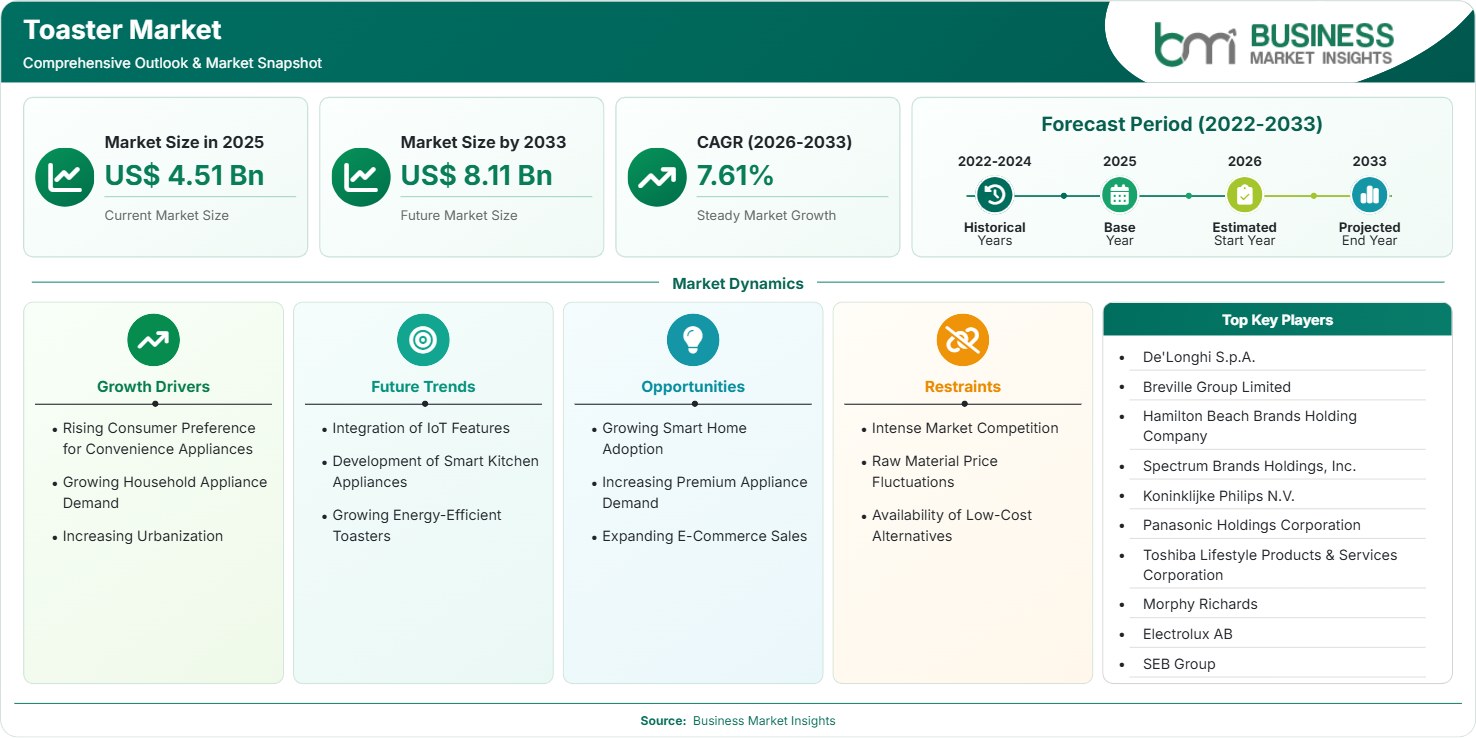
The Toaster Market size was valued at US$ 4.51 Billion in 2025 and is projected to reach US$ 8.11 Billion by 2033, growing at a CAGR of 7.61% during 2026–2033, driven by rising household appliance adoption, smart kitchen integration, premium product innovation, and expanding online retail opportunities.

Report Coverage
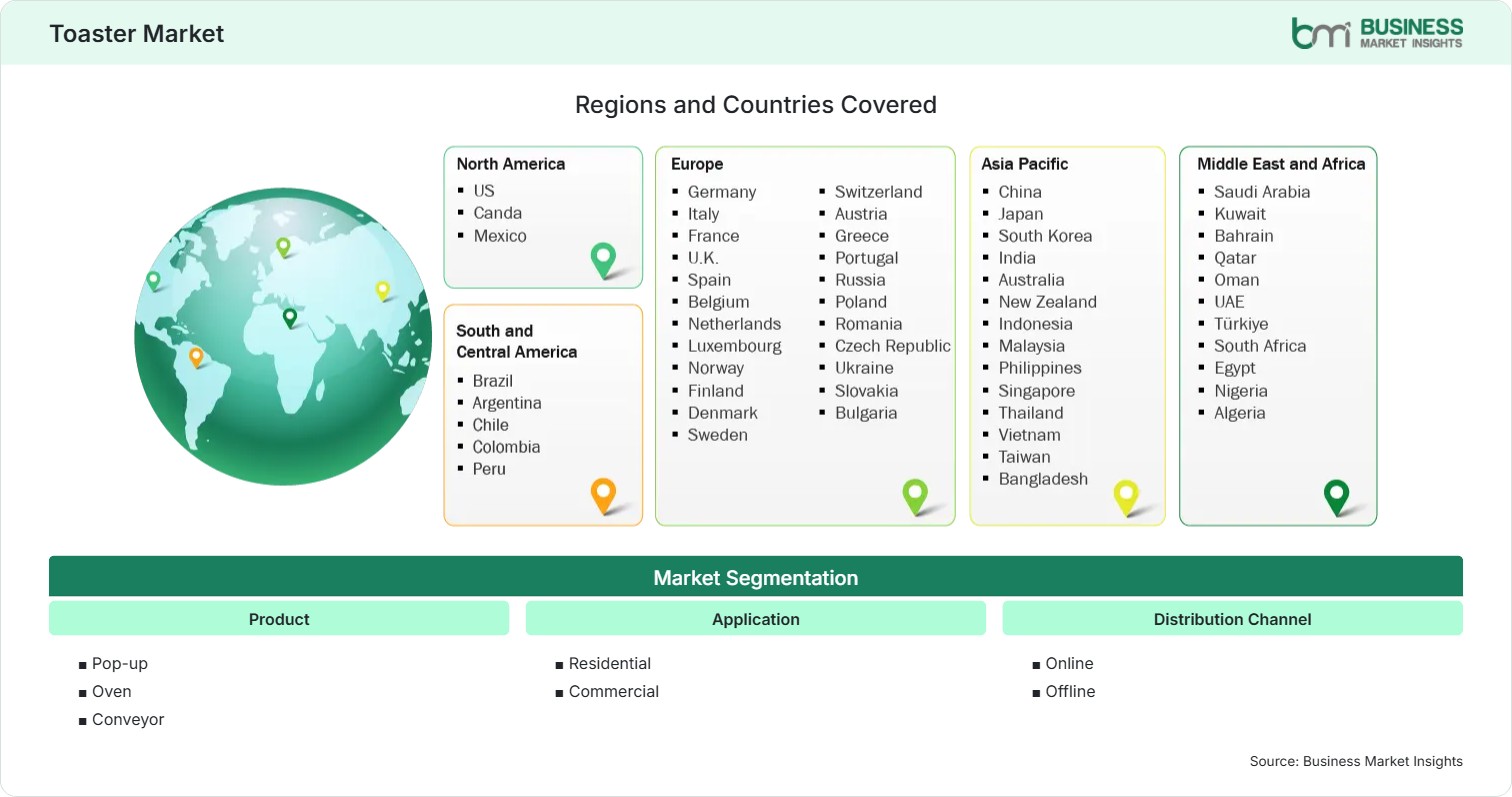
  • Product: Pop-up, Oven, Conveyor
  • Application: Residential, Commercial
  • Distribution Channel: Online, Offline
US$ 4.51 Bn Market size in 2025
US$ 8.11 Bn Market Size by 2033
7.61% CAGR, 2026 - 2033
2026-2033 Forecast Period

01 AI Overview

Toaster Market Summary

  • North America Region: North America holds a 34%–37% share in 2025, growing with a CAGR of 7.20%–7.60% during 2026–2033 due to appliance replacement cycles, smart home adoption, premium kitchen upgrades, and strong retail networks. The US market demonstrates steady expansion with a CAGR of 7.30%–7.70% supported by consumer preference for advanced countertop appliances and connected kitchen solutions.
  • Fastest Growing Region: Asia Pacific accounts for a 27%–30% share in 2025, expanding at a CAGR of 8.10%–8.50% during 2026–2033 due to urbanization, rising disposable income, growing appliance penetration, and increasing e-commerce accessibility across emerging economies.
  • Leading Segment: Pop-up toasters represent the leading product category with a 55%–59% share in 2025, growing at a CAGR of 7.00%–7.40% due to affordability, convenience, compact design, and widespread residential usage.
  • High Growth Segment: Online distribution channels represent the fastest-growing segment with a 9.00%–9.50% CAGR during 2026–2033, supported by digital shopping adoption, broader product comparisons, promotional campaigns, and increasing direct-to-consumer appliance sales.
  • Key Market Opportunity: Manufacturers can capitalize on connected appliances, energy-efficient designs, customized browning technologies, and premium product categories as consumers increasingly prioritize convenience, automation, and improved kitchen experiences.
  • Major Market Players: De'Longhi S.p.A., Breville Group Limited, Hamilton Beach Brands Holding Company, Spectrum Brands Holdings, Inc., Koninklijke Philips N.V., Panasonic Holdings Corporation, Toshiba Lifestyle Products & Services Corporation, Morphy Richards, Electrolux AB, and SEB Group.
02 Strategic Insights

Toaster Market: Strategic Insights

Toaster Market Strategic Framework
FREE PDF
Request your free sample
Request free sample
03 Stakeholder View

Key Takeaways

  • The value chain is shifting toward integrated appliance ecosystems, where manufacturers, component suppliers, digital retailers, and technology providers collaborate to improve product functionality, energy efficiency, and customer engagement.
  • Residential consumers remain the primary demand base, but commercial kitchens, hospitality establishments, and foodservice operators are creating additional opportunities for higher-capacity and specialized toaster models.
  • Product innovation is gradually moving towards smart control mechanisms, sensors for heating adjustments, touch-screen displays, and connectivity options which make life more convenient and give users a unique experience.
  • The Asia Pacific region has good expansion opportunities because of the rising number of appliances per household, middle-class populations, and fast adoption of online buying platforms in countries like India and China.
  • Companies are partnering and acquiring other companies to develop a strong competitive advantage by expanding their geographical presence and technology capabilities.
  • Sustainable product development is becoming an important strategic priority, with manufacturers exploring recyclable materials, reduced energy consumption, and longer product lifecycles.
04 Geographic Outlook

Toaster Market Regional Highlights

North America Toaster Market

North America maintains a leading position with a 34%–37% share in 2025 and records a CAGR of 7.20%–7.60% from 2026–2033. The region benefits from mature appliance ownership, frequent replacement cycles, and strong consumer demand for premium kitchen products. The Toaster Market share remains supported by established retail infrastructure and technology adoption.

  • Smart kitchen integration is increasing demand for connected appliances with programmable settings, remote controls, and energy monitoring features across households.
  • Premium product adoption is rising as consumers prefer durable materials, advanced heating technology, and aesthetically designed countertop appliances.
  • Replacement demand continues supporting sales as households upgrade older appliances with efficient and feature-rich models.
  • Retail partnerships and strong brand recognition provide manufacturers with broad consumer access and stable distribution networks.

US Toaster Market

The US market represents the largest contributor within North America, accounting for a 75%–80% share of regional demand in 2025 with a CAGR of 7.30%–7.70% during 2026–2033. Consumer preference for convenience appliances, premium designs, and multifunctional kitchen products supports continued adoption. The market benefits from established brands and extensive e-commerce penetration.

  • Consumers are increasingly selecting appliances with customized browning controls, wider slots, and enhanced safety mechanisms for daily use.
  • Online retailers are improving product discovery through reviews, comparisons, and promotional pricing strategies.
  • Premium appliance brands are expanding offerings targeting consumers seeking advanced kitchen experiences and long-lasting products.

Europe Toaster Market

Europe accounts for a 29%–32% share in 2025 and grows at a CAGR of 6.80%–7.20% during 2026–2033. Germany, the UK, and France represent major markets due to high household appliance penetration and demand for energy-efficient products. The region emphasizes sustainable designs, compact appliances, and premium household solutions. The market growth is supported by replacement demand and innovation.

  • Germany demonstrates strong demand for efficient appliances due to consumer focus on quality, durability, and energy conservation.
  • The UK market benefits from established breakfast consumption patterns and strong online appliance purchasing behavior.
  • France is witnessing increased adoption of stylish countertop appliances aligned with modern kitchen designs.
  • European manufacturers are focusing on recyclable materials and environmentally responsible production approaches.

Asia Pacific Toaster Market

Asia Pacific represents a 27%–30% share in 2025 and expands at a CAGR of 8.10%–8.50% through 2026–2033. China, India, Japan, and South Korea are major contributors, while emerging economies provide significant growth potential. Rising urban populations, increasing disposable income, and expanding digital commerce are accelerating appliance adoption. The Toaster Market trends reflect changing food habits and growing convenience requirements.

  • China benefits from domestic manufacturing capabilities, competitive pricing, and increasing adoption of modern kitchen appliances.
  • India is experiencing rising demand due to urban household growth, improving living standards, and expanding online retail availability.
  • Japan and South Korea continue supporting premium appliance demand through technology-focused consumer preferences.
  • Regional manufacturers are developing affordable models suited for diverse consumer segments.

Rest of World Toaster Market

Latin America, the Middle East, and Africa represent a 6%–9% share in 2025, expanding at a CAGR of 6.50%–7.20% during 2026–2033. Growth is supported by improving retail infrastructure, urban development, and increasing household appliance adoption. Brazil, Mexico, the UAE, and South Africa are emerging markets with improving consumer access. The Toaster Market share remains influenced by affordability and distribution expansion.

  • Latin American countries are experiencing increased demand through expanding supermarkets and digital commerce platforms.
  • Brazil and Mexico provide growth opportunities due to rising household income and appliance modernization.
  • Middle Eastern markets show increasing interest in premium kitchen appliances among urban consumers.
  • African markets are gradually adopting countertop appliances through improved retail networks and import availability.
Global Market Geography
FREE PDF
Request your free sample
Request free sample
05 Segment Analysis

Toaster Market Segmentation

Product

The product segment represents the core structure of the Toaster, with manufacturers focusing on product differentiation, heating efficiency, compact designs, and consumer convenience. This segment held a 2025 share distribution led by pop-up models, while advanced oven and conveyor formats support specialized applications. Product innovation is expected to maintain steady adoption with CAGR ranges of 7.00%–7.80% during 2026–2033.

  • Pop-up: Pop-up models dominate household usage due to compact structures, affordability, and simple operating mechanisms. Manufacturers continue improving browning controls, slot configurations, and safety features to address evolving residential preferences.
  • Oven: Oven models gain adoption among consumers seeking multifunctional cooking capabilities. These products combine toasting, baking, and reheating functions, making them attractive for space-conscious households requiring versatile countertop solutions.
  • Conveyor: Conveyor models serve commercial kitchens, hotels, restaurants, and institutional foodservice environments requiring continuous high-volume operations. Demand is supported by durability, consistent output, and improved operational efficiency.

Application

The application segment defines demand patterns across residential and commercial users. Residential applications represent the dominant consumption base due to increasing household appliance ownership and convenience-focused lifestyles. The Toaster Market scope continues expanding as commercial establishments adopt efficient equipment for food preparation. Overall application demand is projected to maintain a CAGR of 7.20%–7.90% during 2026–2033, supported by lifestyle changes and foodservice expansion.

  • Residential: Residential applications account for major demand as consumers prioritize convenient breakfast preparation, compact kitchen solutions, and affordable countertop appliances for daily household use.
  • Commercial: Commercial applications are growing through restaurants, hotels, cafes, and institutional kitchens requiring reliable equipment capable of handling frequent usage and higher production volumes.

Distribution Channel

Distribution channels influence product accessibility, pricing strategies, and consumer purchasing decisions. Offline channels remain significant due to physical demonstrations and established retail relationships, while online platforms are gaining momentum through convenience and wider product selection. The market trends within distribution indicate increasing digital transformation, with channel expansion expected to support a CAGR of 7.40%–8.00% during 2026–2033.

  • Online: Online channels are expanding rapidly through marketplace platforms, direct-to-consumer websites, customer reviews, and competitive pricing models that improve appliance accessibility.
  • Offline: Offline channels continue supporting purchases through supermarkets, specialty stores, and electronics retailers where consumers prefer direct product evaluation and immediate availability.
06 Market Forces

Toaster Market Dynamics

Key Market Drivers

Rising Consumer Preference for Convenience Appliances

Growing household appliance demand is encouraging manufacturers to expand product portfolios with energy-efficient and user-friendly models. Increasing appliance penetration in emerging economies, supported by rising disposable income and urban housing development, is contributing to market expansion. The Toaster market growth is augmented through consumer needs for reliable kitchen appliances that can provide ease of use without the need for extra space. Businesses are making efforts towards improving manufacturing processes, stronger materials, and heating technologies to enhance the longevity of the product. The growth in retail outlets and online business platforms is also helping to make appliances accessible for all types of consumers.

Growing Household Appliance Demand

Growing household appliance demand is encouraging manufacturers to expand product portfolios with energy-efficient and user-friendly models. Increasing appliance penetration in emerging economies, supported by rising disposable income and urban housing development, is contributing to market expansion. The market growth is strengthened by consumers seeking reliable kitchen equipment that improves convenience without requiring significant space. Companies are investing in improved manufacturing processes, durable materials, and advanced heating mechanisms to increase product lifespan. Retail expansion and digital commerce platforms are further improving access to appliances across consumer groups.

Increasing Urbanization

Increasing urbanization is influencing appliance adoption as compact living spaces create demand for efficient countertop solutions. Urban households often prefer products that provide quick meal preparation while occupying limited kitchen areas. The Toaster Market trends are based on consumer preferences for multifunctional, stylish, and space-efficient kitchen appliances. Increasing urban population in emerging countries is adding to the potential demand by contributing to more household formations and better retail availability. The toaster manufacturers have reacted by producing smaller toaster models, energy efficient toasters, and affordable ranges.

Key Market Opportunities

Growing Smart Home Adoption

The emergence of smart home technologies has opened up opportunities for integration of smart kitchens where the equipment would be digitalized, automated, and integrated. Toaster manufacturers can produce their own range of smart products featuring unique settings and energy management systems. With rising demand for integrated systems among consumers, more appliance manufacturers are interested in producing smart products. It is possible to use innovations to enter premium product segments and engage customers better. The Toaster Market Forecast is based on integration with other automation platforms at home. Those companies that are able to provide connectivity and user-friendly interfaces are likely to become leaders.

Increasing Premium Appliance Demand

The increasing demand for premium appliances is providing opportunities to manufacturers to develop premium products with better material usage, designs, and performance attributes. People are becoming more interested in investing in high-quality products that can fit well into their modern kitchens and offer more utility value. The use of stainless steel construction, better heating systems, and personalized settings is what manufacturers are concentrating on. The manufacturing of premium products not only improves the profitability of manufacturers but also helps in creating differentiation in the brand. Increasing interest in lifestyle-oriented kitchen appliances creates scope for existing brands and niche product manufacturers.

Expanding E-Commerce Sales

Expanding e-commerce sales are creating new opportunities by improving product accessibility, enabling broader geographic reach, and supporting direct customer relationships. Online platforms allow manufacturers to showcase detailed specifications, customer reviews, and comparison tools that influence purchasing decisions. The digital retail revolution is especially useful in emerging markets where the retail infrastructure still lags. Businesses are using online marketing campaigns, logistics networks, and direct selling in order to create greater awareness. E-commerce provides fast time to market as well as promotional tools. With the rising use of Internet research by consumers prior to purchasing, digital media is becoming part of the appliance distribution strategy.

Market Restraints and Challenges

Intense Market Competition

Factor: Intense market competition among global appliance manufacturers increases pricing pressure and requires continuous product differentiation. Impact: Companies may experience reduced margins and higher investment requirements for innovation, branding, and marketing activities. The established brands have competitors that come from regional producers selling low cost products. This makes it difficult to maintain their profit levels since they have to continue upgrading their products and manufacturing processes. There are also many variations of products which make it difficult for consumers to choose. Firms that engage in research and technological upgrade are able to cope with the competition. However, maintaining differentiation remains a significant challenge in a mature appliance category.

Raw Material Price Fluctuations

Factor: Raw material price fluctuations affecting metals, electronic components, and manufacturing inputs increase production cost uncertainty. Impact: Increasing input prices may have an impact on pricing and the overall profitability of appliance makers. Appliance makers rely on the reliable supply of such raw materials as stainless steel, plastics, heating elements, and semiconductors. In case of fluctuating prices, it will be necessary to develop optimal supply chain strategies and become more efficient in operations. Any supply chain problems may cause delays in production planning and inventory control. Nevertheless, managing material cost variations remains an ongoing challenge affecting manufacturing economics and competitive pricing strategies.

07 Company Analysis

Competitive Landscape

The Toaster Market analysis highlights competition among established appliance manufacturers focusing on product innovation, energy efficiency, smart functionality, and geographic expansion. Companies are strengthening portfolios through advanced heating technologies, premium designs, and diversified distribution strategies.

Company Name

Overview

Products and Services relevant to this market

De'Longhi S.p.A.

Global appliance manufacturer specializing in premium kitchen equipment with strong international consumer presence and innovation capabilities.

Provides stylish household toasters featuring adjustable browning controls, advanced heating systems, and premium countertop designs.

Breville Group Limited

Australian appliance company known for innovative kitchen products emphasizing performance, technology, and consumer-focused designs.

Offers premium toaster products with smart heating functions, variable settings, and advanced user convenience features.

Hamilton Beach Brands Holding Company

Consumer appliance company producing kitchen equipment for residential and commercial applications worldwide.

Manufactures household and professional toaster solutions designed for reliability, efficiency, and daily food preparation needs.

Spectrum Brands Holdings, Inc.

Diversified consumer products company offering appliances through established retail channels and recognized brands.

Provides countertop toaster appliances focused on convenience, affordability, and consumer-friendly operational features.

Koninklijke Philips N.V.

Technology company developing consumer lifestyle products with global appliance distribution networks.

Produces household toasters featuring modern designs, safety features, and efficient heating technologies.

Panasonic Holdings Corporation

Electronics manufacturer with expertise in consumer appliances and advanced technology integration.

Develops toaster products incorporating durable components, reliable performance, and energy-efficient operation.

Toshiba Lifestyle Products & Services Corporation

Appliance manufacturer focused on household products combining technology and functional designs.

Offers toaster appliances designed for residential kitchens with convenient controls and efficient heating performance.

Morphy Richards

Consumer appliance brand specializing in innovative kitchen and household solutions.

Provides toaster models featuring stylish designs, practical controls, and user-friendly cooking functions.

Electrolux AB

Global appliance company delivering household solutions with sustainability-focused product development.

Offers kitchen appliances including toaster products designed for efficiency and modern consumer requirements.

SEB Group

International small domestic appliance manufacturer with multiple consumer brands and market reach.

Develops kitchen appliances with functional designs, advanced features, and broad household applications.

10 Trust & Transparency

Research Methodology

The market analysis combines proprietary research with secondary data from government agencies, company disclosures, regulatory filings, industry databases and expert interviews. Market estimates are validated through data triangulation, cross-market benchmarking and analyst review.

View Full Research Methodology

11 Questions Answered

Frequently Asked Questions

What insights are included in the Toaster Market Report?

The report evaluates industry dynamics, competitive positioning, product segmentation, regional developments, growth opportunities, and challenges affecting manufacturers, suppliers, retailers, and investors operating within the global appliance ecosystem.

How is digital retail changing appliance purchasing behavior?

Digital retail platforms are improving consumer access to product information, reviews, pricing comparisons, and broader brand selections. Online channels enable manufacturers to reach new customers, launch products faster, and develop direct relationships with buyers.

What role does sustainability play in appliance development?

Sustainability is influencing appliance design through energy-efficient components, recyclable materials, and longer product lifecycles. Companies are developing products that reduce energy consumption while maintaining performance, responding to increasing consumer and regulatory attention toward environmentally responsible manufacturing.

How are manufacturers improving product differentiation in this category?

Manufacturers are focusing on advanced heating technology, smart controls, aesthetic designs, durable materials, and multifunctional capabilities. These improvements help brands address diverse consumer requirements while creating higher-value product categories across residential and commercial applications.

What factors are influencing consumer preference for modern toaster appliances?

Consumers are increasingly selecting toaster appliances with customizable settings, improved safety mechanisms, compact designs, and energy-efficient operation. Demand is also influenced by changing lifestyles, smaller urban kitchens, and growing interest in premium countertop appliances offering enhanced convenience.

Access the Full Toaster Market Report

Get segment-level forecasts, regional estimates, competitive benchmarking, company profiles and downloadable Excel datasets.

Access the full Toaster Market Report
350 pages PDF & Excel | 2026-08-07