
Moisturizer Market Outlook: Size, Share, Trends, Growth Analysis, Competitive Landscape & Forecast, 2026-2033

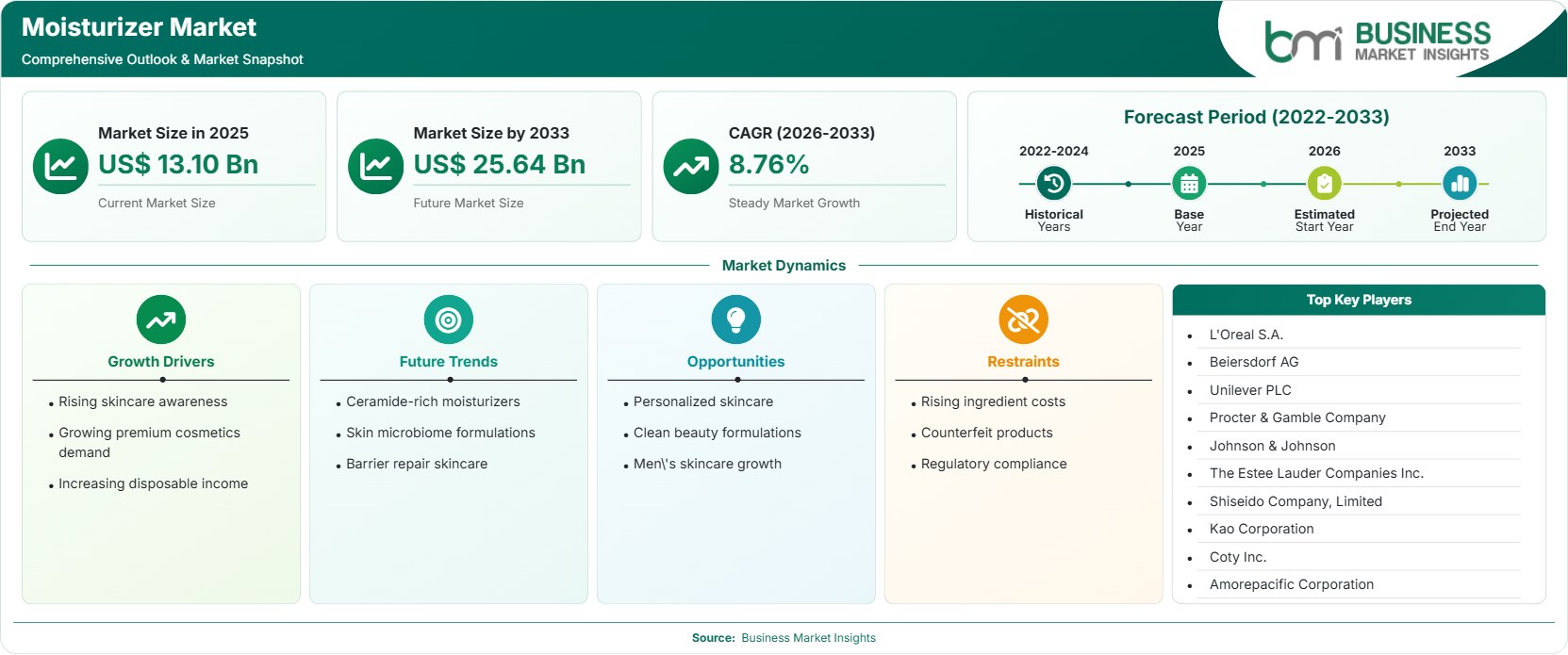
The Moisturizer Market size was valued at US$ 13.10 billion in 2025 and is projected to reach US$ 25.64 billion by 2033, growing at a CAGR of 8.76% during 2026–2033, driven by rising skincare awareness, premium cosmetics demand, increasing disposable income, personalized skincare adoption, clean beauty innovation, and expanding men’s grooming trends.

Report Coverage
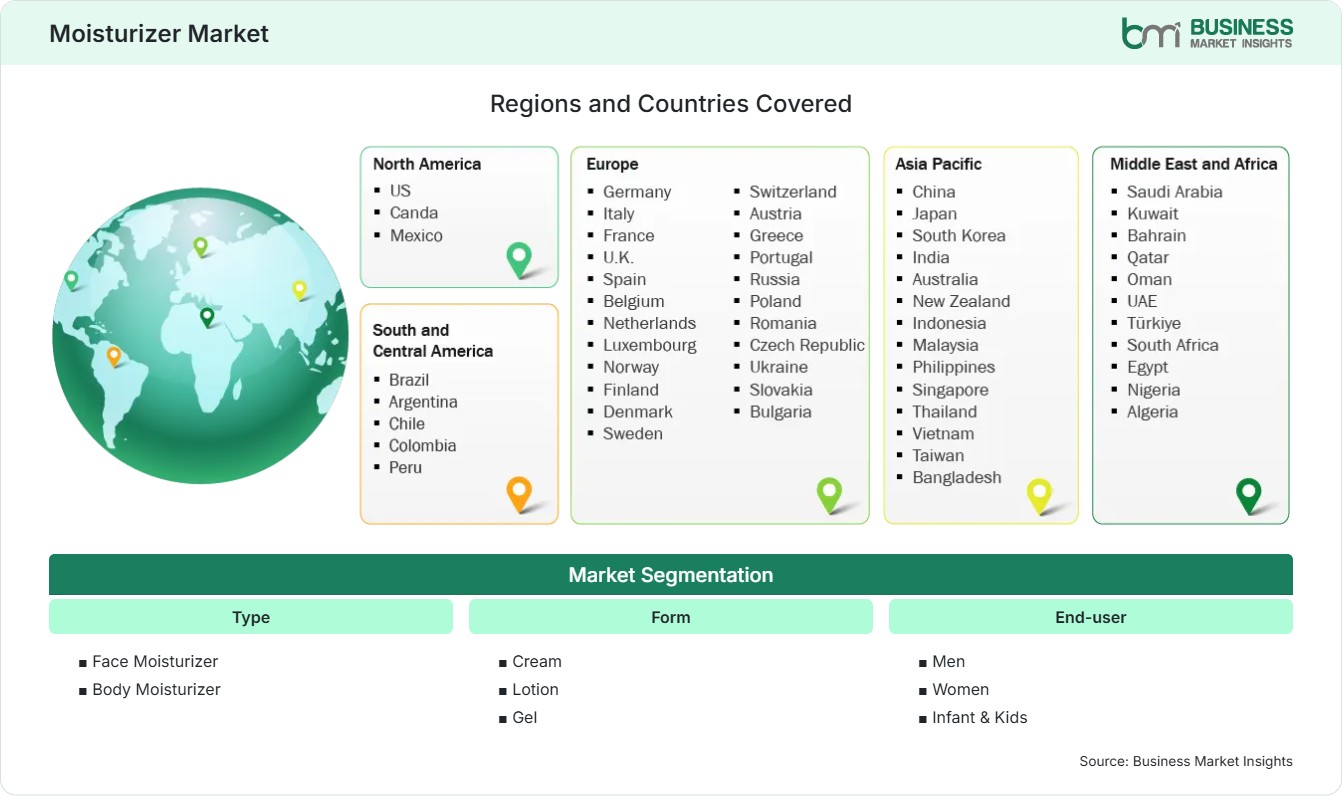
  • Type: Face Moisturizer, Body Moisturizer
  • Form: Cream, Lotion, Gel
  • End-user: Men, Women, Infant & Kids
US$ 13.10 Bn Market size in 2025
US$ 25.64 Bn Market Size by 2033
8.76% CAGR, 2026 - 2033
2026-2033 Forecast Period

AI Overview

Moisturizer Market Summary

  • North America Region: North America accounts for an estimated 30%–34% share in 2025 and is projected to grow at a CAGR of 8.0%–8.5% during 2026–2033. Premium skincare adoption, dermatology-backed products, ingredient innovation, and personalized beauty solutions create opportunities. The U.S. market remains a major contributor with a CAGR of 8.1%–8.6%, supported by strong demand for advanced skincare formulations and premium brands.
  • Fastest Growing Region: Asia Pacific holds approximately 34%–38% share in 2025 and is expected to expand at a CAGR of 9.5%–10.2% through 2033. Rising beauty consciousness, expanding middle-class consumers, e-commerce penetration, and growing demand for multifunctional skincare products support regional growth.
  • Leading Segment: Face Moisturizer represents around 62%–66% share in 2025 and is expected to grow at a CAGR of 8.8%–9.2%. Increasing facial skincare routines, anti-aging demand, and preference for targeted hydration products continue driving adoption.
  • High Growth Segment: Gel formulations account for approximately 22%–26% share in 2025 and are projected to expand at a CAGR of 9.2%–9.8%. Lightweight textures, suitability for humid climates, and demand for non-greasy skincare solutions support growth.
  • Key Market Opportunity: Personalized skincare technologies, clean beauty formulations, digital beauty platforms, and rising men’s skincare adoption create opportunities for brands to develop targeted moisturizer solutions.
  • Major Market Players: L'Oréal S.A., Beiersdorf AG, Unilever PLC, Procter & Gamble Company, Johnson & Johnson, The Estée Lauder Companies Inc., Shiseido Company, Limited, Kao Corporation, Coty Inc., Amorepacific Corporation.
Strategic Insights

Moisturizer Market: Strategic Insights

Moisturizer Market Strategic Framework
FREE PDF
Request your free sample
Request free sample
Stakeholder View

Key Takeaways

  • The skincare value chain is becoming increasingly innovation-driven, with brands focusing on ingredient science, formulation differentiation, digital marketing, and direct consumer engagement.
  • Premium facial care products represent a major growth opportunity as consumers increasingly seek specialized hydration, anti-aging benefits, and dermatological performance.
  • Product development is shifting toward clean beauty, personalized formulations, multifunctional products, and sustainable packaging solutions aligned with changing consumer preferences.
  • Asia Pacific offers strong investment potential due to expanding beauty markets, rising skincare awareness, increasing online shopping adoption, and growing premium product demand.
  • Companies are pursuing acquisitions, partnerships, and portfolio expansion strategies to strengthen positions in emerging skincare categories and capture evolving consumer segments.
Geographic Outlook

Moisturizer Market Regional Highlights

North America Moisturizer Market

North America represented approximately 30%–34% of the global market in 2025 and is projected to expand at a CAGR of 8.0%–8.5% during 2026–2033. The region benefits from high skincare spending, strong brand presence, advanced cosmetic research, and demand for premium formulations. The Moisturizer Market share remains significant due to consumer preference for dermatologist-recommended products and innovative skincare solutions across the United States and Canada.

  • The United States remains the largest regional contributor due to strong demand for premium skincare products, online beauty retail, and innovative formulations.
  • Canada supports growth through increasing interest in clean beauty products, natural ingredients, and specialized skincare solutions.
  • Brands are expanding personalized skincare offerings using consumer data, digital consultations, and targeted product recommendations.
  • Sustainable packaging and environmentally responsible formulations are gaining importance among consumers and manufacturers.

US Moisturizer Market

The United States accounted for approximately 26%–30% of global revenue in 2025 and is expected to register a CAGR of 8.1%–8.6% through 2033. The country remains a major skincare market due to high consumer awareness, premium beauty spending, and strong demand for multifunctional products. The Moisturizer Market growth is influenced by e-commerce expansion, ingredient-focused purchasing decisions, and increasing interest in personalized skincare.

  • Premium skincare brands continue expanding through digital channels, subscription models, and targeted consumer engagement strategies.
  • Consumers are increasingly seeking products containing active ingredients such as hyaluronic acid, peptides, and botanical extracts.
  • Men’s grooming adoption is creating new opportunities through specialized hydration and skincare product launches.

Europe Moisturizer Market

Europe held an estimated 24%–28% share in 2025 and is forecast to grow at a CAGR of 7.4%–8.0% between 2026 and 2033. The region benefits from emerging Moisturizer Market trends, including strong cosmetic regulations, established beauty brands, and growing consumer preference for sustainable and clean skincare products. Germany, France, the United Kingdom, and Italy remain important markets due to mature beauty industries and demand for premium formulations.

  • France remains a leading skincare market supported by luxury cosmetics, scientific formulations, and strong beauty brand heritage.
  • Germany demonstrates demand for natural, dermatological, and environmentally responsible skincare solutions.
  • The United Kingdom continues expanding through premium skincare adoption and online beauty retail channels.
  • European consumers increasingly prioritize ingredient transparency, sustainability, and ethical product development.

Asia Pacific Moisturizer Market

Asia Pacific accounted for approximately 34%–38% of the market in 2025 and is expected to achieve the fastest growth with a CAGR of 9.5%–10.2% through the Moisturizer Market Forecasts. Rising beauty awareness, urbanization, increasing disposable income, and expanding digital commerce are driving regional demand. China, Japan, South Korea, and India represent major growth markets with strong consumer interest in innovative skincare products.

  • China remains a major contributor due to expanding beauty consumption, e-commerce growth, and demand for premium skincare brands.
  • South Korea influences regional trends through advanced cosmetic innovation, ingredient research, and beauty technology adoption.
  • Japan maintains strong demand for high-quality skincare products emphasizing hydration, anti-aging, and sensitive skin care.
  • India represents a growing opportunity due to rising skincare awareness and increasing adoption of premium personal care products.

Rest of World Moisturizer Market

The Rest of World region accounted for approximately 7%–10% share in 2025 and is projected to grow at a CAGR of 8.5%–9.2% during the forecast period. Latin America, the Middle East, and Africa are experiencing increasing skincare demand due to urbanization, rising beauty awareness, and expanding retail accessibility. Growth opportunities are supported by premium cosmetics adoption and broader consumer interest in personal care routines.

  • Brazil represents a significant Latin American market due to strong beauty culture and increasing skincare product consumption.
  • Mexico supports regional growth through expanding retail networks and growing interest in premium personal care products.
  • Middle Eastern markets show demand for luxury skincare products and advanced hydration formulations.
  • African markets provide emerging opportunities through urbanization, rising incomes, and expanding beauty distribution channels.
  • Regional brands are increasingly introducing products tailored to local climate conditions and consumer preferences.
Global Market Geography
FREE PDF
Request your free sample
Request free sample
Segment Analysis

Moisturizer Market Segmentation

Type

The Type segment accounted for approximately 68%–72% of the Moisturizer Market revenue in 2025 and is projected to grow at a CAGR of 8.5%–9.0% during 2026–2033. Consumer skincare routines are increasingly focused on targeted hydration, skin barrier protection, and specialized formulations. Brands are expanding product portfolios across facial and body care categories by incorporating active ingredients, multifunctional benefits, and dermatological positioning to meet diverse consumer requirements.

  • Face Moisturizer: Face moisturizers represent the dominant category due to increasing facial skincare routines, anti-aging concerns, hydration requirements, and demand for specialized formulations targeting different skin types.
  • Body Moisturizer: Body moisturizers continue gaining adoption as consumers prioritize complete skincare routines, improved skin health, seasonal hydration, and products designed for dry or sensitive skin conditions.

Form

The Form segment represented approximately 74%–78% of the Moisturizer Market in 2025 and is expected to expand at a CAGR of 8.6%–9.1% through 2033. Product texture, absorption speed, convenience, and skin compatibility are influencing consumer preferences. Manufacturers are developing advanced formulations across creams, lotions, and gels to address changing lifestyle needs and regional climate conditions.

  • Cream: Cream-based moisturizers remain widely preferred due to rich hydration properties, suitability for dry skin, and effectiveness in barrier repair and intensive skincare applications.
  • Lotions: Lotions maintain strong demand due to lightweight textures, easy application, affordability, and suitability for daily body care routines across broad consumer segments.
  • Gel: Gel moisturizers are gaining popularity due to fast absorption, cooling effects, lightweight texture, and preference among consumers in humid climates and oily skin categories.

End-user

The End-user segment accounted for approximately 88%–92% share in 2025 and is projected to grow at a CAGR of 8.4%–8.9% through 2033. Changing beauty standards, increased skincare education, and broader product availability are encouraging adoption across different consumer groups. Brands are developing targeted products for men, women, and children with specific ingredient profiles and skin requirements.

  • Men: Men’s moisturizer demand is increasing due to growing grooming awareness, rising skincare participation, and introduction of products designed specifically for male skin needs.
  • Women: Women remain the largest consumer group due to established skincare routines, premium beauty adoption, and demand for hydration, anti-aging, and multifunctional skincare products.
  • Infant & Kids: Infant and kids moisturizers are gaining demand as parents prioritize gentle, dermatologically tested products designed to support sensitive skin and maintain skin health.
Market Forces

Moisturizer Market Dynamics

Key Market Drivers

Rising Skincare Awareness

Increasing consumer awareness regarding skin health, hydration, and preventive skincare practices is a major factor supporting market expansion. Consumers are becoming more knowledgeable about ingredients, skin types, and the importance of consistent skincare routines through social media, beauty influencers, dermatological content, and digital platforms. This awareness is encouraging adoption among younger demographics and expanding skincare participation among previously underserved consumer groups. The growing emphasis on maintaining healthy skin barriers and addressing specific concerns such as dryness, sensitivity, and aging is supporting Moisturizer Market growth. Brands are responding by introducing targeted formulations with scientifically supported ingredients, personalized recommendations, and educational marketing strategies that improve consumer engagement.

Growing Premium Cosmetics Demand

Increasing preference for premium beauty products is driving demand for advanced moisturizer formulations with specialized ingredients, enhanced textures, and multifunctional benefits. Consumers are increasingly willing to invest in products offering improved performance, dermatological positioning, and luxury experiences. High-end skincare brands are increasing their product lines by developing products that contain peptides, botanicals, ceramides, and other active compounds meant to target particular skin problems. Increased sales of cosmetics via online platforms and purchases driven by influencers are also contributing to the increased adoption of high-end products. The trend towards quality-oriented skincare consumption is driving skincare companies to focus on researching, packaging, and differentiating their products.

Increasing Disposable Income

Rising disposable income in emerging economies is expanding access to skincare products and accelerating adoption of premium personal care categories. The consumers in developing nations are shifting their spending patterns towards beauty and wellness products with changing urban lifestyles. The growth in the middle class, the availability of these products in retail stores, and exposure to international beauty trends are boosting moisturizer consumption among a wider consumer base. The companies are enhancing their distribution channels, offering products tailored to regions, and providing different price points to cater to a wide range of customers. Purchasing power has significantly increased demand for facial moisturizers and related products.

Key Market Opportunities

Growth of Personalized Skincare Solutions

Personalized skincare represents a significant opportunity as consumers increasingly seek products tailored to individual skin conditions, preferences, and environmental factors. Advances in digital beauty consultations, artificial intelligence-based recommendations, and consumer data analysis are enabling brands to offer customized moisturizer solutions. There is an increased development of products tailored towards particular skin types, age groups, weather conditions, and lifestyle needs. Such efforts help create more involvement from consumers, thus increasing their loyalty. Personalization helps brands to distinguish themselves from others through the use of technology and formulating skills. With increased consumer expectation for effectiveness and transparency, personalized moisturizers have the potential of becoming a growth driver in the future.

Expansion of Clean Beauty Formulations

Growing consumer preference for natural ingredients, transparent labeling, and environmentally responsible products is creating opportunities for clean beauty moisturizer development. Consumers are increasingly evaluating ingredient safety, sourcing practices, and sustainability factors when purchasing skincare products. The industry is counteracting with innovations that offer formulas without select synthetic chemicals but use botanical extracts, natural compounds, and sustainable packaging. Clean beauty products are especially impacting premium skincare, where consumers value sustainability and transparency in the process. Firms that invest in sustainable procurement, chemistry, and manufacturing will be able to gain an advantage in the market.

Increasing Demand for Men’s Skincare Products

Growing acceptance of male grooming routines is creating new opportunities within the moisturizer category. Men are increasingly adopting skincare products as awareness around appearance, personal care, and skin health improves. The development of specialized skincare products for men with lightweight formulas and easy-to-follow processes for men’s needs is taking place. Campaigns that highlight grooming and living style are proving to be effective in increasing consumer participation within the category. Male beauty markets continue to grow due to the development of online shopping portals that help remove the barriers faced by men when purchasing skincare products. The growth of male beauty markets can lead to the development of moisturizers for men.

Market Restraints and Challenges

Rising Ingredient Costs

Factor: Increasing costs of raw materials, specialty ingredients, packaging components, and supply chain inputs are creating production challenges for moisturizer manufacturers.

Impact: The higher cost of higher-quality ingredients can increase manufacturing costs and affect the bottom line and product pricing. Formulations that use active ingredients and compounds are especially prone to cost changes. A company may be required to adopt better supply chains, reformulate products, or change its pricing model to remain competitive. It is important for manufacturers to focus on supplier diversity, improved procurement, and formulation to cope with rising costs.

Counterfeit Product Growth

Factor: Increasing availability of counterfeit skincare products through unauthorized sellers and online marketplaces creates challenges for established moisturizer brands.

Impact: The production of counterfeit products poses risks to brand image, erodes consumer trust, and may pose safety risks, as the ingredients used in their production may not have been approved by the relevant authorities. This problem raises the need for more effective authentication techniques and the need to monitor the use of safe packaging.

Company Analysis

Competitive Landscape

The competitive landscape is shaped by global beauty conglomerates, formulation innovation, brand positioning, sustainability initiatives, and expansion across digital and retail channels. The Moisturizer Market analysis highlights increasing competition among leading skincare companies focusing on advanced hydration technologies, clean beauty formulations, personalized skincare solutions, premium product development, and consumer-focused product portfolios.

Company Name

Overview

Products and Services relevant to this market

L'Oréal S.A.

Global beauty company offering extensive skincare products across mass, premium, and dermatological categories.

Facial moisturizers, body care products, anti-aging hydration solutions, skincare formulations, and personalized beauty technologies.

Beiersdorf AG

German skincare company known for established brands and scientifically developed skin health solutions.

Moisturizers, facial care, body care, sensitive skin solutions, hydration products, and dermatological skincare.

Unilever PLC

Global consumer goods company with strong personal care and skincare product portfolios.

Moisturizing creams, lotions, skincare products, beauty brands, personal care solutions, and sustainable formulations.

Procter & Gamble Company

Multinational consumer products company with broad beauty and skincare offerings.

Facial moisturizers, body care products, skincare treatments, hydration products, and beauty care solutions.

Johnson & Johnson

Healthcare and consumer products company focused on science-based skincare solutions.

Baby moisturizers, sensitive skin products, dermatologist-recommended skincare, hydration creams, and body care products.

The Estée Lauder Companies Inc.

Premium beauty company specializing in luxury skincare and advanced cosmetic formulations.

Premium moisturizers, anti-aging skincare, hydration products, luxury skincare collections, and targeted treatments.

Shiseido Company, Limited

Japanese beauty company recognized for innovative skincare research and premium products.

Facial moisturizers, advanced hydration products, anti-aging solutions, skincare technology, and beauty formulations.

Kao Corporation

Japanese consumer goods company serving skincare and personal care markets globally.

Moisturizers, lotions, facial care products, sensitive skincare solutions, and functional beauty products.

Coty Inc.

Global beauty company with skincare and cosmetic product capabilities.

Skincare products, moisturizing formulations, beauty solutions, premium personal care products, and brand development.

Amorepacific Corporation

South Korean beauty company focused on innovative skincare and cosmetics.

Moisturizers, hydration products, clean beauty formulations, K-beauty skincare solutions, and advanced cosmetic technologies.

Industry Activity

Recent Developments

July 2026

Fixderma re-entered the men's skincare segment with a six-product range including a moisturiser, as the dermatology-led brand targets ₹300 crore in revenue this fiscal. The company expects the men's range to contribute 2–3% of overall revenue by the end of the current fiscal, capitalising on India's evolving male grooming consumer base.

June 2026

CeraVe launched Hydrating Hyaluronic Acid Water Gel Face Moisturizer, an Amazon exclusive, featuring patent-pending Ceramide Booster Technology with pre-ceramides to help boost skin barrier strength. The dry-touch, weightless water gel provides 72-hour hydration and is formulated with Copper PCA, giving it a distinctive blue shade.

February 2026

Viva Cosmetics launched Viva Moisturizer Gel in Surabaya, Indonesia, designed for tropical climate needs with a lightweight, fast-absorbing gel texture that provides a cooling sensation. The product is available in three variants: Glowing Bright (with Niacinamide and Glutathione), Acne Care (with Salicylic Acid and Cica extract), and Hydra Lift (with Sodium Hyaluronate and Collagen).

January 2026

Goop expanded its Youth-Boost franchise with the launch of Youth-Boost NAD+ Peptide Rich Cream, a $105 moisturizer featuring nicotinamide mononucleotide (NMN), a precursor to NAD+. The product is positioned around longevity science and is available through retailers including Ulta, Nordstrom, Credo, and Dermstore.

Trust & Transparency

Research Methodology

The market analysis combines proprietary research with secondary data from government agencies, company disclosures, regulatory filings, industry databases and expert interviews. Market estimates are validated through data triangulation, cross-market benchmarking and analyst review.

View Full Research Methodology

Questions Answered

Frequently Asked Questions

What does the Moisturizer Market Report cover?

The report covers market size, segmentation, regional trends, competitive landscape, growth drivers, opportunities, challenges, company developments, and strategic insights through 2033.

How is technology influencing moisturizer product development?

Technology is enabling personalized skincare recommendations, ingredient innovation, digital consultations, advanced formulations, and improved product targeting based on individual consumer requirements.

Which region offers the highest growth opportunity?

Asia Pacific provides strong growth opportunities due to expanding beauty markets, rising middle-class populations, e-commerce penetration, and increasing adoption of premium skincare products.

Which moisturizer type has the largest market demand?

Face moisturizers represent the leading category due to increasing facial skincare routines, demand for targeted hydration, anti-aging solutions, and specialized formulations for different skin types.

What factors are driving the Moisturizer Market growth?

The market is driven by increasing skincare awareness, premium cosmetics demand, rising disposable income, personalized skincare adoption, clean beauty trends, and growing participation from male consumers.

Access the Full Moisturizer Market Report

Get segment-level forecasts, regional estimates, competitive benchmarking, company profiles and downloadable Excel datasets.

Access the full Moisturizer Market Report
350 pages PDF & Excel | 2026-07-31
Similar Research

Related Market Reports