
Handicraft Market Outlook: Size, Share, Trends, Growth Analysis, Competitive Landscape & Forecast, 2026-2033

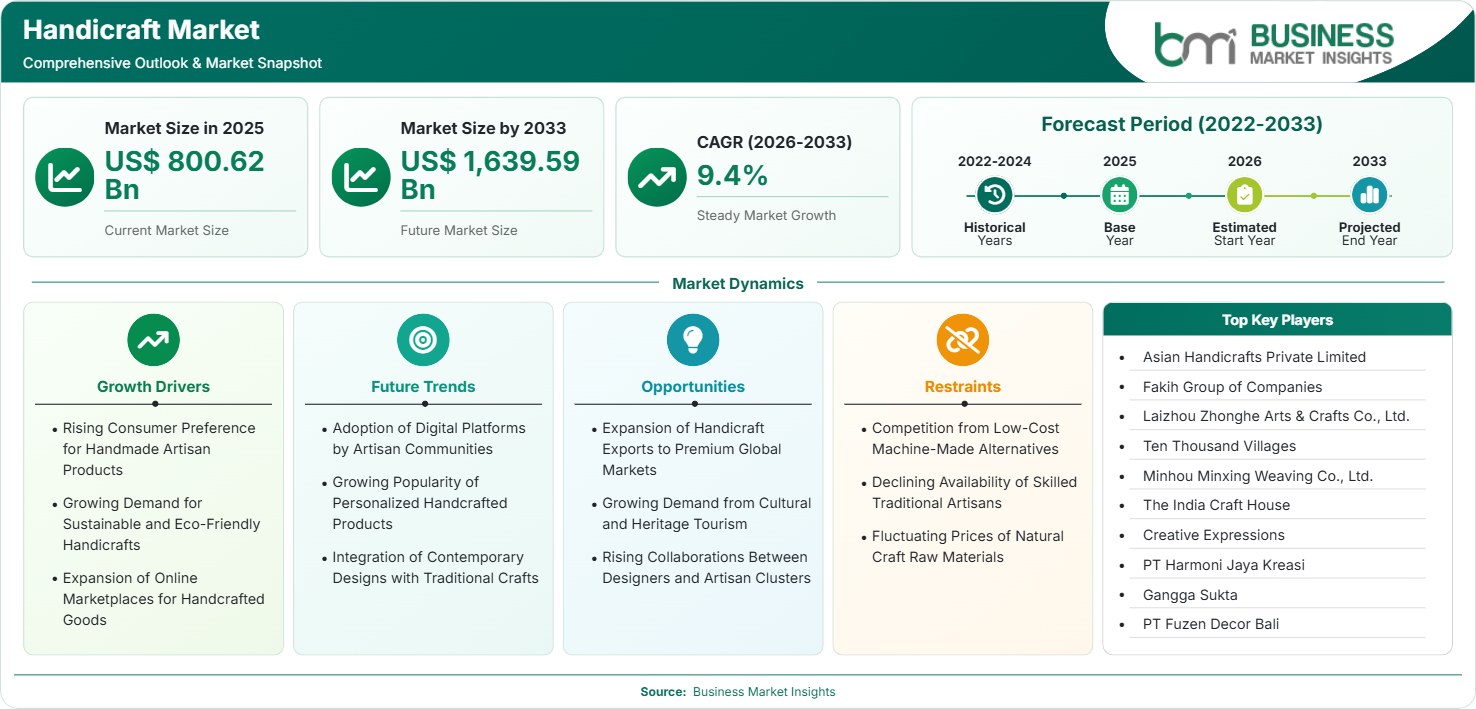
The Handicraft Market size was valued at US$ 800.62 Billion in 2025 and is projected to reach US$ 1,639.59 Billion by 2033, growing at a CAGR of 9.4% during 2026–2033. Growth is driven by rising consumer preference for artisanal products, increasing demand for sustainable home décor, growing cultural tourism, expansion of online handicraft retailing, and rising appreciation for handmade and customized products.

Report Coverage
  • Product: Woodworks, Metal Artworks, Hand-printed Textiles & Embroidered Goods, Imitation Jewelry, Others
  • End-user: Residential, Commercial
  • Distribution Channel: Specialty Stores, Independent Retailers, Online Stores, Others
US$ 800.62 Bn Market size in 2025
US$ 1,639.59 Bn Market Size by 2033
9.4% CAGR, 2026 - 2033
2026-2033 Forecast Period

01 AI Overview

Handicraft Market Summary

  • North America Region: North America holds a market share of 28%–31% in 2025, growing at a CAGR of 8.4%–9.2% during 2026–2033. Demand is supported by premium home décor spending, interest in sustainable products, and increasing adoption of handmade lifestyle goods. The U.S. remains the dominant market, advancing at a CAGR of 8.6%–9.4%.
  • Fastest Growing Region: Asia Pacific accounts for 35%–38% of revenue in 2025 and is projected to register a CAGR of 10.2%–11.0% through 2033. Rich craft traditions, growing e-commerce penetration, and increasing disposable incomes continue supporting market development.
  • Leading Segment: Hand-printed Textiles & Embroidered Goods hold a market share of 29%–33% in 2025 and are expected to grow at a CAGR of 9.8%–10.6%. Demand is driven by appreciation for traditional craftsmanship, fashion applications, and home furnishing products.
  • High Growth Segment: Online Stores account for 24%–28% of market revenue in 2025 and are projected to register a CAGR of 10.5%–11.3% during the forecast period. Greater accessibility, global reach, and direct-to-consumer sales models continue supporting expansion.
  • Key Market Opportunity: Growing global demand for authentic handmade products, ethical sourcing practices, and artisan-focused commerce platforms is creating significant opportunities for handicraft manufacturers and retailers.
  • Major Market Players: Asian Handicrafts Private Limited, Fakih Group of Companies, Laizhou Zhonghe Arts & Crafts Co., Ltd., Ten Thousand Villages, Minhou Minxing Weaving Co., Ltd., The India Craft House, Creative Expressions, PT Harmoni Jaya Kreasi, Gangga Sukta, and PT Fuzen Decor Bali.
02 Strategic Insights

Handicraft Market: Strategic Insights

Handicraft Market Strategic Framework
FREE PDF
Request your free sample
Request free sample
03 Stakeholder View

Key Takeaways

  • The handicraft market analysis includes artisans, cooperatives, exporters, specialty retailers, online marketplaces, tourism operators, and home décor distributors.
  • Textile-based handicrafts remain among the most attractive opportunities due to strong applications in fashion, gifting, interior decoration, and cultural merchandise.
  • Product innovation increasingly focuses on sustainable materials, contemporary designs, personalization options, and fusion craft techniques.
  • Asia Pacific provides the strongest growth potential supported by rich handicraft heritage, extensive artisan networks, and expanding export opportunities.
  • Digital commerce channels continue transforming market dynamics by enabling global reach for local craft producers and artisan communities.
  • Hospitality, commercial interiors, and luxury lifestyle segments are increasingly incorporating handcrafted products to create differentiated customer experiences.
04 Geographic Outlook

Handicraft Market Regional Highlights

North America Handicraft Market

North America accounted for 28%–31% of global revenue in 2025 and is projected to expand at a CAGR of 8.4%–9.2% through 2033. Rising demand for handcrafted home décor, sustainable lifestyle products, and artisan-made gifts continues supporting market growth. The market share in the region is strengthened by increasing consumer preference for personalized products and growing adoption of ethically sourced handcrafted goods across residential and commercial sectors.

  • Consumers increasingly favor handmade and sustainable products that offer authenticity, uniqueness, and cultural value compared to mass-produced alternatives.
  • Home décor and interior design industries continue incorporating handcrafted furniture, textiles, and decorative accessories into premium product offerings.
  • Online artisan marketplaces are expanding access to international handicraft products while supporting direct-to-consumer sales channels.
  • Commercial buyers, including hotels and restaurants, are increasingly sourcing handcrafted products to create distinctive customer experiences.
  • Growing environmental awareness is encouraging demand for products made from renewable, recycled, and responsibly sourced materials.

US Handicraft Market

The United States represented 22%–25% of global revenue in 2025 and is anticipated to register a CAGR of 8.6%–9.4% during the forecast period. Demand is driven by strong spending on premium home décor, personalized gifting products, and artisan-made lifestyle items. Increasing participation in craft-focused retail platforms and growing consumer appreciation for handmade goods continue supporting Handicraft Market growth.

  • Consumers are increasingly seeking customized handcrafted products that reflect personal style and cultural influences.
  • Independent artisans are benefiting from expanding digital commerce platforms and social media-driven marketing strategies.
  • Sustainable and ethically produced handicrafts continue gaining popularity among environmentally conscious buyers.
  • Luxury gifting and premium home décor segments remain important demand contributors across the country.

Europe Handicraft Market

Europe held 24%–27% of global revenue in 2025 and is projected to grow at a CAGR of 8.9%–9.7% through 2033. Strong cultural heritage, established artisan traditions, and growing demand for sustainable consumer products support market expansion. Germany remains the leading market with a CAGR of 9.0%–9.8%, while Poland is the fastest-growing country, expanding at a CAGR of 9.8%–10.6%.

  • Consumers increasingly value traditional craftsmanship, heritage-inspired designs, and locally sourced handmade products.
  • Demand for handcrafted furnishings and decorative accessories continues expanding across residential and hospitality applications.
  • Germany maintains leadership through strong consumer purchasing power and established artisan product distribution networks.
  • Poland is experiencing accelerated growth due to rising disposable incomes and increasing interest in handmade premium products.
  • Sustainability initiatives continue encouraging demand for environmentally friendly artisan-made goods.

Asia Pacific Handicraft Market

Asia Pacific accounted for 35%–38% of global revenue in 2025 and is expected to remain the fastest-growing region, registering a CAGR of 10.2%–11.0% through 2033. Rich craft traditions, large artisan communities, growing tourism activity, and expanding digital retail ecosystems continue driving market growth. China remains the largest regional market with a CAGR of 10.0%–10.8%, while India records the highest growth at 10.8%–11.6%.

  • Strong export activity continues supporting demand for handmade textiles, décor items, jewelry, and artisan accessories.
  • China benefits from a large manufacturing and export ecosystem serving global handicraft distribution networks.
  • India continues to witness strong growth due to government support for artisans and rising international demand for traditional crafts.
  • Growth in tourism and cultural commerce is creating additional opportunities for local craft producers.
  • Online retail platforms are enabling artisans to access international customers and expand brand visibility.

Rest of World Handicraft Market

The Rest of World region accounted for 9%–11% of global revenue in 2025 and is expected to register a CAGR of 8.8%–9.6% through 2033. Market growth is supported by increasing tourism activity, cultural preservation initiatives, and expanding exports of locally produced artisan goods. Demand remains particularly strong for handcrafted decorative products and traditional cultural artifacts.

Brazil is the leading market in South & Central America and is forecast to grow at a CAGR of 9.0%–9.8%. In the Middle East & Africa, the United Arab Emirates is expected to be the fastest-growing country with a CAGR of 9.3%–10.1%.

  • Brazil continues benefiting from strong craft traditions and growing domestic demand for artisan-made home décor products.
  • The United Arab Emirates is witnessing rising demand for premium handcrafted products through luxury retail and tourism channels.
  • Cultural heritage programs are supporting artisan communities and preserving traditional production techniques.
  • Export-oriented handicraft businesses continue expanding access to international markets.
  • Hospitality and tourism industries remain key purchasers of locally crafted souvenirs and decorative products.
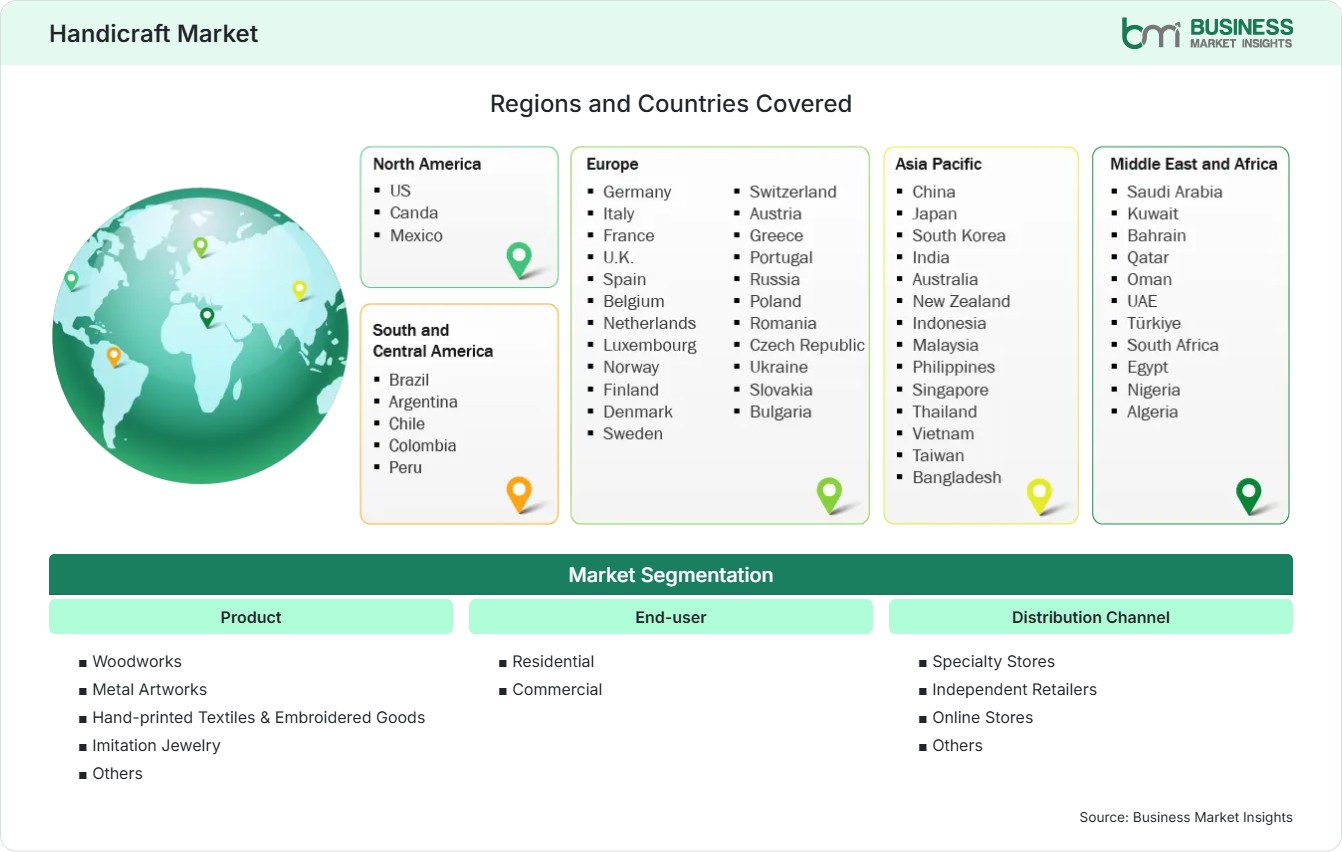
Global Market Geography
FREE PDF
Request your free sample
Request free sample
05 Segment Analysis

Handicraft Market Segmentation

Product

Product diversity remains a defining characteristic of the market, allowing artisans and manufacturers to cater to varying consumer preferences across décor, fashion, gifting, and lifestyle applications. This segment accounted for approximately 29%–33% market share in 2025 and is expected to grow at a CAGR of 9.8%–10.6% through 2033. The Handicraft Market forecast suggests a rapid expansion as consumers seek authentic and culturally significant handcrafted products that offer uniqueness and aesthetic value.

  • Woodworks: Demand is supported by increasing use of handcrafted furniture, decorative accessories, wall art, and functional household products within residential and commercial spaces.
  • Metal Artworks: Metal handicrafts remain popular due to durability, artistic appeal, and growing adoption in luxury décor and gifting applications.
  • Hand-printed Textiles & Embroidered Goods: Traditional craftsmanship, customization possibilities, and rising demand for artisanal fashion and home furnishings continue supporting segment growth.
  • Imitation Jewelry: Increasing consumer preference for affordable fashion accessories and ethnic-inspired designs drives steady demand across multiple demographics.

End-user

End-user demand is influenced by changing lifestyle preferences, interior design trends, and growing appreciation for handmade products. This segment accounted for approximately 62%–66% market revenue in 2025 and is projected to expand at a CAGR of 9.2%–10.0% through 2033. Growing adoption across residential and commercial settings continues strengthening market expansion globally.

  • Residential: Households increasingly purchase handcrafted décor, furniture, textiles, and accessories to create personalized and aesthetically distinctive living environments.
  • Commercial: Hotels, resorts, restaurants, offices, and retail spaces incorporate handicrafts to enhance ambiance, cultural authenticity, and customer experience.

Distribution Channel

Distribution channels play a critical role in connecting artisans with domestic and international consumers. This segment accounted for approximately 24%–28% market share in 2025 and is forecast to register a CAGR of 10.5%–11.3% through 2033. Handicraft Market share gains are increasingly driven by digital commerce and expanding global accessibility of handmade goods.

  • Specialty Stores: These outlets provide curated product selections and attract consumers seeking authentic handcrafted and artisan-made products.
  • Independent Retailers: Local retailers continue serving as important distribution partners for regional artisans and niche handicraft producers.
  • Online Stores: Digital platforms enable wider market reach, direct-to-consumer sales, international visibility, and improved accessibility for artisans and buyers alike.
06 Market Forces

Handicraft Market Dynamics

Key Market Drivers

Rising Consumer Preference for Handmade Artisan Products

There is an increasing consumer preference for goods that are unique, authentic, and culturally meaningful. Artisan-made goods are distinct from mass-produced goods for their craftsmanship, heritage, and individuality. The need for unique household decor and gift-giving keeps demand increasing. Younger consumers, in particular, find handcrafted products appealing because they are creative, exclusive, and emotionally meaningful. With consumers valuing quality and uniqueness, demand for artisan-made handicrafts will continue to grow.

Growing Demand for Sustainable and Eco-Friendly Handicrafts

Sustainability has become an important factor influencing consumer buying behavior in the consumer goods industry. Handicrafts often incorporate natural, recycled, or renewable materials along with processes that involve minimal negative impact on the environment. Consumers are becoming more inclined towards environmentally sound products that help support sustainable lifestyle behaviors. The eco-footprint of artisan products is usually lower compared to that of industrial goods. This handicraft market trend is motivating manufacturers to place greater emphasis on ecological sources and sustainable production.

Expansion of Online Marketplaces for Handcrafted Goods

The evolution of e-commerce platforms has made markets highly accessible to crafters and craft companies. Through online trading platforms, there is an opportunity to create a global presence via sales channels that require little physical infrastructure. Digital marketing and social commerce have enabled craft makers to become more visible to customers and increase their sales. Consumers benefit from being able to choose from a more diverse range of products and easily discover new specialty products.

Key Market Opportunities

Expansion of Handicraft Exports to Premium Global Markets

Demand for authentic handcrafted products continues rising in premium consumer markets across North America, Europe, and parts of Asia. International buyers increasingly seek artisan-made products that reflect cultural heritage and traditional craftsmanship. This creates opportunities for exporters and artisan networks to expand global sales while accessing higher-value customer segments. Manufacturers focusing on quality standards, sustainable sourcing, and premium positioning are well placed to capitalize on expanding international demand and increasing appreciation for handmade goods.

Growing Demand from Cultural and Heritage Tourism

Tourism remains an important demand generator for handicrafts, particularly in destinations known for their cultural heritage and traditional artisan communities. Travelers frequently purchase locally crafted goods as souvenirs, gifts, and decorative items. Governments and tourism organizations continue promoting cultural experiences that highlight traditional craftsmanship and artisan products. As cultural tourism gains popularity globally, handicraft producers are expected to benefit from increased exposure, visitor spending, and retail opportunities linked to tourism activities.

Rising Collaborations Between Designers and Artisan Clusters

Collaborations between contemporary designers and artisan communities are creating new opportunities for product innovation and handicraft market expansion. These partnerships combine traditional craftsmanship with modern aesthetics, allowing handicraft products to appeal to broader consumer segments. Such collaborations also help artisans access premium markets and strengthen product differentiation. Increasing interest from fashion, interior design, and lifestyle brands is expected to generate new growth avenues while supporting preservation of traditional craft skills.

Market Restraints and Challenges

Competition from Low-Cost Machine-Made Alternatives

Factor: Mass-produced products manufactured using automated processes are often available at significantly lower prices than handcrafted alternatives. Impact: Price-sensitive consumers may prefer machine-made products, reducing competitiveness for artisan producers in certain market segments. Lower-priced alternatives can place pressure on profit margins and make it challenging for handicraft businesses to scale production while maintaining traditional craftsmanship. This challenge is particularly significant in highly competitive retail environments where pricing remains a major purchasing criterion.

Declining Availability of Skilled Traditional Artisans

Factor: Many traditional craft skills are experiencing reduced participation as younger generations pursue alternative employment opportunities and urban migration increases. Impact: A shrinking artisan workforce may limit production capacity, reduce knowledge transfer, and threaten preservation of specialized craftsmanship techniques. Businesses dependent on highly skilled artisans may face challenges maintaining product quality and meeting increasing demand. This issue could affect long-term sustainability for certain handicraft categories that rely heavily on traditional manual production methods.

07 Company Analysis

Competitive Landscape

Market fragmentation exists due to the existence of artisan associations, handicraft exporters, specialist retailing firms, and craft-based manufacturers. There is a focus by firms on the authenticity of the products, sustainability, exports, and e-commerce efforts. The continued international value of handmade products continues to influence the Handicraft Market.

Company Name

Overview

Products and Services Relevant to this Market

Asian Handicrafts Private Limited

Manufacturer and exporter specializing in handcrafted home décor and lifestyle products.

Decorative handicrafts, furniture, gift items, artisan home accessories.

Fakih Group of Companies

Diversified business group engaged in handcrafted products and international trade activities.

Home décor products, artisan goods, handcrafted lifestyle products.

Laizhou Zhonghe Arts & Crafts Co., Ltd.

Chinese manufacturer focused on woven and decorative handicraft products.

Woven crafts, home decoration items, storage and lifestyle products.

Ten Thousand Villages

Global fair-trade retailer supporting artisan communities worldwide.

Handmade gifts, décor products, jewelry, textiles, artisan accessories.

Minhou Minxing Weaving Co., Ltd.

Producer of handcrafted weaving products for domestic and export markets.

Woven baskets, décor products, storage solutions, artisan furnishings.

The India Craft House

Indian handicraft retailer promoting traditional artisan-made products.

Handcrafted décor, textiles, gifting products, cultural merchandise.

Creative Expressions

Craft-focused company offering handmade artistic and decorative products.

Decorative crafts, artisan creations, specialty gift products.

PT Harmoni Jaya Kreasi

Indonesian handicraft manufacturer serving local and export markets.

Wooden crafts, home décor items, handmade accessories.

Gangga Sukta

Artisan-focused producer known for traditional handcrafted décor products.

Handcrafted furniture, décor products, cultural artisan collections.

PT Fuzen Decor Bali

Indonesian décor manufacturer specializing in handcrafted home accessories.

Home decoration products, artisan furnishings, handcrafted lifestyle goods.

08 Industry Activity

Recent Developments

July 2026

The Ministry of Textiles announced the Indie Haat 2026 exhibition, showcasing India's handloom and handicraft heritage, with over 85 artisans and weavers participating to promote traditional crafts and support artisan livelihoods ahead of Bharat Tex 2026.

July 2026

Poompuhar announced new gifting and export initiatives and a collaboration with Reliance Retail to market and sell handicrafts made by Tamil Nadu artisans across Reliance's retail network, aiming to expand domestic and international market access for traditional crafts.

March 2026

Ten Thousand Villages expanded its fair-trade artisan sourcing initiatives and introduced new handcrafted collections supporting artisan communities across multiple regions. The expansion strengthens its ethical sourcing strategy while offering consumers a broader selection of sustainably produced handmade products.

November 2025

The India Craft House strengthened its digital commerce capabilities by expanding its online product portfolio and improving direct-to-consumer accessibility. The initiative enhances customer reach, supports growing e-commerce demand, and promotes wider availability of handcrafted products across domestic markets.

10 Trust & Transparency

Research Methodology

The market analysis combines proprietary research with secondary data from government agencies, company disclosures, regulatory filings, industry databases and expert interviews. Market estimates are validated through data triangulation, cross-market benchmarking and analyst review.

View Full Research Methodology

11 Questions Answered

Frequently Asked Questions

What challenge has the greatest long-term impact on the industry?

The declining availability of skilled traditional artisans poses a significant challenge because it affects production capacity, craftsmanship preservation, and long-term supply sustainability.

How are online stores influencing market growth?

Online stores provide artisans with global visibility, direct customer access, lower distribution barriers, and broader product reach across international markets.

Why is Asia Pacific the fastest-growing region?

The region benefits from large artisan populations, rich cultural traditions, growing e-commerce penetration, and strong export demand for handmade products.

Which product segment leads the market?

Hand-printed Textiles & Embroidered Goods represent the leading segment due to strong demand from fashion, home furnishing, and gifting applications.

What is driving growth in the Handicraft Market report?

Increasing consumer preference for handmade products, sustainability awareness, personalized décor trends, and expanding online sales channels are the primary growth drivers.

Access the Full Handicraft Market Report

Get segment-level forecasts, regional estimates, competitive benchmarking, company profiles and downloadable Excel datasets.

Access the full Handicraft Market Report
350 pages PDF & Excel | 2026-07-30