
Colour Cosmetics Market Outlook: Size, Share, Trends, Growth Analysis, Competitive Landscape & Forecast, 2026-2033

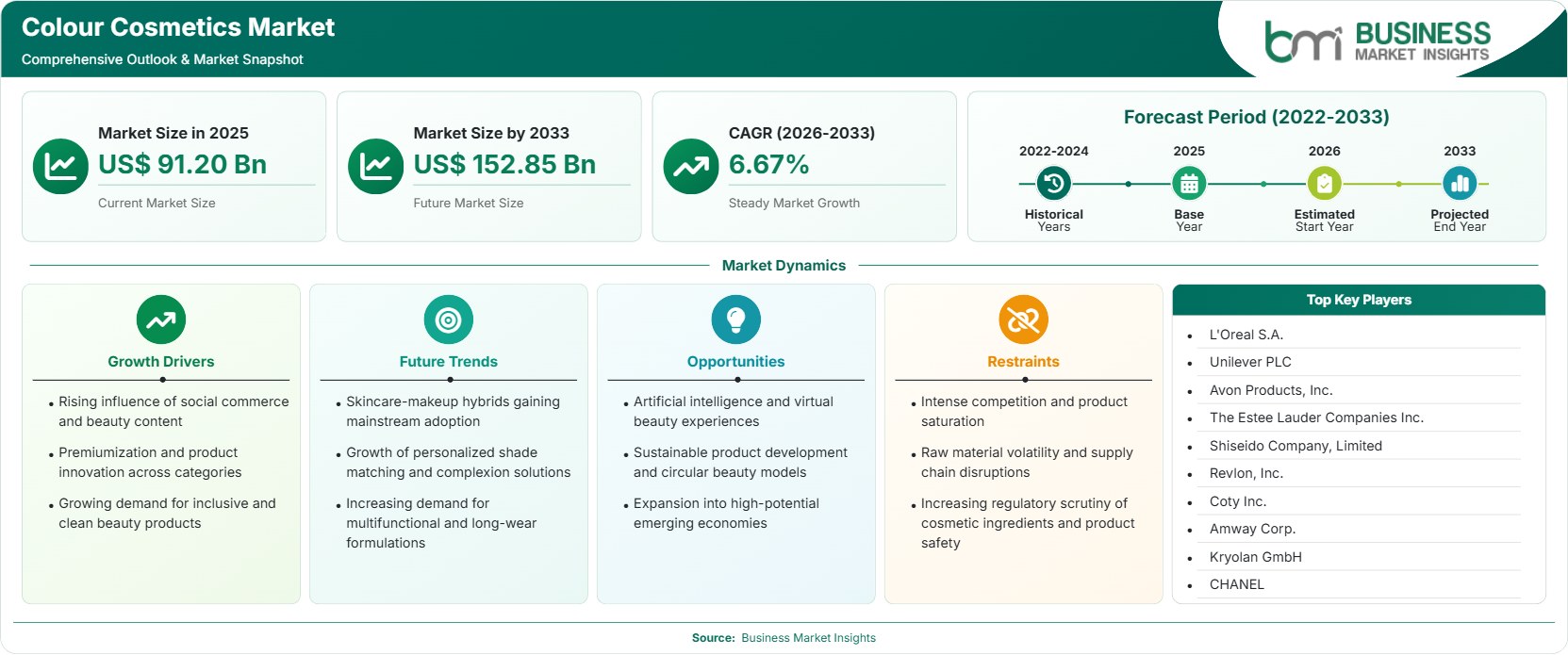
The Colour Cosmetics Market size was valued at US$ 91.20 billion in 2025 and is projected to reach US$ 152.85 billion by 2033, growing at a CAGR of 6.67% during 2026–2033, driven by premium beauty product demand, digital beauty engagement, product personalization, social commerce expansion, sustainable formulations, and innovation in multifunctional cosmetic solutions.

Report Coverage
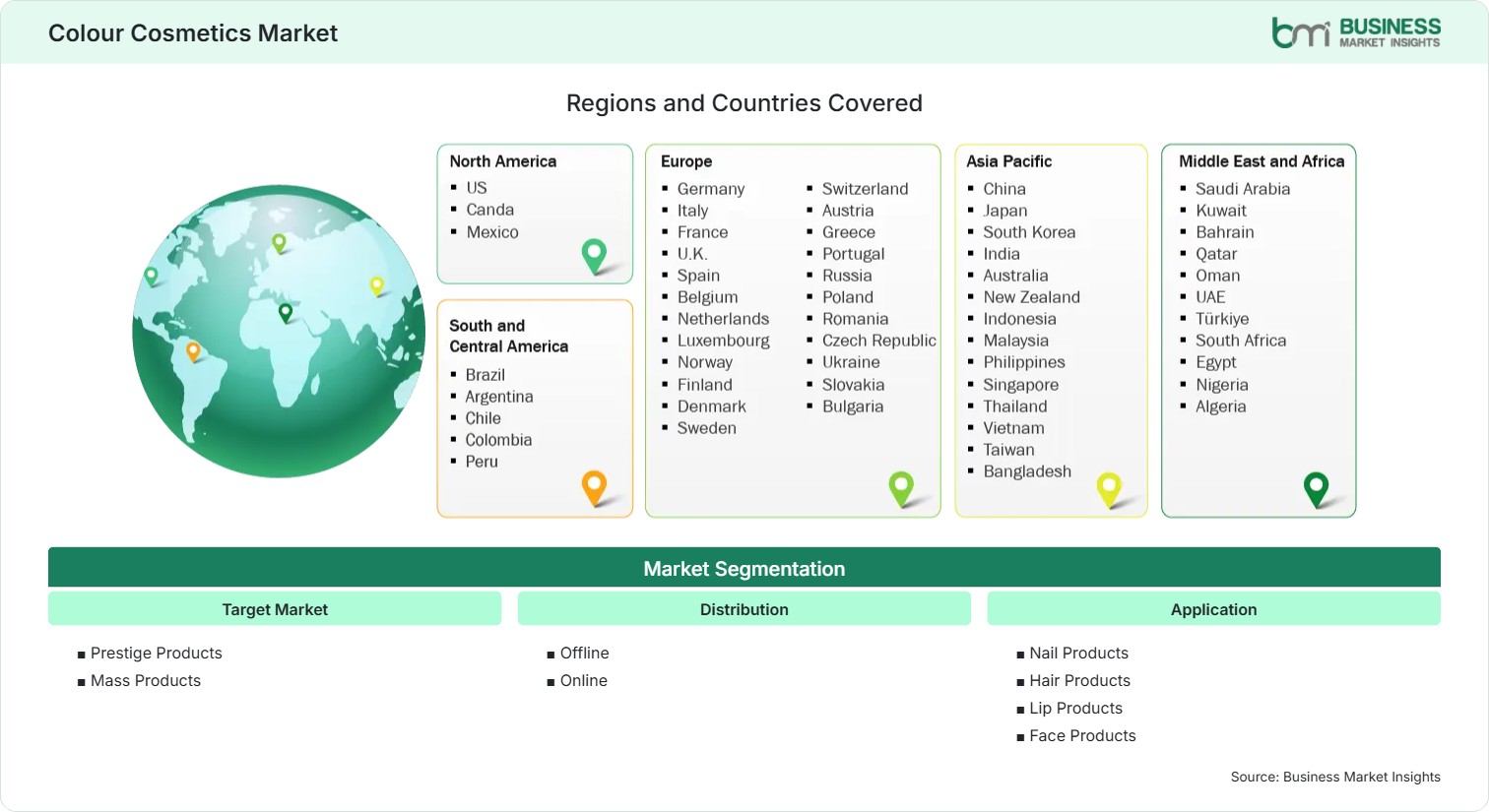
  • Target Market: Prestige Products, Mass Products
  • Distribution: Offline, Online
  • Application: Nail Products, Hair Products, Lip Products, Face Products
US$ 91.20 Bn Market size in 2025
US$ 152.85 Bn Market Size by 2033
6.67% CAGR, 2026 - 2033
2026-2033 Forecast Period

AI Overview

Colour Cosmetics Market Summary

  • North America Region: North America holds a market share of 32%–35% in 2025, growing with a CAGR of 5.8%–6.4% during 2026–2033, influenced by premium product adoption, influencer-led marketing, omnichannel retail expansion, clean beauty demand, personalized cosmetics, innovation in formulations, advanced product launches, strong brand loyalty, digital engagement, and consumer spending growth. Brief US market analysis: The U.S. dominates regional demand through premiumization and digital beauty ecosystems, advancing at a CAGR of 5.9%–6.5% through 2033.
  • Fastest Growing Region: Asia Pacific holds a market share of 28%–31% in 2025, growing with a CAGR of 7.8%–8.5% during 2026–2033, supported by rising disposable income, expanding beauty-conscious populations, e-commerce penetration, social media influence, urbanization, premium product accessibility, youth demographics, local brand innovation, and digital retail transformation.
  • Leading Segment: Mass Products hold a market share of 58%–61% in 2025, growing with a CAGR of 6.2%–6.9% during 2026–2033, supported by affordability, extensive retail availability, increasing beauty awareness, wider shade portfolios, frequent product launches, strong consumer accessibility, and expansion across emerging economies.
  • High Growth Segment: Online distribution holds a market share of 29%–32% in 2025, growing with a CAGR of 8.1%–8.8% during 2026–2033, driven by social commerce adoption, direct-to-consumer strategies, virtual try-on technologies, mobile shopping convenience, influencer engagement, personalized recommendations, broader product discovery, and digital payment adoption.
  • Key Market Opportunity: Integration of artificial intelligence, augmented reality beauty tools, personalized formulations, and sustainability-focused product development is creating differentiated consumer experiences while strengthening premium product positioning globally.
  • Major Market Players: L'Oréal S.A., Unilever PLC, Avon Products, Inc., The Estée Lauder Companies Inc., Shiseido Company, Limited, Revlon, Inc., Coty Inc., Amway Corp., Kryolan GmbH, and CHANEL.
Strategic Insights

Colour Cosmetics Market: Strategic Insights

Colour Cosmetics Market Strategic Framework
FREE PDF
Request your free sample
Request free sample
Stakeholder View

Key Takeaways

  • The industry’s ecosystem is progressively incorporating ingredient suppliers, formulators, beauty technology companies, contract manufacturing organizations, and retail platforms in order to expedite innovation and increase speed-to-market in a variety of consumer segments.
  • Online distribution and premium product lines present the best growth possibilities through revenues since there is an increased consumer preference for personalization, digital interaction, and global access to cosmetics.
  • Product innovation trends include skincare-cosmetics combinations, vegan formulas, sustainable ingredients, refills, and augmented reality purchases that allow for greater consumer interactions.
  • The Asia Pacific region is an attractive investment location considering the growing middle class, growing awareness of beauty, high e-commerce penetration, and growing premium cosmetic products demand.
  • Mergers and acquisitions, along with portfolio expansion, will be among the most important competitive strategies for multinational corporations, considering the increasing presence in the categories, geographic expansion, and ability to interact with consumers.
  • The demand for products that have a wider range of shades and ethical sources for the ingredients is impacting the priorities for product innovations.
Geographic Outlook

Colour Cosmetics Market Regional Highlights

North America Colour Cosmetics Market

North America accounts for approximately 32%–35% of global revenue in 2025 and is projected to grow at a CAGR of 5.8%–6.4% through 2033. The high purchasing power of consumers, premium adoption of beauty products, and advanced retail infrastructure ensure consistent demand. Digital marketing and influencer-led product launches will keep impacting the purchase process. The Colour Cosmetics Market share remains substantial in the region due to high penetration of international brands, expanding clean beauty offerings, and strong demand for personalized cosmetic products among diverse consumer groups.

  • Cosmetic brands of high end are now offering cosmetics which are infused with skin care benefits as well, meeting the demands of consumers who require multipurpose beauty solutions that offer both aesthetic as well as health benefits.
  • Marketing through influencers and social media marketing continues to be an important factor in product discovery for younger generations in search of authenticity and trend-based beauty solutions.
  • Use of technology such as virtual try-ons and AI-based beauty consultations is being implemented by retailers to increase consumer interaction and decrease purchasing confusion.
  • Increasing preference for cruelty-free, vegan, and sustainable beauty products is forcing companies to reformulate their product line-ups.

US Colour Cosmetics Market

The United States represents approximately 76%–80% of North American revenue in 2025 and is expected to register a CAGR of 5.9%–6.5% through 2033. Consumer preference for premium brands, strong beauty retail networks, and rapid adoption of beauty technology platforms support market expansion. High engagement with social commerce and influencer-led purchasing trends contributes to sustained demand. Investments in inclusive product portfolios and personalized beauty experiences continue strengthening competitive differentiation across the national cosmetic landscape.

  • Beauty companies are using consumer data analysis more often for recommendation purposes, marketing effectiveness, and increased customer loyalty through various retail channels.
  • The premium makeup segment still outperforms several traditional segments of beauty products owing to innovation in product formulation, luxuriousness of products, and consumers’ desire to invest in self-care products.
  • The growth in multicultural demographics is driving more inclusiveness of shades and product development among leading cosmetic segments.
  • The direct-to-consumer distribution approach allows companies to engage their customers better and gather insights for future product innovation.

Europe Colour Cosmetics Market

Europe contributes approximately 26%–29% of global revenue in 2025 and is forecast to expand at a CAGR of 5.5%–6.1% through 2033. Support from premium beauty culture, awareness of sustainability, and luxury cosmetics consumption are among the drivers of demand in this market. France leads in terms of regional markets, but the Eastern European nations show higher growth potential due to higher disposable income and expenditures on beauty products.

  • France is the leading regional consumer in terms of its beauty heritage, premium brand dominance, and local demand for advanced cosmetic products.
  • Poland ranks as one of the fastest-growing regions because of rising investments in beauty products, e-commerce growth, and better penetration of international brands.
  • Programs aimed at sustainability are encouraging more sales of packages that can be recycled, refillable products, and environmental responsibility.
  • The beauty industry continues to invest in research and development of their products.

Asia Pacific Colour Cosmetics Market

Asia Pacific represents approximately 28%–31% of global revenue in 2025 and is expected to achieve a CAGR of 7.8%–8.5% through 2033, making it the fastest-growing regional market. Rising disposable income, urbanization, and beauty-conscious younger populations are supporting consumption growth. China remains the largest regional contributor, while India records some of the strongest expansion rates. The Colour Cosmetics Market share in Asia Pacific continues increasing as e-commerce penetration and premium beauty adoption accelerate across major economies.

  • China sustains regional leadership via robust domestic consumption, efficient digital retail infrastructure, and constant innovation from both regional and international beauty brands.
  • India is considered to be one of the fastest-growing regions because of the increase in disposable income, increased e-commerce retail presence, and enhanced beauty awareness among younger consumers.
  • Social commerce is a major factor that impacts purchase decisions due to the ability to discover new products, read reviews, watch tutorials, and interact with beauty influencers.
  • Korean and Japanese beauty innovations drive regional product trends due to formulation technology, skincare benefits, and aesthetic product innovation.

Rest of World Colour Cosmetics Market

Rest of World accounts for approximately 9%–11% of global revenue in 2025 and is projected to expand at a CAGR of 6.3%–7.0% through 2033. The rising awareness of beauty, the development of retail networks, and the power of social media enable adoption in South & Central America, the Middle East, and Africa. Leading international cosmetic companies keep working on their networks to meet growing demands from young customers. Personalized beauty, premium products availability, and the development of e-commerce make markets even more attractive for developing countries.

Brazil is the key market in South & Central America due to a developed beauty culture and high spending on cosmetics per capita. The United Arab Emirates is one of the leaders in premium beauty in the Middle East & Africa region, while Saudi Arabia shows better growth potential owing to higher spending and retail development.

  • Brazil is still propelling regional demand due to the high number of beauty-conscious consumers and increased accessibility of quality cosmetics within the country.
  • Saudi Arabia is among the fastest-growing markets due to rising female workforce participation, growing disposable incomes, and increasing penetration of international beauty brands in colour cosmetics market.
  • The use of social media and influencer-based consumer behavior has increased the rate of consumer awareness and the demand for innovation in the beauty industry.
  • Cosmetics of high quality and luxurious branding have become highly desirable among urban consumers.
Global Market Geography
FREE PDF
Request your free sample
Request free sample
Segment Analysis

Colour Cosmetics Market Segmentation

Target Market

The target market segment reflects diverse consumer purchasing preferences across price points and product positioning strategies. Mass Products account for approximately 58%–61% share in 2025 and are projected to grow at a CAGR of 6.2%–6.9% through 2033. The Colour Cosmetics Market scope continues broadening as affordable beauty products become increasingly accessible through retail chains, digital channels, and emerging market distribution networks, supporting wider consumer adoption and brand penetration.

  • Prestige Products: Premium cosmetics benefit from luxury positioning, advanced formulations, exclusive branding strategies, and growing consumer willingness to invest in high-performance beauty products and personalized experiences.
  • Mass Products: Broad affordability, extensive retail availability, and frequent product launches support strong consumer demand, particularly across emerging economies and price-sensitive demographic segments.

Distribution

The distribution segment is evolving through integration of physical retail and digital commerce ecosystems. Offline channels account for approximately 68%–71% share in 2025 and are projected to expand at a CAGR of 5.4%–6.0% through 2033. Despite digital growth, consumers continue valuing in-store product testing, professional consultations, and immediate product access. Retail innovation remains central to maintaining customer engagement and strengthening purchase confidence.

  • Offline: Department stores, specialty beauty retailers, supermarkets, and branded outlets provide direct product interaction, personalized recommendations, and immersive brand experiences that influence purchasing decisions.
  • Online: Digital platforms offer convenience, extensive product variety, personalized recommendations, virtual try-on experiences, and direct access to international beauty brands.

Application

The application segment demonstrates strong demand diversification across cosmetic categories. Face Products account for approximately 34%–37% share in 2025 and are anticipated to grow at a CAGR of 6.8%–7.4% through 2033. The Colour Cosmetics Market trends increasingly favor multifunctional formulations, skincare-infused makeup, long-lasting performance, and inclusive shade portfolios, encouraging innovation across face-focused cosmetic products and supporting sustained category leadership.

  • Nail Products: Innovation in long-wear finishes, gel technologies, and fashion-driven color palettes continues supporting demand among consumers seeking creative self-expression and professional-quality results.
  • Hair Products: Temporary color solutions and appearance-enhancing formulations are gaining popularity as consumers experiment with personalized beauty styles and trend-driven aesthetics.
  • Lip Products: Demand remains supported by hydration-focused formulations, diverse shade offerings, and product innovations combining color performance with skincare benefits.
  • Face Products: Advanced formulations, broader shade inclusivity, and skincare integration strengthen category leadership while enhancing consumer satisfaction and repeat purchases.
Market Forces

Colour Cosmetics Market Dynamics

Key Market Drivers

Rising Influence of Social Commerce and Beauty Content

The digital beauty ecosystems have been consistently evolving in their ability to change how consumers buy in various markets around the world. Social media has begun to act as a discovery platform, which allows brands to interact with consumers through tutorials, collaborations with influencers, and engaging content. Beauty-oriented creators have been impacting adoption through the demonstration of application techniques. The Colour Cosmetics Market growth is increasingly linked to social commerce integration, where direct purchasing capabilities reduce conversion barriers.

Premiumization and Product Innovation Across Categories

Consumers demand products that are high performing, functional, and provide an elevated experience. The cosmetic industry is meeting this challenge by investing in new pigments, skin care infused products, wear ability technologies, and ingredient transparency programs. There continues to be strong demand for premium cosmetics in the mature economies despite economic turbulence. The premium positioning of products helps brands stand out and make good margins. Innovation is especially evident in face, lip, and multipurpose products.

Growing Demand for Inclusive and Clean Beauty Products

Products that take into account factors such as ethics, the environment, and personal health have become more important for consumers. Companies are introducing products in a wider range of shades, cruelty-free products, and transparency about the ingredients used to cater to these changing tastes. The clean beauty movement focuses on the reduction of controversial ingredients and promotes sustainability goals. The Colour Cosmetics Market growth is reinforced by rising consumer awareness regarding ingredient safety and brand values.

Key Market Opportunities

Artificial Intelligence and Virtual Beauty Experiences

Advances in artificial intelligence and augmented reality are developing new ways of engaging customers and personalizing products. Virtual try-ons are used by consumers to assess colors and formulations prior to purchase, increasing confidence levels and lowering return rates. Increasingly, beauty brands are implementing AI-driven recommendation engines that personalize product recommendations based on skin tone and purchase history. The Colour Cosmetics Market Forecasts for digital beauty technologies remain favorable as retailers continue integrating immersive shopping experiences.

Sustainable Product Development and Circular Beauty Models

Sustainable practices offer significant potential to cosmetics producers looking to grow their business in the long term. More consumers show preference towards brands that are responsible with respect to the environment by utilizing recyclable packaging and refillable products. Companies that are willing to invest in eco-friendly ingredients and sustainable beauty trends may create loyal customers and attract environmentally-conscious consumers.

Expansion into High-Potential Emerging Economies

Urbanization, higher disposable income levels, and higher beauty consciousness are creating an advantageous environment in emerging markets. International beauty firms are improving their local partnerships, digital marketing skills, and distribution networks to boost market penetration. The younger consumer base is very receptive to global beauty fashion trends, making it easier to adopt premium as well as mass-market products. Formulations customized for the local market environment as well as the right product range have made manufacturers better competitors. Beauty stores are also using mobile commerce and social media sites to make themselves more accessible.

Market Restraints and Challenges

Intense Competition and Product Saturation

Factor: The industry features a large number of multinational corporations, regional brands, celebrity-backed labels, and digitally native beauty companies.

Impact: Growing competition implies growing pressure on prices and higher costs of acquiring customers. Multiple product launches may result in market saturation and make differentiation tougher. Heavy investments are required for promotion, innovations, and consumer interaction to ensure visibility. For small players, scaling is a tough task. The fast-changing nature of trends implies shorter product life cycles. All of these elements add to operational complexities.

Raw Material Volatility and Supply Chain Disruptions

Factor: Cosmetic manufacturing relies on pigments, specialty chemicals, packaging materials, and botanical ingredients sourced from global supply networks.

Impact: Price movements and shortages may impact the cost of production and the availability of products. Other factors that may add operational complexities include geopolitical tensions, logistical issues, and regulation shifts. Margins may come under pressure for manufacturers when cost pressures cannot be passed on to the end consumer. Instability in the supply chain could lead to delays in product launches and replenishment activities.

Company Analysis

Competitive Landscape

The competitive environment is characterized by product innovation, premiumization strategies, sustainability initiatives, celebrity endorsements, digital engagement, and omnichannel distribution expansion. Colour Cosmetics Market analysis indicates that leading companies are strengthening portfolios through skincare-infused cosmetics, clean beauty formulations, artificial intelligence-enabled consumer engagement, and strategic investments in emerging markets.

Company Name

Overview

Products and Services relevant to this market

L'Oréal S.A.

Global beauty leader with extensive cosmetic brands spanning luxury, professional, consumer, and dermatological beauty categories across international markets.

Foundations, lipsticks, mascaras, eyeshadows, beauty technology solutions, skincare-infused makeup, and premium cosmetic product portfolios.

Unilever PLC

Multinational consumer goods company with growing beauty and personal care presence supported by innovation and sustainability initiatives.

Color cosmetics, beauty products, skincare-enhanced makeup solutions, digital beauty platforms, and sustainable cosmetic offerings.

Avon Products, Inc.

Direct-selling beauty company with strong presence across emerging and developed markets through broad product accessibility.

Lip products, face cosmetics, nail products, beauty accessories, direct-selling solutions, and personalized beauty offerings.

The Estée Lauder Companies Inc.

Premium beauty company recognized for luxury cosmetic brands, innovation capabilities, and strong global retail presence.

Prestige makeup products, premium foundations, lip colors, beauty technology tools, and luxury cosmetic solutions.

Shiseido Company, Limited

Japanese beauty leader emphasizing advanced research, product innovation, and premium consumer experiences.

Face products, lip products, advanced formulations, skincare-makeup hybrids, and high-performance cosmetic solutions.

Revlon, Inc.

Established cosmetics manufacturer serving diverse consumer segments through broad product portfolios and retail distribution networks.

Nail products, lip products, face cosmetics, beauty accessories, and mass-market cosmetic solutions.

Coty Inc.

Global beauty company with a diverse portfolio spanning prestige and consumer beauty brands.

Premium makeup, nail products, beauty innovations, fragrance-linked cosmetics, and omnichannel beauty solutions.

Amway Corp.

Direct-selling enterprise offering beauty and personal care products through a large independent distributor network.

Cosmetic products, beauty solutions, skincare-integrated makeup, personalized recommendations, and consumer engagement services.

Kryolan GmbH

Professional cosmetics specialist serving beauty professionals, entertainment industries, and commercial makeup applications worldwide.

Professional makeup, face products, color pigments, theatrical cosmetics, and specialized beauty solutions.

CIATÉ London

Beauty brand known for trend-focused cosmetic innovations and fashion-inspired product development.

Nail products, lip products, beauty accessories, color cosmetics, and premium consumer beauty offerings.

CHANEL

Luxury beauty company with strong global recognition and premium cosmetic product portfolios.

Prestige makeup collections, luxury lip products, face cosmetics, beauty innovation, and premium retail experiences.

Trust & Transparency

Research Methodology

The market analysis combines proprietary research with secondary data from government agencies, company disclosures, regulatory filings, industry databases and expert interviews. Market estimates are validated through data triangulation, cross-market benchmarking and analyst review.

View Full Research Methodology

Questions Answered

Frequently Asked Questions

What companies are included in the market report?

The Colour Cosmetics Market Report covers leading participants including L'Oréal S.A., Unilever PLC, Avon Products, Inc., The Estée Lauder Companies Inc., Shiseido Company, Limited, Revlon, Inc., Coty Inc., Amway Corp., Kryolan GmbH, CIATÉ London, and CHANEL.

Why are emerging markets important for future industry expansion?

Emerging economies offer rising disposable incomes, growing urban populations, increasing beauty awareness, expanding retail infrastructure, and strong digital commerce adoption, creating favorable conditions for long-term demand growth.

How is technology influencing cosmetic purchasing decisions?

Artificial intelligence, augmented reality, and digital beauty tools enable personalized recommendations, virtual product testing, and interactive shopping experiences, helping consumers make informed purchasing decisions while improving brand engagement.

Which distribution channel is expanding most rapidly?

Online distribution is the fastest-growing channel due to social commerce adoption, virtual try-on technologies, direct-to-consumer strategies, mobile shopping convenience, and personalized product recommendations that improve purchasing confidence.

What factors are driving consumer preference for premium cosmetics?

Consumers increasingly seek high-performance formulations, skincare benefits, luxury branding, ingredient transparency, and personalized beauty experiences. Premium products also benefit from stronger innovation pipelines and enhanced digital engagement strategies.

Access the Full Colour Cosmetics Market Report

Get segment-level forecasts, regional estimates, competitive benchmarking, company profiles and downloadable Excel datasets.

Access the full Colour Cosmetics Market Report
350 pages PDF & Excel | 2026-09-03