
Halal Cosmetics Market Outlook: Size, Share, Trends, Growth Analysis, Competitive Landscape & Forecast, 2026-2033

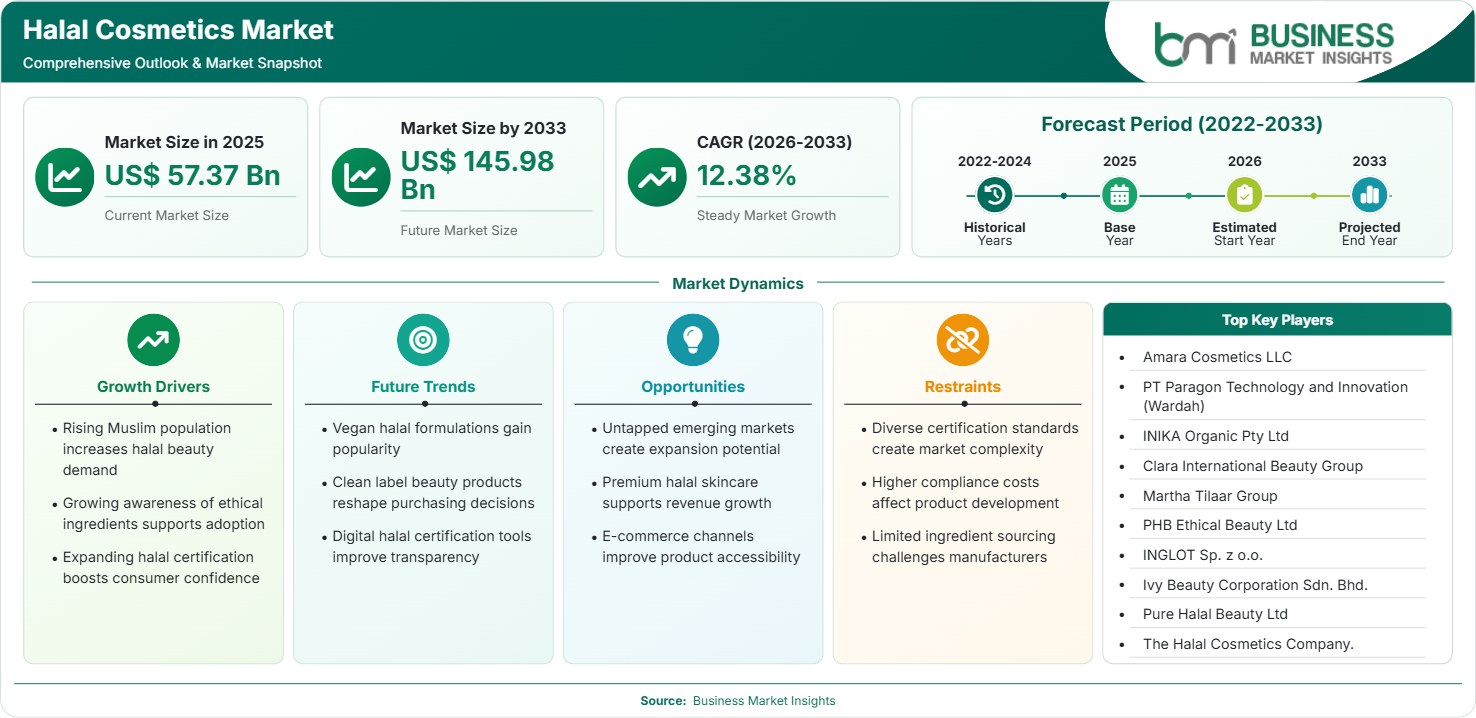
The Halal Cosmetics Market size was valued at US$ 57.37 Billion in 2025 and is projected to reach US$ 145.98 Billion by 2033, growing at a CAGR of 12.38% during 2026–2033. Key drivers include rising Muslim consumer spending, demand for ethical beauty products, expanding halal certification frameworks, clean-label product innovation, e-commerce penetration, and growing acceptance among non-Muslim consumers.

Report Coverage
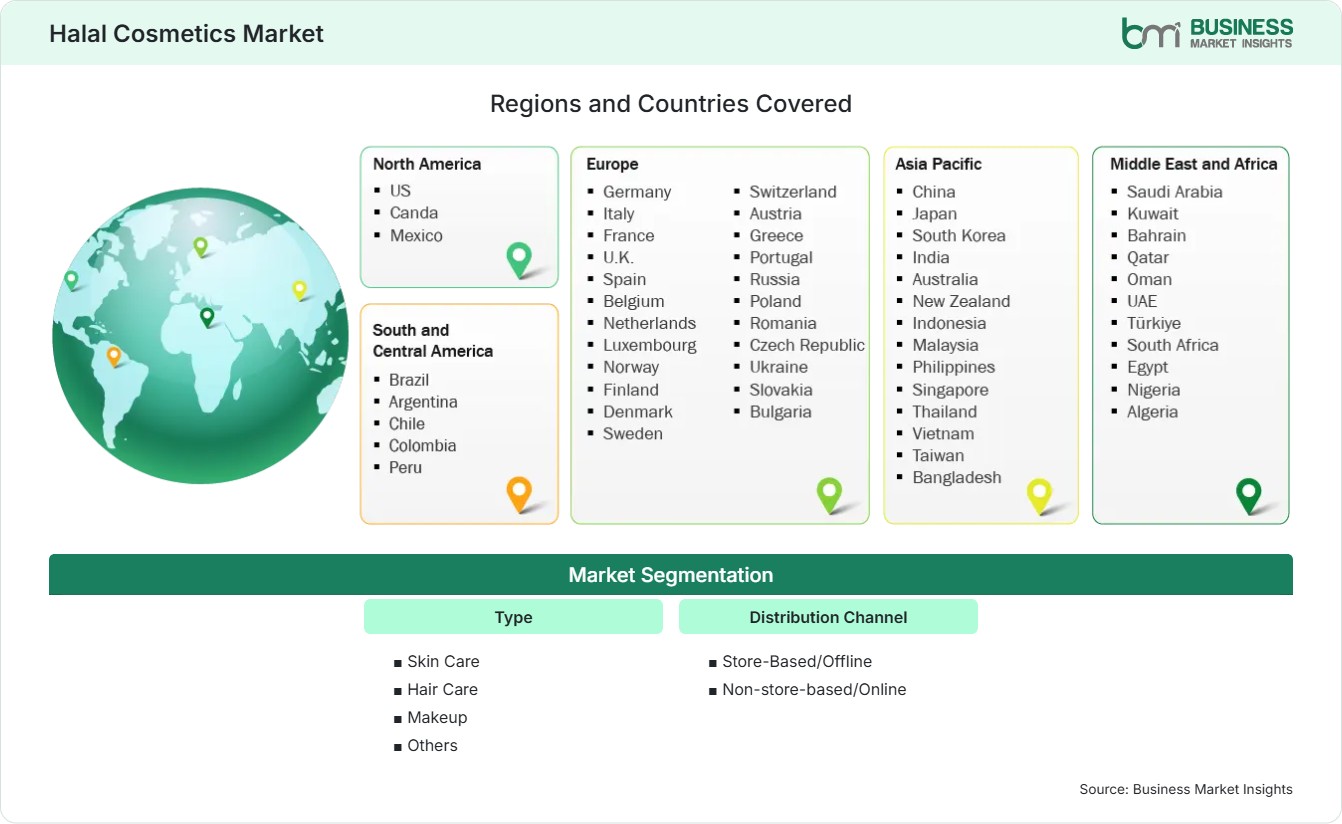
  • Type: Skin Care, Hair Care, Makeup, Others
  • Distribution Channel: Store-Based/Offline, Non-store-based/Online
US$ 57.37 Bn Market size in 2025
US$ 145.98 Bn Market Size by 2033
12.38% CAGR, 2026 - 2033
2026-2033 Forecast Period

AI Overview

Halal Cosmetics Market Summary

  • North America Region: North America holds a market share of 18%–21% in 2025, growing at a CAGR of 10.2%–11.4% during 2026–2033. Growth is supported by ethical beauty demand, ingredient transparency, premium skincare launches, certification awareness, digital retail expansion, multicultural consumer adoption, sustainability preferences, clean formulations, regulatory compliance, influencer engagement, and wellness-driven purchasing decisions. The U.S. market maintains strong momentum through premium halal-certified beauty innovations and online channel expansion, with CAGR estimated at 10.5%–11.5%.
  • Fastest Growing Regaion: Asia Pacific holds a Halal Cosmetics Market share of 39%–42% in 2025 and is forecast to expand at a CAGR of 13.5%–14.7% during 2026–2033. Growth is driven by rising Muslim populations, middle-class expansion, local brand innovation, digital commerce growth, halal certification adoption, beauty awareness, income increases, regional manufacturing investments, influencer marketing, urbanization, and export-oriented product development.
  • Leading Segment: Skin Care accounts for 41%–44% share in 2025 and advances at a CAGR of 12.0%–13.0%. Demand is fueled by premium formulations, clean-label positioning, sensitive-skin compatibility, natural ingredients, certification credibility, anti-aging launches, personalized routines, dermatological awareness, retail visibility, ingredient traceability, and higher repeat-purchase behavior.
  • High Growth Segment: Non-store-based/Online distribution represents 31%–34% share of the Halal Cosmetics Market in 2025 and records a CAGR of 14.0%–15.2%. Expansion is supported by direct-to-consumer models, social media commerce, product accessibility, cross-border purchasing, influencer endorsements, convenience, digital payment adoption, targeted marketing, subscription programs, broader assortments, and enhanced customer engagement.
  • Key Market Opportunity: Untapped premium halal beauty categories across emerging Muslim-majority economies create opportunities for certified skincare, dermatological formulations, sustainable packaging, digital retail ecosystems, private-label expansion, and cross-border brand partnerships.
  • Major Market Players: Amara Cosmetics LLC, PT Paragon Technology and Innovation (Wardah), INIKA Organic Pty Ltd, Clara International Beauty Group, Martha Tilaar Group, PHB Ethical Beauty Ltd, INGLOT Sp. z o.o., Ivy Beauty Corporation Sdn. Bhd., Pure Halal Beauty Ltd, and The Halal Cosmetics Company.
Strategic Insights

Halal Cosmetics Market: Strategic Insights

Halal Cosmetics Market Strategic Framework
FREE PDF
Request your free sample
Request free sample
Stakeholder View

Key Takeaways

  • The value chain increasingly integrates certified ingredient suppliers, specialized testing bodies, packaging providers, contract manufacturers, and e-commerce platforms, creating a more sophisticated halal beauty ecosystem.
  • High growth potential exists within premium skincare, dermatologist-endorsed formulations, and digitally distributed beauty products targeting younger consumers seeking ethical and sustainable alternatives.
  • Product innovation is shifting toward multifunctional formulations featuring natural actives, vegan ingredients, microbiome-friendly technologies, and traceable sourcing practices.
  • Southeast Asia remains a compelling investment destination due to high certification acceptance, strong domestic consumption, competitive manufacturing capabilities, and export potential.
  • Strategic acquisitions, minority investments, and distribution alliances continue strengthening geographic reach and product diversification among regional and international brands.
  • Consumer demand increasingly extends beyond religious compliance toward wellness, sustainability, and clean-beauty benefits, broadening addressable customer segments.
Geographic Outlook

Halal Cosmetics Market Regional Highlights

North America Halal Cosmetics Market

North America represents 18%-21% of total revenue in 2025 and is projected to grow at a CAGR of 10.2%-11.4% during 2033. Consumer preference for ethical cosmetic formulations promotes adoption across diverse cultural groups. The Halal Cosmetics Market share in the region is bolstered by its robust distribution system, high-quality product offerings, broad online availability, and growing interest in product ingredients. Major cities act as innovation hubs for halal certification of the products.

  • Clean-label beauty purchasing continues expanding as consumers increasingly scrutinize ingredient lists and production practices.
  • Specialty retailers and digital marketplaces improve visibility for emerging certified beauty brands across diverse consumer groups.
  • Sustainability commitments encourage manufacturers to adopt recyclable packaging and environmentally responsible sourcing strategies.
  • Premium skincare remains the fastest-expanding category due to wellness-oriented purchasing behaviors.
  • Partnerships between certification agencies and beauty companies strengthen product credibility and consumer trust.

US Halal Cosmetics Market

The United States accounts for 72% to 76% of North American demand and has a CAGR of 10.5% to 11.5%. Growth drivers include a wide customer base, online retailing, and demand for inclusive products. Independent brands are securing shelf space amid the rise of high-end ethical beauty brands. Transparency and animal-friendly brands continue to be key purchase factors.

  • Beauty consumers increasingly associate halal certification with safety, ingredient integrity, and ethical production standards.
  • Social media marketing drives awareness among younger demographics seeking clean beauty alternatives.
  • Diverse population growth supports demand for culturally inclusive product portfolios.
  • Direct-to-consumer brands continue improving market penetration and customer engagement.

Europe Halal Cosmetics Market

Europe accounts for 23%–26% of the total demand for the product in 2025 and is anticipated to witness a CAGR of 11.0%–12.2%. France, Germany, and the United Kingdom continue to be the major sources of revenue, but Eastern Europe is showing growth rates of up to 12%–13%. Consumer awareness of sustainability, vegan formulas, and ethically sourced ingredients helps boost sales.

  • Regulatory focus on ingredient disclosure enhances consumer confidence and premium product adoption.
  • France maintains leadership through established beauty manufacturing expertise and broad export capabilities.
  • The United Kingdom shows accelerated demand via online beauty retail and multicultural consumer segments.
  • Emerging Eastern European markets present attractive opportunities for specialized certified products.
  • Sustainable packaging investments increasingly influence purchasing preferences and brand differentiation.

Asia Pacific Halal Cosmetics Market

Asia Pacific has a 39%-42% share of worldwide revenue and accounts for the highest CAGR of 13.5%-14.7%. Indonesia and Malaysia continue to play important roles as demand hubs, while India boasts the highest growth rates. The Halal Cosmetics Market growth prospects are supported by demographics, growing urbanization, rising disposable incomes, and a strong e-commerce infrastructure that enables access to cosmetics.

  • Indonesia leads regional consumption through established certification systems and strong domestic brands.
  • Malaysia continues strengthening its position as a halal manufacturing and export hub.
  • India exhibits elevated growth due to increasing awareness and expanding digital distribution.
  • Regional beauty influencers significantly shape purchasing decisions and product discovery.
  • Growing middle-class populations support premiumization across skincare and cosmetics categories.

Rest of World Halal Cosmetics Market

The rest of world accounts for 15%–18% of market share and will grow at a CAGR of 12.5%–13.8% through 2033. The Middle East and Africa account for the largest share of demand in the region due to cultural fit and certifications. South and Central America continue to be relatively untapped but increasingly appealing for diversification by beauty brands seeking diversification.

  • Gulf Cooperation Council countries continue investing in halal lifestyle industries and beauty innovation ecosystems.
  • Saudi Arabia and the UAE remain leading regional revenue contributors with premium beauty consumption patterns.
  • South Africa exhibits growing interest in ethical and clean beauty categories.
  • Brazil and selected Latin American markets increasingly embrace cruelty-free and natural beauty formulations.
  • Regional e-commerce development improves product accessibility and cross-border purchasing opportunities.
Global Market Geography
FREE PDF
Request your free sample
Request free sample
Segment Analysis

Halal Cosmetics Market Segmentation

Type

This particular segment is responsible for generating the bulk of the industry's revenue. The Halal Cosmetics Market continues to grow in the personal care products sector due to consumer preference for certified, wellness-focused, and ethically manufactured products. This demand is driven by the type of purchase behavior and constitutes more than 60% of total industry business volume, and grows at a CAGR of around 12%–13% through the forecast period.

  • Skin Care: Dominates demand through moisturizers, serums, cleansers, and anti-aging products supported by ingredient transparency and increasing skincare awareness among younger consumers.
  • Hair Care: Expands steadily through halal-certified shampoos, conditioners, treatments, and scalp-care solutions formulated with plant-based ingredients and chemical-free positioning.
  • Makeup: Benefits from growing product variety, improved formulations, wider shade ranges, and stronger distribution across online and specialty retail channels.

Distribution Channel

Distribution transformation is reshaping purchasing behavior. The Halal Cosmetics Market trends increasingly favor omnichannel engagement, though physical retail remains dominant. Distribution-related revenue accounts for a substantial portion of industry activity, with store-based channels retaining 66%–69% share while online channels register the fastest CAGR of 14.0%–15.2%.

  • Store-Based/Offline: Consumers value product testing, consultations, certification verification, and immediate product availability through supermarkets, specialty stores, and pharmacies.
  • Non-store-based/Online: Digital platforms support broader assortments, cross-border purchasing, direct consumer engagement, subscription models, and data-driven personalization capabilities.
Market Forces

Halal Cosmetics Market Dynamics

Key Market Drivers

Rising Global Muslim Consumer Spending on Lifestyle Products

The rising number of Muslims and the increase in disposable incomes continue driving demand for certified personal care products. According to different Islamic economy reports, there has been an increase in expenditure on halal lifestyle items, which include cosmetics and beauty products. The need for products that meet religious criteria while providing premium-quality, safe, and sustainable options continues growing among consumers. Brand transparency has taken on greater importance given the increased ingredient analysis taking place around the world. Companies making investments in certifications and ethical sourcing get competitive edges in such a scenario.

Convergence of Clean Beauty and Ethical Consumption

Halal certification is now associated with wellness and ethical concerns among consumers. Halal-certified formulations usually include organic ingredients, are cruelty-free, and are traceable in origin. A combination of clean beauty, halal, and other certifications makes halal makeup products attractive to people who do not consider themselves traditionally religious. Retailers are responding to this trend by allocating more shelf space to ethical makeup, while producers are developing sustainable products. Growing concern about ingredient safety and sustainability issues remains a strong driver of development in these segments.

Digital Commerce Expansion and Beauty Influencer Reach

There are changes in beauty-buying behaviors due to social commerce, influencer marketing, and direct-to-consumer selling. Education, reviews, certification, and accessibility can be obtained through online channels. New brands can reach their audiences effectively without necessarily relying on brick-and-mortar outlets alone. Improvements in digital payments, logistics, and personalization help boost the conversion rate and customer retention. Cross-border commerce allows for greater accessibility, especially in neglected areas. The evolution of the digital ecosystem will continue to be a driving force. Continued development of the digital ecosystem remains a major catalyst for demand acceleration throughout the forecast period.

Key Market Opportunities

Premium Dermatological and Science-Based Beauty Solutions

There is an opportunity in clinically proven skincare and dermatology solutions that deliver both effectiveness and certification compliance. It is becoming more common for people to demand results along with credibility. The investment in biologically produced substances, skincare research, and formulations will enable one to gain a competitive advantage. Cooperation among labs, dermatologists, and beauty companies will help accelerate product differentiation. Higher-margin products will allow entering other countries.

Expansion into Emerging African and South Asian Markets

Urbanization, rising disposable incomes, and growing middle-class demographics create an environment of attractive opportunities in emerging markets. Awareness of certification remains comparatively low in some developing markets, creating opportunities for brand establishment as the pioneer company. Localization of products, partnerships within the region, and a digital-first approach can help in entering these markets. Halal Cosmetics Market Forecasts indicate that significant contributions to the growth of these markets will come from such regions in the future. Companies establishing local manufacturing or distribution capabilities may benefit from long-term competitive advantages.

Sustainable Packaging and Circular Beauty Models

Environmentally friendly considerations have increasingly become a key purchasing criterion among beauty product consumers globally. The use of eco-friendly materials, the implementation of refilling systems, and the reduction of plastic packaging can help with brand differentiation. Sustainability practices can be effectively integrated into ethical consumerism, creating opportunities to attract environmentally minded clients. The approach to the circular economy also ensures regulatory compliance and improves corporate reputation. Long-term investments in responsible packaging solutions are expected to generate commercial and brand equity benefits.

Market Restraints and Challenges

Fragmented Certification Standards Across Regions

Factor: Multiple certification bodies and varying regulatory definitions create complexity for cross-border commercialization. Impact: Companies often face duplicated compliance costs, extended product approval timelines, and inconsistent consumer understanding. Certification differences can complicate international expansion efforts and increase administrative burdens. Smaller manufacturers may experience resource constraints when navigating multiple approval systems simultaneously. Although certification remains central to credibility, lack of harmonization reduces operating efficiency and can restrict product availability in selected markets.

Higher Production and Supply Chain Costs

Factor: Specialized ingredients, segregated manufacturing processes, certification requirements, and traceability mechanisms increase operational expenses. Impact: Elevated costs may reduce profit margins or require higher pricing strategies. Competitive pressure from conventional beauty products can make premium pricing challenging in price-sensitive markets. Supply disruptions affecting certified raw materials further intensify procurement challenges. Manufacturers must balance compliance, quality, and affordability to sustain long-term growth trajectories.

Company Analysis

Competitive Landscape

The competitive environment remains fragmented, combining global beauty innovators and specialized certified brands. Current Halal Cosmetics Market analysis indicates increasing focus on product transparency, certification credibility, digital engagement, and premium skincare innovation.

Company Name

Overview

Products and Services relevant to this market

Amara Cosmetics LLC

Pioneer halal-certified beauty company serving consumers through online-focused distribution and ethically positioned formulations.

Halal-certified makeup, skincare products, beauty accessories, and ingredient-transparent cosmetic solutions.

PT Paragon Technology and Innovation (Wardah)

Indonesia-based market leader with extensive halal beauty portfolio and strong regional brand recognition.

Skincare, makeup, hair care, sun protection products, and beauty innovations.

INIKA Organic Pty Ltd

Australian ethical beauty specialist emphasizing natural, organic, and certified product development.

Organic makeup, skincare, vegan cosmetics, and sustainable beauty products.

Clara International Beauty Group

Established beauty company with strong regional presence across Southeast Asian markets.

Skincare, wellness products, beauty treatments, and cosmetic solutions.

Martha Tilaar Group

Indonesian beauty manufacturer focused on natural ingredients and cultural beauty heritage.

Cosmetics, skincare, personal care products, and herbal beauty formulations.

PHB Ethical Beauty Ltd

Ethical beauty producer recognized for vegan and cruelty-free product ranges.

Makeup, skincare, personal care, and sustainable beauty products.

INGLOT Sp. z o.o.

International cosmetics manufacturer expanding inclusive and ethically aligned product offerings.

Color cosmetics, foundations, lip products, eye cosmetics, and beauty accessories.

Ivy Beauty Corporation Sdn. Bhd.

Regional beauty company serving growing halal-focused consumer segments.

Personal care products, beauty solutions, skincare and cosmetics.

Pure Halal Beauty Ltd

Dedicated halal beauty specialist serving religiously compliant cosmetic demand.

Makeup, skincare, fragrance, and halal-certified personal care products.

The Halal Cosmetics Company

Niche market participant focused on specialized halal-compliant formulations.

Cosmetics, skincare, personal care products, and certification-focused beauty solutions.

Trust & Transparency

Research Methodology

The market analysis combines proprietary research with secondary data from government agencies, company disclosures, regulatory filings, industry databases and expert interviews. Market estimates are validated through data triangulation, cross-market benchmarking and analyst review.

View Full Research Methodology

Questions Answered

Frequently Asked Questions

What does a Halal Cosmetics Market Report typically assess?

It generally evaluates market size, competitive positioning, regional trends, consumer behavior, technology developments, distribution evolution, regulatory factors, and long-term growth opportunities.

What distribution channel is evolving most rapidly?

Online retail is expanding fastest because it improves product accessibility, enables influencer-led discovery, supports cross-border commerce, and offers extensive product comparison features.

How does halal certification influence purchasing decisions?

Certification improves confidence regarding ingredient sourcing, manufacturing processes, product integrity, and compliance standards, enhancing brand trust and repeat purchasing behavior.

Which region offers the strongest long-term opportunity?

Asia Pacific presents the strongest growth outlook due to demographics, certification awareness, rising incomes, expanding e-commerce ecosystems, and established halal manufacturing capabilities.

What factors are expanding demand beyond Muslim consumers?

Ethical sourcing, cruelty-free positioning, ingredient transparency, clean-label formulations, and sustainability benefits increasingly attract non-Muslim consumers seeking safer and more responsible beauty products.

Access the Full Halal Cosmetics Market Report

Get segment-level forecasts, regional estimates, competitive benchmarking, company profiles and downloadable Excel datasets.

Access the full Halal Cosmetics Market Report
350 pages PDF & Excel | 2026-08-28