
Cosmetics Market Outlook: Size, Share, Trends, Growth Analysis, Competitive Landscape & Forecast, 2026-2033

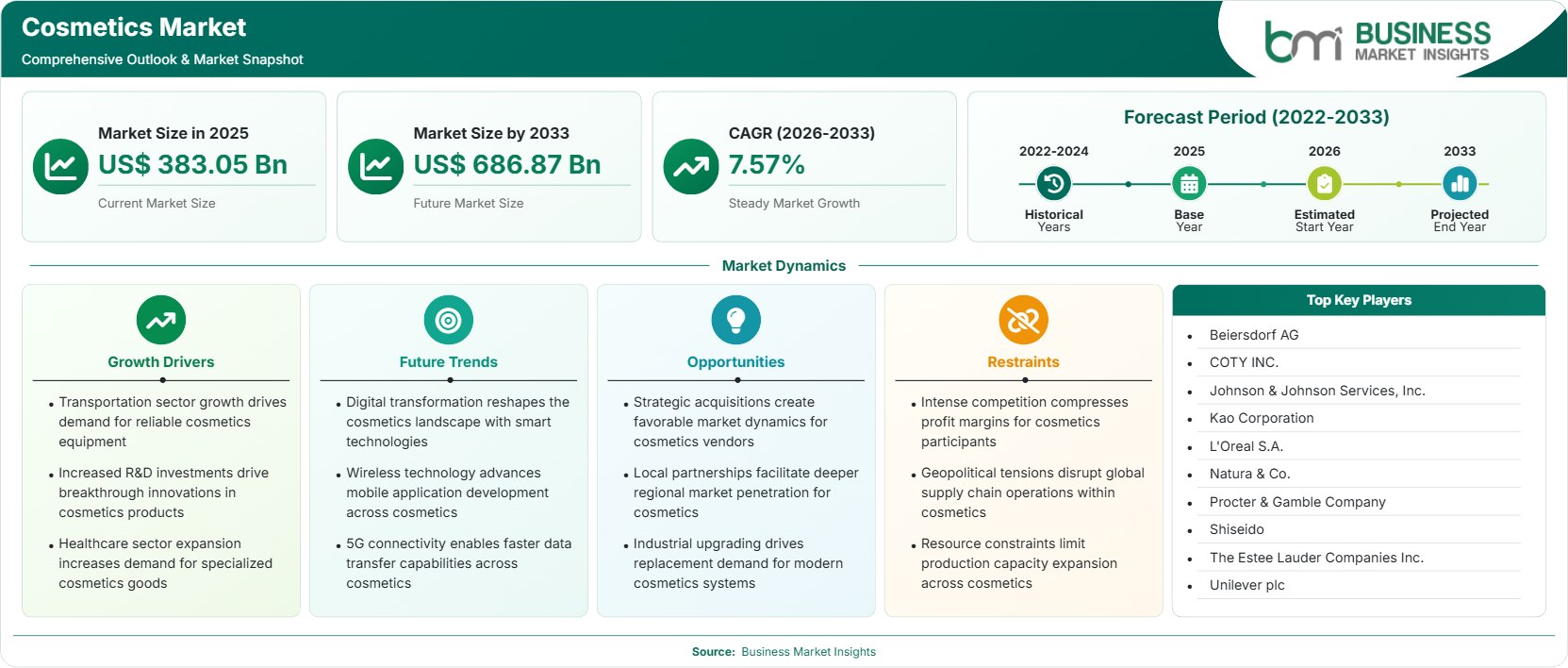
The Cosmetics Market size was valued at US$ 383.05 Billion in 2025 and is projected to reach US$ 686.87 Billion by 2033, growing at a CAGR of 7.57% during 2026–2033, driven by premiumization, skincare innovation, digital commerce, personalization, emerging-market consumption, and sustainable formulations.

Report Coverage
  • Category: Haircare, Skincare, Makeup, Others
  • Gender: Men, Women
  • Distribution Channel: Specialty Stores, Hypermarket/Supermarket, Online Channels, Others
US$ 383.05 Bn Market size in 2025
US$ 686.87 Bn Market Size by 2033
7.57% CAGR, 2026 - 2033
2026-2033 Forecast Period

01 AI Overview

Cosmetics Market Summary

  • North America Region: North America holds a Cosmetics Market share of 25%–28% in 2025, growing with a CAGR of 6.2%–7.0%, influenced by premium skincare, prestige makeup, dermocosmetics, omnichannel retail, personalized beauty technologies, and strong consumer demand for clinically positioned formulations and multifunctional products. The U.S. accounts for 20%–23% of global demand, with a 6.1%–6.9% CAGR from 2026–2033, supported by prestige beauty, dermatological skincare, digital discovery, and premium fragrance adoption.
  • Fastest Growing Region: Asia Pacific represents 36%–39% share in 2025, expanding at a CAGR of 8.4%–9.3%, driven by rising disposable incomes, K-beauty influence, digital-first brands, social commerce, urbanization, premium skincare, localized formulations, and expanding organized retail across India, China, Indonesia, and Southeast Asia.
  • Leading Segment: Skincare commands a 39%–42% share in 2025, advancing at a CAGR of 7.8%–8.6%, supported by preventative routines, dermocosmetics, active ingredients, sun protection, barrier repair, anti-aging solutions, personalized diagnostics, and growing consumer preference for science-backed products across mass and premium channels.
  • High Growth Segment: Men represents 15%–18% share in 2025, recording a CAGR of 8.6%–9.5%, propelled by expanding grooming routines, facial skincare adoption, multifunctional products, influencer-led education, premiumization, e-commerce accessibility, and increasing acceptance of specialized male beauty propositions across emerging and developed economies.
  • Key Market Opportunity: The strongest opportunity lies in combining AI-enabled personalization, clinically validated actives, sustainable packaging, and social commerce to create scalable premium offerings that improve conversion, retention, product relevance, and lifetime customer value.
  • Major Market Players: Beiersdorf AG, Coty Inc., Johnson & Johnson Services, Inc., Kao Corporation, L'Oréal S.A., Natura & Co., The Procter & Gamble Company, Shiseido Company, Limited, The Estée Lauder Companies Inc., and Unilever plc.
02 Strategic Insights

Cosmetics Market: Strategic Insights

Cosmetics Market Strategic Framework
FREE PDF
Request your free sample
Request free sample
03 Stakeholder View

Key Takeaways

  • Market structure insight: Value creation is moving from standalone product manufacturing toward integrated ecosystems linking ingredient suppliers, formulation laboratories, packaging specialists, retailers, marketplaces, influencers, dermatology networks, and proprietary consumer data.
  • Growth opportunity insight: Skincare and men's beauty offer attractive upside because consumers increasingly adopt specialized routines, while dermocosmetics and multifunctional products bridge mass, premium, and healthcare-adjacent positioning.
  • Innovation trend: Biotechnology, AI-powered personalization, advanced skin diagnostics, microbiome-oriented formulations, peptide research, and precision fragrance development are directing research budgets toward measurable efficacy and differentiated consumer experiences.
  • Regional opportunity: India and Southeast Asia provide compelling investment cases because expanding digital infrastructure, younger demographics, increasing organized retail penetration, and locally adapted beauty preferences support sustained category development.
  • Investment / M&A trend: Strategic capital is concentrating on prestige, aesthetics, dermocosmetics, and high-growth specialist brands. L'Oréal's increased investment in Galderma and acquisition of Kering Beauté demonstrate continued interest in adjacent premium beauty ecosystems.
  • Channel insight: Omnichannel capability is becoming a competitive requirement as consumers move between social discovery, marketplaces, brand websites, specialty retailers, pharmacies, and physical stores during one purchase journey.
04 Geographic Outlook

Cosmetics Market Regional Highlights

North America Cosmetics Market

North America held a 25%–28% Cosmetics Market share in 2025 and is projected to grow at a 6.2%–7.0% CAGR through 2033. The region benefits from premium skincare, prestige fragrance, dermocosmetics, advanced retail infrastructure, and high digital adoption. Demand is increasingly shaped by clinical efficacy, ingredient transparency, personalization, and multifunctionality. Consumers are also shifting toward dermatologist-recommended products and wellness-linked beauty propositions, while retailers expand experiential formats and digitally assisted consultations. These dynamics reinforce the region's premium positioning and innovation intensity.

  • Premium skincare continues attracting spending as consumers prioritize active ingredients, barrier repair, sun protection, and clinically supported efficacy, encouraging brands to invest in differentiated formulations and dermatologist-oriented communication.
  • Prestige fragrance benefits from gifting, collection behavior, and niche positioning, while digitally native brands use storytelling, sampling, and social discovery to challenge traditional department-store distribution models.
  • Dermocosmetics are gaining traction through pharmacy and specialist channels, supported by consumers seeking credible solutions for sensitive skin, pigmentation, acne, and aging-related concerns.
  • E-commerce and social commerce increasingly influence discovery, but physical retail remains essential for testing textures, fragrances, shades, and premium products before purchase.

US Cosmetics Market

The U.S. represented 20%–23% of global Cosmetics Market demand in 2025 and is forecast to expand at a 6.1%–6.9% CAGR through 2033. The country's sophisticated prestige ecosystem, high digital penetration, strong specialty retail network, and influential creator economy support category resilience. Consumers increasingly favor clinical claims, multifunctional routines, premium fragrance, and personalized experiences. Brand portfolios are also expanding through acquisitions and collaborations, while omnichannel strategies connect social discovery with retailers, marketplaces, direct websites, and professional beauty services.

  • Prestige and masstige products coexist strongly, allowing consumers to trade between affordable innovation and premium experiences depending on category, occasion, and perceived efficacy.
  • Clinical skincare and dermatologist-led positioning are gaining relevance as consumers increasingly evaluate ingredients, evidence, and measurable outcomes before purchasing higher-priced formulations.
  • Creator-led commerce accelerates product discovery, particularly among younger consumers, while established brands increasingly combine influencer partnerships with controlled direct-to-consumer ecosystems.
  • Retailers are expanding experiential beauty services, shade matching, sampling, and digital consultations to improve conversion and strengthen customer loyalty.

Europe Cosmetics Market

Europe accounted for a 20%–23% Cosmetics Market share in 2025 and is projected to grow at a 5.8%–6.6% CAGR through 2033. France, Germany, the United Kingdom, and Italy remain leading countries, while Spain and Poland provide attractive growth pockets. The region's regulatory sophistication encourages ingredient scrutiny, traceability, safety documentation, and environmental responsibility. Premium fragrance, dermocosmetics, skincare, and sustainable packaging remain important areas of competition. Brands increasingly balance innovation with compliance, responsible sourcing, and transparent claims to protect consumer trust.

  • France remains a leading beauty hub, supported by luxury fragrance, professional expertise, heritage brands, and sophisticated export-oriented supply networks.
  • Germany combines strong skincare demand with disciplined consumer purchasing, creating opportunities for dermocosmetics, efficacy-led products, and accessible premium propositions.
  • The United Kingdom's high-growth beauty ecosystem is supported by specialty retail, digital commerce, influencer discovery, and rapid adoption of emerging independent brands.
  • Italy retains strength in premium beauty and fragrance, while Spain offers expanding opportunities through tourism-linked retail, digital commerce, and younger consumer participation.
  • Regulatory scrutiny encourages investment in compliant formulations, ingredient traceability, packaging redesign, and substantiated claims, increasing differentiation between technically prepared brands and less sophisticated competitors.

Asia Pacific Cosmetics Market

Asia Pacific held a 36%–39% Cosmetics Market share in 2025 and is forecast to expand at an 8.4%–9.3% CAGR through 2033. China, Japan, South Korea, and India are leading markets, while India and Indonesia represent particularly strong high-growth opportunities. Rising disposable incomes, mobile-first purchasing, beauty content, local innovation, and premium skincare adoption are reshaping consumption. Regional consumers increasingly seek functional formulations, sun care, brightening, anti-aging, scalp care, and culturally relevant products delivered through digital-first channels.

  • China remains a major beauty economy, with prestige recovery, domestic brands, social commerce, and sophisticated consumer segmentation shaping competitive strategies across skincare and fragrance.
  • Japan combines mature skincare expertise with demand for efficacy, anti-aging, sensitive-skin products, and high-quality formulations, supporting premium positioning and innovation-led competition.
  • South Korea continues influencing global beauty through fast product cycles, ingredient innovation, digital storytelling, and strong consumer acceptance of specialized skincare routines.
  • India represents a high-growth opportunity, supported by urbanization, rising incomes, expanding e-commerce, premiumization, and increasing participation of men in skincare and grooming.
  • Indonesia and Southeast Asia benefit from young populations, mobile commerce, halal-conscious product development, localized formulations, and rising organized retail penetration.

Rest of World Cosmetics Market

South and Central America represented a 9%–12% Cosmetics Market share in 2025 and are expected to grow at a 7.1%–8.0% CAGR through 2033. Brazil leads regional demand, while Mexico and Colombia provide attractive expansion opportunities. Premiumization coexists with affordability, and consumers increasingly value haircare, skincare, fragrance, and multifunctional products. Local beauty preferences, strong social engagement, and expanding digital retail support broader brand penetration across urban and emerging consumer groups.

The Middle East and Africa contributed a 7%–10% share in 2025 and are projected to expand at an 8.0%–9.0% CAGR. Saudi Arabia, the United Arab Emirates, and South Africa are leading markets, while Gulf countries offer strong premium and fragrance opportunities. Rising tourism, luxury retail, youthful demographics, and digital adoption create additional channels for international and regional brands.

  • Brazil remains a leading beauty economy, supported by strong domestic brands, sophisticated haircare consumption, natural ingredient interest, and broad participation across mass and premium categories.
  • Mexico provides expansion potential through growing modern retail, e-commerce adoption, and increasing demand for skincare, fragrance, and accessible premium offerings.
  • Saudi Arabia and the United Arab Emirates benefit from premium fragrance, luxury beauty, tourism, and high-end retail ecosystems, creating favorable conditions for prestige brands.
  • South Africa provides a diversified regional platform combining established retail infrastructure with rising digital adoption and demand for inclusive products addressing varied skin and hair needs.
  • Across Latin America and the Middle East, localized shade ranges, climate-adapted formulations, culturally relevant campaigns, and flexible pricing can improve penetration.
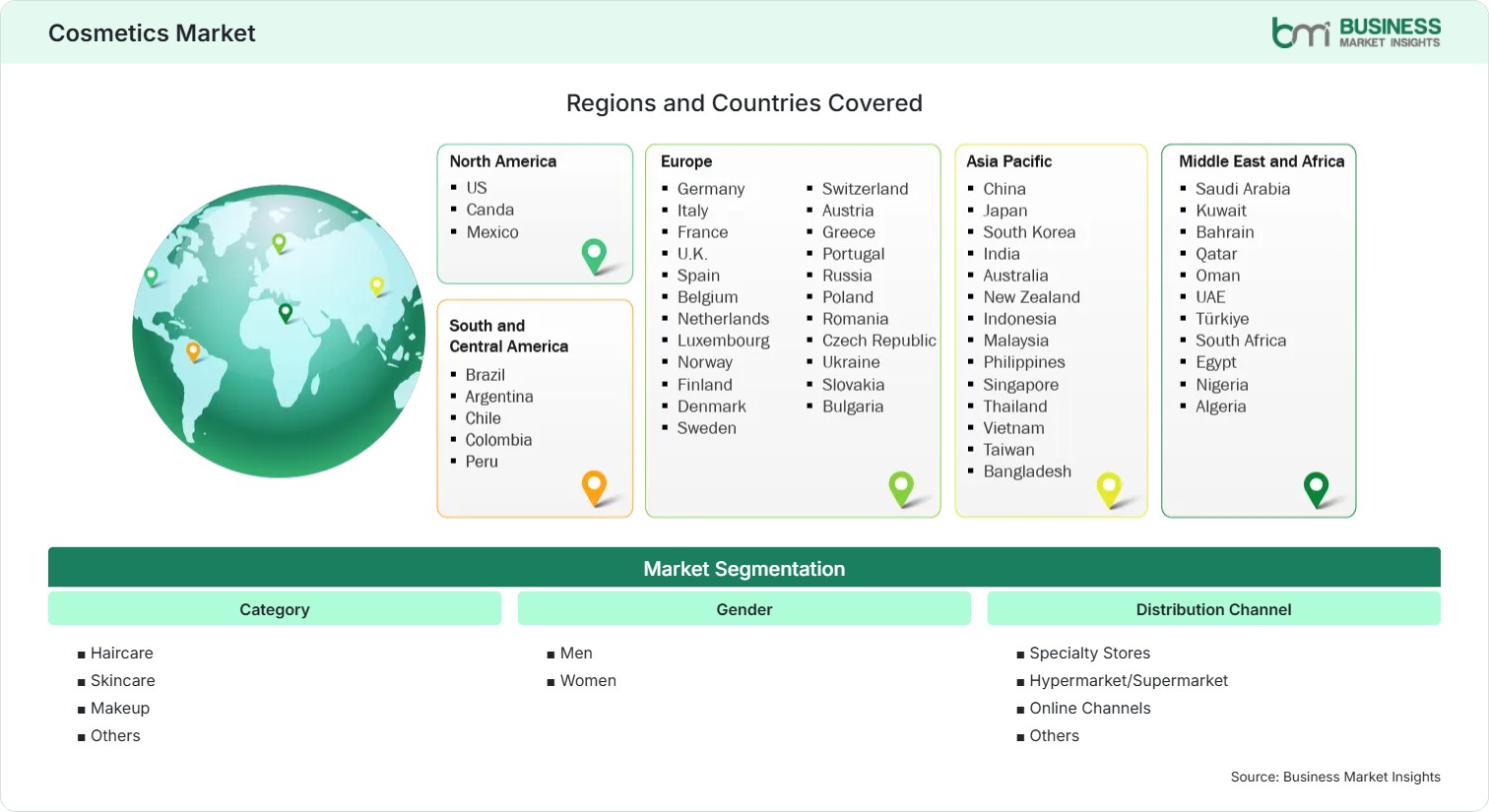
Global Market Geography
FREE PDF
Request your free sample
Request free sample
05 Segment Analysis

Cosmetics Market Segmentation

Category

Category segmentation is led by skincare, representing a 39%–42% Cosmetics Market share in 2025 and advancing at a 7.8%–8.6% CAGR between 2026–2034. Skincare benefits from preventative routines, active ingredients, dermocosmetics, sun protection, and personalization. Haircare, makeup, and specialized products broaden consumer engagement, while digital education accelerates adoption across demographics and geographies.

  • Haircare: Demand is shifting toward scalp health, repair, anti-frizz, and specialized treatments, encouraging premium formulations, multifunctional products, personalized routines, and science-led claims.
  • Skincare: Consumers increasingly prioritize prevention, barrier support, sun protection, anti-aging, and active ingredients, supporting dermocosmetics, clinical positioning, personalized diagnostics, and premiumization.
  • Makeup: Innovation centers on long-wear, skin-enhancing, hybrid formulations, inclusive shades, and social-media-friendly launches that connect cosmetic performance with skincare benefits.

Gender

By gender, men represented a 15%–18% share in 2025 and are projected to grow at an 8.6%–9.5% CAGR between 2026–2034. Male consumers increasingly adopt facial skincare, grooming, fragrance, and specialized routines. Meanwhile, women remain the largest consumer base, supported by broad category participation, premiumization, innovation, and frequent purchasing across skincare, makeup, haircare, and fragrance-oriented products.

  • Men: Expanding grooming routines, social acceptance, influencer education, and multifunctional products are increasing male participation in skincare, haircare, fragrance, and appearance-focused personal care.
  • Women: Broad product adoption across skincare, makeup, and haircare supports recurring purchases, premiumization, personalized routines, and experimentation with new ingredients and beauty technologies.

Distribution Channel

Distribution channels are becoming increasingly integrated as consumers combine physical discovery with digital purchasing. Specialty Stores held a 31%–34% share in 2025 and are forecast to grow at a 6.7%–7.5% CAGR between 2026–2034. Online Channels are gaining faster as discovery, reviews, creator content, and personalized recommendations reduce purchase friction across categories.

  • Specialty Stores: Expert consultations, sampling, premium environments, and product discovery sustain relevance, particularly for prestige skincare, fragrance, professional products, and specialized beauty solutions.
  • Hypermarket/Supermarket: Broad assortment, convenience, frequent promotions, and accessible pricing support mass-market skincare, haircare, makeup, and everyday replenishment purchases.
  • Online Channels: Marketplaces, direct-to-consumer websites, social commerce, reviews, creator recommendations, and personalized algorithms accelerate discovery and expand geographic reach.
06 Market Forces

Cosmetics Market Dynamics

Key Market Drivers

Science-Led Skincare and Dermocosmetic Adoption

Science-led skincare is strengthening Cosmetics Market growth as consumers increasingly evaluate ingredients, efficacy, and clinical credibility. Beiersdorf reported 11.7% organic growth for its Derma business in 2025, marking a fifth consecutive year of double-digit expansion. The move reflects growing commercial strength of propositions that touch on dermatology, despite the fact that the success of each brand should not be seen as an indicator of category growth. Dermatologists' influence on consumers is reflected by brands investing in peptides, retinoid replacements, barrier technology, micro biome solutions, and UV protection. These technological developments justify premium prices for the solutions addressing particular skin issues like acne, hyper-pigmentation, sensitivity, and visible signs of aging. Efficacy-based positioning becomes increasingly important in the face of increasing consumer knowledge.

Premiumization and the Expansion of Prestige Beauty

Premiumization is reshaping Cosmetics Market trends as consumers selectively allocate spending toward products offering visible efficacy, sensory experiences, brand heritage, and differentiated technology. L'Oréal recorded sales of €44.05 billion for 2025 with an increase in like-for-like sales of 4.0%, while the Dermatological Beauty business unit posted a rise in like-for-like sales of 5.5%. These results from L'Oréal demonstrate the importance of diversified product ranges in capturing value from the professional, consumer, luxury, and dermatological offers. Premium perfumes, luxury skincare products, and high-performance treatments have become more popular among consumers who are increasingly trading down on standard products while keeping expenditures on high-value perceived products.

Digital Commerce and Data-Driven Consumer Engagement

E-commerce is turning into a structural force because product discovery happens through social media, influencers, marketplaces, and personal recommendations prior to consumers visiting retailers. In 2025, L'Oréal shared their findings that e-commerce sales represented over 30% of the revenue, growing at a double-digit pace. Digital solutions are strategically important as they enable diagnostics, virtual try-on features, personalization algorithms, and consumer data platforms. The Cosmetics Market growth opportunity thus not only lies in online transaction volumes but also in the more data-intense engagement models. Brands that can link their digital content, retail availability, personal advice, and after-sales loyalty would be able to make the most of it.

Key Market Opportunities

AI-Powered Personalization and Beauty Technology

AI-powered personalization offers an investment opportunity because beauty purchasing is highly individual and influenced by skin type, tone, hair characteristics, lifestyle, climate, and desired outcomes. Companies can utilize technologies such as computer vision, generative AI, virtual consultation, and recommendation engines to optimize their products and lower uncertainty. The 2026 creation of a Beauty Tech hub by L'Oréal in India which involves artificial intelligence beauty solutions through generative and agentic AI shows how technology investments are shifting towards localization. The opportunity extends to intelligent diagnostics, adaptive routines, personalized product bundles, and digital customer service. Cosmetics Market companies that combine proprietary consumer data and scientific formulation experience can build ecosystems that are defensible rather than digital features that are isolated. This allows for better retention and more exact product development.

Emerging-Market Premiumization and Localized Formulation

Emerging markets offer attractive investment opportunities because rising incomes are expanding the addressable consumer base while digital channels reduce the cost of geographic expansion. Areas like India, Indonesia, Southeast Asia, Latin America, and parts of the Middle East will provide the opportunity for customization of the product line depending on climatic factors, skin type, hair type, cultural background, and purchasing power. The business model will permit a blend of premium pricing, smaller pack size, mobile shopping, and influencer marketing on a regional basis. In addition, localization allows the chance for regional brands to go up against multinational brands. Companies that set up local production facilities and regulatory know-how can enhance their supply chain resilience while tapping into emerging markets.

Biotechnology, Sustainable Ingredients, and Circular Packaging

Sustainability through product design and biotech offer long-term prospects since brands will want to differentiate and reduce their footprint without reducing performance. There could be innovations through precision fermentation, biotech-activated actives, upcycling, water-savvy formulas, recyclable packaging, and concentrates. The logic behind investments will be most valid if sustainability improves performance or lowers the overall costs of the product rather than relying on marketing alone. Redesigning packaging allows companies to differentiate themselves by means of refills and sustainable packages. Companies can build consumer trust and be ready for regulations by linking their formulation science, traceability of their products' sources, and sustainability measurements. The issue is especially relevant for European markets.

Market Restraints and Challenges

Raw Material Volatility and Margin Pressure

Factor: Volatility in oils, specialty chemicals, fragrances, packaging materials, and energy costs can raise manufacturing expenses and complicate pricing decisions across mass and premium portfolios.

Impact: Increased expenses related to inputs could put pressure on margins, result in increases in prices, or encourage changes in product formulation and thereby affect customer loyalty in case the buyers are sensitive to price. The fluctuations in currency also play a significant role in impacting profitability internationally for businesses involved in sourcing of products from the global market. As pointed out in the forecast of profitability for 2026 by Beiersdorf, the cost of raw materials and the impact of unfavorable foreign exchange were among the influences on profit margins.

Regulatory Complexity and Product-Claim Scrutiny

Factor: Increasing regulatory expectations around ingredient safety, product claims, labeling, environmental statements, packaging waste, and traceability raise compliance requirements across international supply chains.

Impact: The cost of compliance can cause delays, testing requirements, limitation of formulation options, and reputational risk due to the lack of substantiation. The discrepancy in regulations across borders can hinder the international launch of a product since what is accepted in one jurisdiction might not be acceptable in another and will have to be modified. The need for regulation research, scientific substantiation, and documentation can thus add to the company’s cost base. This burden can be relatively more for small companies due to their finite resources in terms of regulatory experts and testing funds.

07 Company Analysis

Competitive Landscape

Competitive positioning increasingly depends on portfolio breadth, innovation velocity, scientific credibility, channel control, and geographic localization. The Cosmetics Market analysis also indicates that leading companies are combining organic innovation with targeted acquisitions, digital capabilities, and adjacent beauty categories. L'Oréal's 2025 strategy, including increased ownership in Galderma and the acquisition of Kering Beauté, demonstrates the sector's movement toward broader beauty ecosystems spanning traditional cosmetics and aesthetics.

Company Name

Overview

Products and Services relevant to this market

Beiersdorf AG

Germany-based beauty and skincare specialist with strong mass, premium, and dermatological capabilities across established international brands.

NIVEA, Eucerin, La Prairie, Aquaphor, skincare, body care, sun care, facial care, and derma-focused beauty products.

Coty Inc.

Global beauty company with a strong position in prestige and mass fragrance, cosmetics, and luxury brand licensing.

Fragrances, color cosmetics, skincare, beauty licensing, prestige brands, consumer beauty, and professional beauty products.

Johnson & Johnson Services, Inc.

Healthcare-focused organization with established consumer health expertise and brand equity relevant to skincare and personal care.

Skin health products, dermatology-oriented solutions, cleansing products, and consumer health-adjacent skincare offerings.

Kao Corporation

Japanese consumer products and chemical company combining beauty science, personal care expertise, and Asian innovation capabilities.

Skincare, haircare, cosmetics, cleansing products, beauty ingredients, and professional salon-oriented solutions.

L'Oréal S.A.

Diversified global beauty leader operating across mass, professional, luxury, and dermatological categories with strong research capabilities.

Skincare, haircare, makeup, fragrance, professional beauty, dermatological products, beauty technology, and personalized solutions.

Natura & Co.

Brazilian beauty group recognized for direct selling, sustainability positioning, and strong Latin American consumer relationships.

Skincare, haircare, fragrances, makeup, personal care, natural ingredient-based products, and beauty consulting.

The Procter & Gamble Company

Diversified consumer goods company with extensive beauty and personal care brands distributed across mass and premium channels.

Haircare, skincare, grooming, beauty products, personal care, professional formulations, and consumer-focused brand portfolios.

Shiseido Company, Limited

Japanese prestige beauty company combining advanced research, luxury branding, skincare expertise, and international distribution.

Prestige skincare, makeup, fragrance, sun care, beauty technology, and science-led cosmetic formulations.

The Estée Lauder Companies Inc.

Prestige beauty specialist with a broad portfolio spanning luxury skincare, makeup, fragrance, and professional beauty.

Skincare, makeup, fragrance, luxury beauty, professional products, prestige brands, and high-end consumer experiences.

Unilever plc

Diversified consumer products company with significant beauty and wellbeing capabilities across mass and premium personal care.

Skincare, haircare, cleansing, beauty and wellbeing, personal care, premium beauty, and digitally enabled consumer brands.

10 Trust & Transparency

Research Methodology

The market analysis combines proprietary research with secondary data from government agencies, company disclosures, regulatory filings, industry databases and expert interviews. Market estimates are validated through data triangulation, cross-market benchmarking and analyst review.

View Full Research Methodology

11 Questions Answered

Frequently Asked Questions

How does sustainability affect competitive positioning?

The Cosmetics Market Report highlights that sustainability increasingly influences packaging design, sourcing, formulation, and regulatory readiness. Brands that can demonstrate measurable environmental improvements while preserving product performance may strengthen trust, reduce compliance risks, and differentiate premium offerings.

Which channel strategy offers the strongest competitive advantage?

An integrated omnichannel strategy provides the strongest advantage because consumers often discover products through social platforms, research through reviews, test products in stores, and complete purchases through marketplaces or brand websites.

How are beauty companies adapting to changing consumer expectations?

Companies are emphasizing ingredient transparency, clinical substantiation, inclusive product ranges, sustainable packaging, localized formulations, and digital personalization. These priorities respond to consumers who increasingly evaluate both product performance and brand responsibility.

Why are dermocosmetics attracting increased investment?

Dermocosmetics combine beauty benefits with science-led positioning, addressing specific concerns such as sensitivity, acne, pigmentation, and aging. Their credibility, specialist distribution, and higher perceived efficacy can support premium pricing and stronger consumer retention.

What technologies will most influence the Cosmetics Market?

AI-assisted diagnostics, personalized recommendations, virtual consultations, biotechnology-derived ingredients, advanced delivery systems, and connected beauty devices are likely to influence product development by improving customization, measurable efficacy, and consumer engagement.

Access the Full Cosmetics Market Report

Get segment-level forecasts, regional estimates, competitive benchmarking, company profiles and downloadable Excel datasets.

Access the full Cosmetics Market Report
350 pages PDF & Excel | 2026-08-17