
Functional Cosmetics Market Outlook: Size, Share, Trends, Growth Analysis, Competitive Landscape & Forecast, 2026-2033

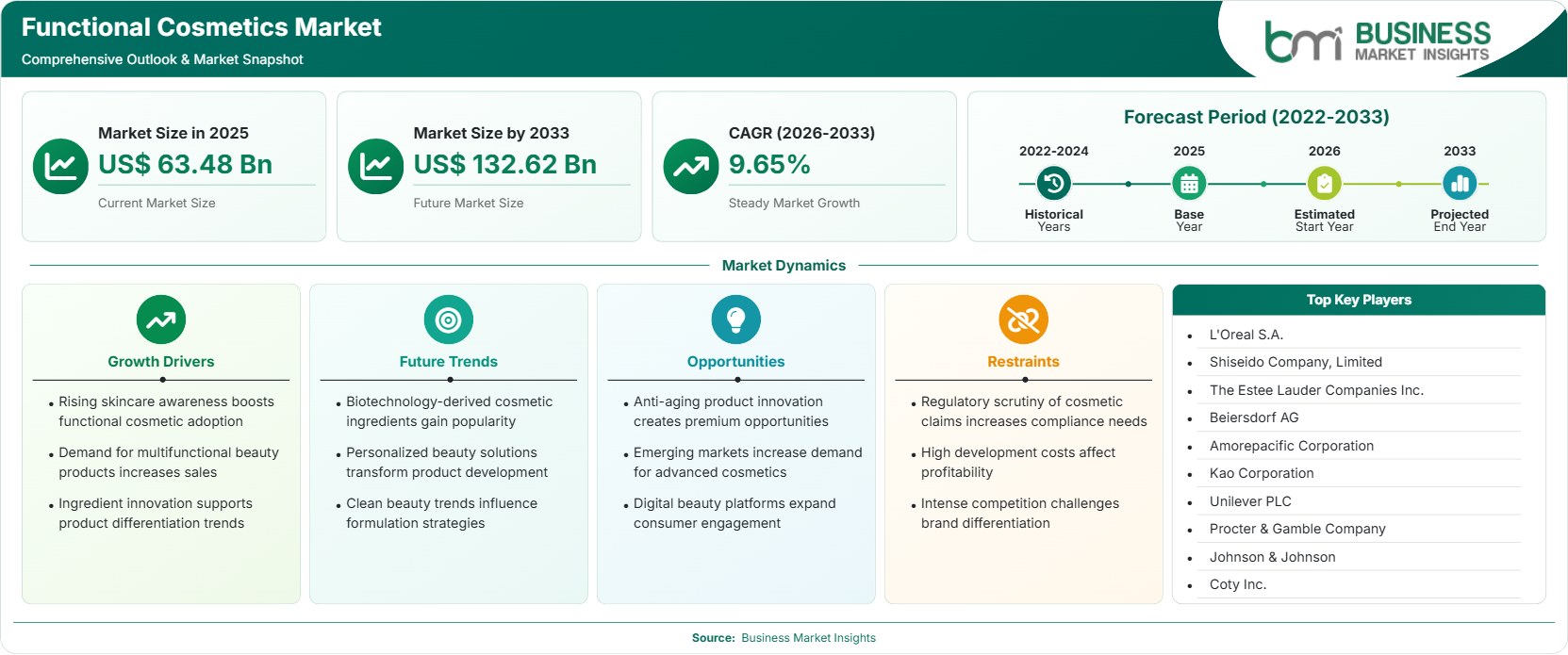
The Functional Cosmetics Market size was valued at US$ 63.48 Billion in 2025 and is projected to reach US$ 132.62 Billion by 2033, growing at a CAGR of 9.65% during 2026–2033, driven by demand for science-backed beauty products, anti-aging solutions, dermatological formulations, personalization technologies, and expanding premium skincare adoption across emerging markets.

Report Coverage
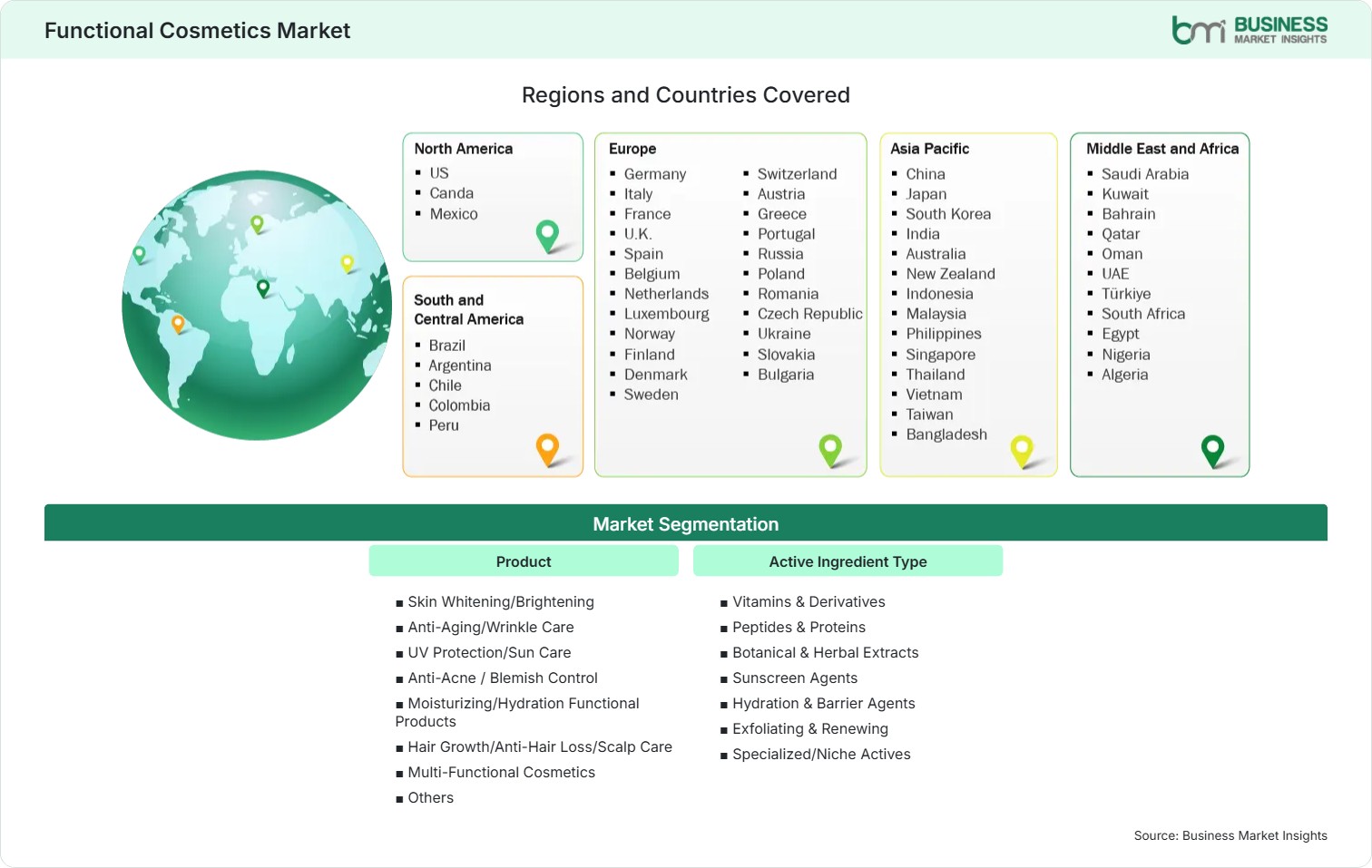
  • Product: Skin Whitening/Brightening, Anti-Aging/Wrinkle Care, UV Protection/Sun Care, Anti-Acne / Blemish Control, Moisturizing/Hydration Functional Products, Hair Growth/Anti-Hair Loss/Scalp Care, Multi-Functional Cosmetics, Others
  • Active Ingredient Type: Vitamins & Derivatives, Peptides & Proteins, Botanical & Herbal Extracts, Sunscreen Agents, Hydration & Barrier Agents, Exfoliating & Renewing, Specialized/Niche Actives
US$ 63.48 Bn Market size in 2025
US$ 132.62 Bn Market Size by 2033
9.65% CAGR, 2026 - 2033
2026-2033 Forecast Period

AI Overview

Functional Cosmetics Market Summary

  • North America Region: Holds a 33%–36% share in 2025, growing at a CAGR of 8.4%–9.1% during 2026–2033. Growth is supported by dermatologist-led skincare adoption, premium beauty spending, biotech ingredients, consumer awareness, and omnichannel distribution expansion across major brands and retailers globally. US market benefits from strong cosmeceutical innovation and grows at an estimated CAGR of 8.6%–9.2%.
  • Fastest Growing Region: Asia Pacific holds a 29%–32% share in 2025 and advances at a CAGR of 10.8%–11.6%. Rising disposable income, K-beauty influence, aging populations, digital commerce penetration, and expanding premium skincare consumption create sustained opportunities across regional markets.
  • Leading Segment: Anti-Aging/Wrinkle Care accounts for 22%–25% share in 2025 and grows at a CAGR of 9.7%–10.4%. Increasing longevity, collagen-support formulations, peptide innovation, clinical efficacy claims, and premium product positioning continue strengthening category demand globally.
  • High Growth Segment: Peptides & Proteins represents 14%–17% share in 2025 and expands at a CAGR of 11.2%–12.0%. Advanced biomimetic ingredients, regenerative skincare applications, biotechnology investments, clinical validation, and consumer preference for performance-driven formulations stimulate adoption.
  • Key Market Opportunity: AI-assisted skin diagnostics integrated with customized functional formulations enable brands to improve efficacy perception, increase customer retention, accelerate premiumization, and build recurring revenue through personalized skincare ecosystems.
  • Major Market Players: L'Oréal S.A., Shiseido Company, Limited, The Estée Lauder Companies Inc., Beiersdorf AG, Amorepacific Corporation, Kao Corporation, Unilever PLC, Procter & Gamble Company, Johnson & Johnson, Coty Inc.
Strategic Insights

Functional Cosmetics Market: Strategic Insights

Functional Cosmetics Market Strategic Framework
FREE PDF
Request your free sample
Request free sample
Stakeholder View

Key Takeaways

  • Value creation is shifting toward ingredient developers, biotechnology specialists, contract manufacturers, dermatology partnerships, and digitally enabled beauty platforms.
  • Anti-aging, multifunctional skincare, and advanced peptide-based formulations present the strongest medium-term revenue opportunities.
  • R&D priorities increasingly focus on microbiome science, epigenetic skincare, encapsulation systems, and personalized efficacy solutions.
  • India, South Korea, China, and Gulf countries offer compelling investment environments supported by rising premium beauty expenditure.
  • Acquisitions increasingly target dermocosmetics, biotech ingredients, AI skin-analysis technology, and premium skincare brands.
  • Sustainability, ingredient traceability, and clinically supported claims are becoming competitive differentiators influencing purchasing decisions.
Geographic Outlook

Functional Cosmetics Market Regional Highlights

North America Functional Cosmetics Market

North America represents 33%–36% of global demand in 2025 and is expected to register a CAGR of 8.4%–9.1% through 2033. Strong consumer preference for clinically validated formulations, widespread dermatologist influence, and premium skincare penetration support growth. The region benefits from advanced biotechnology capabilities, sophisticated retail channels, and expanding wellness-oriented beauty consumption. Functional Cosmetics Market share remains highest in this region due to high spending power and strong innovation ecosystems across the United States and Canada.

  • Dermatologist-recommended products continue gaining traction, supported by increasing awareness regarding skin aging, hyperpigmentation, and preventive care.
  • Peptide-based and multifunctional formulations experience robust adoption as consumers seek measurable efficacy and simplified routines.
  • Regulatory emphasis on claim substantiation encourages investment in testing, validation, and evidence-backed product development.
  • E-commerce and direct-to-consumer channels strengthen consumer engagement and accelerate premium product accessibility.

US Functional Cosmetics Market

The United States contributes 78%–82% of regional revenue and expands at a CAGR of 8.6%–9.2%. Strong demand for premium skincare, sun protection, and personalized beauty supports market expansion. Beauty technology integration and clinical ingredient adoption remain central growth drivers. Consumers increasingly favor products demonstrating measurable benefits through visible outcomes and research-backed formulations.

  • Prestige skincare brands continue outperforming broader beauty categories through innovation and premium positioning.
  • AI-powered skin analysis tools increase adoption of customized and subscription-based skincare solutions.
  • Rising interest in preventive wellness strengthens demand for anti-aging and antioxidant-rich formulations.
  • Specialty retailers and online channels improve access to advanced functional offerings.

Europe Functional Cosmetics Market

Europe accounts for 24%–27% share in 2025 and advances at a CAGR of 8.8%–9.5%. Demand is supported by strong sustainability preferences, premium skincare penetration, and regulatory oversight. Germany and France remain leading markets, while Poland and Spain exhibit faster expansion near 9.5%–10.2%. The region benefits from established cosmetic science capabilities and high consumer awareness regarding active ingredients.

  • Clean-label and environmentally responsible products increasingly influence purchasing decisions.
  • Anti-aging remains the dominant application supported by demographic aging trends.
  • Botanical extracts and barrier-repair formulations are gaining popularity among sensitive-skin consumers.
  • European manufacturers continue investing in biotechnology and sustainable ingredient sourcing.

Asia Pacific Functional Cosmetics Market

Asia Pacific holds 29%–32% share in 2025 and leads global expansion with a CAGR of 10.8%–11.6%. China, Japan, and South Korea remain largest markets while India records particularly strong acceleration above regional averages. Functional Cosmetics Market growth benefits from digital beauty ecosystems, K-beauty innovation, premiumization trends, and rising middle-class consumption. Regional players continue shaping global ingredient and formulation trends.

  • K-beauty and J-beauty innovation strongly influence product development and international demand.
  • E-commerce platforms significantly enhance premium product availability and consumer engagement.
  • Younger consumers increasingly purchase preventive skincare with multifunctional benefits.
  • Biotechnology research strengthens regional competitiveness in advanced active ingredients.
  • India emerges as a high-potential destination for premium skincare investment and localization.

Rest of World Functional Cosmetics Market

The Rest of World region represents 10%–13% share in 2025 and is projected to expand at a CAGR of 9.3%–10.1%. South & Central America benefit from growing beauty consciousness and premium skincare adoption. Middle East & Africa markets gain momentum through rising disposable income, tourism-driven retail, and expanding prestige beauty infrastructure.

  • Brazil remains the leading Latin American market supported by strong beauty culture and product innovation.
  • Saudi Arabia and the UAE demonstrate rapid premium skincare adoption with increasing luxury spending.
  • Retail modernization improves access to specialized functional product categories.
  • Growing awareness regarding sun protection drives demand across high-UV geographies.
  • International brands expand distribution networks across emerging regional markets.
Global Market Geography
FREE PDF
Request your free sample
Request free sample
Segment Analysis

Functional Cosmetics Market Segmentation

Product

Product segmentation accounts for the largest revenue contribution. Anti-aging and multifunctional categories dominate purchasing decisions as consumers seek visible efficacy and convenience. This segment represents approximately 58%–61% of market revenue in 2025 and advances at a CAGR of 9.4%–10.2%. Functional Cosmetics Market scope continues broadening through integrated skincare solutions.

  • Skin Whitening/Brightening: Strong demand across Asia and the Middle East supported by pigmentation management, skin-tone enhancement, and antioxidant ingredient innovation.
  • Anti-Aging/Wrinkle Care: Leading category driven by aging demographics, preventive skincare adoption, and clinically validated performance-focused formulations.
  • UV Protection/Sun Care: Expands through awareness of photoaging, skin-health education, and multifunctional daily protection requirements.
  • Anti-Acne/Blemish Control: Benefits from younger consumer demand, microbiome science, and dermatological treatment-inspired formulations.
  • Moisturizing/Hydration Functional Products: Growth supported by skin barrier health awareness and increasing sensitivity-related concerns.
  • Hair Growth/Anti-Hair Loss/Scalp Care: Rising stress-related hair issues and advanced scalp-care technologies stimulate category expansion.
  • Multi-Functional Cosmetics: Functional Cosmetics Market trends increasingly favor products combining hydration, protection, brightening, and anti-aging benefits.

Active Ingredient Type

Ingredient-focused differentiation remains central to competitive positioning. This segment captures approximately 39%–42% market contribution in 2025 and grows at a CAGR of 10.1%–10.9%, supported by performance-driven purchasing decisions and scientific transparency.

  • Vitamins & Derivatives: Widely utilized for brightening, antioxidant protection, and skin renewal applications across skincare portfolios.
  • Peptides & Proteins: Fastest-growing ingredient class supported by anti-aging efficacy, collagen support, and biotechnology innovation.
  • Botanical & Herbal Extracts: Demand remains strong due to clean-label preferences and natural-origin ingredient positioning.
  • Sunscreen Agents: Essential components enabling multifunctional protection and preventive skincare formulations.
  • Hydration & Barrier Agents: Critical for moisture retention, skin resilience enhancement, and sensitive skin applications.
  • Exfoliating & Renewing: Increasingly used in texture-improvement and pigmentation-management solutions targeting visible results.
  • Specialized/Niche Actives: Includes advanced microbiome, probiotic, stem-cell-inspired, and customized efficacy-support ingredients.
Market Forces

Functional Cosmetics Market Dynamics

Key Market Drivers

Growing Consumer Demand for Evidence-Based Beauty

Consumers are moving towards looking for products that come with clinical validation and not just cosmetics. Knowledge of dermatology, the influence of social media, and transparency about ingredients have raised the bar for effectiveness. Institutions such as the WHO continue to emphasize skin health, and manufacturers are spending significant resources on conducting clinical trials and demonstrating benefits. Functional Cosmetics Market adoption benefits from consumers willing to pay premium prices for measurable results. Brands demonstrating visible outcomes through scientific research gain stronger customer loyalty and higher repeat purchase rates, reinforcing market expansion.

Advancements in Biotechnology and Active Ingredients

Rapid progress in biotechnology is improving ingredient performance, stability, and delivery efficiency. Functional peptides, bio-fermented raw materials, vitamin complexes, and biomimetic substances can be applied to achieve high-performing functionality. Leading brands in the industry continue to increase research budgets to develop their own active components. It helps to justify premium prices and solve several skin issues at the same time. Clinical trials further increase confidence in the product among consumers and healthcare professionals. The improvement of ingredients' effectiveness creates additional possibilities for multifunctional product development.

Rising Aging Population and Preventive Skincare Adoption

Increased population aging in developed as well as developing countries is driving consumers' need for wrinkle management, hydration assistance, and skin elasticity improvement. Customers have started using preventive skincare solutions at a much younger age than before, thus widening the addressable demand to include younger consumers. Anti-aging skincare products have become increasingly peptide-, antioxidant-, and repair-related. Functional Cosmetics Market growth receives substantial support from consumers prioritizing long-term skin health, appearance preservation, and preventative wellness strategies rather than reactive treatment approaches.

Key Market Opportunities

Personalized Beauty Ecosystems and AI Diagnostics

The application of digital skin analysis technology opens up immense prospects for the provision of individualized solutions in terms of beauty care. AI-powered diagnosis systems allow people to detect individual skin problems and get recommendations about the appropriate products. The beauty ecosystem collects important data from customers that contributes to the innovation and development of new products. Personalization is also important for pricing and subscriptions. As demand for customized skincare grows, Functional Cosmetics Market Forecasts indicate that individualized formulations and technology-enabled beauty experiences will remain a major driver of growth

Expansion Across Emerging Premium Beauty Markets

Growing disposable incomes in India, Southeast Asia, the Gulf region, and Latin America are accelerating demand for premium functional cosmetics. Consumers are increasingly inclined to purchase superior skincare solutions that incorporate beauty, wellness, and science-based ingredients. This is reflected by global and regional companies that have been expanding via local product offerings, digital marketing campaigns, and retail partnerships. Increasing urbanization, growing awareness regarding beauty, and changing lifestyles contribute to the market's growth as well. Those firms that will invest in regional network building early enough will be able to establish competitive advantages.

Integration of Wellness and Functional Beauty Concepts

Consumers increasingly connect skincare with broader wellness objectives, including healthy aging, stress management, and holistic self-care. Such changes encourage the development of multi-purpose product lines, which provide both cosmetic effects and a wellness-related approach. Beauty supplements, hair scalp treatments, and skin barrier treatments are examples of converging categories. Companies that can unite cosmetic products and the wellness experience have access to new revenue sources and more consumer engagement opportunities.

Market Restraints and Challenges

Regulatory Complexity and Claim Substantiation Requirements

Factor: Increasing scrutiny regarding ingredient safety, efficacy claims, and marketing communication.

Impact: Higher compliance expenses and extended product development cycle times. Manufacturers must devote considerable effort to conducting clinical trials, performing toxicological tests, preparing documentation, and obtaining regulatory approvals before launching the product on the market. The variations in cosmetic legislation in regions like North America, Europe, and the Asia Pacific add even more compliance concerns for the companies seeking global market penetration. Younger or growing brands often struggle with meeting those evolving demands from the financial and organizational standpoints.

Premium Pricing and Intense Competitive Pressure

Factor: Advanced ingredients, clinical validation requirements, biotechnology research, and premium branding significantly increase product development and commercialization costs.

Impact: High pricing could be detrimental to consumers who are highly sensitive to price changes and could result in stiff competition between various market segments. Well-known international firms are in stiff competition with dermocosmetics brands, K-beauty brands, independent brands, and even direct-to-consumer brands. Increased innovation and marketing efforts increase costs for companies, while private labels pose pressure on margins. As advanced technologies in ingredients become more available, it is becoming increasingly difficult for companies to differentiate their products and retain customers.

Company Analysis

Competitive Landscape

Functional Cosmetics Market analysis indicates competition is centered on scientific innovation, brand equity, ingredient development, and premium consumer engagement.

Company Name

Overview

Products and Services relevant to this market

L'Oréal S.A.

Global beauty leader with extensive R&D and dermatological skincare capabilities.

Anti-aging skincare, vitamins, peptides, sun care, personalized beauty technologies.

Shiseido Company, Limited

Japanese cosmetics innovator focused on advanced skincare research.

Functional skincare, anti-aging products, brightening solutions, beauty technologies.

The Estée Lauder Companies Inc.

Premium beauty company with strong skincare and prestige brands.

Serums, anti-aging products, hydration solutions, advanced active formulations.

Beiersdorf AG

Leading skincare specialist known for dermatologist-supported brands.

Eucerin, hydration products, anti-aging care, sun protection solutions.

Amorepacific Corporation

Major K-beauty innovator with strong functional formulation expertise.

Ginseng-based skincare, brightening products, anti-aging and wellness beauty.

Kao Corporation

Science-driven personal care manufacturer with global presence.

Functional skincare, barrier care, hydration and specialty ingredient products.

Unilever PLC

Consumer goods company expanding premium beauty portfolios.

Functional skincare, sun care, hydration and wellness-focused cosmetics.

Procter & Gamble Company

Global consumer products leader with extensive skincare offerings.

Anti-aging, hydration, dermatological skincare and personalized beauty products.

Johnson & Johnson

Healthcare and consumer products company with skin-health expertise.

Dermatology-inspired skincare, sun protection and targeted treatment solutions.

Coty Inc.

International beauty company emphasizing innovation and premium positioning.

Prestige skincare formulations and active ingredient-based cosmetic solutions.

Trust & Transparency

Research Methodology

The market analysis combines proprietary research with secondary data from government agencies, company disclosures, regulatory filings, industry databases and expert interviews. Market estimates are validated through data triangulation, cross-market benchmarking and analyst review.

View Full Research Methodology

Questions Answered

Frequently Asked Questions

What does a Functional Cosmetics Market Report typically evaluate?

A Functional Cosmetics Market Report assesses market size, growth trends, competitive positioning, ingredient innovation, regional dynamics, segmentation performance, and future opportunity areas.

How does technology influence product development?

AI diagnostics, personalized skincare recommendations, digital skin analysis, and consumer data analytics help brands improve product efficacy perception and customer engagement.

Why is Asia Pacific emerging as the fastest-growing region?

Strong K-beauty influence, rising incomes, rapid digital commerce adoption, premium skincare demand, and expanding consumer awareness are accelerating regional growth.

Which ingredient category is growing fastest in the industry?

Peptides and proteins are among the fastest-growing ingredient groups due to their anti-aging functionality, collagen-support benefits, and expanding biotechnology applications.

What differentiates functional cosmetics from conventional cosmetics?

Functional cosmetics provide specific performance-oriented benefits such as anti-aging, brightening, UV protection, hydration enhancement, or blemish control through active ingredients supported by scientific evidence.

Access the Full Functional Cosmetics Market Report

Get segment-level forecasts, regional estimates, competitive benchmarking, company profiles and downloadable Excel datasets.

Access the full Functional Cosmetics Market Report
350 pages PDF & Excel | 2026-08-31