Market Summary
Executive Summary and Global Market Analysis
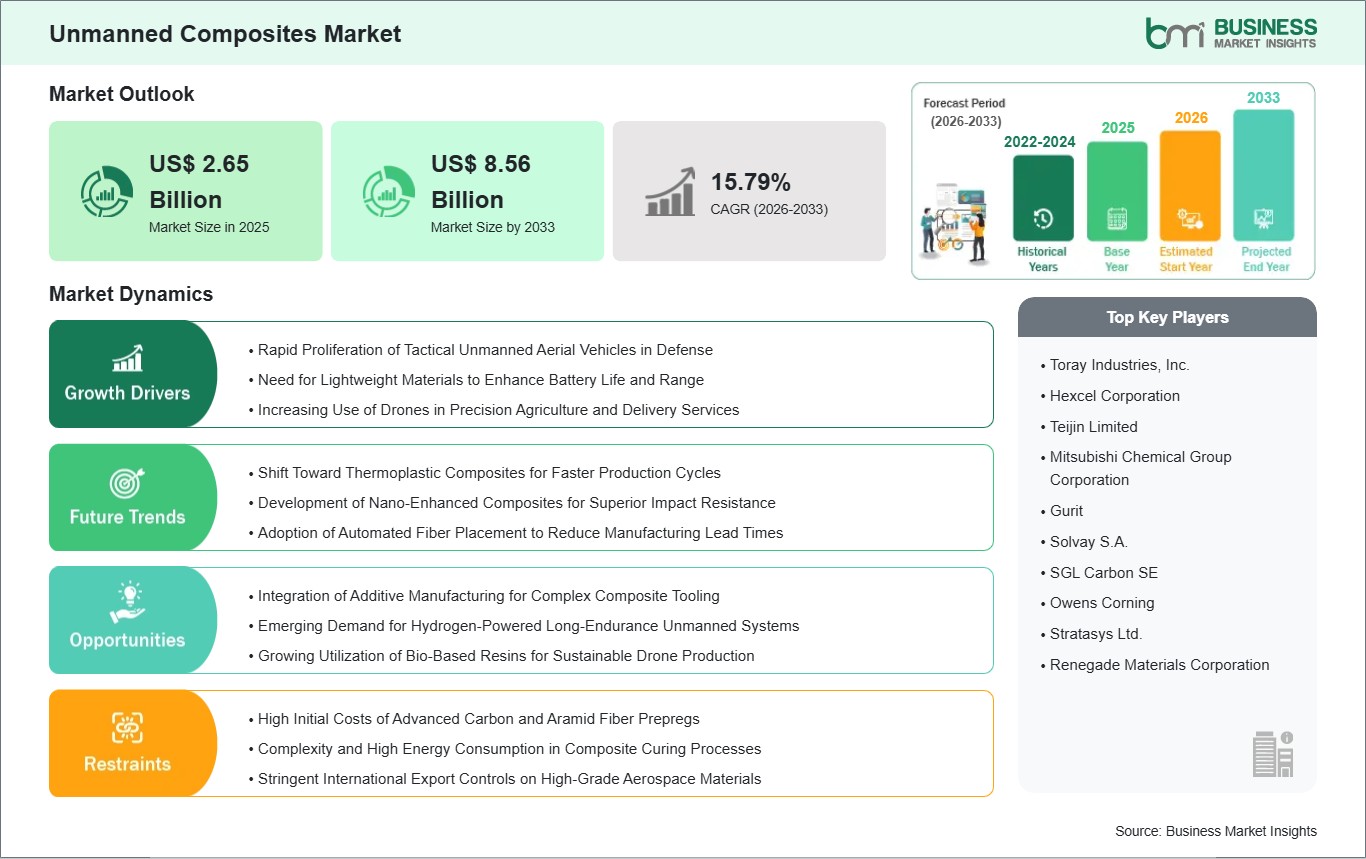
The global unmanned composites market is witnessing a period of accelerated growth, fueled by the rising demand for autonomous systems across military, commercial, and scientific sectors. As the aerospace and defense industries move toward attritable and long-endurance platforms, the superior strength-to-weight ratio of carbon and glass fiber reinforced polymers has become an essential design requirement. These materials enable unmanned vehicles to maximize payload capacity and energy efficiency, which is critical for both battery-electric drones and fuel-powered long-range systems. Currently, the market is characterized by a heavy reliance on carbon fiber for high-performance airframes, while glass fiber remains the preferred choice for cost-sensitive commercial applications like agriculture and mapping.
Strategic advancements in manufacturing, such as the transition from thermoset to recyclable thermoplastic composites and the adoption of automated production lines, are addressing long-standing challenges regarding high material costs and slow throughput. While the market faces hurdles from fluctuating raw material prices and complex regulatory environments, the rapid expansion of urban air mobility and autonomous underwater exploration provides significant new avenues for revenue. Geopolitically, the focus is shifting toward domestic supply chain security for advanced fibers to mitigate the risks of export restrictions. Ultimately, the market is set to expand as composites become the fundamental building blocks for the next generation of intelligent, ultra-lightweight, and resilient unmanned machines.
Segment Analysis
Unmanned Composites Market Segmentation
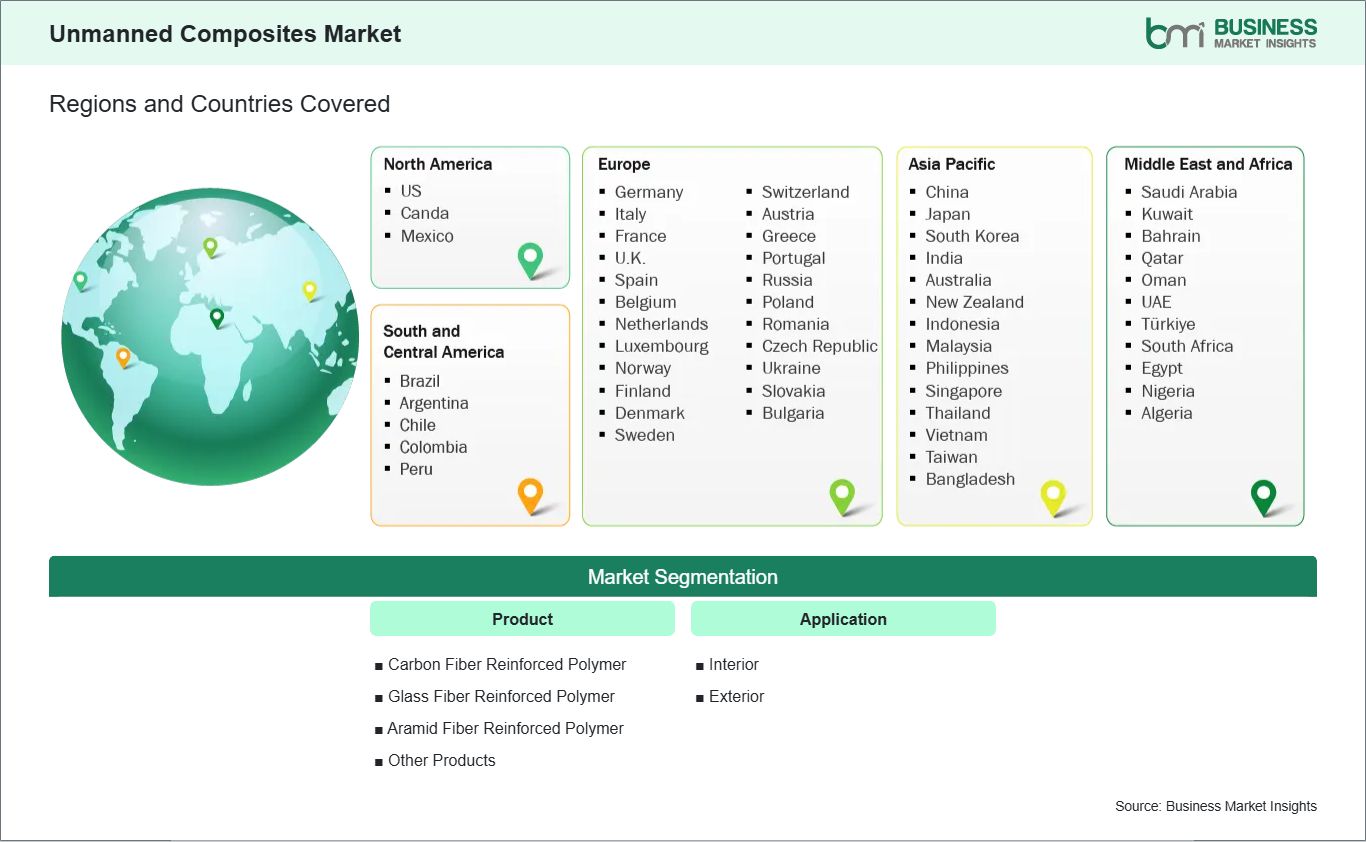
Key segments that contributed to the derivation of the Unmanned Composites market analysis are product and application.
- By product, the unmanned composites market is segmented into Carbon Fiber Reinforced Polymer, Glass Fiber Reinforced Polymer, Aramid Fiber Reinforced Polymer, and Other Products. The Carbon Fiber Reinforced Polymer segment dominated the market in 2025.
- By application, the unmanned composites market is segmented into Interior and Exterior. The Interior segment dominated the market in 2025.
Market Forces
Unmanned Composites Market Drivers and Opportunities
Rapid Proliferation of Tactical Unmanned Aerial Vehicles in Defense
The global defense landscape is experiencing a decisive shift toward the use of distributed, low-cost unmanned aerial systems to perform high-risk missions previously reserved for manned aircraft. Modern military doctrines now prioritize the deployment of large swarms of tactical drones to saturate enemy air defenses and provide persistent intelligence, surveillance, and reconnaissance. This massive increase in procurement volume directly drives the unmanned composites market, as these platforms require airframes that are both inexpensive to mass-produce and capable of high performance. Composite materials provide the ideal solution, allowing for the creation of aerodynamically efficient, stealthy shapes that traditional metal alloys cannot easily replicate.
Furthermore, the operational requirements of tactical drones often include rapid deployment from rugged environments, necessitating airframes that are highly resistant to fatigue and environmental degradation. Carbon fiber and aramid composites ensure that these vehicles can withstand high-G maneuvers and harsh weather conditions without structural failure. As defense budgets globally are reallocated toward autonomous technologies, the demand for high-strength composite shells and internal components continues to rise. This driver is especially strong in regions facing heightened geopolitical tensions, where the rapid replacement and scaling of unmanned fleets have become a core national security priority.
Integration of Additive Manufacturing for Complex Composite Tooling
The convergence of 3D printing technology and composite material science represents a transformative opportunity for the unmanned systems industry. Historically, the production of composite drone parts required expensive, long-lead-time metallic molds, which made rapid prototyping and small-batch production cost-prohibitive. By utilizing additive manufacturing to create complex composite tooling or even printing continuous fiber-reinforced parts directly, manufacturers can significantly reduce the time from design to flight. This agility is critical in the unmanned sector, where technological lifecycles are short and custom configurations for specific mission requirements are frequently requested.
This opportunity extends beyond simple prototyping to the production of optimized internal structures that were previously impossible to manufacture. For instance, 3D-printed composite lattices can be integrated into wings and fuselages to provide high torsional rigidity at a fraction of the weight of solid ribs. Additionally, additive manufacturing allows for the consolidation of multiple parts into a single integrated structure, reducing the number of fasteners and bond lines, which are common points of failure. As binder jetting and fused deposition modeling techniques for high-performance polymers continue to mature, the ability to produce on-demand composite components will allow smaller startups to compete with established aerospace giants in the rapidly evolving drone market.
Size and Share Analysis
Unmanned Composites Market Size and Share Analysis
The global Unmanned Composites market is experiencing steady growth, with market size and share analysis reflecting evolving treatment preferences and competitive dynamics among key players. The report evaluates important subsegments categorized within product and application highlighting their respective contributions to overall market performance.
By product, the Carbon Fiber Reinforced Polymer subsegment dominated the market in 2025 due to its exceptional strength-to-weight ratio and high stiffness. These properties are critical for unmanned aerial vehicles to achieve longer flight endurance and carry heavier sensor payloads while maintaining structural integrity under high-stress flight maneuvers.
By application, the Interior subsegment dominated the market in 2025 owing to the extensive use of composites in internal structural ribs, battery enclosures, and electronic equipment housings. These components provide essential shielding and rigid mounting points for sensitive avionics while significantly reducing the vehicle's overall empty weight.
Report Coverage
Unmanned Composites Market Report Coverage and Deliverables
The "Unmanned Composites Market Size and Forecast (2022 - 2033)" report provides a detailed analysis of the market covering below areas:
- Unmanned Composites market size and forecast at the regional and country levels for segments covered under the scope
- Unmanned Composites market trends, as well as drivers, restraints, and opportunities
- Unmanned Composites market analysis covering key trends, regional framework, major players, regulations, and recent developments
- Industry landscape and competition analysis covering market concentration, heat map analysis, prominent players, and recent developments for the Unmanned Composites market
- Detailed company profiles, including SWOT analysis
Geographic Insights
Unmanned Composites Market Geographic Insights
The geographical scope of the Unmanned Composites market report is divided into: North America, Asia Pacific, Europe, Middle East & Africa, and South & Central America. North America held the largest share in 2025.
North America stands as the preeminent region in the global unmanned composites market, a position rooted in its massive defense budget and its status as a global hub for aerospace innovation. The United States leads the world in the development and deployment of sophisticated unmanned aerial and underwater systems, supported by long-term contracts from the Department of Defense and various intelligence agencies. This established ecosystem provides a steady stream of demand for high-grade carbon fiber and specialized aramid composites required for stealth and high-altitude operations. Furthermore, the region’s mature commercial drone sector, bolstered by a supportive regulatory environment for beyond-visual-line-of-sight operations, is driving the adoption of lightweight composites in logistics and infrastructure inspection.
The regional dominance is further reinforced by the presence of nearly all major composite material suppliers and unmanned platform manufacturers within a tightly integrated supply chain. North American firms are at the forefront of research into smart composites with embedded sensors and self-healing properties, ensuring the region remains a leader in high-value material science. Significant investments in domestic carbon fiber production facilities have also helped buffer the regional market against global supply shocks. As North America continues to prioritize autonomous defense capabilities and the integration of drones into the national airspace, its role as the primary driver of technological standards and market value in the unmanned composites sector is expected to remain unchallenged.
Industry Activity
Recent Developments
The Unmanned Composites market is evaluated by gathering qualitative and quantitative data post primary and secondary research, which includes important corporate publications, association data, and databases. A few of the key developments in the Unmanned Composites market are:
- In March 2024, ARRIS announced the launch of its “Structural Flax” material, a sustainable composite designed for high-performance applications including unmanned aerial systems and lightweight structures.
- In June 2024, Hexcel Corporation highlighted continued expansion of its aerospace-grade carbon fiber composite solutions, supporting increased demand from UAV and defense programs requiring lightweight and high-strength materials.
- In 2023, Teijin Limited expanded its carbon fiber composite production capabilities aimed at aerospace and unmanned system applications, strengthening its position in advanced composite materials.
Trust & Transparency
Research Methodology
The market analysis combines proprietary research with secondary data from government agencies, company disclosures, regulatory filings, industry databases and expert interviews. Market estimates are validated through data triangulation, cross-market benchmarking and analyst
review.
View Full Research Methodology
Key Sources Referred:
American Chemistry Council (ACC)International Council of Chemical Associations (ICCA)European Chemical Industry Council (Cefic)China Petroleum and Chemical Industry Federation (CPCIF)Indian Chemical Council (ICC)Japan Chemical Industry Association (JCIA)Brazilian Chemical Industry Association (ABIQUIM)Company WebsitesCompany Annual ReportsCompany Investor Presentations